
BuddhistCatholicContemplativeEvangelicalGeneral ChristianHinduJewishLatter-day SaintMuslimNew VisionsProgressive Christian
Beliefs
- Buddhist
- Catholic
- Contemplative
- Evangelical
- General Christian
- Hindu
- Jewish
- Latter-day Saint
- More Voices
- Muslim
- New Visions
- Pagan
- Progressive Christian
Topics
- Religion News
- Food and Religion
- Sports and Religion
- Religious Art
- Religious Music and Entertainment
- Religious Events
- History and Religion
- Style and Religion
- Politics and Religion
- Women in Religion
- Recreation Outdoors and Religion
- Business Finance and Religion
- Careers Workplace and Religion
- Education and Religion
- Family Parenting and Religion
- Health Fitness and Religion
- Home and Religion
- Relationships and Religion
- Technology and Religion
- Travel and Religion
Columnists
- Buddhist Columnists
- Business Finance and Religion Columnists
- Careers Workplace and Religion Columnists
- Catholic Columnists
- Contemplative Columnists
- Education and Religion Columnists
- Evangelists Columnists
- Family Parenting and Religion Columnists
- General Christian Columnists
- Health Fitness and Religion Columnists
- Hindu Columnists
- History and Religion Columnists
- Home and Religion Columnists
- Jewish Columnists
- More Voices Columnists
- Latter Day Columnists
- Muslim Columnists
- New Visions Columnists
- Nonreligious Columnists
- Pagan Columnists
- Politics and Religion Columnists
- Progressive Columnists
- Recreation Outdoors and Religion Columnists
- Relationships and Religion Columnists
- Religion News Columnists
- Religious Art Columnists
- Religious Events Columnists
- Religious Music and Entertainment Columnists
- Sports and Religion Columnists
- Style and Religion Columnists
- Technology and Religion Columnists
- Travel and Religion Columnists
- Women in Religion Columnists
Resource Library
- 2026 Calendar
- Library of World Religions
- The 100 Most Holy Places on Earth
- Patheos Answers
- Podcasts
- Videos
- Faith Leaders Database
- Anglican Episcopalian
- Bahai
- Baptist
- Buddhism
- Christianity
- Confucianism
- Eastern Orthodoxy
- Hinduism
- Holiness and Pentecostal
- ISKCON
- Islam
- Judaism
- Lutheran
- Methodist
- The Church of Jesus Christ of Latter-day Saints
- New Age
- Paganism
- Presbytarian and Reformed
- Protestantism
- Religion Behind the Scenes
- Roman Catholic
- Scientology
- Shia Islam
- Sikhism
- Sufism
- Sunni Islam
- Taoism
- Zen
- See all religions
Research Tools
 Ad-Free & Subscriber Log-In Subscription Support
Ad-Free & Subscriber Log-In Subscription Support
Follow Patheos 

- Trending:
- Forgiveness
- |
- Marriage
- |
- Consciousness
- |
- Death Penalty
- |
- Election
- |
- Halloween

- Home
- Latter-day Saint
- On the “east wind” in the Book of Mormon
On the “east wind” in the Book of Mormon
Last updated on: April 2, 2020 at 9:51 pm by Dan Peterson
On the “east wind” in the Book of Mormon 2020-04-02T21:51:53-06:00 Dan Peterson
Patheos Explore the world's faith through different perspectives on religion and spirituality! Patheos has the views of the prevalent religions and spiritualities of the world.
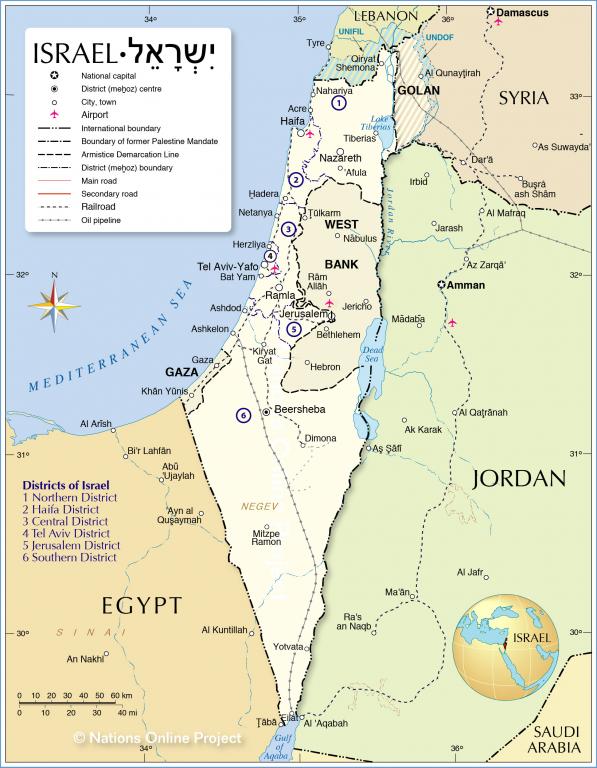
A public domain political map of Israel, from the Nations Online Project
Barring unforeseen mishap, I’ll be on the Interpreter Radio Show tonight (Sunday night) with Martin Tanner, between 7 PM and 9 PM. During the second hour of the program, we’ll be discussing Mosiah 7-10. One of the topics that I hope to address very briefly will be the reference in Mosiah 7:31 to a destructive “east wind.”
I discussed this subject in a column for the print edition of the Deseret News and the online edition of LDS Living back in December of 2018. Here is what I had to say then:
“Why Does the Book of Mormon Reference an Ominous “East Wind”?”
At least 20 references to a powerful and destructive “east wind” occur in the Old Testament (e.g., at Genesis 41:6, Exodus 10:13, Jeremiah 18:17 and Ezekiel 17:10, and Hosea 13:15). Such references reflect conditions in the Palestinian home of the biblical authors. Unlike the moisture-laden west wind from the Mediterranean Sea, the east wind, originating in the Arabian desert, is dry and desiccating.
The east wind shows up twice in the Book of Mormon, with exactly the same negative connotation:
“If my people shall sow filthiness they shall reap the east wind, which bringeth immediate destruction.” (Mosiah 7:31)
“And it shall come to pass that I will send forth hail among them, and it shall smite them; and they shall also be smitten with the east wind; and insects shall pester their land also, and devour their grain.” (Mosiah 12:6)
But is it plausible that a people thousands of miles and more than four centuries removed from their ancestral Near Eastern home would still remember a specifically Palestinian weather pattern?
One possible explanation for the presence of the two passages cited above would be, simply, that the Prophet Joseph Smith or some unidentified other modern author was borrowing from the Bible. That’s conceivable. But the young Joseph Smith wasn’t closely acquainted with the Old Testament, and no good evidence exists to suggest any another modern author.
Let’s consider a couple of other options, though, with the help of the linguistic and cultural data discussed in a recent article by the BYU Mayanist Kerry Hull titled “An ‘East Wind’: Old and New World Perspectives.”
Even in the Bible, the term “east wind” sometimes occurs without actually being associated with any particular direction. In such cases, it effectively “becomes the usual name of every wind that burn(s) up vegetation” and then, by extension, “the proverbial name for whatever is hateful or disagreeable.”
The story of Pharaoh’s dream of seven thin ears of corn that are “blasted with the east wind” (Genesis 41:6) is obviously set in Egypt, where the east wind is actually “soft, favourable, and wholesome.” In the Nile Valley, it is the south or southeast wind that parches. Perhaps in this case, therefore, the “east wind” is merely an inherited metaphor.
However, this need not be the case in the Book of Mormon.
Says Hull, “there does exist a considerable body of evidence that numerous pre-Columbian and modern inhabitants of Mesoamerica indeed viewed the east wind negatively and as a destructive force. Winds throughout Mesoamerica are the quintessential evil force, and so any reference to malevolent or destructive winds would have been readily understood.”
But the east wind, in particular, was often regarded as a bringer of misfortune, pestilent, dangerous, hot and desiccating, and “preeminent among the other winds.” Sometimes, too, it was associated with heavy rains and flooding, probably related to the arrival of Atlantic hurricanes from the east.
Among the Lacandon Maya, Hull reports, the wind gods, along with an earthquake, will be “the means of the final destruction at the end of the world.” (It’s difficult, in this context, not to think of the New World “storm,” “tempest,” “whirlwind,” and earthquake that are recorded in 3 Nephi 8 in connection with Jesus Christ’s crucifixion and death far across the sea.) “The wind in charge among this pantheon is the east wind,” writes Hull. And one Mayan term that seems to be associated with the east means, literally, “wind storm with earthquakes.”
Curiously too, the Maya of the Yucatan worshiped the tapir, a large herbivorous local mammal, in the form of an idol known as “Lord of the East Wind” and celebrated that idol every four years with the staging of sham battles.
Thus, there is absolutely no problem with the use of “east wind” in an authentically ancient Book of Mormon. It may be simply an inherited metaphor, an allusion to Old Testament usage preserved in the brass plates brought by Lehi to the New World, or a reflection of negative associations with the east wind in Pre-Columbian Mesoamerica itself. Any of these possibilities, or some combination of them, would account for the references in the book of Mosiah. “Mentions of a punitive east wind” are, summarizes Hull, “fully intelligible in a New World setting.”
See Kerry Hull, “An ‘East Wind’: Old and New World Perspectives,” in “Abinadi: He Came Among Them in Disguise” edited by Shon D. Hopkin (BYU Religious Studies Center and Deseret Book, 2018), page 169-208.
Previous Post

March 29, 2020
Intellectual schizophrenia as a symptom of a bad theory
Next Post
March 29, 2020 The Real Shangri-La?
Browse Our Archives
Select a Category Uncategorized
Select a Month October 2026 September 2026 August 2026 July 2026 June 2026 May 2026 April 2026 March 2026 February 2026 January 2026 December 2025 November 2025 October 2025 September 2025 August 2025 July 2025 June 2025 May 2025 April 2025 March 2025 February 2025 January 2025 December 2024 November 2024 October 2024 September 2024 August 2024 July 2024 June 2024 May 2024 April 2024 March 2024 February 2024 January 2024 December 2023 November 2023 October 2023 September 2023 August 2023 July 2023 June 2023 May 2023 April 2023 March 2023 February 2023 January 2023 December 2022 November 2022 October 2022 September 2022 August 2022 July 2022 June 2022 May 2022 April 2022 March 2022 February 2022 January 2022 December 2021 November 2021 October 2021 September 2021 August 2021 July 2021 June 2021 May 2021 April 2021 March 2021 February 2021 January 2021 December 2020 November 2020 October 2020 September 2020 August 2020 July 2020 June 2020 May 2020 April 2020 March 2020 February 2020 January 2020 December 2019 November 2019 October 2019 September 2019 August 2019 July 2019 June 2019 May 2019 April 2019 March 2019 February 2019 January 2019 December 2018 November 2018 October 2018 September 2018 August 2018 July 2018 June 2018 May 2018 April 2018 March 2018 February 2018 January 2018 December 2017 November 2017 October 2017 September 2017 August 2017 July 2017 June 2017 May 2017 April 2017 March 2017 February 2017 January 2017 December 2016 November 2016 October 2016 September 2016 August 2016 July 2016 June 2016 May 2016 April 2016 March 2016 February 2016 January 2016 December 2015 November 2015 October 2015 September 2015 August 2015 July 2015 June 2015 May 2015 April 2015 March 2015 February 2015 January 2015 December 2014 November 2014 March 2014 August 2013 February 2012
Follow Us!
TAKE THE
Religious Wisdom Quiz
Where did Elijah confront the prophets of Baal?
Select your answer to see how you score.
Mount Horeb Mount Zion Mount Sinai Mount Carmel
Related posts from Sic et Non


Some notes on the archaeology of the Bible


TRENDING AT PATHEOS Latter-day Saint

The First Eucharistic Controversy: Christ’s Real Presence
For Catholics, the Eucharist is the source and summit of the Christian...

How to Make a Decision When You Can't...
Main point: It’s much more valuable to stay close to God so...

Archdiocese Hosts Military Marriage Retreat in Germany
RASTATT, Germany — The transient military lifestyle, with its frequent deployments and...

Nearly every morning, I make the drive to Detroit with my high-school-age...

The Real AI Story Is Adoption Without Trust
Artificial intelligence has crossed a political threshold. It is no longer a...

A new article, written by Jeff Lindsay and Gale L. Pooley,...
view all Latter-day Saint blogs
Ad-Free & Subscriber Log-In Subscription Support
- About Us
- 2026 Calendar
- Videos
- Podcasts
- Library of World Religions
- Faith In Media Tracker
- Advertise With Us
- Write for Us
- Privacy Policy
- Terms of Service
- Do Not Sell My Data
- Contact Us
- Radiant Digital
- Manage Newsletter Subscriptions
- Unsubscribe From Notifications
- Sitemap
Copyright 2008-2026, Patheos. All rights reserved.
Subscription Support Ad-Free & Subscriber Log-In
Follow Patheos