
BuddhistCatholicContemplativeEvangelicalGeneral ChristianHinduJewishLatter-day SaintMuslimNew VisionsProgressive Christian
Beliefs
- Buddhist
- Catholic
- Contemplative
- Evangelical
- General Christian
- Hindu
- Jewish
- Latter-day Saint
- More Voices
- Muslim
- New Visions
- Pagan
- Progressive Christian
Topics
- Religion News
- Food and Religion
- Sports and Religion
- Religious Art
- Religious Music and Entertainment
- Religious Events
- History and Religion
- Style and Religion
- Politics and Religion
- Women in Religion
- Recreation Outdoors and Religion
- Business Finance and Religion
- Careers Workplace and Religion
- Education and Religion
- Family Parenting and Religion
- Health Fitness and Religion
- Home and Religion
- Relationships and Religion
- Technology and Religion
- Travel and Religion
Columnists
- Buddhist Columnists
- Business Finance and Religion Columnists
- Careers Workplace and Religion Columnists
- Catholic Columnists
- Contemplative Columnists
- Education and Religion Columnists
- Evangelists Columnists
- Family Parenting and Religion Columnists
- General Christian Columnists
- Health Fitness and Religion Columnists
- Hindu Columnists
- History and Religion Columnists
- Home and Religion Columnists
- Jewish Columnists
- More Voices Columnists
- Latter Day Columnists
- Muslim Columnists
- New Visions Columnists
- Nonreligious Columnists
- Pagan Columnists
- Politics and Religion Columnists
- Progressive Columnists
- Recreation Outdoors and Religion Columnists
- Relationships and Religion Columnists
- Religion News Columnists
- Religious Art Columnists
- Religious Events Columnists
- Religious Music and Entertainment Columnists
- Sports and Religion Columnists
- Style and Religion Columnists
- Technology and Religion Columnists
- Travel and Religion Columnists
- Women in Religion Columnists
Resource Library
- 2026 Calendar
- Library of World Religions
- The 100 Most Holy Places on Earth
- Patheos Answers
- Podcasts
- Videos
- Faith Leaders Database
- Anglican Episcopalian
- Bahai
- Baptist
- Buddhism
- Christianity
- Confucianism
- Eastern Orthodoxy
- Hinduism
- Holiness and Pentecostal
- ISKCON
- Islam
- Judaism
- Lutheran
- Methodist
- The Church of Jesus Christ of Latter-day Saints
- New Age
- Paganism
- Presbytarian and Reformed
- Protestantism
- Religion Behind the Scenes
- Roman Catholic
- Scientology
- Shia Islam
- Sikhism
- Sufism
- Sunni Islam
- Taoism
- Zen
- See all religions
Research Tools
 Ad-Free & Subscriber Log-In Subscription Support
Ad-Free & Subscriber Log-In Subscription Support
Follow Patheos 

- Trending:
- Forgiveness
- |
- Marriage
- |
- Consciousness
- |
- Death Penalty
- |
- Election
- |
- Halloween

- Home
- Latter-day Saint
- Geology and Third Nephi (8): An Interim Update
Geology and Third Nephi (8): An Interim Update
Last updated on: March 1, 2020 at 11:28 pm by Dan Peterson
Geology and Third Nephi (8): An Interim Update 2020-03-01T23:28:58-07:00 Dan Peterson
Patheos Explore the world's faith through different perspectives on religion and spirituality! Patheos has the views of the prevalent religions and spiritualities of the world.
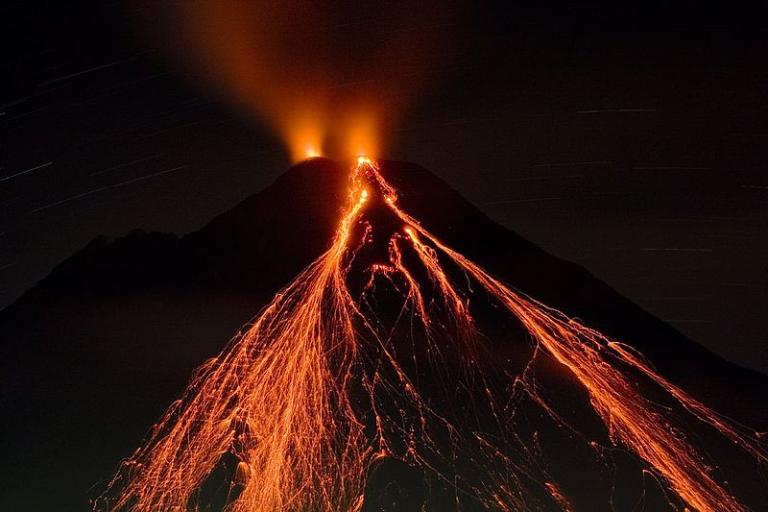
Another view of Costa Rica’s Mount Arenal. See also “apocalypse”
(Image from Matthew.Landry at English Wikipedia)
I’ve been sharing notes that I’ve largely drawn from an article written by a longtime friend of mine, Dr. Bart Kowallis, who is a Professor Emeritus in the Department of Geological Sciences at Brigham Young University, about the natural catastrophe described in the Book of Mormon as having occurred in the New World at the death of Christ: Bart J. Kowallis, “In the Thirty and Fourth Year: A Geologist’s View of the Great Destruction in 3 Nephi,” BYU Studies 37/3 (1997-1998):
With his permission, I share some correspondence between us from earlier today:
Bart:
One of the objections that critics have been raising to my notes from your article is that, while your arguments are relevant to Book of Mormon volcanism if there IS Book of Mormon volcanism (they point to the fact that no volcano is explicitly mentioned), there is no actual evidence of such a catastrophic eruption in the Americas at the time of Christ.
Do you know of any evidence that might have appeared since your article was published about a significant American volcanic event in or near the early first century?
Just curious.
Dan
***
Dan — In the Central American area and southern Mexico, there have been hundreds of volcanic eruptions, most of which have not been studied or dated in any detail. There is more data now than when I wrote that paper several years ago, but it is only a small sampling of all the eruptions that have occurred. Some devastating eruptions have been documented in some detail, such as the Ilopango eruption in about 500 AD that devastated the Mayan peoples living around that volcano. But many of the eruptions have not been studied, documented or even recognized. In the wet climate of this area, the ash from a volcano can alter from glassy particles to clay in a couple thousand years and these layers are often not recognized by archaeologists during excavations (although I believe that the more recent workers now pay more attention to them). So, the short answer is: no, I do not know of any particular eruption that can be pinpointed for the BofM story. But I do try to look at the literature on occasion to see if any new dates on eruptions have been documented. –Bart
***
In a follow-up email, Dr. Kowallis wrote:
I have attached an article that appeared in 2016. The article is not meant to document any particular eruption, but demonstrates the input of ash (now mostly altered to clay) in the Mayan lowlands and the importance of the ash for sustaining agriculture. The authors did obtain one radiocarbon date that falls in the range of Christ’s death (15-110 CE). Even though this is not a date on a particular volcano, it shows that volcanic ash was input into this area around that time. I have also attached Payson Sheets 2012 paper on the effects of volcanism on Central American cultures.
I did not feel it appropriate to pass either of the articles on here. In particular, as regards the paper by Payson Sheets, Professor Kowallis sent me a PDF of the entire book in which it’s included (Jago Cooper and Payson Sheets, eds. Surviving Sudden Environmental Change: Answers from Archaeology [Boulder: University Press of Colorado, 2012]), and I don’t believe that I have the right to share that book openly on a blog. But I do offer here the titles of the two specific articles, with their abstracts, for anybody who might be interested in pursuing the subject:
Kenneth Barnett Tankersley, Nicholas P. Dunning, Vernon Scarborough, Warren D. Huff, David L. Lentz, and Christopher Carr, “Catastrophic volcanism and its implication for agriculture in the Maya Lowlands,” Journal of Archaeological Science: Reports 5 (2016) 465–470.
Powder X-ray diffraction, high-magnification microscopy, and whole rock X-ray fluorescence spectrometry analyses of sediment samples collected from an ancient Maya reservoir at Tikal, Guatemala in 2009 demonstrated conclusively that volcanic ash was repeatedly deposited on the site. To test the hypothesis that volcanic ash was a major contributor of new parent material to soils in the southern Yucatan Peninsula we used these same techniques to analyze samples taken from several natural depressions (bajos) in the region. Our findings clearly indicate that volcanic ash is a major constituent of regional soils. Hence, explosive volcanism was a critical factor in the development and maintenance of ancient Maya urban centers by renewing agricultural soils. These centers were typically low-density “garden cities” largely dependent on their immediate environs for agricultural production. For these cities to flourish in a difficult environment a flux of volcanic material occurring within an optimal window was critical. Regional wind patterns and rainfall are seasonal, linked to the annual shift in the Intertropical Convergence Zone (ITCZ). During the wet season, the ITCZ sits over the Yucatan Peninsula with Trade Winds and Easterly Waves predominating and blocking ash fall from reaching the Maya Lowlands from the volcanic arc to the south. During the dry season, the southward shift of the ITCZ allows westerly and southerly winds to bring erupted ash over the region. However, ash fall occurring during the dry season also posed a risk for ancient Maya,who were dependent on capturing and storing rainwater to meet their water needs because of the problem of reservoir fouling. Intermittent periods of increased aridity amplified drought frequency and severity, which likely contributed to periods of disruption in the course of Maya prehistory.
“Responses to Explosive Volcanic Eruptions by Small to Complex Societies in Ancient Mexico and Central America”
Payson Sheets, University of Colorado, Boulder
The full range of societal complexities, from small egalitarian villages to state level civilizations, was impacted by explosive volcanic eruptions in ancient Central America and Mexico. Some societies were remarkably resilient and recovered from the volcanic disasters within decades. Others were vulnerable to sudden massive stresses and failed to recover. This chapter explores the factors that contribute to resilience or vulnerability, including societal complexity, demography and mobility, connectivity, magnitude of the eruption, social conflict, organization of the economy, loss of traditional environmental knowledge (TEK), and political organization. Each factor can be scaled regarding its contribution to vulnerability. As societies respond to disasters, not everyone suffers. There were winners and losers in the ancient past, as there are with contemporary disasters. People learn from disasters and modify their vulnerabilities. Therefore the creative aspects of hazard perception are also explored in this chapter.
Previous Post

March 1, 2020
"The True Believer"
Next Post
March 2, 2020 We aren't dead yet.
Browse Our Archives
Select a Category Uncategorized
Select a Month October 2026 September 2026 August 2026 July 2026 June 2026 May 2026 April 2026 March 2026 February 2026 January 2026 December 2025 November 2025 October 2025 September 2025 August 2025 July 2025 June 2025 May 2025 April 2025 March 2025 February 2025 January 2025 December 2024 November 2024 October 2024 September 2024 August 2024 July 2024 June 2024 May 2024 April 2024 March 2024 February 2024 January 2024 December 2023 November 2023 October 2023 September 2023 August 2023 July 2023 June 2023 May 2023 April 2023 March 2023 February 2023 January 2023 December 2022 November 2022 October 2022 September 2022 August 2022 July 2022 June 2022 May 2022 April 2022 March 2022 February 2022 January 2022 December 2021 November 2021 October 2021 September 2021 August 2021 July 2021 June 2021 May 2021 April 2021 March 2021 February 2021 January 2021 December 2020 November 2020 October 2020 September 2020 August 2020 July 2020 June 2020 May 2020 April 2020 March 2020 February 2020 January 2020 December 2019 November 2019 October 2019 September 2019 August 2019 July 2019 June 2019 May 2019 April 2019 March 2019 February 2019 January 2019 December 2018 November 2018 October 2018 September 2018 August 2018 July 2018 June 2018 May 2018 April 2018 March 2018 February 2018 January 2018 December 2017 November 2017 October 2017 September 2017 August 2017 July 2017 June 2017 May 2017 April 2017 March 2017 February 2017 January 2017 December 2016 November 2016 October 2016 September 2016 August 2016 July 2016 June 2016 May 2016 April 2016 March 2016 February 2016 January 2016 December 2015 November 2015 October 2015 September 2015 August 2015 July 2015 June 2015 May 2015 April 2015 March 2015 February 2015 January 2015 December 2014 November 2014 March 2014 August 2013 February 2012
Follow Us!
TAKE THE
Religious Wisdom Quiz
In the Parable of the Pearl of Great Price, what does the merchant do?
Select your answer to see how you score.
Finds a lost coin Sells all to buy the pearl Buys many pearls Builds a bigger barn
Related posts from Sic et Non


Some notes on the archaeology of the Bible

An action movie and some vacuous theology

TRENDING AT PATHEOS Latter-day Saint

Letters on Living the Faith by C.S. Lewis
Most of us met C.S. Lewis as a public intellectual. Mere Christianity....

When Halloween Unmasks Married Hearts
Written by Dr. David K. Ewen from Eternal Truth Bible College Behind...

Aristotle. He’s been called the father of logic, the father of the...

Methodist Central Hall and Westminster Abbey
Situated on the same square is Methodist Central Hall and Westminster Abbey. ...

57th Dove Awards Honor Dolly Parton, Crown New...
On gospel music’s biggest night, the 57th annual GMA Dove Awards honored...

The First Eucharistic Controversy: Christ’s Real Presence
For Catholics, the Eucharist is the source and summit of the Christian...
view all Latter-day Saint blogs
Ad-Free & Subscriber Log-In Subscription Support
- About Us
- 2026 Calendar
- Videos
- Podcasts
- Library of World Religions
- Faith In Media Tracker
- Advertise With Us
- Write for Us
- Privacy Policy
- Terms of Service
- Do Not Sell My Data
- Contact Us
- Radiant Digital
- Manage Newsletter Subscriptions
- Unsubscribe From Notifications
- Sitemap
Copyright 2008-2026, Patheos. All rights reserved.
Subscription Support Ad-Free & Subscriber Log-In
Follow Patheos