
BuddhistCatholicContemplativeEvangelicalGeneral ChristianHinduJewishLatter-day SaintMuslimNew VisionsProgressive Christian
Beliefs
- Buddhist
- Catholic
- Contemplative
- Evangelical
- General Christian
- Hindu
- Jewish
- Latter-day Saint
- More Voices
- Muslim
- New Visions
- Pagan
- Progressive Christian
Topics
- Religion News
- Food and Religion
- Sports and Religion
- Religious Art
- Religious Music and Entertainment
- Religious Events
- History and Religion
- Style and Religion
- Politics and Religion
- Women in Religion
- Recreation Outdoors and Religion
- Business Finance and Religion
- Careers Workplace and Religion
- Education and Religion
- Family Parenting and Religion
- Health Fitness and Religion
- Home and Religion
- Relationships and Religion
- Technology and Religion
- Travel and Religion
Columnists
- Buddhist Columnists
- Business Finance and Religion Columnists
- Careers Workplace and Religion Columnists
- Catholic Columnists
- Contemplative Columnists
- Education and Religion Columnists
- Evangelists Columnists
- Family Parenting and Religion Columnists
- General Christian Columnists
- Health Fitness and Religion Columnists
- Hindu Columnists
- History and Religion Columnists
- Home and Religion Columnists
- Jewish Columnists
- More Voices Columnists
- Latter Day Columnists
- Muslim Columnists
- New Visions Columnists
- Nonreligious Columnists
- Pagan Columnists
- Politics and Religion Columnists
- Progressive Columnists
- Recreation Outdoors and Religion Columnists
- Relationships and Religion Columnists
- Religion News Columnists
- Religious Art Columnists
- Religious Events Columnists
- Religious Music and Entertainment Columnists
- Sports and Religion Columnists
- Style and Religion Columnists
- Technology and Religion Columnists
- Travel and Religion Columnists
- Women in Religion Columnists
Resource Library
- 2026 Calendar
- Library of World Religions
- The 100 Most Holy Places on Earth
- Patheos Answers
- Podcasts
- Videos
- Faith Leaders Database
- Anglican Episcopalian
- Bahai
- Baptist
- Buddhism
- Christianity
- Confucianism
- Eastern Orthodoxy
- Hinduism
- Holiness and Pentecostal
- ISKCON
- Islam
- Judaism
- Lutheran
- Methodist
- The Church of Jesus Christ of Latter-day Saints
- New Age
- Paganism
- Presbytarian and Reformed
- Protestantism
- Religion Behind the Scenes
- Roman Catholic
- Scientology
- Shia Islam
- Sikhism
- Sufism
- Sunni Islam
- Taoism
- Zen
- See all religions
Research Tools
 Ad-Free & Subscriber Log-In Subscription Support
Ad-Free & Subscriber Log-In Subscription Support
Follow Patheos 

- Trending:
- Forgiveness
- |
- Marriage
- |
- Consciousness
- |
- Death Penalty
- |
- Election
- |
- Halloween

- Home
- Latter-day Saint
- Amazing scientific progress and surprising scientific ignorance
Amazing scientific progress and surprising scientific ignorance
Last updated on: March 31, 2020 at 10:45 pm by Dan Peterson
Amazing scientific progress and surprising scientific ignorance 2020-03-31T22:45:46-06:00 Dan Peterson
Patheos Explore the world's faith through different perspectives on religion and spirituality! Patheos has the views of the prevalent religions and spiritualities of the world.
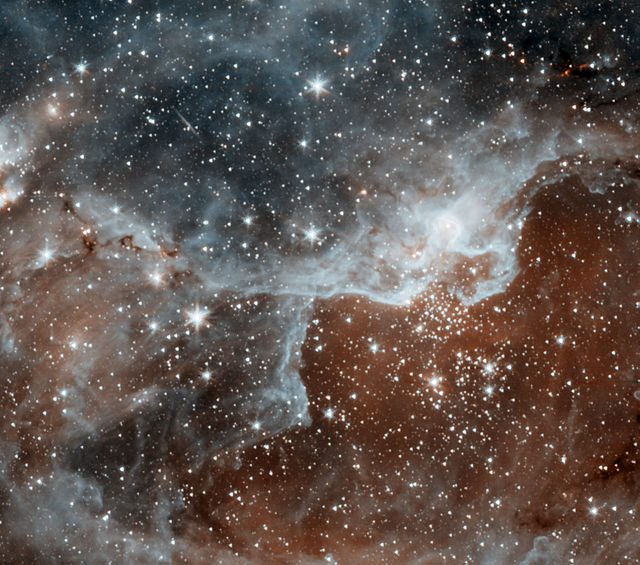
Region DR 22 (Cygnus) Wikimedia Commons public domain image
One online critic of the Church likes to use me in order to illustrate the nadir of Latter-day Saint scientific ignorance — rather analogously to the concept of “absolute zero” or “zero degrees Kelvin,” the minimum temperature possible, at which there is no heat and the movement of fundamental particles is at a minimum. I’m sure that he’s right to do so; surely nobody online would engage in an unfair caricature on so important a point. Still, I like to pretend to know something about current science, which is why (compared to the typical medieval Arabist) I read quite a bit on the subject.
Two articles that I’ve read recently strike me when taken together:
The first is Ryan C. Fortenberry, “First Molecule in the Universe: Scientists have identified mystery molecules in space and the compound thought to have started chemistry in the cosmos,” Scientific American 322/2 (February 2020): 58-65. In it, Professor Fortenberry discusses an important new development in the field of astrochemistry:
The first “atoms” in the universe were not atoms at all — they were just nuclei that had not found electrons yet. The simplest nucleus, that of common hydrogen, is a bare proton with no frills. When the universe banged into existence, energy was rampant. Everything was smashing into everything else. Protons and neutrons often collided, and some formed larger nuclei, such as that of deuterium (containing a proton and a neutron), as well as helium nuclei with two protons and two neutrons. Various other arrangements of protons and neutrons also formed, but because the identity of an atom is determined by its number of protons, all these other conglomerations were basically just different versions of hydrogen, helium, and traces of lithium. (60)
Helium, it seems, was the first of these to begin forming “real” atoms — that is, nuclei possessing electrons. When the first chemical bonds were formed, “the very first molecule (of any sustained abundance) in the universe” appeared. It was a new compound of helium and hydrogen, and it is called “helium hydride” or “helonium” (HeH+).
Unfortunately, while it is well grounded in theory, HeH+ cannot form on earth, except — if only very transiently — in laboratories. Now, though, after forty years of searching, it has been observed in space, in “the burned out cinder of an exploded star in the planetary nebula NGC 7027, part of the constellation Cygnus.”
I confess to amazement that science is able to find such things, both theoretically and, now, observationally. But humility is still in order.
Consider, for example, the second of the two articles: Ed Regis, “The Enigma of Aerodynamic Lift: No one can completely explain why planes stay in the air,” Scientific American 322/2 (February 2020): 44-51.
It turns out that, while nature figured flying out a very long time ago (in pterodactyls and birds and bats, for example) and while humans were able to achieve it somewhat more than a century ago, we still don’t really know how it works.
In December 2003, to commemorate the 100th anniversary of the first flight of the Wright brothers, the New York Times ran a story entitled “Staying Aloft: What Does Keep Them Up There?” The point of the piece was a simple question: What keeps planes in the air? To answer it, the Times turned to John D. Anderson, curator of aerodynamics at the National Air and Space Museum and author of several textbooks in the field.
What Anderson said, however, is that there is actually no agreement on what generates the aerodynamic force known as lift. “There is no simple one-liner answer to this,” he told the Times. People give different answers to the question, some with “religious fervor.” (46)

Albert Einstein lecturing in Vienna in 1921. (Wikimedia Commons public domain photo)
Even the great Albert Einstein waded into the controversy, with a 1916 article in the journal Die Naturwissenschaften entitled “Elementare Theorie der Wasserwellen und des Fluges” (“Elementary Theory of Water Waves and of Flight”). It didn’t fare well, and an attempt to implement his theory in an actual airplane design ended with considerable embarrassment. Decades later, in 1954, a year before his death, Einstein himself called his venture into aeronautics a “youthful folly.” (He was thirty-seven when the article appeared. He had already published on his “Special Theory of Relativity” in 1905 and on his “General Theory of Relativity” in 1915. He would win the Nobel Prize for Physics just five years later.)
We — speaking collectively — can predict the existence of HeH+ in theory and then go on actually to locate it in a distant planetary nebula. We fly around the world. (Or, least, we used to, prior to the advent of COVID-19.) Flying is routine. But we can’t explain flight. Which reminds me: We’re all familiar with consciousness. Many of us, in fact, are conscious. But we can’t explain consciousness, either.
Previous Post

March 27, 2020
We fall so very short of the ideal
Next Post
March 28, 2020 Martin Harris, reputable witness
Browse Our Archives
Select a Category Uncategorized
Select a Month October 2026 September 2026 August 2026 July 2026 June 2026 May 2026 April 2026 March 2026 February 2026 January 2026 December 2025 November 2025 October 2025 September 2025 August 2025 July 2025 June 2025 May 2025 April 2025 March 2025 February 2025 January 2025 December 2024 November 2024 October 2024 September 2024 August 2024 July 2024 June 2024 May 2024 April 2024 March 2024 February 2024 January 2024 December 2023 November 2023 October 2023 September 2023 August 2023 July 2023 June 2023 May 2023 April 2023 March 2023 February 2023 January 2023 December 2022 November 2022 October 2022 September 2022 August 2022 July 2022 June 2022 May 2022 April 2022 March 2022 February 2022 January 2022 December 2021 November 2021 October 2021 September 2021 August 2021 July 2021 June 2021 May 2021 April 2021 March 2021 February 2021 January 2021 December 2020 November 2020 October 2020 September 2020 August 2020 July 2020 June 2020 May 2020 April 2020 March 2020 February 2020 January 2020 December 2019 November 2019 October 2019 September 2019 August 2019 July 2019 June 2019 May 2019 April 2019 March 2019 February 2019 January 2019 December 2018 November 2018 October 2018 September 2018 August 2018 July 2018 June 2018 May 2018 April 2018 March 2018 February 2018 January 2018 December 2017 November 2017 October 2017 September 2017 August 2017 July 2017 June 2017 May 2017 April 2017 March 2017 February 2017 January 2017 December 2016 November 2016 October 2016 September 2016 August 2016 July 2016 June 2016 May 2016 April 2016 March 2016 February 2016 January 2016 December 2015 November 2015 October 2015 September 2015 August 2015 July 2015 June 2015 May 2015 April 2015 March 2015 February 2015 January 2015 December 2014 November 2014 March 2014 August 2013 February 2012
Follow Us!
TAKE THE
Religious Wisdom Quiz
How many books are in the entire Bible?
Select your answer to see how you score.
80 39 66 73
Related posts from Sic et Non

A case of twin near-death experiences?

Toward a "Post-Materialist Science"?

A great American thinker on dogmatic scientific orthodoxy
Of Spheres, Spirals, Spindles, and the Divine
TRENDING AT PATHEOS Latter-day Saint

57th Dove Awards Honor Dolly Parton, Crown New...
On gospel music’s biggest night, the 57th annual GMA Dove Awards honored...

The First Eucharistic Controversy: Christ’s Real Presence
For Catholics, the Eucharist is the source and summit of the Christian...

What a Stop Sign Can Teach Us About...
How to Make a Decision When You Can't Hear God Main point:...

Archdiocese Hosts Military Marriage Retreat in Germany
RASTATT, Germany — The transient military lifestyle, with its frequent deployments and...

Nearly every morning, I make the drive to Detroit with my high-school-age...

The Real AI Story Is Adoption Without Trust
Artificial intelligence has crossed a political threshold. It is no longer a...
view all Latter-day Saint blogs
Ad-Free & Subscriber Log-In Subscription Support
- About Us
- 2026 Calendar
- Videos
- Podcasts
- Library of World Religions
- Faith In Media Tracker
- Advertise With Us
- Write for Us
- Privacy Policy
- Terms of Service
- Do Not Sell My Data
- Contact Us
- Radiant Digital
- Manage Newsletter Subscriptions
- Unsubscribe From Notifications
- Sitemap
Copyright 2008-2026, Patheos. All rights reserved.
Subscription Support Ad-Free & Subscriber Log-In
Follow Patheos