
BuddhistCatholicContemplativeEvangelicalGeneral ChristianHinduJewishLatter-day SaintMuslimNew VisionsProgressive Christian
Beliefs
- Buddhist
- Catholic
- Contemplative
- Evangelical
- General Christian
- Hindu
- Jewish
- Latter-day Saint
- More Voices
- Muslim
- New Visions
- Pagan
- Progressive Christian
Topics
- Religion News
- Food and Religion
- Sports and Religion
- Religious Art
- Religious Music and Entertainment
- Religious Events
- History and Religion
- Style and Religion
- Politics and Religion
- Women in Religion
- Recreation Outdoors and Religion
- Business Finance and Religion
- Careers Workplace and Religion
- Education and Religion
- Family Parenting and Religion
- Health Fitness and Religion
- Home and Religion
- Relationships and Religion
- Technology and Religion
- Travel and Religion
Columnists
- Buddhist Columnists
- Business Finance and Religion Columnists
- Careers Workplace and Religion Columnists
- Catholic Columnists
- Contemplative Columnists
- Education and Religion Columnists
- Evangelists Columnists
- Family Parenting and Religion Columnists
- General Christian Columnists
- Health Fitness and Religion Columnists
- Hindu Columnists
- History and Religion Columnists
- Home and Religion Columnists
- Jewish Columnists
- More Voices Columnists
- Latter Day Columnists
- Muslim Columnists
- New Visions Columnists
- Nonreligious Columnists
- Pagan Columnists
- Politics and Religion Columnists
- Progressive Columnists
- Recreation Outdoors and Religion Columnists
- Relationships and Religion Columnists
- Religion News Columnists
- Religious Art Columnists
- Religious Events Columnists
- Religious Music and Entertainment Columnists
- Sports and Religion Columnists
- Style and Religion Columnists
- Technology and Religion Columnists
- Travel and Religion Columnists
- Women in Religion Columnists
Resource Library
- 2026 Calendar
- Library of World Religions
- The 100 Most Holy Places on Earth
- Patheos Answers
- Podcasts
- Videos
- Faith Leaders Database
- Anglican Episcopalian
- Bahai
- Baptist
- Buddhism
- Christianity
- Confucianism
- Eastern Orthodoxy
- Hinduism
- Holiness and Pentecostal
- ISKCON
- Islam
- Judaism
- Lutheran
- Methodist
- The Church of Jesus Christ of Latter-day Saints
- New Age
- Paganism
- Presbytarian and Reformed
- Protestantism
- Religion Behind the Scenes
- Roman Catholic
- Scientology
- Shia Islam
- Sikhism
- Sufism
- Sunni Islam
- Taoism
- Zen
- See all religions
Research Tools
 Ad-Free & Subscriber Log-In Subscription Support
Ad-Free & Subscriber Log-In Subscription Support
Follow Patheos 

- Trending:
- Forgiveness
- |
- Marriage
- |
- Consciousness
- |
- Death Penalty
- |
- Election
- |
- Halloween

- Home
- Latter-day Saint
- Sacred Calendars and the Millennium
Sacred Calendars and the Millennium
Last updated on: February 7, 2020 at 10:18 pm by Dan Peterson
Sacred Calendars and the Millennium 2020-02-07T22:18:41-07:00 Dan Peterson
Patheos Explore the world's faith through different perspectives on religion and spirituality! Patheos has the views of the prevalent religions and spiritualities of the world.
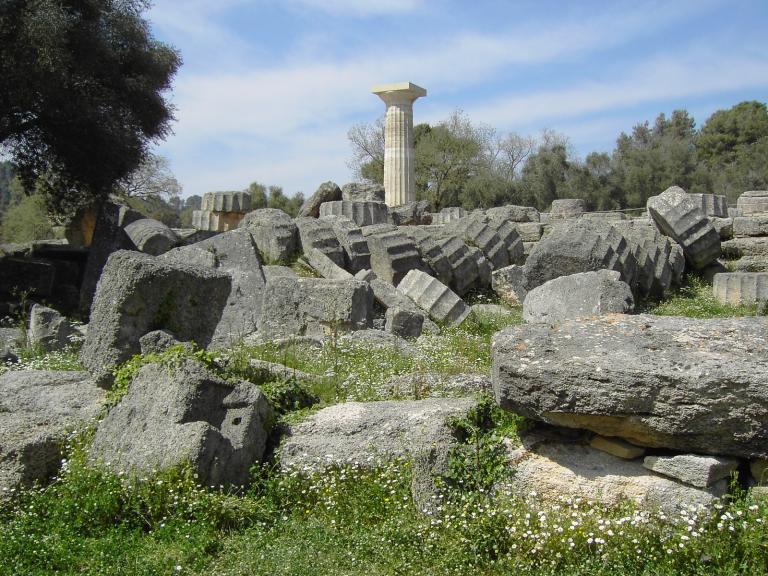
The ruins of the temple of Zeus at Olympia, in Greece.
Photo by Napoleon Vier, NL (Wikimedia Commons public domain photograph)
I published the article below in the Provo Daily Herald on 1 December 1999:
The approach of the year 2000 has led to much reflection, speculation, and arrant nonsense. For some it has become an excuse to celebrate the “party of the millennium.” Some fear the economic and social chaos of the Y2K bug. Others expect the apocalypse; hundreds are flocking to Jerusalem to prepare for what they believe to be the imminent return of Christ.
Few stop to ask if the coming New Year’s day will actually be the beginning of year 2000. The answer depends on how you cut the calendrical pie. Each great religion and civilization has had its own method of reckoning time and formulating calendars, based on different assumptions, practices, calculations and beliefs.
Year One of the Roman calendar was 753 BC, the traditional date of Rome’s founding. Greeks often calculated from the first Olympic games in 776 BC. Muslims commence their reckoning from Muhammad’s arrival in Medina. In the Christian calendar, this corresponds to 622 AD, which would seem at first glance to make 2000 AD correspond to the Muslim year 1378. However, the Muslim calendar is based on twelve lunar months and is eleven days shorter than our solar year, meaning that our 2000 is the Muslim year 1421. For the Chinese, the Christian year 2000 is actually year 4698.
Many, including ancient Christians and Jews, began their calendars with the anno mundi, the year of the world’s creation. For the ancient Maya, this occurred in 3113 BC. One might expect Jews and Christians to agree on the year of creation, based on biblical chronology. However, differing assumptions, gaps, overlaps and manuscript variants have produced many rival calculations. For the rabbis, creation occurred in 3760 BC, making AD 2000 earth’s 5760th year. For Greek Orthodox Christians, the year of creation was 5508 BC. Catholic Dante almost concurred, believing the world was created in 5198 BC. Many Protestants follow Archbishop Ussher’s calculations, accepting 4004 BC as the year of creation.
Who, then, devised the calendar we now use, which calculates this coming year as the 2000th since the birth of Christ? Our current chronological system was established by the Scythian monk Dionysius Exiguus in the early sixth century AD. He calculated the annunciation of the birth of Christ as occurring on 25 March, 1 AD — that is, nine months before the birth of Christ, which was celebrated on December 25th. The annunciation, rather than the birth of Christ, was considered to be the moment of God’s incarnation (as a fetus in the Virgin Mary’s womb). March 25th, the vernal equinox, was also thought to have been the first of the seven days of creation, and, for centuries, many countries celebrated it as the Christian New Year.
Unfortunately, however, Dionysius seems to have erred in his calculations. Modern research demonstrates that Herod the Great died in 4 BC. And since Jesus was born before Herod died (Matthew 2:1), it is fairly certain that Jesus was born in or before 4 BC, and, therefore, that the 2000th year since the birth of Jesus was actually 1996. The real dawning of the third Christian millennium appears to have occurred while few noticed — four years ago.
Matters are further complicated by the fact that the Roman Julian calendar — created by Julius Caesar in 46 BC — erred slightly in calculating leap years. By 1582, the astronomical vernal equinox, used to determine Easter, was occurring ten days ahead of the calendar’s March 25th. Convening a body of astronomers, Pope Gregory XIII revised the faulty calculations and ordered ten days surreptitiously removed from the calendar in order to return it to proper alignment with the astronomical seasons. He also shifted New Year from the ancient Christian March 25th to the Roman 1 January. This Gregorian calendar is still used today and is the basis of our modern calculation of New Year’s Day, although some Greek Orthodox, rejecting the Pope’s authority, retained the old calendar. (It is now thirteen days behind ours.)
Given the variables, calculating the two thousandth year after Christ precisely becomes problematic. In any case, if we accept Dionysius’s placement of the birth of Christ at 25 December, 1 AD, the two thousandth year actually begins in 2001, not 2000.
Previous Post

February 6, 2020
Iconoclasm
Next Post
February 6, 2020 Reprise: "Harry Reid, My Brother"
Browse Our Archives
Select a Category Uncategorized
Select a Month October 2026 September 2026 August 2026 July 2026 June 2026 May 2026 April 2026 March 2026 February 2026 January 2026 December 2025 November 2025 October 2025 September 2025 August 2025 July 2025 June 2025 May 2025 April 2025 March 2025 February 2025 January 2025 December 2024 November 2024 October 2024 September 2024 August 2024 July 2024 June 2024 May 2024 April 2024 March 2024 February 2024 January 2024 December 2023 November 2023 October 2023 September 2023 August 2023 July 2023 June 2023 May 2023 April 2023 March 2023 February 2023 January 2023 December 2022 November 2022 October 2022 September 2022 August 2022 July 2022 June 2022 May 2022 April 2022 March 2022 February 2022 January 2022 December 2021 November 2021 October 2021 September 2021 August 2021 July 2021 June 2021 May 2021 April 2021 March 2021 February 2021 January 2021 December 2020 November 2020 October 2020 September 2020 August 2020 July 2020 June 2020 May 2020 April 2020 March 2020 February 2020 January 2020 December 2019 November 2019 October 2019 September 2019 August 2019 July 2019 June 2019 May 2019 April 2019 March 2019 February 2019 January 2019 December 2018 November 2018 October 2018 September 2018 August 2018 July 2018 June 2018 May 2018 April 2018 March 2018 February 2018 January 2018 December 2017 November 2017 October 2017 September 2017 August 2017 July 2017 June 2017 May 2017 April 2017 March 2017 February 2017 January 2017 December 2016 November 2016 October 2016 September 2016 August 2016 July 2016 June 2016 May 2016 April 2016 March 2016 February 2016 January 2016 December 2015 November 2015 October 2015 September 2015 August 2015 July 2015 June 2015 May 2015 April 2015 March 2015 February 2015 January 2015 December 2014 November 2014 March 2014 August 2013 February 2012
Follow Us!
TAKE THE
Religious Wisdom Quiz
What did God put in Isaiah's mouth in his vision to cleanse his lips?
Select your answer to see how you score.
A scroll Oil A burning coal Honey
Related posts from Sic et Non

The Book of Mormon and a Gospel View...
Hijacking the Book of Mormon for the Satanic...
Slandering the Lord's anointed
TRENDING AT PATHEOS Latter-day Saint

Methodist Central Hall and Westminster Abbey
Situated on the same square is Methodist Central Hall and Westminster Abbey. ...

57th Dove Awards Honor Dolly Parton, Crown New...
On gospel music’s biggest night, the 57th annual GMA Dove Awards honored...

The First Eucharistic Controversy: Christ’s Real Presence
For Catholics, the Eucharist is the source and summit of the Christian...

What a Stop Sign Can Teach Us About...
How to Make a Decision When You Can't Hear God Main point:...

Archdiocese Hosts Military Marriage Retreat in Germany
RASTATT, Germany — The transient military lifestyle, with its frequent deployments and...

Nearly every morning, I make the drive to Detroit with my high-school-age...
view all Latter-day Saint blogs
Ad-Free & Subscriber Log-In Subscription Support
- About Us
- 2026 Calendar
- Videos
- Podcasts
- Library of World Religions
- Faith In Media Tracker
- Advertise With Us
- Write for Us
- Privacy Policy
- Terms of Service
- Do Not Sell My Data
- Contact Us
- Radiant Digital
- Manage Newsletter Subscriptions
- Unsubscribe From Notifications
- Sitemap
Copyright 2008-2026, Patheos. All rights reserved.
Subscription Support Ad-Free & Subscriber Log-In
Follow Patheos