
BuddhistCatholicContemplativeEvangelicalGeneral ChristianHinduJewishLatter-day SaintMuslimNew VisionsProgressive Christian
Beliefs
- Buddhist
- Catholic
- Contemplative
- Evangelical
- General Christian
- Hindu
- Jewish
- Latter-day Saint
- More Voices
- Muslim
- New Visions
- Pagan
- Progressive Christian
Topics
- Religion News
- Food and Religion
- Sports and Religion
- Religious Art
- Religious Music and Entertainment
- Religious Events
- History and Religion
- Style and Religion
- Politics and Religion
- Women in Religion
- Recreation Outdoors and Religion
- Business Finance and Religion
- Careers Workplace and Religion
- Education and Religion
- Family Parenting and Religion
- Health Fitness and Religion
- Home and Religion
- Relationships and Religion
- Technology and Religion
- Travel and Religion
Columnists
- Buddhist Columnists
- Business Finance and Religion Columnists
- Careers Workplace and Religion Columnists
- Catholic Columnists
- Contemplative Columnists
- Education and Religion Columnists
- Evangelists Columnists
- Family Parenting and Religion Columnists
- General Christian Columnists
- Health Fitness and Religion Columnists
- Hindu Columnists
- History and Religion Columnists
- Home and Religion Columnists
- Jewish Columnists
- More Voices Columnists
- Latter Day Columnists
- Muslim Columnists
- New Visions Columnists
- Nonreligious Columnists
- Pagan Columnists
- Politics and Religion Columnists
- Progressive Columnists
- Recreation Outdoors and Religion Columnists
- Relationships and Religion Columnists
- Religion News Columnists
- Religious Art Columnists
- Religious Events Columnists
- Religious Music and Entertainment Columnists
- Sports and Religion Columnists
- Style and Religion Columnists
- Technology and Religion Columnists
- Travel and Religion Columnists
- Women in Religion Columnists
Resource Library
- 2026 Calendar
- Library of World Religions
- The 100 Most Holy Places on Earth
- Patheos Answers
- Podcasts
- Videos
- Faith Leaders Database
- Anglican Episcopalian
- Bahai
- Baptist
- Buddhism
- Christianity
- Confucianism
- Eastern Orthodoxy
- Hinduism
- Holiness and Pentecostal
- ISKCON
- Islam
- Judaism
- Lutheran
- Methodist
- The Church of Jesus Christ of Latter-day Saints
- New Age
- Paganism
- Presbytarian and Reformed
- Protestantism
- Religion Behind the Scenes
- Roman Catholic
- Scientology
- Shia Islam
- Sikhism
- Sufism
- Sunni Islam
- Taoism
- Zen
- See all religions
Research Tools
 Ad-Free & Subscriber Log-In Subscription Support
Ad-Free & Subscriber Log-In Subscription Support
Follow Patheos 

- Trending:
- Forgiveness
- |
- Marriage
- |
- Consciousness
- |
- Death Penalty
- |
- Election
- |
- Halloween

- Home
- Latter-day Saint
- Iconoclasm
Iconoclasm
Last updated on: February 7, 2020 at 10:28 pm by Dan Peterson
Iconoclasm 2020-02-07T22:28:19-07:00 Dan Peterson
Patheos Explore the world's faith through different perspectives on religion and spirituality! Patheos has the views of the prevalent religions and spiritualities of the world.
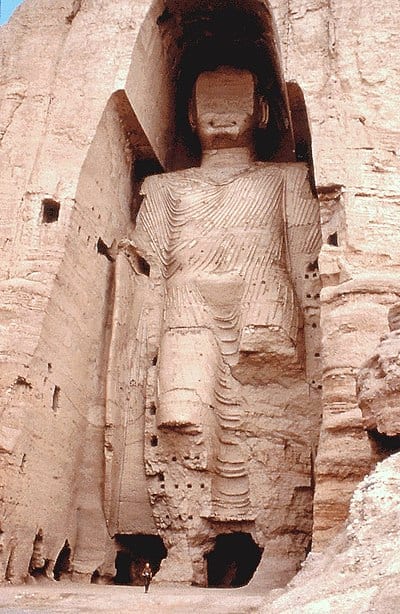
One of the two Buddhas of Bamiyan, prior to their destruction by the Taliban
(Wikimedia Commons public domain photo)
I published this column in the Provo Daily Herald on or around 5 March 2001:
Notwithstanding the international outcry that followed their announcement that they intended to destroy two massive ancient statues of the Buddha, the Taliban militia who control 90% of Afghanistan have apparently proceeded with the demolition. “It is not a big issue,” said Taliban minister of information and culture Mawlawi Qudratullah Jamal. “The statues are objects only made of mud or stone.”
The two statues – one roughly 120 feet high and the other 175 feet – were among the greatest surviving pieces of early Buddhist art. Carved into a sandstone cliff near the city of Bamiyan, about 90 miles west of the capital city of Kabul, the statues were at least 1500 years old. Previously, they had survived cannon fire from the soldiers of Genghis Khan in the early thirteenth century, an attack ordered by the Moghul emperor Aurangzeb in the seventeenth, and a damaging 1998 rocket-and-dynamite assault by the Taliban themselves.
The Taliban represent an extraordinarily rigid form of Islam. They imprison men who trim their beards in a fashion unlike that of the Prophet Muhammad. They refuse to allow the education of girls. They bar women from employment (or even, really, being seen) outside the home – and thus, by an edict disastrous in a very Third World country, have stripped nurseries, elementary schools, and hospitals of their principal staff. Even the Islamic Republic of Iran (scarcely a hotbed of feminism) has denounced them for their repression of women. The difference between the two Islamic factions can be neatly summarized as follows: For Iran’s Ayatollah Khomeini, anything not expressly forbidden to women by the Qur’an and authoritative Islamic tradition is permitted. By contrast, for the Afghani Taliban, anything that the Qur’an and tradition do not expressly permit to women is forbidden. As might easily be predicted, the two rules lead to very distinct social policies.
Afghanistan, once a crossroads of Europe, India, and China, is now, more than ever before, a backwater. The Soviet invasion of the 1970s and the Western military aid designed to counter it energized and equipped a fundamentalist Islamic movement among the legendarily fierce Afghan warriors. Seemingly, nobody foresaw the direction it has taken. The Taliban are recognized by only three countries (Pakistan, Saudi Arabia, and the United Arab Emirates) – all of them Islamic – as the legitimate government of Afghanistan. Now, however, even these three nations have expressed disapproval of the appalling plan to destroy the statues at Bamiyan.
But the destruction of images, and particularly of those associated with another religion, has an ancient pedigree and many precedents in the history of the three kindred faiths, Judaism, Christianity, and Islam. One of the Ten Commandments given to Moses at Sinai declares, “You shall not make yourself a carved image of any likeness of anything in heaven above or on earth beneath or in the waters under the earth. You shall not bow down to them or serve them. For I, Yahweh your God, am a jealous God” (Exodus 20:4-5, New Jerusalem Bible). Similar prohibitions exist in Islam. And, although many commentators have emphasized the ban on worshiping such images – the forbidding of idolatry – some have taken the principle very literally, even banishing photography and representational art.
The conquering Israelites, for whom Canaanite religion was a long-standing temptation, destroyed temples and images of Canaanite gods that modern archaeologists would dearly love to possess. Triumphant Christians engaged in wholesale destruction of pagan shrines and idols wherever they found them. The temples of ancient Egypt still bear the marks of early Christian devotion: Reliefs and statues were mutilated on an impressive scale. In the eighth and ninth centuries, the bitter “iconoclastic controversy,” in which (perhaps under Muslim influence) factions of Greek Orthodox Christians contended with one another over the legitimacy of “icons” or devotional images obliterated innumerable works of art. So too, as part of the cultural upheaval that accompanied the European Reformation in the sixteenth century, a great deal of the decoration of northern Europe’s churches was destroyed. (The austere interior of Ulrich Zwingli’s great church in Zürich, the Grossmuenster, furnishes a particularly clear illustration of the Reformation’s effects in this regard.) Just a few years ago, citing the precedent of Moses and Joshua, an evangelist in Texas announced that he had destroyed several pieces of twelfth-century Japanese Buddhist art that a donor had given to him to support his ministry.
Culture minister Jamal expected no difficulty with the demolition of the Buddhas. “It is easier,” he remarked a few days ago, “to destroy than to build.” Depressing, but true.
Next Post

February 6, 2020 Sacred Calendars and the Millennium
Browse Our Archives
Select a Category Uncategorized
Select a Month October 2026 September 2026 August 2026 July 2026 June 2026 May 2026 April 2026 March 2026 February 2026 January 2026 December 2025 November 2025 October 2025 September 2025 August 2025 July 2025 June 2025 May 2025 April 2025 March 2025 February 2025 January 2025 December 2024 November 2024 October 2024 September 2024 August 2024 July 2024 June 2024 May 2024 April 2024 March 2024 February 2024 January 2024 December 2023 November 2023 October 2023 September 2023 August 2023 July 2023 June 2023 May 2023 April 2023 March 2023 February 2023 January 2023 December 2022 November 2022 October 2022 September 2022 August 2022 July 2022 June 2022 May 2022 April 2022 March 2022 February 2022 January 2022 December 2021 November 2021 October 2021 September 2021 August 2021 July 2021 June 2021 May 2021 April 2021 March 2021 February 2021 January 2021 December 2020 November 2020 October 2020 September 2020 August 2020 July 2020 June 2020 May 2020 April 2020 March 2020 February 2020 January 2020 December 2019 November 2019 October 2019 September 2019 August 2019 July 2019 June 2019 May 2019 April 2019 March 2019 February 2019 January 2019 December 2018 November 2018 October 2018 September 2018 August 2018 July 2018 June 2018 May 2018 April 2018 March 2018 February 2018 January 2018 December 2017 November 2017 October 2017 September 2017 August 2017 July 2017 June 2017 May 2017 April 2017 March 2017 February 2017 January 2017 December 2016 November 2016 October 2016 September 2016 August 2016 July 2016 June 2016 May 2016 April 2016 March 2016 February 2016 January 2016 December 2015 November 2015 October 2015 September 2015 August 2015 July 2015 June 2015 May 2015 April 2015 March 2015 February 2015 January 2015 December 2014 November 2014 March 2014 August 2013 February 2012
Follow Us!
TAKE THE
Religious Wisdom Quiz
Who interpreted Nebuchadnezzar's dream of a statue?
Select your answer to see how you score.
Ezekiel Joseph Abraham Daniel
Related posts from Sic et Non

"The World's Sixteen Crucified Saviors"?
"Proven quality and solidarity"

"The beginning of the end of death’s dominion"

TRENDING AT PATHEOS Latter-day Saint

Swimfan: Forgotten Aughts Pleasures
This is a recovery effort. In 2002, My Big Fat Greek Wedding...

Top Three Anti-Catholic Lies About Catholicism
This is my initial transcript for the video, "THE 3 WORST...

Pope Leo Celebrates Mass for Nurses & Docs...
I don't have any idea how he did it, but Pope Leo...

The Sermon on the Mount, Part I: Matthew...
The Sermon on the Mount, Part I (Matthew 4:12-5:12) St. Matthew moves...

What's up from Crossway: Reviewing some of their latest A few weeks...

Janie Learns the Way of the Cross: A...
Teaching children about Jesus' Passion can be challenging. Many parents and educators...
view all Latter-day Saint blogs
Ad-Free & Subscriber Log-In Subscription Support
- About Us
- 2026 Calendar
- Videos
- Podcasts
- Library of World Religions
- Faith In Media Tracker
- Advertise With Us
- Write for Us
- Privacy Policy
- Terms of Service
- Do Not Sell My Data
- Contact Us
- Radiant Digital
- Manage Newsletter Subscriptions
- Unsubscribe From Notifications
- Sitemap
Copyright 2008-2026, Patheos. All rights reserved.
Subscription Support Ad-Free & Subscriber Log-In
Follow Patheos