
BuddhistCatholicContemplativeEvangelicalGeneral ChristianHinduJewishLatter-day SaintMuslimNew VisionsProgressive Christian
Beliefs
- Buddhist
- Catholic
- Contemplative
- Evangelical
- General Christian
- Hindu
- Jewish
- Latter-day Saint
- More Voices
- Muslim
- New Visions
- Pagan
- Progressive Christian
Topics
- Religion News
- Food and Religion
- Sports and Religion
- Religious Art
- Religious Music and Entertainment
- Religious Events
- History and Religion
- Style and Religion
- Politics and Religion
- Women in Religion
- Recreation Outdoors and Religion
- Business Finance and Religion
- Careers Workplace and Religion
- Education and Religion
- Family Parenting and Religion
- Health Fitness and Religion
- Home and Religion
- Relationships and Religion
- Technology and Religion
- Travel and Religion
Columnists
- Buddhist Columnists
- Business Finance and Religion Columnists
- Careers Workplace and Religion Columnists
- Catholic Columnists
- Contemplative Columnists
- Education and Religion Columnists
- Evangelists Columnists
- Family Parenting and Religion Columnists
- General Christian Columnists
- Health Fitness and Religion Columnists
- Hindu Columnists
- History and Religion Columnists
- Home and Religion Columnists
- Jewish Columnists
- More Voices Columnists
- Latter Day Columnists
- Muslim Columnists
- New Visions Columnists
- Nonreligious Columnists
- Pagan Columnists
- Politics and Religion Columnists
- Progressive Columnists
- Recreation Outdoors and Religion Columnists
- Relationships and Religion Columnists
- Religion News Columnists
- Religious Art Columnists
- Religious Events Columnists
- Religious Music and Entertainment Columnists
- Sports and Religion Columnists
- Style and Religion Columnists
- Technology and Religion Columnists
- Travel and Religion Columnists
- Women in Religion Columnists
Resource Library
- 2026 Calendar
- Library of World Religions
- The 100 Most Holy Places on Earth
- Patheos Answers
- Podcasts
- Videos
- Faith Leaders Database
- Anglican Episcopalian
- Bahai
- Baptist
- Buddhism
- Christianity
- Confucianism
- Eastern Orthodoxy
- Hinduism
- Holiness and Pentecostal
- ISKCON
- Islam
- Judaism
- Lutheran
- Methodist
- The Church of Jesus Christ of Latter-day Saints
- New Age
- Paganism
- Presbytarian and Reformed
- Protestantism
- Religion Behind the Scenes
- Roman Catholic
- Scientology
- Shia Islam
- Sikhism
- Sufism
- Sunni Islam
- Taoism
- Zen
- See all religions
Research Tools
 Ad-Free & Subscriber Log-In Subscription Support
Ad-Free & Subscriber Log-In Subscription Support
Follow Patheos 

- Trending:
- Forgiveness
- |
- Marriage
- |
- Consciousness
- |
- Death Penalty
- |
- Election
- |
- Halloween

- Home
- Latter-day Saint
- A note on “sociobiology” or “evolutionary psychology”
A note on “sociobiology” or “evolutionary psychology”
Last updated on: February 4, 2020 at 11:48 pm by Dan Peterson
A note on “sociobiology” or “evolutionary psychology” 2020-02-04T23:48:43-07:00 Dan Peterson
Patheos Explore the world's faith through different perspectives on religion and spirituality! Patheos has the views of the prevalent religions and spiritualities of the world.
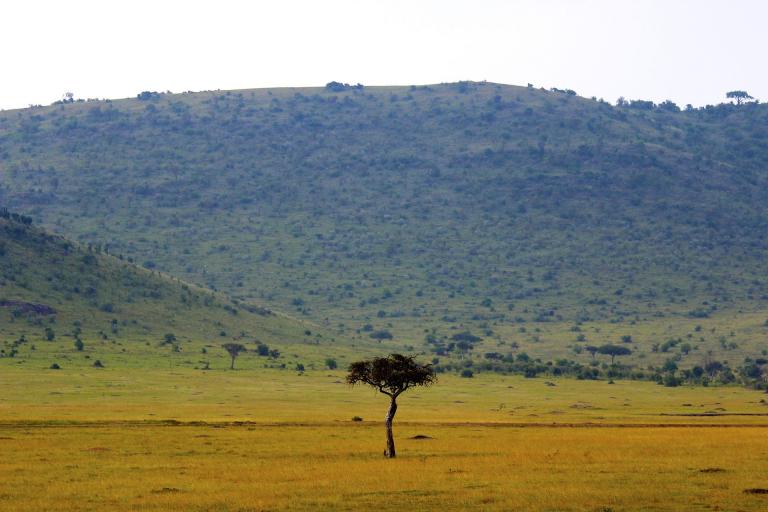
An acacia tree in the Kenyan savanna (Wikimedia Commons public domain photo)
I published this column in the Provo Daily Herald back in March 2001, but I remain skeptical still today of theories that purport to explain everything on the basis of scientific reductionism:
Of the three thinkers who have most influenced the modern world – Darwin, Freud, and Marx – only Darwin has entered the twenty-first century with his reputation more or less intact. Indeed, an ambitious new movement claims to have explained all the patterns of human behavior, from religion and morality all the way to child-rearing practices and shopping behavior, on the basis of Darwinian natural selection.
Sociobiology, as it was first known, burst onto the scene roughly twenty-five years ago, with the publication of Edward O. Wilson’s On Human Nature. Now, in slightly modified form, it tends to go under the name of “evolutionary psychology.” The movement traces human behavioral patterns, and the cultural and social patterns that arise from them, back to the African savanna, where, it says, human nature took its final evolutionary form roughly 100,000-600,000 years ago. That African setting, as one writer puts it, serves as something of a “Garden of Eden for materialists – unimaginably remote, cloaked in mystery.” Long, long ago, in a far-away place. It can even be used to explain a passion for golf: The typical golf course, dotted with small ponds and groves of trees, a rolling, grassy landscape, appeals to the memory of our ancient homeland that is somehow imprinted upon our genes.
Ironically, although every prominent exponent of sociobiology or evolutionary psychology is an outspoken atheist, critics of the movement ridicule it as a kind of religious faith. (These critics are usually themselves atheistic naturalists, who intend the label to be devastating.) “We have finally figured out,” says a leading member of the movement, “where we come from, why we’re here, and who we are.” This truly does sound like a religious claim, and, in fact, sociobiology seems to offer the same kind of comprehensive explanation of everything that has traditionally been the province of theological systems.
Of course, if Darwinian natural selection is a true principle, and if matter and randomness are all that really exists, Darwinism should indeed be able to explain absolutely everything in the biological world as well as in the social and psychological realms that (since there is nothing else) must derive from it.
But there are problems. For one thing, sociobiology seems to rest, in many cases, upon blatantly circular reasoning. Human behavior today seems to derive from that ancient African savanna. And how do we know about the behavioral patterns of our ancient African ancestors? By studying contemporary human behavior. (When possible, by studying the behavior of modern tribes of hunter-gatherers.) But how do we know that modern behavior derives from that of the ancient savanna? Because it matches precisely the model of ancient African behavior that we have built up on the basis of . . . the modern data.
Moreover, sociobiology seems entirely too flexible. It can explain anything, but in a way that seems both too glib and beyond scientific testing. Humans crave salty and fatty foods, for example. But this clearly seems to be maladaptive and unhealthy behavior. Shouldn’t the Darwinian process have “selected out” such cravings, on the basis of the fact the people who eat too much fat and salt die earlier? No, says one sociobiologist. Our taste buds, he asserts, were engineered for the Old Stone Age, when salty and fatty foods were presumably difficult to obtain. The pleasure we derived from them motivated us to work harder, and was therefore an incentive to survival. Some mothers kill their children. Why? Because, in the African savanna, doing so sometimes aided the survival of the group. Other mothers die for their children. Why? Because, in the African savanna, doing so was in the interests of the group.
As one critic of the movement has noted, “evolutionary psychologists can’t seem to decide whether theirs is an inductive or deductive science – whether, that is, they are shaping a theory about the past to account for a contemporary fact, or whether they’re asserting that what we know of the past will reveal something about contemporary behavior. In practice, sociobiology moves in both directions, forward or back, depending on what’s required to sustain the reductionist premise. Natural selection must be shown to be the root cause (and often the proximate cause) of whatever tendencies human behavior exhibits.”
Still, sociobiology seems unable to offer a convincing explanation for such evolutionarily useless things as music, poetry, sculpture, or acts of kindness offered to genetically unrelated strangers. It doesn’t account for Mother Teresa or Maximilian Kolbe. Worst of all, in making the “selfish gene” the driving force not only of biology, but of all psychological and social life, it destroys our sense of being individuals. If the sociobiologists are right, we turn out to be mere colonies of genes that use us for their ends. Our sense of being persons, of having purposes and agency, is pure illusion. Our concepts of law and moral responsibility rest upon genetically programmed deceptions.
If sociobiology does, in fact, represent a kind of religious vision, it is a profoundly anti-human one.
(A very insightful but accessible discussion of sociobiology is Andrew Ferguson’s review of six books on the subject, “Evolutionary Biology and Its True Believers,” in The Weekly Standard [19 March 2001]: 31-39, which inspired this column.)
Previous Post

February 3, 2020
The gullible Martin Harris and his wife, Lucy
Next Post
February 4, 2020 Christianity in Ethiopia
Browse Our Archives
Select a Category Uncategorized
Select a Month October 2026 September 2026 August 2026 July 2026 June 2026 May 2026 April 2026 March 2026 February 2026 January 2026 December 2025 November 2025 October 2025 September 2025 August 2025 July 2025 June 2025 May 2025 April 2025 March 2025 February 2025 January 2025 December 2024 November 2024 October 2024 September 2024 August 2024 July 2024 June 2024 May 2024 April 2024 March 2024 February 2024 January 2024 December 2023 November 2023 October 2023 September 2023 August 2023 July 2023 June 2023 May 2023 April 2023 March 2023 February 2023 January 2023 December 2022 November 2022 October 2022 September 2022 August 2022 July 2022 June 2022 May 2022 April 2022 March 2022 February 2022 January 2022 December 2021 November 2021 October 2021 September 2021 August 2021 July 2021 June 2021 May 2021 April 2021 March 2021 February 2021 January 2021 December 2020 November 2020 October 2020 September 2020 August 2020 July 2020 June 2020 May 2020 April 2020 March 2020 February 2020 January 2020 December 2019 November 2019 October 2019 September 2019 August 2019 July 2019 June 2019 May 2019 April 2019 March 2019 February 2019 January 2019 December 2018 November 2018 October 2018 September 2018 August 2018 July 2018 June 2018 May 2018 April 2018 March 2018 February 2018 January 2018 December 2017 November 2017 October 2017 September 2017 August 2017 July 2017 June 2017 May 2017 April 2017 March 2017 February 2017 January 2017 December 2016 November 2016 October 2016 September 2016 August 2016 July 2016 June 2016 May 2016 April 2016 March 2016 February 2016 January 2016 December 2015 November 2015 October 2015 September 2015 August 2015 July 2015 June 2015 May 2015 April 2015 March 2015 February 2015 January 2015 December 2014 November 2014 March 2014 August 2013 February 2012
Follow Us!
TAKE THE
Religious Wisdom Quiz
I am a goat released into the wilderness, carrying away the sins of the people. What am I?
Select your answer to see how you score.
An atonement goat A sin offering The scapegoat A sacrifice
Related posts from Sic et Non

What if Wallace had prevailed, rather than Darwin?

Studying the Pearl of Great Price, and Evolution
Evolutionary Biology and Divine Creation?
TRENDING AT PATHEOS Latter-day Saint

Swimfan: Forgotten Aughts Pleasures
This is a recovery effort. In 2002, My Big Fat Greek Wedding...

Top Three Anti-Catholic Lies About Catholicism
This is my initial transcript for the video, "THE 3 WORST...

Pope Leo Celebrates Mass for Nurses & Docs...
I don't have any idea how he did it, but Pope Leo...

The Sermon on the Mount, Part I: Matthew...
The Sermon on the Mount, Part I (Matthew 4:12-5:12) St. Matthew moves...

What's up from Crossway: Reviewing some of their latest A few weeks...

Janie Learns the Way of the Cross: A...
Teaching children about Jesus' Passion can be challenging. Many parents and educators...
view all Latter-day Saint blogs
Ad-Free & Subscriber Log-In Subscription Support
- About Us
- 2026 Calendar
- Videos
- Podcasts
- Library of World Religions
- Faith In Media Tracker
- Advertise With Us
- Write for Us
- Privacy Policy
- Terms of Service
- Do Not Sell My Data
- Contact Us
- Radiant Digital
- Manage Newsletter Subscriptions
- Unsubscribe From Notifications
- Sitemap
Copyright 2008-2026, Patheos. All rights reserved.
Subscription Support Ad-Free & Subscriber Log-In
Follow Patheos