
BuddhistCatholicContemplativeEvangelicalGeneral ChristianHinduJewishLatter-day SaintMuslimNew VisionsProgressive Christian
Beliefs
- Buddhist
- Catholic
- Contemplative
- Evangelical
- General Christian
- Hindu
- Jewish
- Latter-day Saint
- More Voices
- Muslim
- New Visions
- Pagan
- Progressive Christian
Topics
- Religion News
- Food and Religion
- Sports and Religion
- Religious Art
- Religious Music and Entertainment
- Religious Events
- History and Religion
- Style and Religion
- Politics and Religion
- Women in Religion
- Recreation Outdoors and Religion
- Business Finance and Religion
- Careers Workplace and Religion
- Education and Religion
- Family Parenting and Religion
- Health Fitness and Religion
- Home and Religion
- Relationships and Religion
- Technology and Religion
- Travel and Religion
Columnists
- Buddhist Columnists
- Business Finance and Religion Columnists
- Careers Workplace and Religion Columnists
- Catholic Columnists
- Contemplative Columnists
- Education and Religion Columnists
- Evangelists Columnists
- Family Parenting and Religion Columnists
- General Christian Columnists
- Health Fitness and Religion Columnists
- Hindu Columnists
- History and Religion Columnists
- Home and Religion Columnists
- Jewish Columnists
- More Voices Columnists
- Latter Day Columnists
- Muslim Columnists
- New Visions Columnists
- Nonreligious Columnists
- Pagan Columnists
- Politics and Religion Columnists
- Progressive Columnists
- Recreation Outdoors and Religion Columnists
- Relationships and Religion Columnists
- Religion News Columnists
- Religious Art Columnists
- Religious Events Columnists
- Religious Music and Entertainment Columnists
- Sports and Religion Columnists
- Style and Religion Columnists
- Technology and Religion Columnists
- Travel and Religion Columnists
- Women in Religion Columnists
Resource Library
- 2026 Calendar
- Library of World Religions
- The 100 Most Holy Places on Earth
- Patheos Answers
- Podcasts
- Videos
- Faith Leaders Database
- Anglican Episcopalian
- Bahai
- Baptist
- Buddhism
- Christianity
- Confucianism
- Eastern Orthodoxy
- Hinduism
- Holiness and Pentecostal
- ISKCON
- Islam
- Judaism
- Lutheran
- Methodist
- The Church of Jesus Christ of Latter-day Saints
- New Age
- Paganism
- Presbytarian and Reformed
- Protestantism
- Religion Behind the Scenes
- Roman Catholic
- Scientology
- Shia Islam
- Sikhism
- Sufism
- Sunni Islam
- Taoism
- Zen
- See all religions
Research Tools
 Ad-Free & Subscriber Log-In Subscription Support
Ad-Free & Subscriber Log-In Subscription Support
Follow Patheos 

- Trending:
- Forgiveness
- |
- Marriage
- |
- Consciousness
- |
- Death Penalty
- |
- Election
- |
- Halloween

- Home
- Latter-day Saint
- Who really cares?
Who really cares?
Last updated on: January 12, 2020 at 9:03 pm by Dan Peterson
Who really cares? 2020-01-12T21:03:07-07:00 Dan Peterson
Patheos Explore the world's faith through different perspectives on religion and spirituality! Patheos has the views of the prevalent religions and spiritualities of the world.
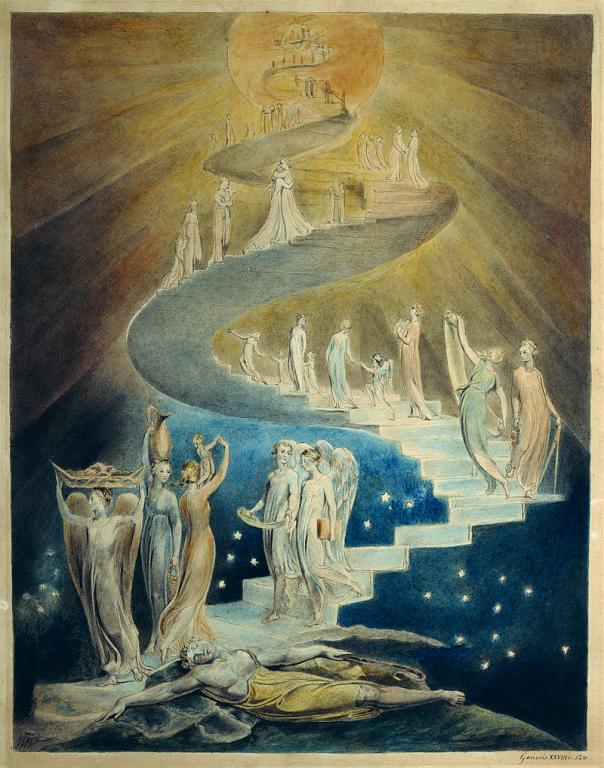
William Blake, “Jacob’s Ladder” (1804); Wikimedia Commons public domain image
I published this column in Provo’s Daily Herald all the way back in 2007:
For as long as I can remember, people who disagree with my fairly libertarian economic views have told me how much more they care about the poor than I do. Non-religious people have assured me that, while I’m focused on some sort of illusory “pie in the sky when I die” and on “saving” others from mythical sufferings in a fairy-tale afterlife, they are devoted to making life in this world, on this planet, tangibly better for everybody.
In my particular case, the critics may be right. They may be far better people than I am in every regard, including charity, kindness, and concern for their fellow humans. With the publication of Arthur C. Brooks’s Who Really Cares: The Surprising Truth about Compassionate Conservatism (New York: Basic Books, 2006), however, it’s going to be much, much harder for left-leaning secularists to preen themselves, as a class, on their superior compassion without supplying actual evidence to demonstrate it.
Brooks, a professor of public administration in the Maxwell School of Citizenship and Public Affairs at Syracuse University in New York, has been studying patterns in charitable giving and service for many years and is widely recognized as perhaps the preeminent authority on the subject. Still, he reports that even he has been surprised by what he has found.
Religious people, it turns out, give more to charity than do non-religious people. They donate more money—and not merely to their churches, synagogues, temples, and mosques. “Religious people are more charitable in every measurable nonreligious way—including secular donations, informal giving, and even acts of kindness and honesty—than secularists.” They are more likely to give money to family and friends, and, when they give, to do so in larger amounts. They are more likely to volunteer, and to give blood. Even in the case of nonchurchgoers, those who were raised in religious households are more likely to donate to charity than those who were not.
Unsurprisingly, private charity in ever-more-secular Europe has plummeted—to the point, in some areas, almost of extinction. Brooks, who also argues that charitable giving is essential to a strong economy, points to polling data suggesting that Europeans are, according to their own reports, less happy with their lives than Americans are, and suggests that their unhappiness may be connected with their low rates of charity and volunteerism. Humans feel better when they give.
As befits a premiere social scientist, Brooks concentrates heavily on multiple streams of contemporary statistical data to form his judgments. However, the historical record also seems to support the general conclusions of his very important book. Rodney Stark, in his insightful study of The Rise of Christianity (Princeton, 1996), has shown that the superior charity of the ancient Christians was among the factors in the rapid growth of the early Christian movement. And, as an examination of the surviving sources demonstrates, even the pagans recognized that. “The impious Galileans support not only their poor, but ours as well,” complained the fourth-century Roman Emperor Julian (known to subsequent history as “the Apostate” for his efforts to turn back the religious tide even after his uncle Constantine had declared Christianity the official religion of the empire). “Everyone can see that our people lack aid from us.”
“Religion is the opiate of the people,” Karl Marx famously said. Elsewhere, he remarked that, while “philosophers have said that the purpose of philosophy is to understand the world, the purpose is to change it.” Religion, in his view, was a distraction from the real business of making this world a better place. Unfortunately for Marx’s thesis, though (and, even more so, for those who had to live through the twentieth century), the millennium that just closed was heavily influenced at its end by Marxism and by a related ideology that went under the names of fascism and “National Socialism” or Nazism. We now have quite graphic evidence of exactly how such theories tend to “change the world.” Many tens of millions of people died—and many national economies were destroyed.
Religion doesn’t look too bad by contrast. But even when contrasted with the soft secularism—what one wit has called “apatheism”—that has come to dominate Europe, and perhaps Canada, and certain portions of the American elite, and even though religious people can undoubtedly do much more and much better than they are doing now, believers fare pretty well.
Next Post

January 11, 2020 It's a Book of Mormon year, so this is all appropriate
Browse Our Archives
Select a Category Uncategorized
Select a Month October 2026 September 2026 August 2026 July 2026 June 2026 May 2026 April 2026 March 2026 February 2026 January 2026 December 2025 November 2025 October 2025 September 2025 August 2025 July 2025 June 2025 May 2025 April 2025 March 2025 February 2025 January 2025 December 2024 November 2024 October 2024 September 2024 August 2024 July 2024 June 2024 May 2024 April 2024 March 2024 February 2024 January 2024 December 2023 November 2023 October 2023 September 2023 August 2023 July 2023 June 2023 May 2023 April 2023 March 2023 February 2023 January 2023 December 2022 November 2022 October 2022 September 2022 August 2022 July 2022 June 2022 May 2022 April 2022 March 2022 February 2022 January 2022 December 2021 November 2021 October 2021 September 2021 August 2021 July 2021 June 2021 May 2021 April 2021 March 2021 February 2021 January 2021 December 2020 November 2020 October 2020 September 2020 August 2020 July 2020 June 2020 May 2020 April 2020 March 2020 February 2020 January 2020 December 2019 November 2019 October 2019 September 2019 August 2019 July 2019 June 2019 May 2019 April 2019 March 2019 February 2019 January 2019 December 2018 November 2018 October 2018 September 2018 August 2018 July 2018 June 2018 May 2018 April 2018 March 2018 February 2018 January 2018 December 2017 November 2017 October 2017 September 2017 August 2017 July 2017 June 2017 May 2017 April 2017 March 2017 February 2017 January 2017 December 2016 November 2016 October 2016 September 2016 August 2016 July 2016 June 2016 May 2016 April 2016 March 2016 February 2016 January 2016 December 2015 November 2015 October 2015 September 2015 August 2015 July 2015 June 2015 May 2015 April 2015 March 2015 February 2015 January 2015 December 2014 November 2014 March 2014 August 2013 February 2012
Follow Us!
TAKE THE
Religious Wisdom Quiz
What principle about debt is found in Proverbs?
Select your answer to see how you score.
Ignore money The borrower is slave to the lender Debt is always good Never lend
Related posts from Sic et Non

Is the Church collapsing? And two questions on...

"A Fresh Investigation of Latter-day Saint Theology"


TRENDING AT PATHEOS Latter-day Saint

The First Eucharistic Controversy: Christ’s Real Presence
For Catholics, the Eucharist is the source and summit of the Christian...

What a Stop Sign Can Teach Us About...
How to Make a Decision When You Can't Hear God Main point:...

Archdiocese Hosts Military Marriage Retreat in Germany
RASTATT, Germany — The transient military lifestyle, with its frequent deployments and...

Nearly every morning, I make the drive to Detroit with my high-school-age...

The Real AI Story Is Adoption Without Trust
Artificial intelligence has crossed a political threshold. It is no longer a...

A new article, written by Jeff Lindsay and Gale L. Pooley,...
view all Latter-day Saint blogs
Ad-Free & Subscriber Log-In Subscription Support
- About Us
- 2026 Calendar
- Videos
- Podcasts
- Library of World Religions
- Faith In Media Tracker
- Advertise With Us
- Write for Us
- Privacy Policy
- Terms of Service
- Do Not Sell My Data
- Contact Us
- Radiant Digital
- Manage Newsletter Subscriptions
- Unsubscribe From Notifications
- Sitemap
Copyright 2008-2026, Patheos. All rights reserved.
Subscription Support Ad-Free & Subscriber Log-In
Follow Patheos