
BuddhistCatholicContemplativeEvangelicalGeneral ChristianHinduJewishLatter-day SaintMuslimNew VisionsProgressive Christian
Beliefs
- Buddhist
- Catholic
- Contemplative
- Evangelical
- General Christian
- Hindu
- Jewish
- Latter-day Saint
- More Voices
- Muslim
- New Visions
- Pagan
- Progressive Christian
Topics
- Religion News
- Food and Religion
- Sports and Religion
- Religious Art
- Religious Music and Entertainment
- Religious Events
- History and Religion
- Style and Religion
- Politics and Religion
- Women in Religion
- Recreation Outdoors and Religion
- Business Finance and Religion
- Careers Workplace and Religion
- Education and Religion
- Family Parenting and Religion
- Health Fitness and Religion
- Home and Religion
- Relationships and Religion
- Technology and Religion
- Travel and Religion
Columnists
- Buddhist Columnists
- Business Finance and Religion Columnists
- Careers Workplace and Religion Columnists
- Catholic Columnists
- Contemplative Columnists
- Education and Religion Columnists
- Evangelists Columnists
- Family Parenting and Religion Columnists
- General Christian Columnists
- Health Fitness and Religion Columnists
- Hindu Columnists
- History and Religion Columnists
- Home and Religion Columnists
- Jewish Columnists
- More Voices Columnists
- Latter Day Columnists
- Muslim Columnists
- New Visions Columnists
- Nonreligious Columnists
- Pagan Columnists
- Politics and Religion Columnists
- Progressive Columnists
- Recreation Outdoors and Religion Columnists
- Relationships and Religion Columnists
- Religion News Columnists
- Religious Art Columnists
- Religious Events Columnists
- Religious Music and Entertainment Columnists
- Sports and Religion Columnists
- Style and Religion Columnists
- Technology and Religion Columnists
- Travel and Religion Columnists
- Women in Religion Columnists
Resource Library
- 2026 Calendar
- Library of World Religions
- The 100 Most Holy Places on Earth
- Patheos Answers
- Podcasts
- Videos
- Faith Leaders Database
- Anglican Episcopalian
- Bahai
- Baptist
- Buddhism
- Christianity
- Confucianism
- Eastern Orthodoxy
- Hinduism
- Holiness and Pentecostal
- ISKCON
- Islam
- Judaism
- Lutheran
- Methodist
- The Church of Jesus Christ of Latter-day Saints
- New Age
- Paganism
- Presbytarian and Reformed
- Protestantism
- Religion Behind the Scenes
- Roman Catholic
- Scientology
- Shia Islam
- Sikhism
- Sufism
- Sunni Islam
- Taoism
- Zen
- See all religions
Research Tools
 Ad-Free & Subscriber Log-In Subscription Support
Ad-Free & Subscriber Log-In Subscription Support
Follow Patheos 

- Trending:
- Forgiveness
- |
- Marriage
- |
- Consciousness
- |
- Death Penalty
- |
- Election
- |
- Halloween

- Home
- Latter-day Saint
- Was Lehi following in the footsteps of earlier refugees?
Was Lehi following in the footsteps of earlier refugees?
Last updated on: January 15, 2020 at 11:22 pm by Dan Peterson
Was Lehi following in the footsteps of earlier refugees? 2020-01-15T23:22:12-07:00 Dan Peterson
Patheos Explore the world's faith through different perspectives on religion and spirituality! Patheos has the views of the prevalent religions and spiritualities of the world.
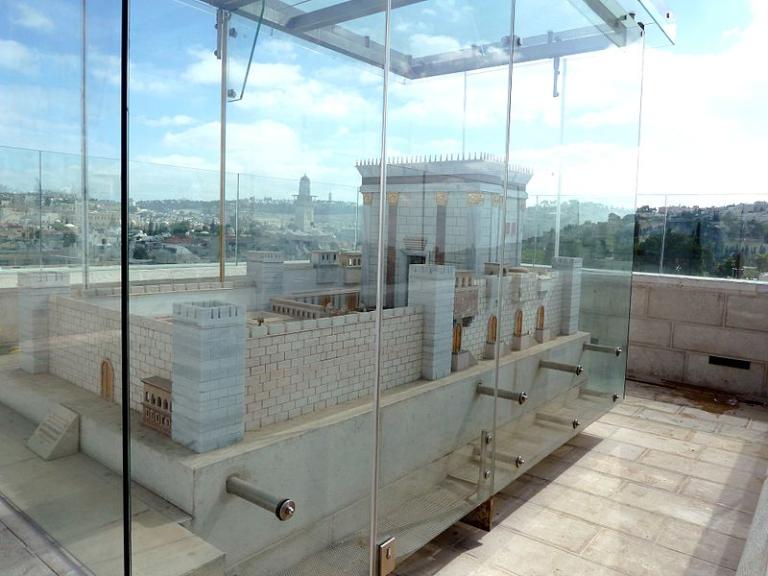
A model of Solomon’s temple, located in modern Jerusalem
(Wikimedia commons public domain photograph)
First, a lengthy quotation from Haggai 1:1-11, in the New English Translation of the Bible, with one three-word explanatory interpolation from me:
On the first day of the sixth month of [the Persian Achaemenid] King Darius’ second year, the Lord’s message came through the prophet Haggai to Zerubbabel son of Shealtiel, governor of Judah, and to the high priest Joshua son of Jehozadak:
2 This is what the Lord of Heaven’s Armies has said: “These people have said, ‘The time for rebuilding the Lord’s temple has not yet come.’” 3 The Lord’s message came through the prophet Haggai as follows: 4 “Is it right for you to live in richly paneled houses while my temple is in ruins? 5 Here then, this is what the Lord of Heaven’s Armies has said: ‘Think carefully about what you are doing. 6 You have planted much, but have harvested little. You eat, but are never filled. You drink, but are still thirsty. You put on clothes, but are not warm. Those who earn wages end up with holes in their money bags.’”
7 Moreover, this is what the Lord of Heaven’s Armies has said: “Pay close attention to these things also. 8 Go up to the hill country and bring back timber to build the temple. Then I will be pleased and honored,” says the Lord. 9 “You expected a large harvest, but instead there was little. And when you would bring it home, I would blow it right away. Why?” asks the Lord of Heaven’s Armies. “Because my temple remains in ruins, thanks to each of you favoring his own house! 10 This is why the sky has held back its dew and the earth its produce. 11 Moreover, I have called for a drought that will affect the fields, the hill country, the grain, new wine, fresh olive oil, and everything that grows from the ground; it also will harm people, animals, and everything they produce.”
I now append notes taken from and/or inspired by a reading of Gordon Darnell Newby, A History of the Jews of Arabia: From Ancient Times to Their Eclipse under Islam (Columbia, SC: University of South Carolina Press, 1988), 18-19:
The Jewish communities of south Arabia had foundation legends associated with the destruction of . . . the First Temple. According to Yemenite legend, the original Jewish settlers had left Jerusalem forty-two years before the destruction of the Temple. When Ezra called on them to return from exile to help in the rebuilding of the Temple, they refused because they foresaw the second destruction of the Temple. This brought Ezra’s curse on them, condemning them to a life of poverty and intellectual privation. They, in turn, cursed Ezra so that he would not be interred in the Holy Land. (18-19)
Some explanation of the timeline here might be in order:
According to the Hebrew Bible or Old Testament, the First Temple — which is often referred as Solomon’s Temple — was the sacred structure in ancient Jerusalem that Solomon, the third (and last) king of united Israel, built around 1000 BC. That temple was destroyed by Nebuchadnezzar II, the king of Babylon, after his siege of Jerusalem in 587 BC. The destruction proper may have occurred in 586 BC.
If a group of Jews, concerned about the rising threat from Mesopotamia, really left Jerusalem for refuge in Yemen forty-two years before the destruction of the Temple of Solomon, that would put their departure at around 628-629 BC.
According to 1 Nephi 1 in the Book of Mormon, the prophet Lehi, concerned about the Babylonian threat and commanded by God, left Jerusalem around 600 BC. Is it possible that an awareness of a prior flight of Jewish refugees toward south Arabia was a factor in his decision to head out in the same direction that they had allegedly gone?
The so-called Second Temple was constructed after the return of many (but not all) Jews from their exile in Babylonia in 516 BC. It was originally a relatively modest structure built in their poverty by a number of returning Jewish exiles under Zerubbabel, a governor appointed by the Persian rulers of the Achaemenid Empire, which had recently overthrown the Neo-Babylonian or Second Babylonian Empire. It is the temple associated with Ezra, Nehemiah, and Haggai. (King Herod the Great completely reconstructed the Second Temple just before and during the childhood of Jesus, making it far more grandiose — and this is the temple, familiar from the New Testament, that was destroyed by the Romans in AD 70. Even after Herod’s expansion and improvements, it is still known as the “Second Temple.”
So far as I’m aware, there is no biblical account of Ezra unsuccessfully exhorting reluctant exiles to return and rebuild the temple. But (as shown in the quotation given above) the prophet Haggai certainly exhorted the Jewish returnees to greater efforts toward its reconstruction, and, according to Haggai 1:12-15, he did so successfully.
What of the supposed Jewish refugees in Yemen and their alleged refusal to return? G. D. Newby comments as follows:
It is difficult to ascertain the antiquity of this legend, although its grounding in Haggai would argue that the tension between the exiles and the forces of return was widespread and early. The folklorist Schwarzbaum assumes that the story is late, but other scholars, like B. Heller, argue for its antiquity. (19)
If the story is authentically ancient, it might shed some light on the context of Lehi’s journey to southern Arabia.
Previous Post

January 13, 2020
“Am I dead or what?” (continued)
Next Post
January 13, 2020 Tierra del Fuego and the Book of Mormon
Browse Our Archives
Select a Category Uncategorized
Select a Month October 2026 September 2026 August 2026 July 2026 June 2026 May 2026 April 2026 March 2026 February 2026 January 2026 December 2025 November 2025 October 2025 September 2025 August 2025 July 2025 June 2025 May 2025 April 2025 March 2025 February 2025 January 2025 December 2024 November 2024 October 2024 September 2024 August 2024 July 2024 June 2024 May 2024 April 2024 March 2024 February 2024 January 2024 December 2023 November 2023 October 2023 September 2023 August 2023 July 2023 June 2023 May 2023 April 2023 March 2023 February 2023 January 2023 December 2022 November 2022 October 2022 September 2022 August 2022 July 2022 June 2022 May 2022 April 2022 March 2022 February 2022 January 2022 December 2021 November 2021 October 2021 September 2021 August 2021 July 2021 June 2021 May 2021 April 2021 March 2021 February 2021 January 2021 December 2020 November 2020 October 2020 September 2020 August 2020 July 2020 June 2020 May 2020 April 2020 March 2020 February 2020 January 2020 December 2019 November 2019 October 2019 September 2019 August 2019 July 2019 June 2019 May 2019 April 2019 March 2019 February 2019 January 2019 December 2018 November 2018 October 2018 September 2018 August 2018 July 2018 June 2018 May 2018 April 2018 March 2018 February 2018 January 2018 December 2017 November 2017 October 2017 September 2017 August 2017 July 2017 June 2017 May 2017 April 2017 March 2017 February 2017 January 2017 December 2016 November 2016 October 2016 September 2016 August 2016 July 2016 June 2016 May 2016 April 2016 March 2016 February 2016 January 2016 December 2015 November 2015 October 2015 September 2015 August 2015 July 2015 June 2015 May 2015 April 2015 March 2015 February 2015 January 2015 December 2014 November 2014 March 2014 August 2013 February 2012
Follow Us!
TAKE THE
Religious Wisdom Quiz
What vision did Daniel have of four beasts representing empires?
Select your answer to see how you score.
Four dragons Horse, eagle, serpent, leopard Ox, ram, goat, lion Lion, bear, leopard, terrifying beast
Related posts from Sic et Non


Some notes on the archaeology of the Bible


TRENDING AT PATHEOS Latter-day Saint

How to Make a Decision When You Can't...
Main point: It’s much more valuable to stay close to God so...

Archdiocese Hosts Military Marriage Retreat in Germany
RASTATT, Germany — The transient military lifestyle, with its frequent deployments and...

Nearly every morning, I make the drive to Detroit with my high-school-age...

The Real AI Story Is Adoption Without Trust
Artificial intelligence has crossed a political threshold. It is no longer a...

A new article, written by Jeff Lindsay and Gale L. Pooley,...

Swimfan: Forgotten Aughts Pleasures
This is a recovery effort. In 2002, My Big Fat Greek Wedding...
view all Latter-day Saint blogs
Ad-Free & Subscriber Log-In Subscription Support
- About Us
- 2026 Calendar
- Videos
- Podcasts
- Library of World Religions
- Faith In Media Tracker
- Advertise With Us
- Write for Us
- Privacy Policy
- Terms of Service
- Do Not Sell My Data
- Contact Us
- Radiant Digital
- Manage Newsletter Subscriptions
- Unsubscribe From Notifications
- Sitemap
Copyright 2008-2026, Patheos. All rights reserved.
Subscription Support Ad-Free & Subscriber Log-In
Follow Patheos