
BuddhistCatholicContemplativeEvangelicalGeneral ChristianHinduJewishLatter-day SaintMuslimNew VisionsProgressive Christian
Beliefs
- Buddhist
- Catholic
- Contemplative
- Evangelical
- General Christian
- Hindu
- Jewish
- Latter-day Saint
- More Voices
- Muslim
- New Visions
- Pagan
- Progressive Christian
Topics
- Religion News
- Food and Religion
- Sports and Religion
- Religious Art
- Religious Music and Entertainment
- Religious Events
- History and Religion
- Style and Religion
- Politics and Religion
- Women in Religion
- Recreation Outdoors and Religion
- Business Finance and Religion
- Careers Workplace and Religion
- Education and Religion
- Family Parenting and Religion
- Health Fitness and Religion
- Home and Religion
- Relationships and Religion
- Technology and Religion
- Travel and Religion
Columnists
- Buddhist Columnists
- Business Finance and Religion Columnists
- Careers Workplace and Religion Columnists
- Catholic Columnists
- Contemplative Columnists
- Education and Religion Columnists
- Evangelists Columnists
- Family Parenting and Religion Columnists
- General Christian Columnists
- Health Fitness and Religion Columnists
- Hindu Columnists
- History and Religion Columnists
- Home and Religion Columnists
- Jewish Columnists
- More Voices Columnists
- Latter Day Columnists
- Muslim Columnists
- New Visions Columnists
- Nonreligious Columnists
- Pagan Columnists
- Politics and Religion Columnists
- Progressive Columnists
- Recreation Outdoors and Religion Columnists
- Relationships and Religion Columnists
- Religion News Columnists
- Religious Art Columnists
- Religious Events Columnists
- Religious Music and Entertainment Columnists
- Sports and Religion Columnists
- Style and Religion Columnists
- Technology and Religion Columnists
- Travel and Religion Columnists
- Women in Religion Columnists
Resource Library
- 2026 Calendar
- Library of World Religions
- The 100 Most Holy Places on Earth
- Patheos Answers
- Podcasts
- Videos
- Faith Leaders Database
- Anglican Episcopalian
- Bahai
- Baptist
- Buddhism
- Christianity
- Confucianism
- Eastern Orthodoxy
- Hinduism
- Holiness and Pentecostal
- ISKCON
- Islam
- Judaism
- Lutheran
- Methodist
- The Church of Jesus Christ of Latter-day Saints
- New Age
- Paganism
- Presbytarian and Reformed
- Protestantism
- Religion Behind the Scenes
- Roman Catholic
- Scientology
- Shia Islam
- Sikhism
- Sufism
- Sunni Islam
- Taoism
- Zen
- See all religions
Research Tools
 Ad-Free & Subscriber Log-In Subscription Support
Ad-Free & Subscriber Log-In Subscription Support
Follow Patheos 

- Trending:
- Forgiveness
- |
- Marriage
- |
- Consciousness
- |
- Death Penalty
- |
- Election
- |
- Halloween

- Home
- Latter-day Saint
- The real Tower of Babel
The real Tower of Babel
Last updated on: January 26, 2020 at 11:11 pm by Dan Peterson
The real Tower of Babel 2020-01-26T23:11:31-07:00 Dan Peterson
Patheos Explore the world's faith through different perspectives on religion and spirituality! Patheos has the views of the prevalent religions and spiritualities of the world.
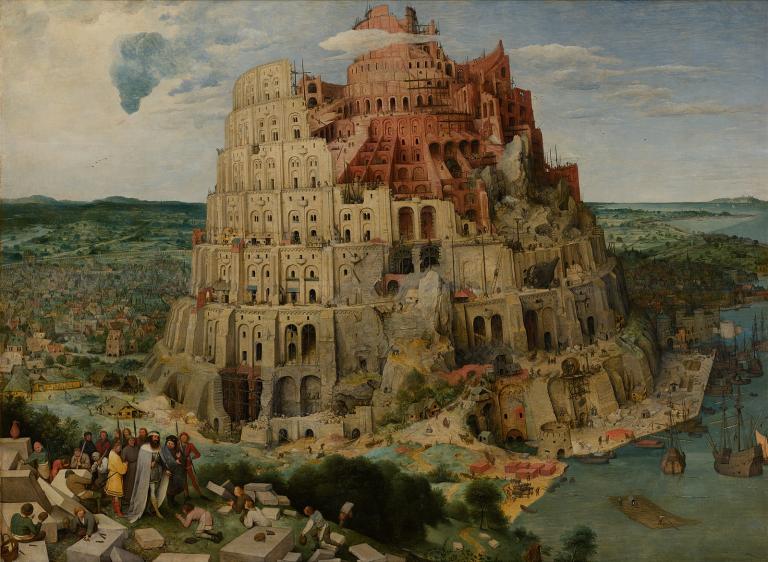
Pieter Bruegel the Elder, “The Tower of Babel” (1563)
Bill Hamblin and I published this column in the Deseret News several years ago:
Most religions have attempted to build their sanctuaries on prominent heights to be visible to all the faithful. Since no such natural heights were available in the flat flood plains of ancient Mesopotamia (modern Iraq), ancient priests and kings determined to build ziggurats (Akkadian “ziqqurratu”), artificial square or rectangular stepped temple platforms. Functionally, temples were placed on raised platforms to give them prominence over other buildings in a city, and to allow more people to watch the services performed at the temple. Symbolically, however, the ziggurat represents the cosmic mountain on which God or the gods dwell. The priest’s ascent up the stairway to the temple at the top of the ziggurat represents the ascent to heaven. The great ziggurat at Khorsabad, for example, had seven different stages, each painted a different color, representing the heavenly spheres of the five known planets and the moon and sun.
Although the specific architectural details of ziggurats differ, they all exhibit a similar overall structure. A courtyard surrounded by a sacred enclosure wall—as large as 500 yards square—generally encompassed the ziggurat, creating a ritual plaza for religious ceremonies. Ziggurat complexes often included storehouses, residences for priests and kings, and altars for sacrifice. The huge temple—often as long as a football field and generally oriented to the cardinal directions—occupied a prominent place in the courtyard. Ascent of the platforms was comonly restricted to the priests, and was achieved by climbing vast stairways, some stretching out perpendicular to the platform, with others attached to the walls or spiraling around the platform. The top of the ziggurat was crowned by a temple containing the statue of the god. Ziggurats thus provided the link between heaven and earth, allowing humans to ritually ascend into the presence of God. (In this regard, Jacob’s vision of the “ladder” (Hebrew “sullam”) or, better, “stairway” into heaven (Genesis 28:10-22) matches the symbolism of the ziggurat.) In Babylon, the largest ziggurat was the Marduk temple Etemenanki (“the house that is the foundation of heaven and earth”), with a square base almost 100 yards long. Priests and artisans of Mesopotamia provided their temple and ziggurat complexes with fantastic ornamentation. Twenty-two tons of gold are said to have been used in the ornamentation of the temple of Marduk alone.
Although the building of ziggurats declined following the Greek conquest of Mesopotamia in the fourth century BC, the significance of these temple complexes lived on in the religious imagination for the next two thousand years. Berossus, a Babylonian scholar of the third century BC, described the Hanging Gardens of Babylon as one of the wonders of the world. He claimed the Hanging Gardens were a type of pleasure palace and garden built by king Nebuchadnezzar for his wife Amuita; the gardens were probably part of a ziggurat complex, intended to represent the celestial garden of the gods that surrounds the mountain on which the gods dwell.
Building temples on raised platforms is a widespread phenomenon in world religious architecture, notably in China. Functionally and architecturally, however, the closest parallels to the Mesopotamian ziggurat come from the stepped temple mounds of Pre-Columbian America. In Mesoamerica these are most strikingly preserved at the temples of the Maya and Aztecs, to which millions of tourists flock each year. But the phenomenon dates back at least to the late second millennium B.C., as found in Olmec examples at La Venta and San Lorenzo.
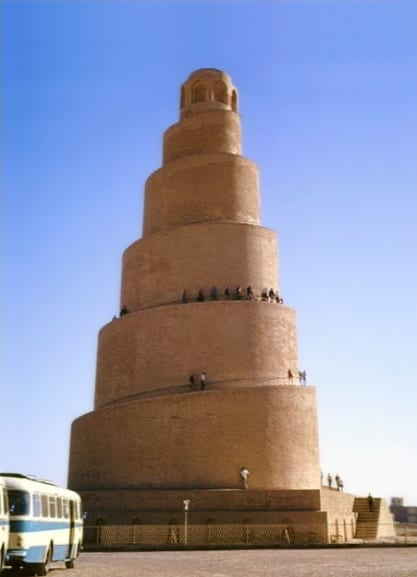
The minaret of the Great Mosque of Samarra, in Iraq
(Wikimedia Commons public domain photograph)
When the Arabs conquered Mesopotamia in the seventh century AD, the crumbling and abandoned ruins of ziggurats may have been the architectural inspiration for the building of the great minaret of Samarra (near Baghdad) in the ninth century. This huge tapering tower is surrounded by an outside spiral corkscrew staircase to the top. Seeing this minaret, medieval Europeans mistook it for the biblical Tower of Babel (Gen. 11:1-9), and, as such, it lent its form to medieval and Renaissance representations of the Tower, as in the famous “Tower of Babel” by Bruegel (1563). And, indirectly, they may not have been entirely mistaken. Many scholars believe that the story of the Tower of Babel in fact describes the building of a ziggurat, a tower that doesn’t literally ascend into the physical sky but, rather, ritually allows the priests to ascend into the presence of the heavenly gods by climbing to the temple at the top of the holy mountain.
Previous Post

January 26, 2020
"Ask thy father, and he will shew thee"
Next Post
January 27, 2020 My career as a water witcher, armed with a divining rod
Browse Our Archives
Select a Category Uncategorized
Select a Month October 2026 September 2026 August 2026 July 2026 June 2026 May 2026 April 2026 March 2026 February 2026 January 2026 December 2025 November 2025 October 2025 September 2025 August 2025 July 2025 June 2025 May 2025 April 2025 March 2025 February 2025 January 2025 December 2024 November 2024 October 2024 September 2024 August 2024 July 2024 June 2024 May 2024 April 2024 March 2024 February 2024 January 2024 December 2023 November 2023 October 2023 September 2023 August 2023 July 2023 June 2023 May 2023 April 2023 March 2023 February 2023 January 2023 December 2022 November 2022 October 2022 September 2022 August 2022 July 2022 June 2022 May 2022 April 2022 March 2022 February 2022 January 2022 December 2021 November 2021 October 2021 September 2021 August 2021 July 2021 June 2021 May 2021 April 2021 March 2021 February 2021 January 2021 December 2020 November 2020 October 2020 September 2020 August 2020 July 2020 June 2020 May 2020 April 2020 March 2020 February 2020 January 2020 December 2019 November 2019 October 2019 September 2019 August 2019 July 2019 June 2019 May 2019 April 2019 March 2019 February 2019 January 2019 December 2018 November 2018 October 2018 September 2018 August 2018 July 2018 June 2018 May 2018 April 2018 March 2018 February 2018 January 2018 December 2017 November 2017 October 2017 September 2017 August 2017 July 2017 June 2017 May 2017 April 2017 March 2017 February 2017 January 2017 December 2016 November 2016 October 2016 September 2016 August 2016 July 2016 June 2016 May 2016 April 2016 March 2016 February 2016 January 2016 December 2015 November 2015 October 2015 September 2015 August 2015 July 2015 June 2015 May 2015 April 2015 March 2015 February 2015 January 2015 December 2014 November 2014 March 2014 August 2013 February 2012
Follow Us!
TAKE THE
Religious Wisdom Quiz
Which mountain did Jesus ascend from at His ascension?
Select your answer to see how you score.
Mount Zion Mount Carmel Mount Sinai Mount of Olives
Related posts from Sic et Non

Some notes on the archaeology of the Bible
Mandatory Bible reading in Texas public schools?

The Book of Mormon on the composition of...
TRENDING AT PATHEOS Latter-day Saint

57th Dove Awards Honor Dolly Parton, Crown New...
On gospel music’s biggest night, the 57th annual GMA Dove Awards honored...

The First Eucharistic Controversy: Christ’s Real Presence
For Catholics, the Eucharist is the source and summit of the Christian...

What a Stop Sign Can Teach Us About...
How to Make a Decision When You Can't Hear God Main point:...

Archdiocese Hosts Military Marriage Retreat in Germany
RASTATT, Germany — The transient military lifestyle, with its frequent deployments and...

Nearly every morning, I make the drive to Detroit with my high-school-age...

The Real AI Story Is Adoption Without Trust
Artificial intelligence has crossed a political threshold. It is no longer a...
view all Latter-day Saint blogs
Ad-Free & Subscriber Log-In Subscription Support
- About Us
- 2026 Calendar
- Videos
- Podcasts
- Library of World Religions
- Faith In Media Tracker
- Advertise With Us
- Write for Us
- Privacy Policy
- Terms of Service
- Do Not Sell My Data
- Contact Us
- Radiant Digital
- Manage Newsletter Subscriptions
- Unsubscribe From Notifications
- Sitemap
Copyright 2008-2026, Patheos. All rights reserved.
Subscription Support Ad-Free & Subscriber Log-In
Follow Patheos