
BuddhistCatholicContemplativeEvangelicalGeneral ChristianHinduJewishLatter-day SaintMuslimNew VisionsProgressive Christian
Beliefs
- Buddhist
- Catholic
- Contemplative
- Evangelical
- General Christian
- Hindu
- Jewish
- Latter-day Saint
- More Voices
- Muslim
- New Visions
- Pagan
- Progressive Christian
Topics
- Religion News
- Food and Religion
- Sports and Religion
- Religious Art
- Religious Music and Entertainment
- Religious Events
- History and Religion
- Style and Religion
- Politics and Religion
- Women in Religion
- Recreation Outdoors and Religion
- Business Finance and Religion
- Careers Workplace and Religion
- Education and Religion
- Family Parenting and Religion
- Health Fitness and Religion
- Home and Religion
- Relationships and Religion
- Technology and Religion
- Travel and Religion
Columnists
- Buddhist Columnists
- Business Finance and Religion Columnists
- Careers Workplace and Religion Columnists
- Catholic Columnists
- Contemplative Columnists
- Education and Religion Columnists
- Evangelists Columnists
- Family Parenting and Religion Columnists
- General Christian Columnists
- Health Fitness and Religion Columnists
- Hindu Columnists
- History and Religion Columnists
- Home and Religion Columnists
- Jewish Columnists
- More Voices Columnists
- Latter Day Columnists
- Muslim Columnists
- New Visions Columnists
- Nonreligious Columnists
- Pagan Columnists
- Politics and Religion Columnists
- Progressive Columnists
- Recreation Outdoors and Religion Columnists
- Relationships and Religion Columnists
- Religion News Columnists
- Religious Art Columnists
- Religious Events Columnists
- Religious Music and Entertainment Columnists
- Sports and Religion Columnists
- Style and Religion Columnists
- Technology and Religion Columnists
- Travel and Religion Columnists
- Women in Religion Columnists
Resource Library
- 2026 Calendar
- Library of World Religions
- The 100 Most Holy Places on Earth
- Patheos Answers
- Podcasts
- Videos
- Faith Leaders Database
- Anglican Episcopalian
- Bahai
- Baptist
- Buddhism
- Christianity
- Confucianism
- Eastern Orthodoxy
- Hinduism
- Holiness and Pentecostal
- ISKCON
- Islam
- Judaism
- Lutheran
- Methodist
- The Church of Jesus Christ of Latter-day Saints
- New Age
- Paganism
- Presbytarian and Reformed
- Protestantism
- Religion Behind the Scenes
- Roman Catholic
- Scientology
- Shia Islam
- Sikhism
- Sufism
- Sunni Islam
- Taoism
- Zen
- See all religions
Research Tools
 Ad-Free & Subscriber Log-In Subscription Support
Ad-Free & Subscriber Log-In Subscription Support
Follow Patheos 

- Trending:
- Forgiveness
- |
- Marriage
- |
- Consciousness
- |
- Death Penalty
- |
- Election
- |
- Halloween

- Home
- Latter-day Saint
- A couple of songs from my first residence in the Middle East
A couple of songs from my first residence in the Middle East
Last updated on: January 17, 2020 at 11:38 pm by Dan Peterson
A couple of songs from my first residence in the Middle East 2020-01-17T23:38:20-07:00 Dan Peterson
Patheos Explore the world's faith through different perspectives on religion and spirituality! Patheos has the views of the prevalent religions and spiritualities of the world.
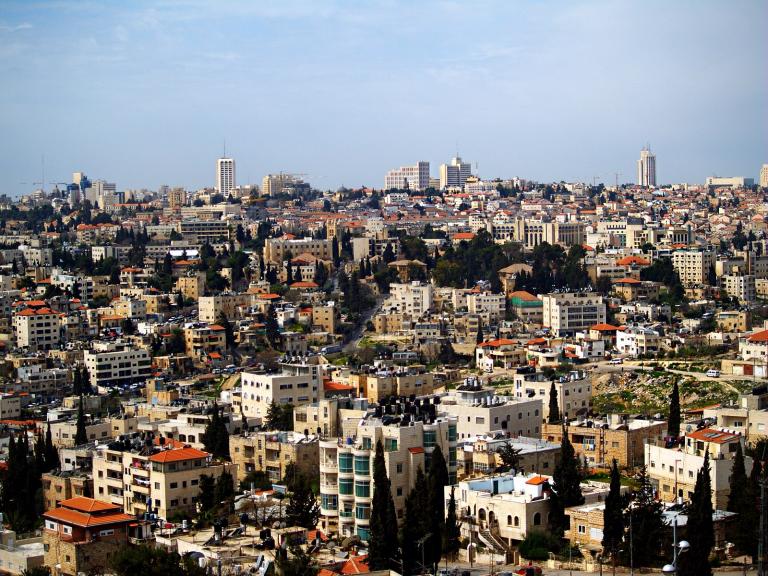
A view of the Sheikh Jarrah neighborhood of predominantly Palestinian East Jerusalem, roughly a mile or a mile and a half from the Old City. In the background are the highrise buildings of modern Jerusalem. The area has built up a bit since I lived there in 1978.
(Wikimedia Commons public domain photograph by David Shankbone)
Since my teens, I’ve enjoyed and been interested in folk music. And one of the towering figures in the preservation of American folk tunes, a person whose name I ran into over and over again, was the ethnomusicologist Alan Lomax. You can, if you will, regard this blog entry as a tribute to him and his work.
My first stay in the Middle East was six months with a BYU study abroad group in Israel. For roughly the first half of that 1978 program — just eleven years after Israel had seized control of East Jerusalem (and the West Bank and the Sinai and the Golan Heights) during the Six-Day War of 1967 — we were housed (and had our classes) in the Vienna Hotel, a Palestinian establishment in an Arab neighborhood called Shaykh Jarrah. (The building has long since been demolished.)
The Vienna Hotel wasn’t exactly the Ritz Carlton. Here’s a song that my roommate and I (mostly my roommate, if I recall correctly) made up in honor of that august place of lodging:
V is for the vermin in the bathtub.
I is for the instant milk we drink.
E is for the broken elevator.
N is for that nasty sewer stink.
N is for the nutrients we’re lacking.
A’s for Abu Fu’ad slinging slop.
Put them all together, it’s “Vienna.”
For refugee camps, it’s the top!
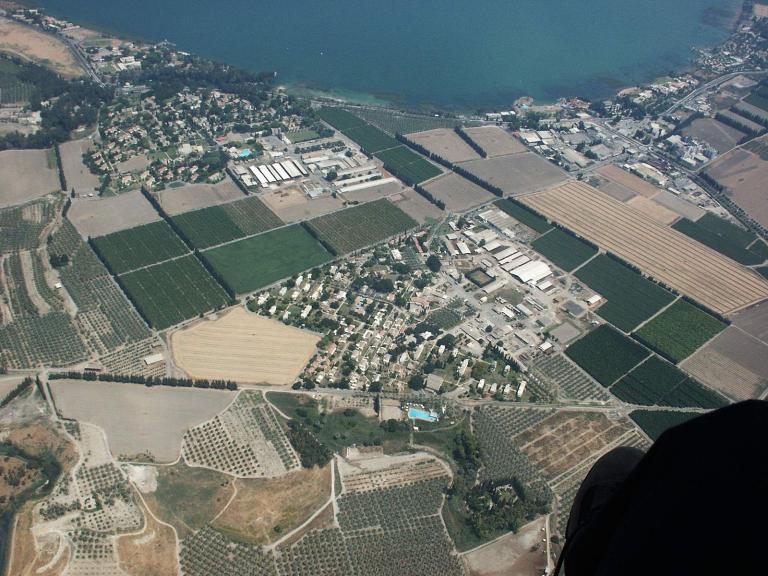
The kibbutzim Deganya Alef and Deganya Bet — Deganya A and Deganya B — at the southern end of Lake Tiberias (i.e., the “Sea of Galilee”). Deganya Alef is at the upper left, directly on the shore of the lake. The earliest socialist Zionist farming commune in Israel (it was founded in 1910), it is sometimes called “the mother of all kibbutzim.”
(Wikimedia Commons public domain photograph)
Somewhere near the midway point of our program, we spent a couple of weeks up north in the Galilee, first at the collective farm Kibbutz Deganya Alef or Deganya A (דְּגַנְיָה א’). The permanent settlement was established in 1910, making it the earliest socialist Zionist farming commune in Israel. It’s sometimes called “the mother of all kibbutzim.”
We were essentially agricultural workers, spending much of our time pruning banana trees. (In order to escape the banana-tree pruning detail, I volunteered to spend most of one night loading geese onto trucks. They bite. I went back to pruning banana trees. They don’t bite.)
But that’s a story for another time. Anyway, here’s a little piece that my roomate and I made up, to be sung to the tune of “Go Down, Moses.” I would sing it, with choral response, while we were working in the fields. Galbraith, of course, refers to the director of the BYU Jerusalem Program at the time, David Galbraith (later a friend and BYU faculty colleague). Izzy (presumably short for Israel) was one of the leaders of Kibbutz Deganya Alef, and the person most responsible for our group’s being there:
When BYU was in Israel land
(Let my people go!)
They worked so hard they could not stand.
(Let my people go!)
Go down, Galbraith! Go down Deganya way!
Tell old Izzy, “Let my people go!”
Next Post

January 18, 2020 A Prolegomenon to My First Sojourn in the Middle East
Browse Our Archives
Select a Category Uncategorized
Select a Month October 2026 September 2026 August 2026 July 2026 June 2026 May 2026 April 2026 March 2026 February 2026 January 2026 December 2025 November 2025 October 2025 September 2025 August 2025 July 2025 June 2025 May 2025 April 2025 March 2025 February 2025 January 2025 December 2024 November 2024 October 2024 September 2024 August 2024 July 2024 June 2024 May 2024 April 2024 March 2024 February 2024 January 2024 December 2023 November 2023 October 2023 September 2023 August 2023 July 2023 June 2023 May 2023 April 2023 March 2023 February 2023 January 2023 December 2022 November 2022 October 2022 September 2022 August 2022 July 2022 June 2022 May 2022 April 2022 March 2022 February 2022 January 2022 December 2021 November 2021 October 2021 September 2021 August 2021 July 2021 June 2021 May 2021 April 2021 March 2021 February 2021 January 2021 December 2020 November 2020 October 2020 September 2020 August 2020 July 2020 June 2020 May 2020 April 2020 March 2020 February 2020 January 2020 December 2019 November 2019 October 2019 September 2019 August 2019 July 2019 June 2019 May 2019 April 2019 March 2019 February 2019 January 2019 December 2018 November 2018 October 2018 September 2018 August 2018 July 2018 June 2018 May 2018 April 2018 March 2018 February 2018 January 2018 December 2017 November 2017 October 2017 September 2017 August 2017 July 2017 June 2017 May 2017 April 2017 March 2017 February 2017 January 2017 December 2016 November 2016 October 2016 September 2016 August 2016 July 2016 June 2016 May 2016 April 2016 March 2016 February 2016 January 2016 December 2015 November 2015 October 2015 September 2015 August 2015 July 2015 June 2015 May 2015 April 2015 March 2015 February 2015 January 2015 December 2014 November 2014 March 2014 August 2013 February 2012
Follow Us!
TAKE THE
Religious Wisdom Quiz
What does "Barnabas" mean?
Select your answer to see how you score.
Son of encouragement Son of thunder Gifted one Faithful one
Related posts from Sic et Non

A Follow-Up on How I Met President Jeffrey...

I was delighted by this morning's class
Once more on Elder Gilbert and BYU (and...
TRENDING AT PATHEOS Latter-day Saint

Emotion in Early Christianity by Andrew Crislip
Andrew Crislip’s Emotion in Early Christianity examines an often overlooked dimension of...

16 Spiritual Touchstones for a More Grounded Life
After decades of spiritual study, here are 16 principles I try...

Catholic Evangelization: Sharing Your Faith Every Day
Welcome back to the Graceful Awakening mini-series called, “From Faith to Mission.” ...

The Pillar of the Boatmen: the Ancient Monument...
The Pillar of the Boatmen is a Romano-Gaulish sculpture that dates from...

In one sense walking into Westminster Abbey is like walking down the...

'Super Scam Me' Exposes AI Jon Bon Jovi...
Leslie Pickett believed she was in a relationship with Jon Bon Jovi....
view all Latter-day Saint blogs
Ad-Free & Subscriber Log-In Subscription Support
- About Us
- 2026 Calendar
- Videos
- Podcasts
- Library of World Religions
- Faith In Media Tracker
- Advertise With Us
- Write for Us
- Privacy Policy
- Terms of Service
- Do Not Sell My Data
- Contact Us
- Radiant Digital
- Manage Newsletter Subscriptions
- Unsubscribe From Notifications
- Sitemap
Copyright 2008-2026, Patheos. All rights reserved.
Subscription Support Ad-Free & Subscriber Log-In
Follow Patheos