
BuddhistCatholicContemplativeEvangelicalGeneral ChristianHinduJewishLatter-day SaintMuslimNew VisionsProgressive Christian
Beliefs
- Buddhist
- Catholic
- Contemplative
- Evangelical
- General Christian
- Hindu
- Jewish
- Latter-day Saint
- More Voices
- Muslim
- New Visions
- Pagan
- Progressive Christian
Topics
- Religion News
- Food and Religion
- Sports and Religion
- Religious Art
- Religious Music and Entertainment
- Religious Events
- History and Religion
- Style and Religion
- Politics and Religion
- Women in Religion
- Recreation Outdoors and Religion
- Business Finance and Religion
- Careers Workplace and Religion
- Education and Religion
- Family Parenting and Religion
- Health Fitness and Religion
- Home and Religion
- Relationships and Religion
- Technology and Religion
- Travel and Religion
Columnists
- Buddhist Columnists
- Business Finance and Religion Columnists
- Careers Workplace and Religion Columnists
- Catholic Columnists
- Contemplative Columnists
- Education and Religion Columnists
- Evangelists Columnists
- Family Parenting and Religion Columnists
- General Christian Columnists
- Health Fitness and Religion Columnists
- Hindu Columnists
- History and Religion Columnists
- Home and Religion Columnists
- Jewish Columnists
- More Voices Columnists
- Latter Day Columnists
- Muslim Columnists
- New Visions Columnists
- Nonreligious Columnists
- Pagan Columnists
- Politics and Religion Columnists
- Progressive Columnists
- Recreation Outdoors and Religion Columnists
- Relationships and Religion Columnists
- Religion News Columnists
- Religious Art Columnists
- Religious Events Columnists
- Religious Music and Entertainment Columnists
- Sports and Religion Columnists
- Style and Religion Columnists
- Technology and Religion Columnists
- Travel and Religion Columnists
- Women in Religion Columnists
Resource Library
- 2026 Calendar
- Library of World Religions
- The 100 Most Holy Places on Earth
- Patheos Answers
- Podcasts
- Videos
- Faith Leaders Database
- Anglican Episcopalian
- Bahai
- Baptist
- Buddhism
- Christianity
- Confucianism
- Eastern Orthodoxy
- Hinduism
- Holiness and Pentecostal
- ISKCON
- Islam
- Judaism
- Lutheran
- Methodist
- The Church of Jesus Christ of Latter-day Saints
- New Age
- Paganism
- Presbytarian and Reformed
- Protestantism
- Religion Behind the Scenes
- Roman Catholic
- Scientology
- Shia Islam
- Sikhism
- Sufism
- Sunni Islam
- Taoism
- Zen
- See all religions
Research Tools
 Ad-Free & Subscriber Log-In Subscription Support
Ad-Free & Subscriber Log-In Subscription Support
Follow Patheos 

- Trending:
- Forgiveness
- |
- Marriage
- |
- Consciousness
- |
- Death Penalty
- |
- Election
- |
- Halloween

- Home
- Latter-day Saint
- On the Magi, and the Deity of Christ
On the Magi, and the Deity of Christ
Last updated on: December 24, 2019 at 9:16 am by Dan Peterson
On the Magi, and the Deity of Christ 2019-12-24T09:16:53-07:00 Dan Peterson
Patheos Explore the world's faith through different perspectives on religion and spirituality! Patheos has the views of the prevalent religions and spiritualities of the world.
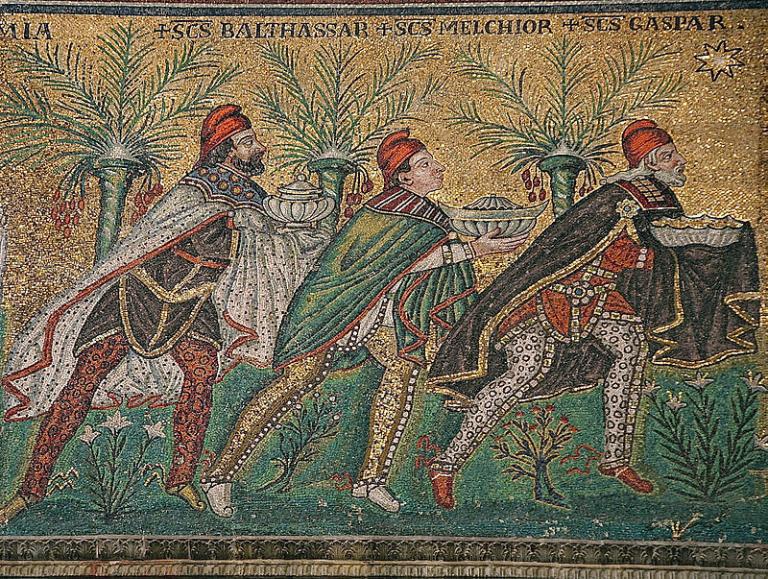
The Wise Men (whose traditional names appear above them
Detail from an AD 526 Byzantine mosaic in the Church of Sant’ Apollinare Nuovo, in Ravenna
(Wikimedia Commons public domain image)
A few days ago, early last week, I gave a brief interview to BYUradio about the “wise men” of the gospel of Matthew, their possible identities, how many of them there were, and so forth. It was broadcast for the first time on Tuesday of last week, and it is now accessible online at your convenience and at no charge. It lasts something like ten minutes. Maybe a bit longer:
***
I published this column in the Deseret News back just before Christmas in 2013 or so:
Historians of Christianity have always sought to understand how certain Jews, despite the strict monotheism in which they were raised, came to believe that the man Jesus was divine—“that,” in other words, “God was in Christ, reconciling the world unto himself” (2 Corinthians 5:19).
And Christians did indeed pay divine honors to Jesus from quite early times. For example, Pliny the Younger, governor of Pontus/Bithynia (a region of today’s Turkey) from 111-113 AD, famously reported to his boss, the Emperor Trajan, that the Christians within his jurisdiction “were accustomed to meet on a fixed day before dawn and sing responsively a hymn to Christ as to a god.”
Assisted by such New Testament scholarship as that of the so-called “Tubingen school,” which proposed a very late date for the four gospels, some writers argued that Jesus himself never claimed deity. It was, they said, relatively late Gentile converts, with their notions of demigods like Hercules, who brought such ideas into Christianity, ultimately transforming the simple, humane teachings of a reforming Jewish peasant rabbi into the arcane theology of the Nicene Creed. And, in fact, Pliny’s Christians may well have been mostly if not entirely Gentiles, rather than Jews.
However, historical facts eventually defeated the “Tubingen school”; many New Testament documents appear to be earlier than liberal German scholarship once thought. And historical facts seem to be undermining the theory that the divinity of Christ was a relatively late Gentile invention. There’s simply insufficient time for a long, gradual evolution.
Contemporary New Testament scholars such as Larry Hurtado, James Dunn, and N. T. Wright persuasively argue that the deification of Christ is extremely early in Christianity, and native to it, rather than merely a late foreign innovation. This change in attitude has come, in part, from a long overdue recognition of the historical significance of the letters of Paul—letters that are indisputably early and clearly datable.
In 1 Corinthians 8:6, for example, which was almost certainly written around A.D. 54, Paul includes Christ in the famous “shema” declaration of Deuteronomy 6:4 (“Hear, O Israel! The Lord our God is one lord!”) Moreover, in remarkable texts such as Philippians 2 and Colossians 1, and elsewhere as well, Paul takes Old Testament passages plainly written about Jehovah (or Yahweh)—rendered in the Septuagint Greek translation as “kyrios” or “Lord”—and makes them refer to Jesus.
Moreover, Margaret Barker contends that belief in Christ’s divinity arose precisely out of Jewish soil, because it reflects the very oldest Hebrew beliefs—which, almost but not quite forgotten, were not strictly monotheistic as we’ve long imagined. The earliest Jewish Christians tapped into the oldest layer of Israelite religion, she says; no late Gentile converts are required to explain Christian belief in Jesus’ deity.
In fact, Jesus himself seems to have had an exalted view of his own authority and status. Thus, when he ascends a hill to deliver his “sermon on the mount,” he may be consciously contrasting himself with Moses, the great founding prophet of Judaism, who ascended a mountain to receive the law from God. “Ye have heard that it was said by them of old time,” he repeatedly declares during that sermon, “but I say unto you” (for examples, see Matthew 5:21-22, 27-28).
The famous observation by C. S. Lewis comes inescapably to mind at this point:
“I am trying here,” Lewis wrote in “Mere Christianity,” “to prevent anyone saying the really foolish thing that people often say about Him: ‘I’m ready to accept Jesus as a great moral teacher, but I don’t accept His claim to be God.’ That is the one thing we must not say. A man who was merely a man and said the sort of things Jesus said would not be a great moral teacher. He would either be a lunatic—on the level with the man who says he is a poached egg—or else he would be the Devil of Hell. You must make your choice. Either this man was, and is, the Son of God: or else a madman or something worse. You can shut Him up for a fool, you can spit at Him and kill Him as a demon; or you can fall at His feet and call Him Lord and God. But let us not come with any patronizing nonsense about His being a great human teacher. He has not left that open to us. He did not intend to.”
Posted from Richmond, Virginia
Previous Post

December 23, 2019
LDS Inc. (Part 17)
Next Post
December 24, 2019 LDS Inc. (Part 18)
Browse Our Archives
Select a Category Uncategorized
Select a Month October 2026 September 2026 August 2026 July 2026 June 2026 May 2026 April 2026 March 2026 February 2026 January 2026 December 2025 November 2025 October 2025 September 2025 August 2025 July 2025 June 2025 May 2025 April 2025 March 2025 February 2025 January 2025 December 2024 November 2024 October 2024 September 2024 August 2024 July 2024 June 2024 May 2024 April 2024 March 2024 February 2024 January 2024 December 2023 November 2023 October 2023 September 2023 August 2023 July 2023 June 2023 May 2023 April 2023 March 2023 February 2023 January 2023 December 2022 November 2022 October 2022 September 2022 August 2022 July 2022 June 2022 May 2022 April 2022 March 2022 February 2022 January 2022 December 2021 November 2021 October 2021 September 2021 August 2021 July 2021 June 2021 May 2021 April 2021 March 2021 February 2021 January 2021 December 2020 November 2020 October 2020 September 2020 August 2020 July 2020 June 2020 May 2020 April 2020 March 2020 February 2020 January 2020 December 2019 November 2019 October 2019 September 2019 August 2019 July 2019 June 2019 May 2019 April 2019 March 2019 February 2019 January 2019 December 2018 November 2018 October 2018 September 2018 August 2018 July 2018 June 2018 May 2018 April 2018 March 2018 February 2018 January 2018 December 2017 November 2017 October 2017 September 2017 August 2017 July 2017 June 2017 May 2017 April 2017 March 2017 February 2017 January 2017 December 2016 November 2016 October 2016 September 2016 August 2016 July 2016 June 2016 May 2016 April 2016 March 2016 February 2016 January 2016 December 2015 November 2015 October 2015 September 2015 August 2015 July 2015 June 2015 May 2015 April 2015 March 2015 February 2015 January 2015 December 2014 November 2014 March 2014 August 2013 February 2012
Follow Us!
TAKE THE
Religious Wisdom Quiz
Who is considered the ideal wife and mother in Proverbs?
Select your answer to see how you score.
Martha Eve The Proverbs 31 woman Mary Magdalene
Related posts from Sic et Non

An action movie and some vacuous theology

"The World's Sixteen Crucified Saviors"?

"The Loss of Jesus in the Small Plates...

TRENDING AT PATHEOS Latter-day Saint

The First Eucharistic Controversy: Christ’s Real Presence
For Catholics, the Eucharist is the source and summit of the Christian...

What a Stop Sign Can Teach Us About...
How to Make a Decision When You Can't Hear God Main point:...

Archdiocese Hosts Military Marriage Retreat in Germany
RASTATT, Germany — The transient military lifestyle, with its frequent deployments and...

Nearly every morning, I make the drive to Detroit with my high-school-age...

The Real AI Story Is Adoption Without Trust
Artificial intelligence has crossed a political threshold. It is no longer a...

A new article, written by Jeff Lindsay and Gale L. Pooley,...
view all Latter-day Saint blogs
Ad-Free & Subscriber Log-In Subscription Support
- About Us
- 2026 Calendar
- Videos
- Podcasts
- Library of World Religions
- Faith In Media Tracker
- Advertise With Us
- Write for Us
- Privacy Policy
- Terms of Service
- Do Not Sell My Data
- Contact Us
- Radiant Digital
- Manage Newsletter Subscriptions
- Unsubscribe From Notifications
- Sitemap
Copyright 2008-2026, Patheos. All rights reserved.
Subscription Support Ad-Free & Subscriber Log-In
Follow Patheos