
BuddhistCatholicContemplativeEvangelicalGeneral ChristianHinduJewishLatter-day SaintMuslimNew VisionsProgressive Christian
Beliefs
- Buddhist
- Catholic
- Contemplative
- Evangelical
- General Christian
- Hindu
- Jewish
- Latter-day Saint
- More Voices
- Muslim
- New Visions
- Pagan
- Progressive Christian
Topics
- Religion News
- Food and Religion
- Sports and Religion
- Religious Art
- Religious Music and Entertainment
- Religious Events
- History and Religion
- Style and Religion
- Politics and Religion
- Women in Religion
- Recreation Outdoors and Religion
- Business Finance and Religion
- Careers Workplace and Religion
- Education and Religion
- Family Parenting and Religion
- Health Fitness and Religion
- Home and Religion
- Relationships and Religion
- Technology and Religion
- Travel and Religion
Columnists
- Buddhist Columnists
- Business Finance and Religion Columnists
- Careers Workplace and Religion Columnists
- Catholic Columnists
- Contemplative Columnists
- Education and Religion Columnists
- Evangelists Columnists
- Family Parenting and Religion Columnists
- General Christian Columnists
- Health Fitness and Religion Columnists
- Hindu Columnists
- History and Religion Columnists
- Home and Religion Columnists
- Jewish Columnists
- More Voices Columnists
- Latter Day Columnists
- Muslim Columnists
- New Visions Columnists
- Nonreligious Columnists
- Pagan Columnists
- Politics and Religion Columnists
- Progressive Columnists
- Recreation Outdoors and Religion Columnists
- Relationships and Religion Columnists
- Religion News Columnists
- Religious Art Columnists
- Religious Events Columnists
- Religious Music and Entertainment Columnists
- Sports and Religion Columnists
- Style and Religion Columnists
- Technology and Religion Columnists
- Travel and Religion Columnists
- Women in Religion Columnists
Resource Library
- 2026 Calendar
- Library of World Religions
- The 100 Most Holy Places on Earth
- Patheos Answers
- Podcasts
- Videos
- Faith Leaders Database
- Anglican Episcopalian
- Bahai
- Baptist
- Buddhism
- Christianity
- Confucianism
- Eastern Orthodoxy
- Hinduism
- Holiness and Pentecostal
- ISKCON
- Islam
- Judaism
- Lutheran
- Methodist
- The Church of Jesus Christ of Latter-day Saints
- New Age
- Paganism
- Presbytarian and Reformed
- Protestantism
- Religion Behind the Scenes
- Roman Catholic
- Scientology
- Shia Islam
- Sikhism
- Sufism
- Sunni Islam
- Taoism
- Zen
- See all religions
Research Tools
 Ad-Free & Subscriber Log-In Subscription Support
Ad-Free & Subscriber Log-In Subscription Support
Follow Patheos 

- Trending:
- Forgiveness
- |
- Marriage
- |
- Consciousness
- |
- Death Penalty
- |
- Election
- |
- Halloween

- Home
- Latter-day Saint
- Christmas Messages
Christmas Messages
Last updated on: December 22, 2019 at 6:06 pm by Dan Peterson
Christmas Messages 2019-12-22T18:06:27-07:00 Dan Peterson
Patheos Explore the world's faith through different perspectives on religion and spirituality! Patheos has the views of the prevalent religions and spiritualities of the world.
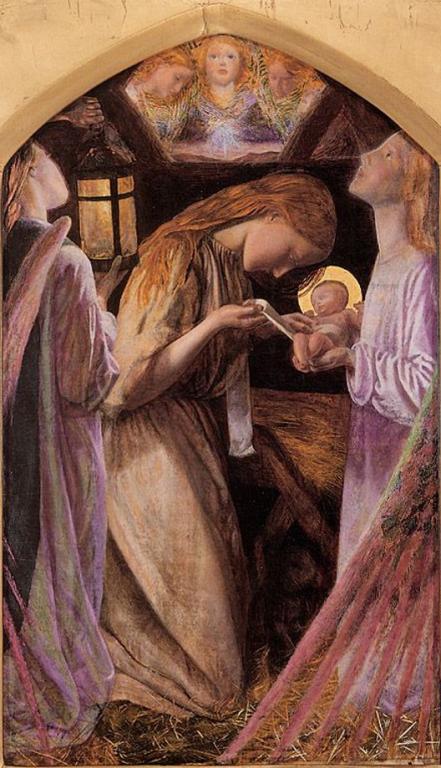
Arthur Hughes, “The Nativity” (1858)
Wikimedia Commons public domain
On Friday, the Interpreter Foundation published its 2019 Christmas message, by Dr. Kristine Wardle Frederickson:
“Musings on the Birth of the Savior Jesus Christ”
Our 2015 Interpreter Christmas message was provided by Dr. Clayton M. Christensen, of Harvard Business School:
““He Did It”: A Christmas Message”
***
I published this Christmas article in the Deseret News back in 2013
This next week, many will re-read the gospel stories of Jesus’ birth. In that light, a few brief notes on those accounts might be helpful and of interest.
First, let’s look at the word “espoused,” which is used in the King James translations of Matthew 1:18 and Luke 1:27 to describe Mary’s relationship with Joseph at the time of the annunciation of Christ. The ancient Jewish marriage ceremony was only fully complete when the groom took the bride into his house, and, in their case, this hadn’t yet happened. “Espousal” or “betrothal” refers to a written contract of marriage that had been drawn up between the groom (or his parents) and the bride’s parents, specifying such matters as property sharing and provisions for Mary in the event of Joseph’s death. (A woman was considered a widow even if her “fiancé” died between betrothal and full marriage.) During this interim period, commonly lasting a year, unchastity between bride and groom, though frowned upon, wasn’t quite considered adultery. But an espoused woman’s unchastity with another man would have been a deeply serious offense—perhaps, in an earlier period, even a capital crime—and this seemed to be exactly Mary’s situation. Repudiation of a marriage contract, which Joseph briefly considered, wasn’t precisely equivalent to divorce, but it was a very grave matter.
Only Matthew mentions the “Magi” or wise men from “the East”—that is, from Persia, Mesopotamia (modern Iraq) or the Arabian desert. The word “magus” comes from a Persian term for the learned religious leadership of Zoroastrianism, the pre-Islamic faith of Iran. As they are in Matthew, they were often linked with the lore of stars. The Magi suggested a threat to Herod’s rule because they arrived in his kingdom like ancient ambassadors trying to establish contact with a foreign monarch—one who clearly wasn’t Herod. The King James Bible says that they “worshipped” Jesus (Mt 2:10); the Greek word can refer to religious worship, but also describes the traditional Persian act of bowing before a king or important person.
In the gospel of Luke, “all the world” (2:1) refers to the “world” of the Roman empire. The process described was a preliminary registration or census for eventual tax purposes.
“Swaddling clothes” (2:7) were bands of cloth wrapped rather tightly around the baby in order, as was thought, to ensure its proper straight growth. The “manger” (from the Old French “mangier,” “to eat”) was a feeding trough, probably of stone (which is abundant throughout Palestine) rather than of wood (which isn’t). Middle Eastern inns (known in the Islamic period as “khans” or “caravanserais”) often included places for guests’ riding or pack animals—not unlike a modern motel’s parking lot. (Tradition identifies it, in Jesus’ case, as a cave. Bethlehem sits atop many of them.) This, says Luke, is where God’s Son was born.
Only Luke mentions shepherds in connection with the Nativity (2:8). As is typical in his gospel the poor are those who first receive the message of salvation through Jesus. One of the signs given to John the Baptist of Messiah’s coming is that “to the poor the gospel is preached” (7:22; compare Isaiah 61:1 and Luke 4:17). But the shepherds’ veneration of the newborn Jesus also suggests his role as the culmination of the Old Testament. After all, the patriarchs Abraham, Isaac, and Jacob and the prophet Moses were also shepherds, as was King David. And the Lord himself is called the shepherd of Israel (Psalms 23:1, 80:2).
The very popular King James phrase “good will to(ward) men” (2:14) probably misrepresents what the angels said. (The Greek is somewhat difficult and ambiguous, perhaps reflecting a non-Greek origin.) A better rendering is “to people of good will,” most likely referring not to nice people but to those on whom God’s good will or favor rests.
Finally, the description of Jesus as “the son of the Highest” or of “the Most High” in Luke 1:32 importantly indicates both his elevated status and the distinction between him and his Father. In this regard, John 1:1-14 can also be read as a kind of Christmas or Nativity story. Around the time of Jesus and John, Jewish thinkers (notably Philo of Alexandria) were using the term “logos” (“word”) to describe an intermediary between humans and the Most High God. For more than two thousand years, the Christmas message has been that, in Jesus, this intermediary came to earth and dwelt among us.
Posted from Richmond, Virginia
Previous Post

December 22, 2019
LDS Inc. (Part 16)
Next Post
December 22, 2019 “Then pealed the bells more loud and deep"
Browse Our Archives
Select a Category Uncategorized
Select a Month October 2026 September 2026 August 2026 July 2026 June 2026 May 2026 April 2026 March 2026 February 2026 January 2026 December 2025 November 2025 October 2025 September 2025 August 2025 July 2025 June 2025 May 2025 April 2025 March 2025 February 2025 January 2025 December 2024 November 2024 October 2024 September 2024 August 2024 July 2024 June 2024 May 2024 April 2024 March 2024 February 2024 January 2024 December 2023 November 2023 October 2023 September 2023 August 2023 July 2023 June 2023 May 2023 April 2023 March 2023 February 2023 January 2023 December 2022 November 2022 October 2022 September 2022 August 2022 July 2022 June 2022 May 2022 April 2022 March 2022 February 2022 January 2022 December 2021 November 2021 October 2021 September 2021 August 2021 July 2021 June 2021 May 2021 April 2021 March 2021 February 2021 January 2021 December 2020 November 2020 October 2020 September 2020 August 2020 July 2020 June 2020 May 2020 April 2020 March 2020 February 2020 January 2020 December 2019 November 2019 October 2019 September 2019 August 2019 July 2019 June 2019 May 2019 April 2019 March 2019 February 2019 January 2019 December 2018 November 2018 October 2018 September 2018 August 2018 July 2018 June 2018 May 2018 April 2018 March 2018 February 2018 January 2018 December 2017 November 2017 October 2017 September 2017 August 2017 July 2017 June 2017 May 2017 April 2017 March 2017 February 2017 January 2017 December 2016 November 2016 October 2016 September 2016 August 2016 July 2016 June 2016 May 2016 April 2016 March 2016 February 2016 January 2016 December 2015 November 2015 October 2015 September 2015 August 2015 July 2015 June 2015 May 2015 April 2015 March 2015 February 2015 January 2015 December 2014 November 2014 March 2014 August 2013 February 2012
Follow Us!
TAKE THE
Religious Wisdom Quiz
Who led the Israelites into the Promised Land?
Select your answer to see how you score.
Aaron Joshua Moses Caleb
Related posts from Sic et Non

An action movie and some vacuous theology

"The World's Sixteen Crucified Saviors"?

"The Loss of Jesus in the Small Plates...
We definitely didn't elect a mere choirboy.
TRENDING AT PATHEOS Latter-day Saint

The Sermon on the Mount, Part I: Matthew...
The Sermon on the Mount, Part I (Matthew 4:12-5:12) St. Matthew moves...

What's up from Crossway: Reviewing some of their latest A few weeks...

Janie Learns the Way of the Cross: A...
Teaching children about Jesus' Passion can be challenging. Many parents and educators...

Looking For Good Catholic Writing - October 2026
He alone extends the heavens, and he walks upon the waves of...

In "Irreplaceable," our book on vocation and technology, Trevor Sutton and I...

I was strolling through the top floor of the brand new Parthenon...
view all Latter-day Saint blogs
Ad-Free & Subscriber Log-In Subscription Support
- About Us
- 2026 Calendar
- Videos
- Podcasts
- Library of World Religions
- Faith In Media Tracker
- Advertise With Us
- Write for Us
- Privacy Policy
- Terms of Service
- Do Not Sell My Data
- Contact Us
- Radiant Digital
- Manage Newsletter Subscriptions
- Unsubscribe From Notifications
- Sitemap
Copyright 2008-2026, Patheos. All rights reserved.
Subscription Support Ad-Free & Subscriber Log-In
Follow Patheos