
BuddhistCatholicContemplativeEvangelicalGeneral ChristianHinduJewishLatter-day SaintMuslimNew VisionsProgressive Christian
Beliefs
- Buddhist
- Catholic
- Contemplative
- Evangelical
- General Christian
- Hindu
- Jewish
- Latter-day Saint
- More Voices
- Muslim
- New Visions
- Pagan
- Progressive Christian
Topics
- Religion News
- Food and Religion
- Sports and Religion
- Religious Art
- Religious Music and Entertainment
- Religious Events
- History and Religion
- Style and Religion
- Politics and Religion
- Women in Religion
- Recreation Outdoors and Religion
- Business Finance and Religion
- Careers Workplace and Religion
- Education and Religion
- Family Parenting and Religion
- Health Fitness and Religion
- Home and Religion
- Relationships and Religion
- Technology and Religion
- Travel and Religion
Columnists
- Buddhist Columnists
- Business Finance and Religion Columnists
- Careers Workplace and Religion Columnists
- Catholic Columnists
- Contemplative Columnists
- Education and Religion Columnists
- Evangelists Columnists
- Family Parenting and Religion Columnists
- General Christian Columnists
- Health Fitness and Religion Columnists
- Hindu Columnists
- History and Religion Columnists
- Home and Religion Columnists
- Jewish Columnists
- More Voices Columnists
- Latter Day Columnists
- Muslim Columnists
- New Visions Columnists
- Nonreligious Columnists
- Pagan Columnists
- Politics and Religion Columnists
- Progressive Columnists
- Recreation Outdoors and Religion Columnists
- Relationships and Religion Columnists
- Religion News Columnists
- Religious Art Columnists
- Religious Events Columnists
- Religious Music and Entertainment Columnists
- Sports and Religion Columnists
- Style and Religion Columnists
- Technology and Religion Columnists
- Travel and Religion Columnists
- Women in Religion Columnists
Resource Library
- 2026 Calendar
- Library of World Religions
- The 100 Most Holy Places on Earth
- Patheos Answers
- Podcasts
- Videos
- Faith Leaders Database
- Anglican Episcopalian
- Bahai
- Baptist
- Buddhism
- Christianity
- Confucianism
- Eastern Orthodoxy
- Hinduism
- Holiness and Pentecostal
- ISKCON
- Islam
- Judaism
- Lutheran
- Methodist
- The Church of Jesus Christ of Latter-day Saints
- New Age
- Paganism
- Presbytarian and Reformed
- Protestantism
- Religion Behind the Scenes
- Roman Catholic
- Scientology
- Shia Islam
- Sikhism
- Sufism
- Sunni Islam
- Taoism
- Zen
- See all religions
Research Tools
 Ad-Free & Subscriber Log-In Subscription Support
Ad-Free & Subscriber Log-In Subscription Support
Follow Patheos 

- Trending:
- Forgiveness
- |
- Marriage
- |
- Consciousness
- |
- Death Penalty
- |
- Election
- |
- Halloween

- Home
- Latter-day Saint
- Approaching the Thanksgiving Holiday
Approaching the Thanksgiving Holiday
Last updated on: November 18, 2019 at 12:06 am by Dan Peterson
Approaching the Thanksgiving Holiday 2019-11-18T00:06:38-07:00 Dan Peterson
Patheos Explore the world's faith through different perspectives on religion and spirituality! Patheos has the views of the prevalent religions and spiritualities of the world.
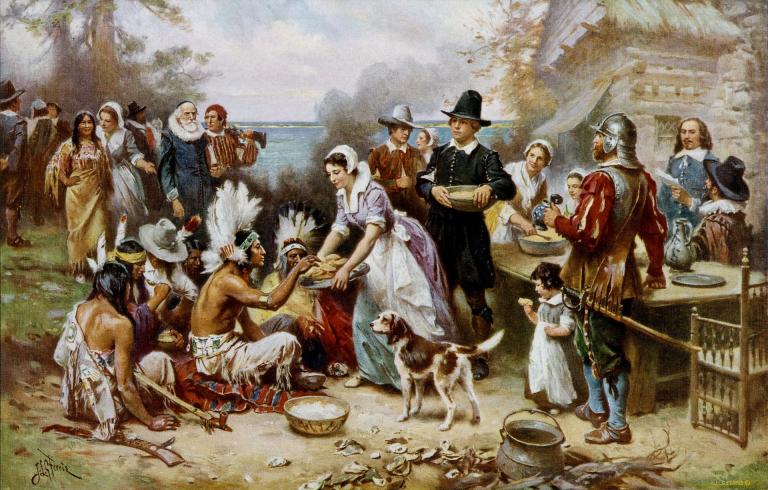
Jean Leon Gerome Ferris, “The First Thanksgiving” (ca. 1912-1915)
Wikimedia Commons public domain
I published this column in the Deseret News for Thanksgiving 2013:
It’s the season of Thanksgiving, and, so, minds like mine turn naturally to etymology, to word origins. Please be patient. There is method in my madness.
The origin of the word “religion” is obscure, and has been much debated. But all suggestions for it seem to agree that remembrance, an awareness of dependence and obligation, is at the core of what it means to be religious. The ancient Roman politician and writer Cicero derived the word from “legere,” “to read,” believing that it meant “to go over” something again in the sense of “re-reading,” “re-thinking” or considering it very carefully. Other writers, ancient and modern, connect it with the word “religare,” “to bind fast,” from which we also receive our modern verb “to rely.” They emphasize the bond between humans and the divine. Still others suggest a distant relationship to the archaic English verb “to reck” or “to reckon,” meaning “to pay attention to,” or that it stems from the Latin adjective “religiens,” “careful” or “mindful,” which is the opposite of “negligens.”
Most if not all religions are saturated with exhortations to remember, and with practices designed to help us to do so. The liturgical year of many Jews and Christians, for example, is a profound teaching device centered on events (e.g., Passover, Easter, the Day of Atonement, the Feast of Tabernacles, Hannukah, and Christ’s Nativity) that are charged with deep meaning for believers. The Qur’an continually encourages readers to “remember,” and not to be “neglectful” or “heedless” of the mighty acts of God, and it condemns those who fail to reflect on the lessons of the past.
In the Mormon context, the most obvious example of memorializing is the weekly sacrament. Those who partake are to do so “in remembrance” of Christ’s suffering on their behalf, and to “always remember him.” But examples abound. The ordinances of the temple remind us, for instance, that the creation of the world was purposeful, and that we can only enter into his presence again through the wounds he suffered in his atoning sacrifice. The scriptures were essential, Alma taught his son Helaman, because they “enlarged the memory of this people” (Alma 37:8); had they not been preserved, explained King Benjamin (in Mosiah 1:3-5), the Nephites would have fallen into “ignorance” and “dwindled in unbelief.” Hence the vital importance, even today, of repeatedly immersing ourselves in the scriptures, which continually admonish us to “remember.”
Even such modern programs as Pioneer Day celebrations throughout the Church and reenactments of the handcart treks in Africa, Europe, and the Philippines, as well as in Wyoming, allow us to “remember,” and to make ourselves one with our spiritual progenitors (whether or not we are biological kin). Just as the nineteenth century pioneers saw themselves as a modern Israel led by an American Moses, we are to identify with them, and, thus, with the ancient people of the Exodus. Latter-day Saints are to relive the experience, in their own way, of former-day Saints. “I did liken all scriptures unto us,” Nephi explains, “that it might be for our profit and learning” (1 Nephi 19:23)
Abraham Lincoln’s proclamation of a national “day of Thanksgiving and Praise,” issued 150 years ago on October 3, 1863, was a summons to explicitly religious reflection on the many blessings that the American people had received even amidst the sadness, death, and destruction of the still ongoing Civil War. While it says precisely nothing about turkey, stuffing, cranberry sauce, or pumpkin pie, it calls upon the nation to remember “our beneficent Father who dwelleth in the heavens” and, in “humble penitence for our national perverseness and disobedience,” to seek his caring help for all those who were suffering.
On this Thanksgiving Day, accordingly, it is worthwhile to recall that the English verb “to thank” derives from the same root as the verb “to think.” (Compare the equivalent German words “danken” and “denken.”) With all the busyness and the rush of the day, we should still try to find time to reflect.
Thanksgiving isn’t about eating. It isn’t even, really, about spending time with family and friends, important as those are. It is, or should be, about thinking, about contemplation. From its very origin, it was about considering the debt that we owe to God and to the others who laid the foundation of the blessings and prosperity that we enjoy, about reflecting, repenting, and seeking to extend those blessings to others.
Posted from Bountiful, Utah
Previous Post

November 16, 2019
How Solomon built his temple
Next Post
November 17, 2019 A bit of "biblical" history that you may never have encountered before
Browse Our Archives
Select a Category Uncategorized
Select a Month October 2026 September 2026 August 2026 July 2026 June 2026 May 2026 April 2026 March 2026 February 2026 January 2026 December 2025 November 2025 October 2025 September 2025 August 2025 July 2025 June 2025 May 2025 April 2025 March 2025 February 2025 January 2025 December 2024 November 2024 October 2024 September 2024 August 2024 July 2024 June 2024 May 2024 April 2024 March 2024 February 2024 January 2024 December 2023 November 2023 October 2023 September 2023 August 2023 July 2023 June 2023 May 2023 April 2023 March 2023 February 2023 January 2023 December 2022 November 2022 October 2022 September 2022 August 2022 July 2022 June 2022 May 2022 April 2022 March 2022 February 2022 January 2022 December 2021 November 2021 October 2021 September 2021 August 2021 July 2021 June 2021 May 2021 April 2021 March 2021 February 2021 January 2021 December 2020 November 2020 October 2020 September 2020 August 2020 July 2020 June 2020 May 2020 April 2020 March 2020 February 2020 January 2020 December 2019 November 2019 October 2019 September 2019 August 2019 July 2019 June 2019 May 2019 April 2019 March 2019 February 2019 January 2019 December 2018 November 2018 October 2018 September 2018 August 2018 July 2018 June 2018 May 2018 April 2018 March 2018 February 2018 January 2018 December 2017 November 2017 October 2017 September 2017 August 2017 July 2017 June 2017 May 2017 April 2017 March 2017 February 2017 January 2017 December 2016 November 2016 October 2016 September 2016 August 2016 July 2016 June 2016 May 2016 April 2016 March 2016 February 2016 January 2016 December 2015 November 2015 October 2015 September 2015 August 2015 July 2015 June 2015 May 2015 April 2015 March 2015 February 2015 January 2015 December 2014 November 2014 March 2014 August 2013 February 2012
Follow Us!
TAKE THE
Religious Wisdom Quiz
I am a goat released into the wilderness, carrying away the sins of the people. What am I?
Select your answer to see how you score.
An atonement goat A sin offering The scapegoat A sacrifice
Related posts from Sic et Non


A really, really long post for the eve...

As easy a way to do good as...
TRENDING AT PATHEOS Latter-day Saint

Swimfan: Forgotten Aughts Pleasures
This is a recovery effort. In 2002, My Big Fat Greek Wedding...

Top Three Anti-Catholic Lies About Catholicism
This is my initial transcript for the video, "THE 3 WORST...

Pope Leo Celebrates Mass for Nurses & Docs...
I don't have any idea how he did it, but Pope Leo...

The Sermon on the Mount, Part I: Matthew...
The Sermon on the Mount, Part I (Matthew 4:12-5:12) St. Matthew moves...

What's up from Crossway: Reviewing some of their latest A few weeks...

Janie Learns the Way of the Cross: A...
Teaching children about Jesus' Passion can be challenging. Many parents and educators...
view all Latter-day Saint blogs
Ad-Free & Subscriber Log-In Subscription Support
- About Us
- 2026 Calendar
- Videos
- Podcasts
- Library of World Religions
- Faith In Media Tracker
- Advertise With Us
- Write for Us
- Privacy Policy
- Terms of Service
- Do Not Sell My Data
- Contact Us
- Radiant Digital
- Manage Newsletter Subscriptions
- Unsubscribe From Notifications
- Sitemap
Copyright 2008-2026, Patheos. All rights reserved.
Subscription Support Ad-Free & Subscriber Log-In
Follow Patheos