
BuddhistCatholicContemplativeEvangelicalGeneral ChristianHinduJewishLatter-day SaintMuslimNew VisionsProgressive Christian
Beliefs
- Buddhist
- Catholic
- Contemplative
- Evangelical
- General Christian
- Hindu
- Jewish
- Latter-day Saint
- More Voices
- Muslim
- New Visions
- Pagan
- Progressive Christian
Topics
- Religion News
- Food and Religion
- Sports and Religion
- Religious Art
- Religious Music and Entertainment
- Religious Events
- History and Religion
- Style and Religion
- Politics and Religion
- Women in Religion
- Recreation Outdoors and Religion
- Business Finance and Religion
- Careers Workplace and Religion
- Education and Religion
- Family Parenting and Religion
- Health Fitness and Religion
- Home and Religion
- Relationships and Religion
- Technology and Religion
- Travel and Religion
Columnists
- Buddhist Columnists
- Business Finance and Religion Columnists
- Careers Workplace and Religion Columnists
- Catholic Columnists
- Contemplative Columnists
- Education and Religion Columnists
- Evangelists Columnists
- Family Parenting and Religion Columnists
- General Christian Columnists
- Health Fitness and Religion Columnists
- Hindu Columnists
- History and Religion Columnists
- Home and Religion Columnists
- Jewish Columnists
- More Voices Columnists
- Latter Day Columnists
- Muslim Columnists
- New Visions Columnists
- Nonreligious Columnists
- Pagan Columnists
- Politics and Religion Columnists
- Progressive Columnists
- Recreation Outdoors and Religion Columnists
- Relationships and Religion Columnists
- Religion News Columnists
- Religious Art Columnists
- Religious Events Columnists
- Religious Music and Entertainment Columnists
- Sports and Religion Columnists
- Style and Religion Columnists
- Technology and Religion Columnists
- Travel and Religion Columnists
- Women in Religion Columnists
Resource Library
- 2026 Calendar
- Library of World Religions
- The 100 Most Holy Places on Earth
- Patheos Answers
- Podcasts
- Videos
- Faith Leaders Database
- Anglican Episcopalian
- Bahai
- Baptist
- Buddhism
- Christianity
- Confucianism
- Eastern Orthodoxy
- Hinduism
- Holiness and Pentecostal
- ISKCON
- Islam
- Judaism
- Lutheran
- Methodist
- The Church of Jesus Christ of Latter-day Saints
- New Age
- Paganism
- Presbytarian and Reformed
- Protestantism
- Religion Behind the Scenes
- Roman Catholic
- Scientology
- Shia Islam
- Sikhism
- Sufism
- Sunni Islam
- Taoism
- Zen
- See all religions
Research Tools
 Ad-Free & Subscriber Log-In Subscription Support
Ad-Free & Subscriber Log-In Subscription Support
Follow Patheos 

- Trending:
- Forgiveness
- |
- Marriage
- |
- Consciousness
- |
- Death Penalty
- |
- Election
- |
- Halloween

- Home
- Latter-day Saint
- “The oldest historic buildings along the Pacific shore of the United States”
“The oldest historic buildings along the Pacific shore of the United States”
Last updated on: October 20, 2019 at 7:56 pm by Dan Peterson
“The oldest historic buildings along the Pacific shore of the United States” 2019-10-20T19:56:43-06:00 Dan Peterson
Patheos Explore the world's faith through different perspectives on religion and spirituality! Patheos has the views of the prevalent religions and spiritualities of the world.
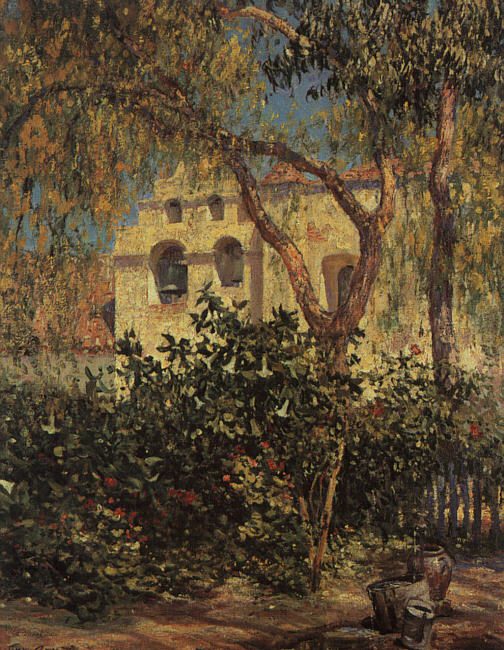
“The San Gabriel Mission,” by Guy Rose (1914)
Wikimedia Commons public domain image
I grew up not far from the San Gabriel Mission — more properly, the Mission San Gabriel Arcángel. I saw it nearly every day of my life for my first seventeen years; it was essentially across the street from my high school. And I’ve visited most if not all of the other Spanish missions in California. That’s part of the reason behind my writing this article for the Provo Daily Herald back in 2001:
The oldest historic buildings along the Pacific shore of the United States are the twenty-one (mostly eighteenth century) California missions. Established as remote colonial outposts of a Spanish empire in the twilight of its glory, they are young by Middle Eastern or even European standards. By American standards, though, they are venerable.
When, after expelling the Muslims, Spain emerged unified under Ferdinand and Isabella in 1492, its warrior aristocrats, in whom the spirit of the Crusades still lingered, sought new lands for conversion and wealth. Eventually, they claimed all of Mexico and Central America, the Caribbean, half of South America, and much of the present-day United States.
But California’s colonization came relatively late, nearly two centuries after San Diego and Monterrey had been mapped. And, even then, the Spanish viceroy was moved to action only when the Russians showed interest in the region. The assignment to take Christianity to California fell, in 1769, to a Franciscan priest named Junipero Serra.
He succeeded brilliantly. By his death in 1784, he had established nine missions. The first two anchored the port settlements of San Diego and Monterrey; the other seven were designed to link them. With the addition of twelve further missions by Father Serra’s successors, each settlement lay a stiff day’s march from its nearest neighbor. The first missions were built near the coast, so that they could be supplied by sea. As the Spanish felt more secure, they began to establish missions further inland. A separate string of them was planned for the Central Valley, but the mission system collapsed before they could be built.
While the Catholic padres indisputably intended to spread Christian doctrine and save souls, the Spanish government, which supported them, had political ends in mind. Spain realized that the vast and distant territory of California would be very difficult to settle and control. Approximately 100,000 native Americans lived there at the time. But Spain found a way of extending its empire that required few men and little money. One or two priests, protected by a few soldiers and given an initial load of supplies, could set up a mission that would soon become self-supporting.
As they appear now, the missions are usually little more than a chapel and some surrounding buildings. In their heyday, though, they were hives of economic activity. A typical mission supported a weavery, a pottery, a winery, a blacksmith’s shop, and a tannery, along with its church and agricultural plantation. Indian villages soon clustered around each mission settlement, first attracted by bright beads, clothing, and food, but rapidly assimilated into the mission economy. The padres’ plan—and, happily, the government’s plan as well—was not only to Christianize the natives, but to teach them basic manual skills along with reading and writing. They hoped they would then become genuinely Spanish in both culture and political loyalty. The Franciscan fathers held the properties in trust, and intended, when their Indian charges were ready, to turn everything over to them and move on.
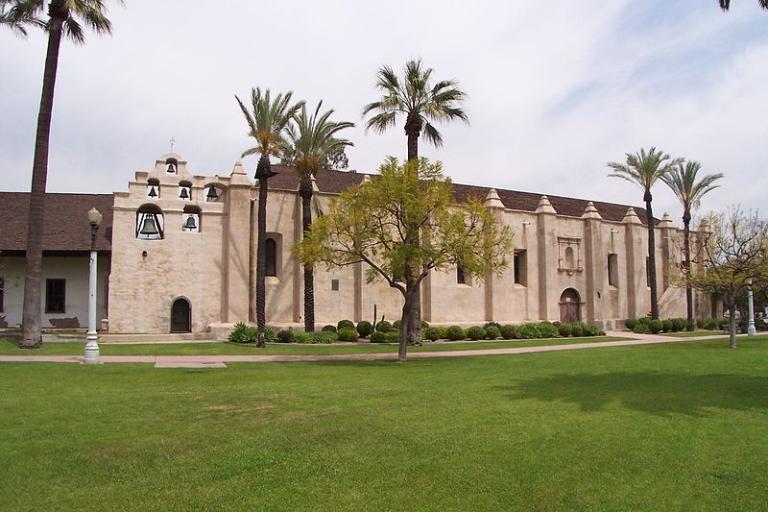
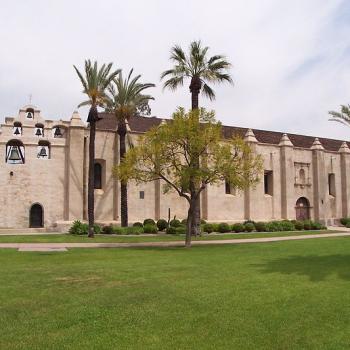
The Mission San Gabriel Arcángel was visible from my high school. (Wikimedia CC public domain)
The political success of the mission system is shown in the fact that a mere 300 soldiers, dispersed along a line more than 650 miles long, were able to control virtually all of modern California. Its religious success appears in the fact that, at the end, when the Mexican government ordered the “secularization” of the missions in 1833, 60 padres ministered to the spiritual needs of roughly 31,000 Christianized natives.
But it was the very economic success of the missions that led to the end first of Spanish and then of Mexican control. The missions’ ability to sustain themselves soon gave rise to thoughts of political independence. And the wealth of California quickly drew the attention of others—most notably that of the vigorous new English-speaking nation to the east.
The Spaniards first came to California seeking gold, but never found it. Ironically, Mexico lost control of the area to the United States just two years before the California Gold Rush, which began only ninety miles from Sonoma where the last mission had been founded. Two years and a few miles prevented California from becoming a rich Mexican province, or perhaps even an independent and wealthy Spanish-speaking nation of its own.
Posted from Tempe, Arizona
Previous Post

October 15, 2019
Russell M. Nelson, M.D., Ph.D.
Next Post
October 16, 2019 Thinking about religion and science while in Arizona
Browse Our Archives
Select a Category Uncategorized
Select a Month October 2026 September 2026 August 2026 July 2026 June 2026 May 2026 April 2026 March 2026 February 2026 January 2026 December 2025 November 2025 October 2025 September 2025 August 2025 July 2025 June 2025 May 2025 April 2025 March 2025 February 2025 January 2025 December 2024 November 2024 October 2024 September 2024 August 2024 July 2024 June 2024 May 2024 April 2024 March 2024 February 2024 January 2024 December 2023 November 2023 October 2023 September 2023 August 2023 July 2023 June 2023 May 2023 April 2023 March 2023 February 2023 January 2023 December 2022 November 2022 October 2022 September 2022 August 2022 July 2022 June 2022 May 2022 April 2022 March 2022 February 2022 January 2022 December 2021 November 2021 October 2021 September 2021 August 2021 July 2021 June 2021 May 2021 April 2021 March 2021 February 2021 January 2021 December 2020 November 2020 October 2020 September 2020 August 2020 July 2020 June 2020 May 2020 April 2020 March 2020 February 2020 January 2020 December 2019 November 2019 October 2019 September 2019 August 2019 July 2019 June 2019 May 2019 April 2019 March 2019 February 2019 January 2019 December 2018 November 2018 October 2018 September 2018 August 2018 July 2018 June 2018 May 2018 April 2018 March 2018 February 2018 January 2018 December 2017 November 2017 October 2017 September 2017 August 2017 July 2017 June 2017 May 2017 April 2017 March 2017 February 2017 January 2017 December 2016 November 2016 October 2016 September 2016 August 2016 July 2016 June 2016 May 2016 April 2016 March 2016 February 2016 January 2016 December 2015 November 2015 October 2015 September 2015 August 2015 July 2015 June 2015 May 2015 April 2015 March 2015 February 2015 January 2015 December 2014 November 2014 March 2014 August 2013 February 2012
Follow Us!
TAKE THE
Religious Wisdom Quiz
What biblical figure was prepared to sacrifice his son Isaac on an altar?
Select your answer to see how you score.
Moses Abraham Isaiah Noah
Related posts from Sic et Non
From a small, specialized Interpreter Foundation gathering
California, out I come, back from where I...
TRENDING AT PATHEOS Latter-day Saint

The Problem with False Prophets
Miller’s Station UMC| 10/18/26| Anchor Verse: Jeremiah 23: 1, 9-23 I...

Emotion in Early Christianity by Andrew Crislip
Andrew Crislip’s Emotion in Early Christianity examines an often overlooked dimension of...

16 Spiritual Touchstones for a More Grounded Life
After decades of spiritual study, here are 16 principles I try...

Catholic Evangelization: Sharing Your Faith Every Day
Welcome back to the Graceful Awakening mini-series called, “From Faith to Mission.” ...

The Pillar of the Boatmen: the Ancient Monument...
The Pillar of the Boatmen is a Romano-Gaulish sculpture that dates from...

In one sense walking into Westminster Abbey is like walking down the...
view all Latter-day Saint blogs
Ad-Free & Subscriber Log-In Subscription Support
- About Us
- 2026 Calendar
- Videos
- Podcasts
- Library of World Religions
- Faith In Media Tracker
- Advertise With Us
- Write for Us
- Privacy Policy
- Terms of Service
- Do Not Sell My Data
- Contact Us
- Radiant Digital
- Manage Newsletter Subscriptions
- Unsubscribe From Notifications
- Sitemap
Copyright 2008-2026, Patheos. All rights reserved.
Subscription Support Ad-Free & Subscriber Log-In
Follow Patheos