
BuddhistCatholicContemplativeEvangelicalGeneral ChristianHinduJewishLatter-day SaintMuslimNew VisionsProgressive Christian
Beliefs
- Buddhist
- Catholic
- Contemplative
- Evangelical
- General Christian
- Hindu
- Jewish
- Latter-day Saint
- More Voices
- Muslim
- New Visions
- Pagan
- Progressive Christian
Topics
- Religion News
- Food and Religion
- Sports and Religion
- Religious Art
- Religious Music and Entertainment
- Religious Events
- History and Religion
- Style and Religion
- Politics and Religion
- Women in Religion
- Recreation Outdoors and Religion
- Business Finance and Religion
- Careers Workplace and Religion
- Education and Religion
- Family Parenting and Religion
- Health Fitness and Religion
- Home and Religion
- Relationships and Religion
- Technology and Religion
- Travel and Religion
Columnists
- Buddhist Columnists
- Business Finance and Religion Columnists
- Careers Workplace and Religion Columnists
- Catholic Columnists
- Contemplative Columnists
- Education and Religion Columnists
- Evangelists Columnists
- Family Parenting and Religion Columnists
- General Christian Columnists
- Health Fitness and Religion Columnists
- Hindu Columnists
- History and Religion Columnists
- Home and Religion Columnists
- Jewish Columnists
- More Voices Columnists
- Latter Day Columnists
- Muslim Columnists
- New Visions Columnists
- Nonreligious Columnists
- Pagan Columnists
- Politics and Religion Columnists
- Progressive Columnists
- Recreation Outdoors and Religion Columnists
- Relationships and Religion Columnists
- Religion News Columnists
- Religious Art Columnists
- Religious Events Columnists
- Religious Music and Entertainment Columnists
- Sports and Religion Columnists
- Style and Religion Columnists
- Technology and Religion Columnists
- Travel and Religion Columnists
- Women in Religion Columnists
Resource Library
- 2026 Calendar
- Library of World Religions
- The 100 Most Holy Places on Earth
- Patheos Answers
- Podcasts
- Videos
- Faith Leaders Database
- Anglican Episcopalian
- Bahai
- Baptist
- Buddhism
- Christianity
- Confucianism
- Eastern Orthodoxy
- Hinduism
- Holiness and Pentecostal
- ISKCON
- Islam
- Judaism
- Lutheran
- Methodist
- The Church of Jesus Christ of Latter-day Saints
- New Age
- Paganism
- Presbytarian and Reformed
- Protestantism
- Religion Behind the Scenes
- Roman Catholic
- Scientology
- Shia Islam
- Sikhism
- Sufism
- Sunni Islam
- Taoism
- Zen
- See all religions
Research Tools
 Ad-Free & Subscriber Log-In Subscription Support
Ad-Free & Subscriber Log-In Subscription Support
Follow Patheos 

- Trending:
- Forgiveness
- |
- Marriage
- |
- Consciousness
- |
- Death Penalty
- |
- Election
- |
- Halloween

- Home
- Latter-day Saint
- National Geographic discovery of Mayan ruins wasn’t proof, but it was very interesting
National Geographic discovery of Mayan ruins wasn’t proof, but it was very interesting
Last updated on: October 20, 2019 at 7:53 pm by Dan Peterson
National Geographic discovery of Mayan ruins wasn’t proof, but it was very interesting 2019-10-20T19:53:13-06:00 Dan Peterson
Patheos Explore the world's faith through different perspectives on religion and spirituality! Patheos has the views of the prevalent religions and spiritualities of the world.
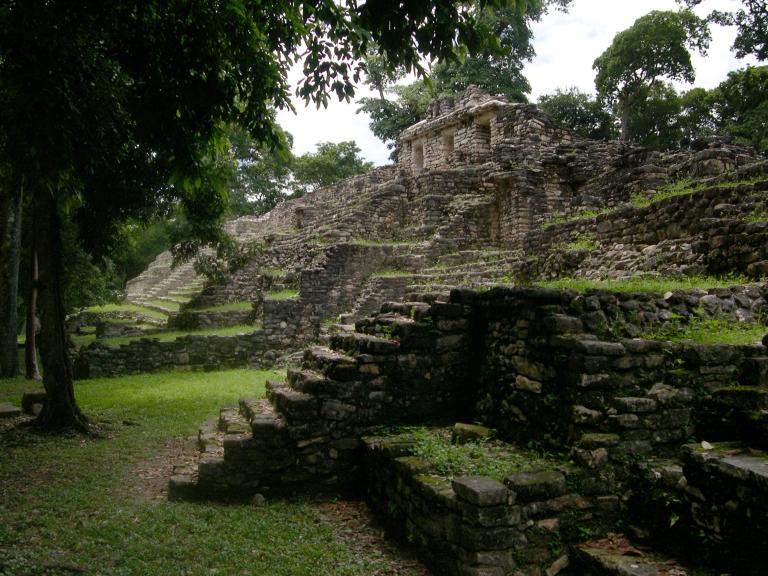
A scene in the ancient Maya city of Yaxchilan, located beside the Usumacinta River in what is today the Mexican state of Chiapas (Wikimedia Commons public domain photo)
I originally published this article in the Deseret News back on 8 February 2018. It seems to me appropriate to bring it up again in connection with Steve Houston’s upcoming BYU lecture (on which, see “Monday, 28 October 2019: “Recovering a Lost World: The LiDAR Revolution and Ancient Maya Warfare””):
Many members of The Church of Jesus Christ of Latter-day Saints are excited about an exclusive National Geographic article that appeared online at news.nationalgeographic.com on Feb. 1, 2018, by Tom Clynes, titled, “Laser Scans Reveal Maya ‘Megalopolis’ Below Guatemalan Jungle: A vast, interconnected network of ancient cities was home to millions more people than previously thought.”
Their excitement is both understandable and justified.
The article discusses a laser technology known as LiDAR, which stands for light detection and ranging, that has revealed previously undiscovered ancient ruins by digitally removing the tropical forest canopy of northern Guatemala that conceals them. Using this “major breakthrough” in Maya archaeology, researchers have thus far identified artificial features, including more than 60,000 houses, palaces and roads that have been hidden for centuries. “After decades of combing through the forests,” writes Clynes in National Geographic, “no archaeologists had stumbled across these sites.”
Plainly, a great deal remains to be learned about Pre-Columbian America, and several new findings here seem relevant to the Book of Mormon.
For example, according to Mosiah 7:4 and 8:8 — not to mention my own personal experience — it’s easy to lose cities in the Mesoamerican jungle and to walk, wholly unaware, past massive structures.
But they exist, though they’re difficult to see: Contrary to previous population estimates of around 5 million, Tulane University archaeologist Francisco Estrada-Belli says that the ancient Guatemalan lowlands may have supported 10-15 million people. “At its peak in the Maya classic period (approximately A.D. 250–900),” summarizes National Geographic, “the civilization covered an area about twice the size of medieval England, but it was far more densely populated.”
Thus, when Mormon’s father brought him southward to the capital district of Zarahemla in roughly A.D. 321-326, the 11-year-old future prophet was wide-eyed with astonishment: “The whole face of the land had become covered with buildings, and the people were as numerous almost, as it were the sand of the sea” (see Mormon 1:7).
In the National Geographic article, Clynes describes “highways connecting urban centers and quarries.” “Virtually all the Mayan cities,” he says, “were connected by causeways wide enough to suggest that they were heavily trafficked and used for trade and other forms of regional interaction. These highways were elevated to allow easy passage even during rainy seasons.”
Similarly, 3 Nephi 6:8 records that “there were many highways cast up, and many roads made, which led from city to city, and from land to land, and from place to place.” (Does the verb “cast up” suggest that Nephite highways were “elevated”?)
The National Geographic account speaks of “militarization” and “the ubiquity of defensive walls, ramparts, terraces and fortresses.”
“Warfare wasn’t only happening toward the end of the civilization,” says Ithaca College archaeologist Thomas Garrison. “It was large-scale and systematic, and it endured over many years.”
For its part, the Book of Mormon is notoriously full of warfare. At Alma 49:2-8; 50:1-6; 53:1-5; and62:42-43, for instance, we read of innovative fortifications built during the first century B.C. Ultimately, the Nephites are destroyed around A.D. 385, but the fighting continues:
“The Lamanites have hunted my people, the Nephites, down from city to city and from place to place,” Moroni reports somewhere between A.D. 400-421, “even until they are no more; and great has been their fall; yea, great and marvelous is the destruction of my people, the Nephites. And behold, it is the hand of the Lord which hath done it. And behold also, the Lamanites are at war one with another; and the whole face of this land is one continual round of murder and bloodshed; and no one knoweth the end of the war” (see Mormon 8:7-8).
None of this proves the Book of Mormon true, of course. But it’s certainly consistent with the book’s historical narrative. And it bears further watching:
“LiDAR is revolutionizing archaeology the way the Hubble Space Telescope revolutionized astronomy,” says Estrada-Belli. “We’ll need 100 years to go through all (the data) and really understand what we’re seeing.”
So far, National Geographic notes, the project has covered 800 square miles (2,100 square kilometers) of the Maya Biosphere Reserve, in Guatemala’s Petén region, producing the largest LiDAR data set ever obtained for archaeological research. Mayanists hope, though, that they will have mapped more than 5,000 square miles (14,000 square kilometers) of the heavily forested Guatemalan lowlands within three years.
For further information on LiDAR and the Maya — readable, and with an explicit Mormon connection — see “King of the Jungle: The Mayan Empire of Archaeologist Richard Hansen: On the trail with the man who discovered the preclassic Mayan civilization” [online, from the now defunct Weekly Standard].
Church of Jesus Christ of Latter-day Saints
Next Post

October 20, 2019 Temples in Germany, Utah, and the Congo
Browse Our Archives
Select a Category Uncategorized
Select a Month October 2026 September 2026 August 2026 July 2026 June 2026 May 2026 April 2026 March 2026 February 2026 January 2026 December 2025 November 2025 October 2025 September 2025 August 2025 July 2025 June 2025 May 2025 April 2025 March 2025 February 2025 January 2025 December 2024 November 2024 October 2024 September 2024 August 2024 July 2024 June 2024 May 2024 April 2024 March 2024 February 2024 January 2024 December 2023 November 2023 October 2023 September 2023 August 2023 July 2023 June 2023 May 2023 April 2023 March 2023 February 2023 January 2023 December 2022 November 2022 October 2022 September 2022 August 2022 July 2022 June 2022 May 2022 April 2022 March 2022 February 2022 January 2022 December 2021 November 2021 October 2021 September 2021 August 2021 July 2021 June 2021 May 2021 April 2021 March 2021 February 2021 January 2021 December 2020 November 2020 October 2020 September 2020 August 2020 July 2020 June 2020 May 2020 April 2020 March 2020 February 2020 January 2020 December 2019 November 2019 October 2019 September 2019 August 2019 July 2019 June 2019 May 2019 April 2019 March 2019 February 2019 January 2019 December 2018 November 2018 October 2018 September 2018 August 2018 July 2018 June 2018 May 2018 April 2018 March 2018 February 2018 January 2018 December 2017 November 2017 October 2017 September 2017 August 2017 July 2017 June 2017 May 2017 April 2017 March 2017 February 2017 January 2017 December 2016 November 2016 October 2016 September 2016 August 2016 July 2016 June 2016 May 2016 April 2016 March 2016 February 2016 January 2016 December 2015 November 2015 October 2015 September 2015 August 2015 July 2015 June 2015 May 2015 April 2015 March 2015 February 2015 January 2015 December 2014 November 2014 March 2014 August 2013 February 2012
Follow Us!
TAKE THE
Religious Wisdom Quiz
Who built the ark?
Select your answer to see how you score.
Noah Solomon David Moses
Related posts from Sic et Non


"The Book of Moses as a Temple Text"

TRENDING AT PATHEOS Latter-day Saint

Emotion in Early Christianity by Andrew Crislip
Andrew Crislip’s Emotion in Early Christianity examines an often overlooked dimension of...

16 Spiritual Touchstones for a More Grounded Life
After decades of spiritual study, here are 16 principles I try...

Catholic Evangelization: Sharing Your Faith Every Day
Welcome back to the Graceful Awakening mini-series called, “From Faith to Mission.” ...

The Pillar of the Boatmen: the Ancient Monument...
The Pillar of the Boatmen is a Romano-Gaulish sculpture that dates from...

In one sense walking into Westminster Abbey is like walking down the...

'Super Scam Me' Exposes AI Jon Bon Jovi...
Leslie Pickett believed she was in a relationship with Jon Bon Jovi....
view all Latter-day Saint blogs
Ad-Free & Subscriber Log-In Subscription Support
- About Us
- 2026 Calendar
- Videos
- Podcasts
- Library of World Religions
- Faith In Media Tracker
- Advertise With Us
- Write for Us
- Privacy Policy
- Terms of Service
- Do Not Sell My Data
- Contact Us
- Radiant Digital
- Manage Newsletter Subscriptions
- Unsubscribe From Notifications
- Sitemap
Copyright 2008-2026, Patheos. All rights reserved.
Subscription Support Ad-Free & Subscriber Log-In
Follow Patheos