
BuddhistCatholicContemplativeEvangelicalGeneral ChristianHinduJewishLatter-day SaintMuslimNew VisionsProgressive Christian
Beliefs
- Buddhist
- Catholic
- Contemplative
- Evangelical
- General Christian
- Hindu
- Jewish
- Latter-day Saint
- More Voices
- Muslim
- New Visions
- Pagan
- Progressive Christian
Topics
- Religion News
- Food and Religion
- Sports and Religion
- Religious Art
- Religious Music and Entertainment
- Religious Events
- History and Religion
- Style and Religion
- Politics and Religion
- Women in Religion
- Recreation Outdoors and Religion
- Business Finance and Religion
- Careers Workplace and Religion
- Education and Religion
- Family Parenting and Religion
- Health Fitness and Religion
- Home and Religion
- Relationships and Religion
- Technology and Religion
- Travel and Religion
Columnists
- Buddhist Columnists
- Business Finance and Religion Columnists
- Careers Workplace and Religion Columnists
- Catholic Columnists
- Contemplative Columnists
- Education and Religion Columnists
- Evangelists Columnists
- Family Parenting and Religion Columnists
- General Christian Columnists
- Health Fitness and Religion Columnists
- Hindu Columnists
- History and Religion Columnists
- Home and Religion Columnists
- Jewish Columnists
- More Voices Columnists
- Latter Day Columnists
- Muslim Columnists
- New Visions Columnists
- Nonreligious Columnists
- Pagan Columnists
- Politics and Religion Columnists
- Progressive Columnists
- Recreation Outdoors and Religion Columnists
- Relationships and Religion Columnists
- Religion News Columnists
- Religious Art Columnists
- Religious Events Columnists
- Religious Music and Entertainment Columnists
- Sports and Religion Columnists
- Style and Religion Columnists
- Technology and Religion Columnists
- Travel and Religion Columnists
- Women in Religion Columnists
Resource Library
- 2026 Calendar
- Library of World Religions
- The 100 Most Holy Places on Earth
- Patheos Answers
- Podcasts
- Videos
- Faith Leaders Database
- Anglican Episcopalian
- Bahai
- Baptist
- Buddhism
- Christianity
- Confucianism
- Eastern Orthodoxy
- Hinduism
- Holiness and Pentecostal
- ISKCON
- Islam
- Judaism
- Lutheran
- Methodist
- The Church of Jesus Christ of Latter-day Saints
- New Age
- Paganism
- Presbytarian and Reformed
- Protestantism
- Religion Behind the Scenes
- Roman Catholic
- Scientology
- Shia Islam
- Sikhism
- Sufism
- Sunni Islam
- Taoism
- Zen
- See all religions
Research Tools
 Ad-Free & Subscriber Log-In Subscription Support
Ad-Free & Subscriber Log-In Subscription Support
Follow Patheos 

- Trending:
- Forgiveness
- |
- Marriage
- |
- Consciousness
- |
- Death Penalty
- |
- Election
- |
- Halloween

- Home
- Latter-day Saint
- Banned in Boston? No, suppressed in Salt Lake City.
Banned in Boston? No, suppressed in Salt Lake City.
Last updated on: December 30, 2019 at 4:20 pm by Dan Peterson
Banned in Boston? No, suppressed in Salt Lake City. 2019-12-30T16:20:05-07:00 Dan Peterson
Patheos Explore the world's faith through different perspectives on religion and spirituality! Patheos has the views of the prevalent religions and spiritualities of the world.
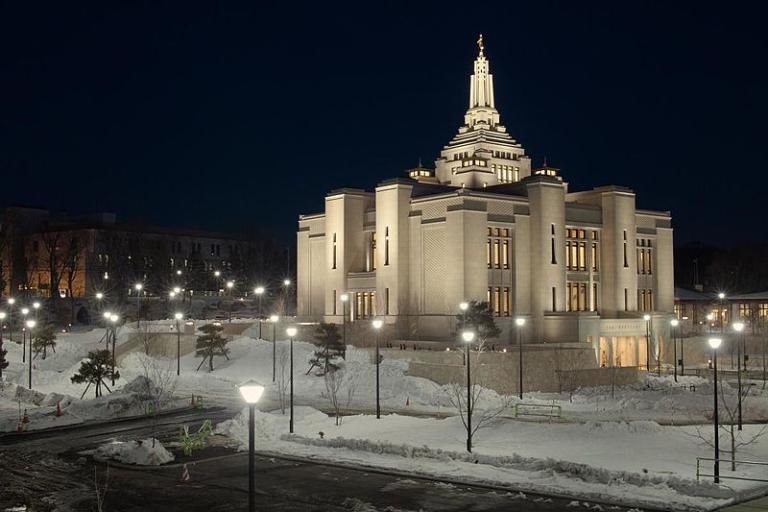
An early March 2016 Wikimedia CC photo, by Tomoyuki Miyauchi, of the then nearly-completed Sapporo Japan Temple
During the decade or so that I’ve been writing regular columns for the Deseret News, the editors have opted twice not to publish an article that I’ve submitted.
The first occasion came quite a few years ago. My subject then was how current Catholic and Protestant theologians writing on the “social model” of the Trinity were, in my view, arguing for positions that, in important ways, have come to resemble Latter-day Saint conceptions of the Godhead. Although the article wasn’t even slightly combative, the editors judged that the topic might be too inflammatory. Several years later — I publicly confess it here for the very first time — I resubmitted the article. It sailed right on through, without resistance, and it aroused no controversy.
The second time came this past week. The column articulated a thought that first occurred to me quite a while ago, while my wife and I were touring an early Soviet-era prison in what, at the time, was still called Leningrad. The prison, inherited from the czars, was a rather humble predecessor of the enormous “Gulag archipelago” of Communist prison camps that would shortly follow.
Although I didn’t address the question of vicarous baptisms on behalf of Holocaust victims, an enormously sensitive issue for both the Church of Jesus Christ of Latter-day Saints and the Jewish community, and although I’m fully supportive of the compromise worked out between the Church and Jewish leaders and had absolutely no thought of upsetting it, my proposed column mentioned temple work and the Holocaust in fairly close proximity to each other — and that, the editors decided, was simply too risky. The Deseret News is owned by the Church, and some folks out there are much more interested in generating heat than light. They couldn’t be relied upon to read the column carefully or sympathetically. Some might actually be seeking to take offense. (Nobody needs to be reminded of the existence of such sensationalizing polemicists less than I do.)
I understand the decision, although (candidly) I regret it. But my blog is independent. I speak for nobody but myself. I certainly don’t speak for the Church. And therefore, to a degree, I’m free to go “rogue.”
So here is the column that I submitted to the Deseret News last week and that the Deseret News declined to publish:
A veteran of World War Two, my father had served with the 11th Armored Division in General George Patton’s U.S. Third Army. One of his pivotal, life-changing experiences was his involvement in the liberation of the Nazi death camp at Mauthausen, Austria. It affected him for life, and he wanted me to know about it and to remember it. I have.
Tragically, the death camp (as exemplified at locations like Buchenwald, Auschwitz and Mauthausen, the Cambodian “killing fields,” Vietnamese “reeducation camps,” the Soviet “Gulag,” and various institutions throughout Communist China) ranks among the major creations of the twentieth century—not quite novel but certainly taken to a massively higher level. In these infamous places, modern managerial techniques and, often, cutting-edge industrial technology were employed to murder scores of millions of people.
We are sadly all too familiar with sterile-sounding terms like “liquidation,” “Final Solution,” “ethnic cleansing,” and “unperson.” The point of such exercises was to utterly erase entire ethnicities and social classes. Those who presided over the camps saw their victims not as individuals but merely as representatives of a hated human type, as what the National Socialists called “Untermenschen”— the Jews, for example, or the Ukrainian kulaks, the bourgeoisie, the Slavs, or the Roma. In Yad Vashem, Israel’s Holocaust memorial, one large hall is devoted to towns and villages that were completely obliterated by the Nazis, leaving not a single individual behind. Everybody was killed. No descendants survived to continue their lines or to remember them. No records remain to confirm that they ever existed.
Quietly and without fanfare, though, an effort that directly contradicts these totalitarian attempts at liquidation and erasure has been gathering steam since the first half of the nineteenth century. In the family history research fostered by the Church of Jesus Christ of Latter-day Saints, an attempt is underway to identify every individual human person who has ever lived and to recover and reconstruct the family relationships that link us all together. It’s not coincidental that the words “genocide” and “genealogy” share the same Greek root, “genos,” meaning (among other things) “race” or “lineage.”
Virtually every day in the Church’s dedicated temples worldwide, tens of thousands of men, women, and children act on behalf of those who are gone. Moreover, these ordinances, these acts of remembrance, are carried out individually, not en masse. In many cases, the names of these individuals are being uttered, even remembered, for the first time in generations.
Baptisms for the dead began to be performed by followers of the Prophet Joseph Smith during the 1840s in Nauvoo, Illinois. “Upon his church,” remarked his unbelieving biographer Fawn Brodie, “now rested the burden of freeing the billions of spirits who had never heard the law of the Lord. Nauvoo had become the center not only of the world, but also of the universe.”
Brodie presumably intended her comment ironically and with condescension. For once, though, she was right. But Nauvoo didn’t conclude the development of doctrines and practices associated with the redemption of the dead. (That development plainly continues still.) The required ordinances beyond baptism were first performed on behalf of the dead in the St. George Utah Temple. “It is hard,” comments historian Richard Bennett, “to overemphasize the importance of what happened for the first time in the St. George Temple in January 1877.”
In a real sense, temples are the polar opposite to extermination camps, a divine response to the dehumanizing demonic forces behind those places of unspeakable horror. Temple service constitutes a radical rejection of Satan’s attempt at what C. S. Lewis, in another context, called “the abolition of man.” It embodies the Lord’s concern for his “lost sheep” (Luke 15:1-10); it demonstrates the truth of the claim that “the worth of souls is great in the sight of God” (Doctrine and Covenants 18:10).
We aren’t mere interchangeable exemplars of a class or set. Each human person is of infinite and eternal intrinsic value, of inestimable worth, with unimaginable potential.
“What is gold or silver in comparison to the redemption of our dead?” asked Wilford Woodruff, who served as the first president of the temple in St. George. “Nothing.”
Temples affirm human dignity in a war in which the Adversary has scored painful victories but in which the Lord, his faithful Saints, and, indeed, all of God’s children will ultimately triumph.
See Richard E. Bennett, Temples Rising: A Heritage of Sacrifice (Salt Lake City: Deseret Book, 2019).
Church of Jesus Christ of Latter-day Saints
Next Post

October 23, 2019 "Does time spent on social media impact mental health?"
Browse Our Archives
Select a Category Uncategorized
Select a Month October 2026 September 2026 August 2026 July 2026 June 2026 May 2026 April 2026 March 2026 February 2026 January 2026 December 2025 November 2025 October 2025 September 2025 August 2025 July 2025 June 2025 May 2025 April 2025 March 2025 February 2025 January 2025 December 2024 November 2024 October 2024 September 2024 August 2024 July 2024 June 2024 May 2024 April 2024 March 2024 February 2024 January 2024 December 2023 November 2023 October 2023 September 2023 August 2023 July 2023 June 2023 May 2023 April 2023 March 2023 February 2023 January 2023 December 2022 November 2022 October 2022 September 2022 August 2022 July 2022 June 2022 May 2022 April 2022 March 2022 February 2022 January 2022 December 2021 November 2021 October 2021 September 2021 August 2021 July 2021 June 2021 May 2021 April 2021 March 2021 February 2021 January 2021 December 2020 November 2020 October 2020 September 2020 August 2020 July 2020 June 2020 May 2020 April 2020 March 2020 February 2020 January 2020 December 2019 November 2019 October 2019 September 2019 August 2019 July 2019 June 2019 May 2019 April 2019 March 2019 February 2019 January 2019 December 2018 November 2018 October 2018 September 2018 August 2018 July 2018 June 2018 May 2018 April 2018 March 2018 February 2018 January 2018 December 2017 November 2017 October 2017 September 2017 August 2017 July 2017 June 2017 May 2017 April 2017 March 2017 February 2017 January 2017 December 2016 November 2016 October 2016 September 2016 August 2016 July 2016 June 2016 May 2016 April 2016 March 2016 February 2016 January 2016 December 2015 November 2015 October 2015 September 2015 August 2015 July 2015 June 2015 May 2015 April 2015 March 2015 February 2015 January 2015 December 2014 November 2014 March 2014 August 2013 February 2012
Follow Us!
TAKE THE
Religious Wisdom Quiz
Who was Isaac's wife?
Select your answer to see how you score.
Sarah Rebekah Rachel Leah
Related posts from Sic et Non

Notes on Women, Priesthood, and General Conference

"The Book of Moses as a Temple Text"

TRENDING AT PATHEOS Latter-day Saint

How to Make a Decision When You Can't...
Main point: It’s much more valuable to stay close to God so...

Archdiocese Hosts Military Marriage Retreat in Germany
RASTATT, Germany — The transient military lifestyle, with its frequent deployments and...

Nearly every morning, I make the drive to Detroit with my high-school-age...

The Real AI Story Is Adoption Without Trust
Artificial intelligence has crossed a political threshold. It is no longer a...

A new article, written by Jeff Lindsay and Gale L. Pooley,...

Swimfan: Forgotten Aughts Pleasures
This is a recovery effort. In 2002, My Big Fat Greek Wedding...
view all Latter-day Saint blogs
Ad-Free & Subscriber Log-In Subscription Support
- About Us
- 2026 Calendar
- Videos
- Podcasts
- Library of World Religions
- Faith In Media Tracker
- Advertise With Us
- Write for Us
- Privacy Policy
- Terms of Service
- Do Not Sell My Data
- Contact Us
- Radiant Digital
- Manage Newsletter Subscriptions
- Unsubscribe From Notifications
- Sitemap
Copyright 2008-2026, Patheos. All rights reserved.
Subscription Support Ad-Free & Subscriber Log-In
Follow Patheos