
BuddhistCatholicContemplativeEvangelicalGeneral ChristianHinduJewishLatter-day SaintMuslimNew VisionsProgressive Christian
Beliefs
- Buddhist
- Catholic
- Contemplative
- Evangelical
- General Christian
- Hindu
- Jewish
- Latter-day Saint
- More Voices
- Muslim
- New Visions
- Pagan
- Progressive Christian
Topics
- Religion News
- Food and Religion
- Sports and Religion
- Religious Art
- Religious Music and Entertainment
- Religious Events
- History and Religion
- Style and Religion
- Politics and Religion
- Women in Religion
- Recreation Outdoors and Religion
- Business Finance and Religion
- Careers Workplace and Religion
- Education and Religion
- Family Parenting and Religion
- Health Fitness and Religion
- Home and Religion
- Relationships and Religion
- Technology and Religion
- Travel and Religion
Columnists
- Buddhist Columnists
- Business Finance and Religion Columnists
- Careers Workplace and Religion Columnists
- Catholic Columnists
- Contemplative Columnists
- Education and Religion Columnists
- Evangelists Columnists
- Family Parenting and Religion Columnists
- General Christian Columnists
- Health Fitness and Religion Columnists
- Hindu Columnists
- History and Religion Columnists
- Home and Religion Columnists
- Jewish Columnists
- More Voices Columnists
- Latter Day Columnists
- Muslim Columnists
- New Visions Columnists
- Nonreligious Columnists
- Pagan Columnists
- Politics and Religion Columnists
- Progressive Columnists
- Recreation Outdoors and Religion Columnists
- Relationships and Religion Columnists
- Religion News Columnists
- Religious Art Columnists
- Religious Events Columnists
- Religious Music and Entertainment Columnists
- Sports and Religion Columnists
- Style and Religion Columnists
- Technology and Religion Columnists
- Travel and Religion Columnists
- Women in Religion Columnists
Resource Library
- 2026 Calendar
- Library of World Religions
- The 100 Most Holy Places on Earth
- Patheos Answers
- Podcasts
- Videos
- Faith Leaders Database
- Anglican Episcopalian
- Bahai
- Baptist
- Buddhism
- Christianity
- Confucianism
- Eastern Orthodoxy
- Hinduism
- Holiness and Pentecostal
- ISKCON
- Islam
- Judaism
- Lutheran
- Methodist
- The Church of Jesus Christ of Latter-day Saints
- New Age
- Paganism
- Presbytarian and Reformed
- Protestantism
- Religion Behind the Scenes
- Roman Catholic
- Scientology
- Shia Islam
- Sikhism
- Sufism
- Sunni Islam
- Taoism
- Zen
- See all religions
Research Tools
 Ad-Free & Subscriber Log-In Subscription Support
Ad-Free & Subscriber Log-In Subscription Support
Follow Patheos 

- Trending:
- Forgiveness
- |
- Marriage
- |
- Consciousness
- |
- Death Penalty
- |
- Election
- |
- Halloween

- Home
- Latter-day Saint
- Johannes Kepler and the supposed war between science and religion
Johannes Kepler and the supposed war between science and religion
Last updated on: September 5, 2019 at 10:51 pm by Dan Peterson
Johannes Kepler and the supposed war between science and religion 2019-09-05T22:51:09-06:00 Dan Peterson
Patheos Explore the world's faith through different perspectives on religion and spirituality! Patheos has the views of the prevalent religions and spiritualities of the world.
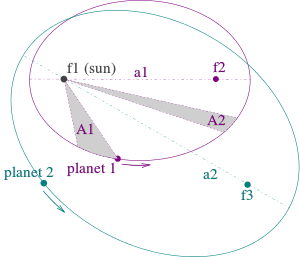
An illustration of Kepler’s three laws of planetary motion: 1. The orbit of a planet is an ellipse with the Sun at one of the two foci. 2. A line segment joining a planet and the Sun sweeps out equal areas during equal intervals of time. 3. The square of the orbital period of a planet is proportional to the cube of the semi-major axis of its orbit.
(Image from Wikimedia CC)
I published the article below in the 9 August 2018 issue of the Deseret News:
Atheists and other religious skeptics often portray the European Renaissance (of the 14th to 17th centuries) and the so-called scientific revolution (of the 17th to 18th centuries) as episodes of liberation from the smothering tyranny of medieval religion, which supposedly favored magic over rationality, suppressed scientific thought and thwarted progress. It’s a moral tale, according to which religion and science are adversaries and faith is an obstacle to human advancement
The historical reality, however, is — to put things mildly — quite different from that claim (and, in fact, very different from what I was taught growing up).
A good place to learn about the real history is James Hannam, “The Genesis of Science: How the Christian Middle Ages Launched the Scientific Revolution” (Henry Regnery, 2011). Well-qualified to write his book, Hannam earned a bachelor’s degree in physics at Oxford University and a doctorate in the history of science from the University of Cambridge.
Hannam demonstrates that considerable scientific and technological progress occurred during the European Middle Ages and that such advancements were very commonly achieved by priests. Galileo, who is often considered the founder of modern science, owed far more to his medieval predecessors than he and others have been willing to admit.
Moreover, the golden age of European “magic” wasn’t the supposedly benighted Middle Ages but, rather, the Renaissance. Additionally, to choose one example, Sir Isaac Newton, the iconic titan of the scientific revolution, was a deeply committed theologian and alchemist, as well as a physicist and mathematician.
However, I’ll focus here on Johannes Kepler (1571-1630), who formulated Kepler’s laws of planetary motion and demonstrated that the orbits of the planets around the sun are elliptical rather than circular.
Kepler’s initial goal was to become a priest. Ultimately, he didn’t. But, observes Hannam, “Religion was the central theme of Kepler’s life — both with respect to his own beliefs and the social climate in which he lived. He was an unusually devout man at a time when strong religious views were commonplace.” He “saw his science as a religious duty and wrote as if it were a complicated piece of theology. … Sheet after sheet of calculations (in his notebooks) are punctuated with mystical speculation and prayers.”
Kepler worked in the light of the Copernican revolution, named after Nicolaus Copernicus (1473-1543), the mathematician, astronomer and cathedral official who contended that Earth revolved around the sun, rather than vice versa — an idea actually first proposed by Aristarchus of Samos in the third century before Christ.
Copernicus, Hannam showed, had derived his astronomical ideas from his theology, as well as from the observational data. But his model of the solar system wasn’t completely accurate because he was committed to the notion that the planets move in perfect circles.
Kepler accepted Copernicus’ heliocentric model, but he was horrified that its prediction of the orbit of Mars was off by eight minutes of arc, which is about two-fifteenths of a degree.
“For Kepler,” wrote Hannam, “the most important fact about the world was that God had created it. Like Copernicus, Kepler was convinced that the structure of the heavens had to reflect the perfection of its creator.”
Some skeptics had even begun to argue that genuine knowledge of the movement of celestial objects was impossible, too grand for mere mortals.
“Kepler,” Hannam said, “rejected the defeatism of the skeptics, although his reasons were religious rather than scientific. As far as he was concerned, the heavens must reflect their maker. … There was no imprecision about God and he did not make eight-minute mistakes. Nor was he the capricious sort who would make the heavens into an unsolvable puzzle. If the paths of the planets were ordained by God, then they must be simple and elegant.”
But perfectly circular planetary orbits were a pagan Greek assumption that he could drop without compromising his belief in God’s perfection and rationality.
In this important instance, religion certainly wasn’t an obstacle to science. Kepler’s theology inspired his hypothesis, and he was able to prove it true because of both the more accurate data provided by the great Danish astronomer Tycho Brahe (1546-1601) and his own remarkable mathematical ability.
“Kepler,” wrote Hannam, “cracked the mystery of the planets’ movements because of his faith in God’s creative power.”
“For a long time,” wrote Kepler himself, “I wanted to be a theologian. Now, however, behold how through my effort God is being celebrated through astronomy.”
Previous Post

September 5, 2019
Church history, then and now
Next Post
September 5, 2019 No Ma’am, that's not Islamic history
Browse Our Archives
Select a Category Uncategorized
Select a Month October 2026 September 2026 August 2026 July 2026 June 2026 May 2026 April 2026 March 2026 February 2026 January 2026 December 2025 November 2025 October 2025 September 2025 August 2025 July 2025 June 2025 May 2025 April 2025 March 2025 February 2025 January 2025 December 2024 November 2024 October 2024 September 2024 August 2024 July 2024 June 2024 May 2024 April 2024 March 2024 February 2024 January 2024 December 2023 November 2023 October 2023 September 2023 August 2023 July 2023 June 2023 May 2023 April 2023 March 2023 February 2023 January 2023 December 2022 November 2022 October 2022 September 2022 August 2022 July 2022 June 2022 May 2022 April 2022 March 2022 February 2022 January 2022 December 2021 November 2021 October 2021 September 2021 August 2021 July 2021 June 2021 May 2021 April 2021 March 2021 February 2021 January 2021 December 2020 November 2020 October 2020 September 2020 August 2020 July 2020 June 2020 May 2020 April 2020 March 2020 February 2020 January 2020 December 2019 November 2019 October 2019 September 2019 August 2019 July 2019 June 2019 May 2019 April 2019 March 2019 February 2019 January 2019 December 2018 November 2018 October 2018 September 2018 August 2018 July 2018 June 2018 May 2018 April 2018 March 2018 February 2018 January 2018 December 2017 November 2017 October 2017 September 2017 August 2017 July 2017 June 2017 May 2017 April 2017 March 2017 February 2017 January 2017 December 2016 November 2016 October 2016 September 2016 August 2016 July 2016 June 2016 May 2016 April 2016 March 2016 February 2016 January 2016 December 2015 November 2015 October 2015 September 2015 August 2015 July 2015 June 2015 May 2015 April 2015 March 2015 February 2015 January 2015 December 2014 November 2014 March 2014 August 2013 February 2012
Follow Us!
TAKE THE
Religious Wisdom Quiz
I am the root of all kinds of evil when loved. What am I?
Select your answer to see how you score.
Pride Money Power Greed
Related posts from Sic et Non

Cosmology and Cosmic Design, Again
Science and Religion: A Great Scottish Example


TRENDING AT PATHEOS Latter-day Saint

Nearly every morning, I make the drive to Detroit with my high-school-age...

The Real AI Story Is Adoption Without Trust
Artificial intelligence has crossed a political threshold. It is no longer a...

A new article, written by Jeff Lindsay and Gale L. Pooley,...

Swimfan: Forgotten Aughts Pleasures
This is a recovery effort. In 2002, My Big Fat Greek Wedding...

Top Three Anti-Catholic Lies About Catholicism
This is my initial transcript for the video, "THE 3 WORST...

Pope Leo Celebrates Mass for Nurses & Docs...
I don't have any idea how he did it, but Pope Leo...
view all Latter-day Saint blogs
Ad-Free & Subscriber Log-In Subscription Support
- About Us
- 2026 Calendar
- Videos
- Podcasts
- Library of World Religions
- Faith In Media Tracker
- Advertise With Us
- Write for Us
- Privacy Policy
- Terms of Service
- Do Not Sell My Data
- Contact Us
- Radiant Digital
- Manage Newsletter Subscriptions
- Unsubscribe From Notifications
- Sitemap
Copyright 2008-2026, Patheos. All rights reserved.
Subscription Support Ad-Free & Subscriber Log-In
Follow Patheos