
BuddhistCatholicContemplativeEvangelicalGeneral ChristianHinduJewishLatter-day SaintMuslimNew VisionsProgressive Christian
Beliefs
- Buddhist
- Catholic
- Contemplative
- Evangelical
- General Christian
- Hindu
- Jewish
- Latter-day Saint
- More Voices
- Muslim
- New Visions
- Pagan
- Progressive Christian
Topics
- Religion News
- Food and Religion
- Sports and Religion
- Religious Art
- Religious Music and Entertainment
- Religious Events
- History and Religion
- Style and Religion
- Politics and Religion
- Women in Religion
- Recreation Outdoors and Religion
- Business Finance and Religion
- Careers Workplace and Religion
- Education and Religion
- Family Parenting and Religion
- Health Fitness and Religion
- Home and Religion
- Relationships and Religion
- Technology and Religion
- Travel and Religion
Columnists
- Buddhist Columnists
- Business Finance and Religion Columnists
- Careers Workplace and Religion Columnists
- Catholic Columnists
- Contemplative Columnists
- Education and Religion Columnists
- Evangelists Columnists
- Family Parenting and Religion Columnists
- General Christian Columnists
- Health Fitness and Religion Columnists
- Hindu Columnists
- History and Religion Columnists
- Home and Religion Columnists
- Jewish Columnists
- More Voices Columnists
- Latter Day Columnists
- Muslim Columnists
- New Visions Columnists
- Nonreligious Columnists
- Pagan Columnists
- Politics and Religion Columnists
- Progressive Columnists
- Recreation Outdoors and Religion Columnists
- Relationships and Religion Columnists
- Religion News Columnists
- Religious Art Columnists
- Religious Events Columnists
- Religious Music and Entertainment Columnists
- Sports and Religion Columnists
- Style and Religion Columnists
- Technology and Religion Columnists
- Travel and Religion Columnists
- Women in Religion Columnists
Resource Library
- 2026 Calendar
- Library of World Religions
- The 100 Most Holy Places on Earth
- Patheos Answers
- Podcasts
- Videos
- Faith Leaders Database
- Anglican Episcopalian
- Bahai
- Baptist
- Buddhism
- Christianity
- Confucianism
- Eastern Orthodoxy
- Hinduism
- Holiness and Pentecostal
- ISKCON
- Islam
- Judaism
- Lutheran
- Methodist
- The Church of Jesus Christ of Latter-day Saints
- New Age
- Paganism
- Presbytarian and Reformed
- Protestantism
- Religion Behind the Scenes
- Roman Catholic
- Scientology
- Shia Islam
- Sikhism
- Sufism
- Sunni Islam
- Taoism
- Zen
- See all religions
Research Tools
 Ad-Free & Subscriber Log-In Subscription Support
Ad-Free & Subscriber Log-In Subscription Support
Follow Patheos 

- Trending:
- Forgiveness
- |
- Marriage
- |
- Consciousness
- |
- Death Penalty
- |
- Election
- |
- Halloween

- Home
- Latter-day Saint
- Comrade Stalin and the Pope’s Divisions
Comrade Stalin and the Pope’s Divisions
Last updated on: October 5, 2019 at 12:45 am by Dan Peterson
Comrade Stalin and the Pope’s Divisions 2019-10-05T00:45:39-06:00 Dan Peterson
Patheos Explore the world's faith through different perspectives on religion and spirituality! Patheos has the views of the prevalent religions and spiritualities of the world.
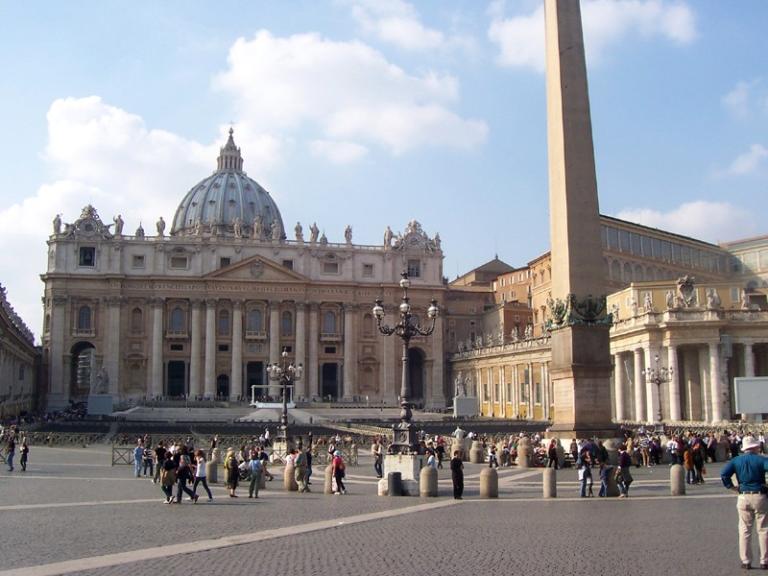
St. Peter’s Square, in Vatican City (Wikimedia Commons public domain photograph)
Bill Hamblin and I launched our series of columns on world religions for the Deseret News back in 2012. I submitted this column as our inaugural article:
When an advisor warned him against conflict with the Catholic Church, Josef Stalin contemptuously demanded, “How many divisions does the pope have?” It was a rhetorical question. It presumed the obvious: With no army at all, what threat could the pope pose to Soviet tyranny?
Stalin’s presumption was wrong. Less than three decades after his death, the Catholic Church elected a Polish pope. This was a vital factor in the collapse of communism, not only in Poland but throughout eastern Europe. The triumphant homecoming of John Paul II soon after his election in 1978 demonstrated that the pope has many powerful “divisions.”
Blindness to the continuing power of religion is not limited to Kremlin atheists. In the mid- to late 1970s, as discontent with the rule of the Shah in Iran began to boil, both government and academic experts on the Middle East routinely downplayed it. After all, who were the Shah’s opponents? A ragtag alliance of bazaar merchants, led by Islamic clergy who, it seemed, had scarcely emerged from the Middle Ages. The Shah, by contrast, had a large and well-trained army. He had tanks. He had jet fighter aircraft. In a struggle between the twentieth century and the seventh, who could doubt the outcome?
For more than two decades now, the West has struggled to cope with the Islamic Republic of Iran. We have faced militant Islam in Algeria, in the Sudanese civil war, in Afghanistan, in Beirut and south Lebanon, in the Philippines, at the World Trade Center. Islamic fundamentalism will challenge us for years to come, abroad and at home.
The notion that the world is growing more secular — that, as technology and prosperity increase, religion inevitably loses its influence — is simply wrong. Stalin and his successors are gone; the pope remains. Even in the State Department, an awareness of religion as a forgotten dimension of diplomacy and political analysis begins to dawn.
The realization has hardly come too soon. Around the world, religions and religious people exercise not a diminishing, but an increasing influence on public affairs. India and Pakistan exist as separate countries because of divisions between Hindus and Muslims. Now Sikh activism complicates the scene. Extremist Catholics and Protestants in northern Ireland have kept their bloody conflict going for years. Ultra-orthodox Jews in Israel confront an ever more militant Palestinian Islamic movement. U.S. politicians court the Christian Right. Sportswear giant Nike recently capitulated to a coalition of unhappy American Muslims who threatened it with a boycott. Even the prosperous and largely secular Japanese have suffered from the deadly fantasies of a conspiratorial religious group armed with poison gas.
Of course, not all manifestations of religion in contemporary society are negative. While violent, frightening or bizarre elements of religion grab headlines, its most powerful effects are surely found in the private lives of ordinary people, in their work and families, in what they choose to value or reject, and how they respond to stress and sorrow. The surge of evangelical Christianity gives meaning and discipline to millions of Americans. Prison officials across the nation report that the spread of Islam and conservative Protestantism assists in rehabilitating inmates and lowering their rate of recidivism. Recent studies seem to confirm the power of religious belief to promote mental health, and even to aid recovery from illness and injury.
Religion is hardly dead. Fundamentalist Christianity flourishes in Brazil. In rural Guatemala, it may already have supplanted Catholicism. Mormonism, some say, is poised to become the first new global faith since Islam emerged from Arabia in the seventh century. U.S. Muslims now outnumber adherents of some of the so-called “mainline” churches. There will soon be more regular worshipers in the mosques of the United Kingdom than in Anglican churches. The Islamic prayer call echoes through Balkan cities where, not long ago, atheism was imposed by law and the practice of any faith at all was a criminal offense.
Religion is vibrantly, fascinatingly, alive.
Our essays will examine it around the world — Christian and non-Christian, ancient, medieval, and modern — from many perspectives. Religion is of virtually infinite interest and human significance (not to mention its importance in eternity). We hope that you share our enthusiasm for this richly varied and instructive subject.
Previous Post

September 28, 2019
The Behemoth at the Center of Our Galaxy
Next Post
September 29, 2019 A note on Philo of Alexandria
Browse Our Archives
Select a Category Uncategorized
Select a Month October 2026 September 2026 August 2026 July 2026 June 2026 May 2026 April 2026 March 2026 February 2026 January 2026 December 2025 November 2025 October 2025 September 2025 August 2025 July 2025 June 2025 May 2025 April 2025 March 2025 February 2025 January 2025 December 2024 November 2024 October 2024 September 2024 August 2024 July 2024 June 2024 May 2024 April 2024 March 2024 February 2024 January 2024 December 2023 November 2023 October 2023 September 2023 August 2023 July 2023 June 2023 May 2023 April 2023 March 2023 February 2023 January 2023 December 2022 November 2022 October 2022 September 2022 August 2022 July 2022 June 2022 May 2022 April 2022 March 2022 February 2022 January 2022 December 2021 November 2021 October 2021 September 2021 August 2021 July 2021 June 2021 May 2021 April 2021 March 2021 February 2021 January 2021 December 2020 November 2020 October 2020 September 2020 August 2020 July 2020 June 2020 May 2020 April 2020 March 2020 February 2020 January 2020 December 2019 November 2019 October 2019 September 2019 August 2019 July 2019 June 2019 May 2019 April 2019 March 2019 February 2019 January 2019 December 2018 November 2018 October 2018 September 2018 August 2018 July 2018 June 2018 May 2018 April 2018 March 2018 February 2018 January 2018 December 2017 November 2017 October 2017 September 2017 August 2017 July 2017 June 2017 May 2017 April 2017 March 2017 February 2017 January 2017 December 2016 November 2016 October 2016 September 2016 August 2016 July 2016 June 2016 May 2016 April 2016 March 2016 February 2016 January 2016 December 2015 November 2015 October 2015 September 2015 August 2015 July 2015 June 2015 May 2015 April 2015 March 2015 February 2015 January 2015 December 2014 November 2014 March 2014 August 2013 February 2012
Follow Us!
TAKE THE
Religious Wisdom Quiz
Who said "as for me and my house, we will serve the Lord"?
Select your answer to see how you score.
Abraham Peter Paul Joshua
Related posts from Sic et Non

Once more unto the breach, dear friends, once...


We definitely didn't elect a mere choirboy.
TRENDING AT PATHEOS Latter-day Saint

A new article, written by Jeff Lindsay and Gale L. Pooley,...

Swimfan: Forgotten Aughts Pleasures
This is a recovery effort. In 2002, My Big Fat Greek Wedding...

Top Three Anti-Catholic Lies About Catholicism
This is my initial transcript for the video, "THE 3 WORST...

Pope Leo Celebrates Mass for Nurses & Docs...
I don't have any idea how he did it, but Pope Leo...

The Sermon on the Mount, Part I: Matthew...
The Sermon on the Mount, Part I (Matthew 4:12-5:12) St. Matthew moves...

What's up from Crossway: Reviewing some of their latest A few weeks...
view all Latter-day Saint blogs
Ad-Free & Subscriber Log-In Subscription Support
- About Us
- 2026 Calendar
- Videos
- Podcasts
- Library of World Religions
- Faith In Media Tracker
- Advertise With Us
- Write for Us
- Privacy Policy
- Terms of Service
- Do Not Sell My Data
- Contact Us
- Radiant Digital
- Manage Newsletter Subscriptions
- Unsubscribe From Notifications
- Sitemap
Copyright 2008-2026, Patheos. All rights reserved.
Subscription Support Ad-Free & Subscriber Log-In
Follow Patheos