
BuddhistCatholicContemplativeEvangelicalGeneral ChristianHinduJewishLatter-day SaintMuslimNew VisionsProgressive Christian
Beliefs
- Buddhist
- Catholic
- Contemplative
- Evangelical
- General Christian
- Hindu
- Jewish
- Latter-day Saint
- More Voices
- Muslim
- New Visions
- Pagan
- Progressive Christian
Topics
- Religion News
- Food and Religion
- Sports and Religion
- Religious Art
- Religious Music and Entertainment
- Religious Events
- History and Religion
- Style and Religion
- Politics and Religion
- Women in Religion
- Recreation Outdoors and Religion
- Business Finance and Religion
- Careers Workplace and Religion
- Education and Religion
- Family Parenting and Religion
- Health Fitness and Religion
- Home and Religion
- Relationships and Religion
- Technology and Religion
- Travel and Religion
Columnists
- Buddhist Columnists
- Business Finance and Religion Columnists
- Careers Workplace and Religion Columnists
- Catholic Columnists
- Contemplative Columnists
- Education and Religion Columnists
- Evangelists Columnists
- Family Parenting and Religion Columnists
- General Christian Columnists
- Health Fitness and Religion Columnists
- Hindu Columnists
- History and Religion Columnists
- Home and Religion Columnists
- Jewish Columnists
- More Voices Columnists
- Latter Day Columnists
- Muslim Columnists
- New Visions Columnists
- Nonreligious Columnists
- Pagan Columnists
- Politics and Religion Columnists
- Progressive Columnists
- Recreation Outdoors and Religion Columnists
- Relationships and Religion Columnists
- Religion News Columnists
- Religious Art Columnists
- Religious Events Columnists
- Religious Music and Entertainment Columnists
- Sports and Religion Columnists
- Style and Religion Columnists
- Technology and Religion Columnists
- Travel and Religion Columnists
- Women in Religion Columnists
Resource Library
- 2026 Calendar
- Library of World Religions
- The 100 Most Holy Places on Earth
- Patheos Answers
- Podcasts
- Videos
- Faith Leaders Database
- Anglican Episcopalian
- Bahai
- Baptist
- Buddhism
- Christianity
- Confucianism
- Eastern Orthodoxy
- Hinduism
- Holiness and Pentecostal
- ISKCON
- Islam
- Judaism
- Lutheran
- Methodist
- The Church of Jesus Christ of Latter-day Saints
- New Age
- Paganism
- Presbytarian and Reformed
- Protestantism
- Religion Behind the Scenes
- Roman Catholic
- Scientology
- Shia Islam
- Sikhism
- Sufism
- Sunni Islam
- Taoism
- Zen
- See all religions
Research Tools
 Ad-Free & Subscriber Log-In Subscription Support
Ad-Free & Subscriber Log-In Subscription Support
Follow Patheos 

- Trending:
- Forgiveness
- |
- Marriage
- |
- Consciousness
- |
- Death Penalty
- |
- Election
- |
- Halloween

- Home
- Latter-day Saint
- Some work on the name “Alma”
Some work on the name “Alma”
Last updated on: August 3, 2019 at 11:33 pm by Dan Peterson
Some work on the name “Alma” 2019-08-03T23:33:54-06:00 Dan Peterson
Patheos Explore the world's faith through different perspectives on religion and spirituality! Patheos has the views of the prevalent religions and spiritualities of the world.
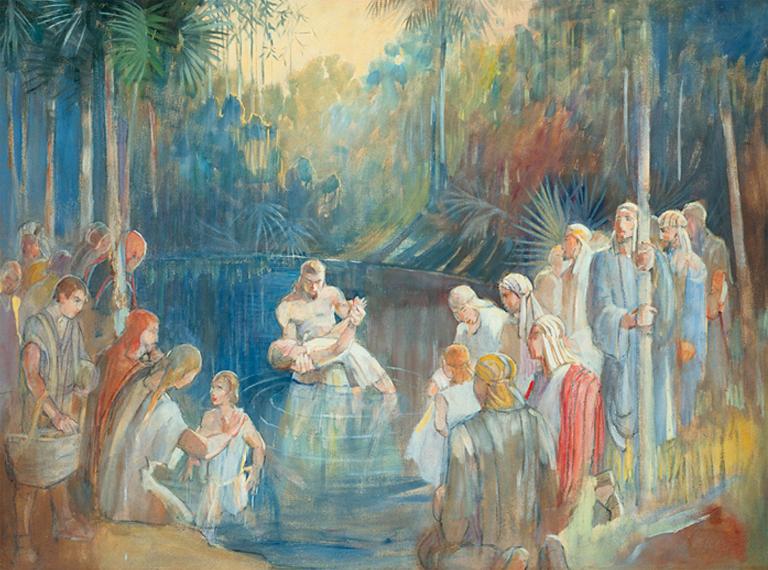
“Alma Baptizes in the Waters of Mormon” by Minerva Teichert (1888-1976)
Wikimedia Commons public domain image
“Ifs, Ands, or Buts: A Reminder on the Origins of the Book of Mormon”
“Why Must We Beware Wolves in Sheep’s Clothing?”
***
Latter-day Saints Around the World: Country Newsroom Websites, August 2, 2019
“Groundbreaking Announced for the Belém Brazil Temple”
***
I want to call attention to a trio of related articles previously published in Interpreter that you might possibly find of interest:
Stephen D. Ricks, Interpreter: A Journal of Latter-day Saint Faith and Scholarship 4 (2013): 155-160
Abstract: This study considers the Book of Mormon personal names Josh, Nahom, and Alma as test cases for the Book of Mormon as an historically authentic ancient document.
Matthew L. Bowen, Interpreter: A Journal of Latter-day Saint Faith and Scholarship 19 (2016): 343-353
“Alma — Young Man, Hidden Prophet”
Abstract: The biographical introduction of Alma the Elder into the Book of Mormon narrative (Mosiah 17:2) also introduces the name Alma into the text for the first time, this in close juxtaposition with a description of Alma as a “young man.” The best explanation for the name Alma is that it derives from the Semitic term ǵlm (Hebrew ʿelem), “young man,” “youth,” “lad.” This suggests the strong probability of an intentional wordplay on the name Alma in the Book of Mormon’s underlying text: Alma became “[God’s] young man” or “servant.” Additional lexical connections between Mosiah 17:2 and Mosiah 14:1 (quoting Isaiah 53:1) suggest that Abinadi identified Alma as the one “to whom” or “upon whom” (ʿal-mî) the Lord was “reveal[ing]” his arm as Abinadi’s prophetic successor. Alma began his prophetic succession when he “believed” Abinadi’s report and pled with King Noah for Abinadi’s life. Forced to flee, Alma began his prophetic ministry “hidden” and “concealed” while writing the words of Abinadi and teaching them “privately.” The narrative’s dramatic emphasis on this aspect of Alma’s life suggests an additional thread of wordplay that exploits the homonymy between Alma and the Hebrew root *ʿlm, forms of which mean “to hide,” “conceal,” “be hidden,” “be concealed.” The richness of the wordplay and allusion revolving around Alma’s name in Mosiah 17–18 accentuates his importance as a prophetic figure and founder of the later Nephite church. Moreover, it suggests that Alma’s name was appropriate given the details of his life and that he lived up to the positive connotations latent in his name.
Matthew L. Bowen, Interpreter: A Journal of Latter-day Saint Faith and Scholarship 27 (2017): 197-212
““He Did Go About Secretly”: Additional Thoughts on the Literary Use of Alma’s Name”
Abstract: Mormon describes Alma the Younger’s “go[ing] about secretly” to destroy the church that his father, Alma the Elder, had established (Mosiah 27:8–10), this as a narratalogical inversion of that period when Alma the Elder “went about privately” teaching the words of Abinadi and establishing a church “that it might not come to the knowledge of the king” (Mosiah 18:1–6). In Mosiah 27:10, Mormon subtly reworks Alma the Younger’s autobiographical statement preserved in Alma 36:6, adding in the former passage a word rendered “secretly” to create a midrashic or interpretive pun on the name Alma,echoing the meaning of the Semitic root ʿlm*, “hide,” “conceal”). Mosiah 27:8–10 contains additional language that evokes the introduction of the name Alma in the Book of Mormon (at first in terms of ʿelem [“young man”] but also in terms of the homonymous root ʿlm) in Mosiah 17:2–4 but also re-invokes allusions in the latter passage to Mosiah 14:1 (Isaiah 53:1).*
Previous Post

August 3, 2019
Memories of Heaven?
Next Post
August 4, 2019 The Circle of (Latter-day Saint) Life
Browse Our Archives
Select a Category Uncategorized
Select a Month October 2026 September 2026 August 2026 July 2026 June 2026 May 2026 April 2026 March 2026 February 2026 January 2026 December 2025 November 2025 October 2025 September 2025 August 2025 July 2025 June 2025 May 2025 April 2025 March 2025 February 2025 January 2025 December 2024 November 2024 October 2024 September 2024 August 2024 July 2024 June 2024 May 2024 April 2024 March 2024 February 2024 January 2024 December 2023 November 2023 October 2023 September 2023 August 2023 July 2023 June 2023 May 2023 April 2023 March 2023 February 2023 January 2023 December 2022 November 2022 October 2022 September 2022 August 2022 July 2022 June 2022 May 2022 April 2022 March 2022 February 2022 January 2022 December 2021 November 2021 October 2021 September 2021 August 2021 July 2021 June 2021 May 2021 April 2021 March 2021 February 2021 January 2021 December 2020 November 2020 October 2020 September 2020 August 2020 July 2020 June 2020 May 2020 April 2020 March 2020 February 2020 January 2020 December 2019 November 2019 October 2019 September 2019 August 2019 July 2019 June 2019 May 2019 April 2019 March 2019 February 2019 January 2019 December 2018 November 2018 October 2018 September 2018 August 2018 July 2018 June 2018 May 2018 April 2018 March 2018 February 2018 January 2018 December 2017 November 2017 October 2017 September 2017 August 2017 July 2017 June 2017 May 2017 April 2017 March 2017 February 2017 January 2017 December 2016 November 2016 October 2016 September 2016 August 2016 July 2016 June 2016 May 2016 April 2016 March 2016 February 2016 January 2016 December 2015 November 2015 October 2015 September 2015 August 2015 July 2015 June 2015 May 2015 April 2015 March 2015 February 2015 January 2015 December 2014 November 2014 March 2014 August 2013 February 2012
Follow Us!
TAKE THE
Religious Wisdom Quiz
What was a "phylactery" used by Jews during prayer?
Select your answer to see how you score.
A musical instrument A festival garment A lamp A small leather box with scripture
Related posts from Sic et Non


Learning more about a region of which I've...

From Serbia's "White City," Belgrade

TRENDING AT PATHEOS Latter-day Saint

Letters on Living the Faith by C.S. Lewis
Most of us met C.S. Lewis as a public intellectual. Mere Christianity....

When Halloween Unmasks Married Hearts
Written by Dr. David K. Ewen from Eternal Truth Bible College Behind...

Aristotle. He’s been called the father of logic, the father of the...

Methodist Central Hall and Westminster Abbey
Situated on the same square is Methodist Central Hall and Westminster Abbey. ...

57th Dove Awards Honor Dolly Parton, Crown New...
On gospel music’s biggest night, the 57th annual GMA Dove Awards honored...

The First Eucharistic Controversy: Christ’s Real Presence
For Catholics, the Eucharist is the source and summit of the Christian...
view all Latter-day Saint blogs
Ad-Free & Subscriber Log-In Subscription Support
- About Us
- 2026 Calendar
- Videos
- Podcasts
- Library of World Religions
- Faith In Media Tracker
- Advertise With Us
- Write for Us
- Privacy Policy
- Terms of Service
- Do Not Sell My Data
- Contact Us
- Radiant Digital
- Manage Newsletter Subscriptions
- Unsubscribe From Notifications
- Sitemap
Copyright 2008-2026, Patheos. All rights reserved.
Subscription Support Ad-Free & Subscriber Log-In
Follow Patheos