
BuddhistCatholicContemplativeEvangelicalGeneral ChristianHinduJewishLatter-day SaintMuslimNew VisionsProgressive Christian
Beliefs
- Buddhist
- Catholic
- Contemplative
- Evangelical
- General Christian
- Hindu
- Jewish
- Latter-day Saint
- More Voices
- Muslim
- New Visions
- Pagan
- Progressive Christian
Topics
- Religion News
- Food and Religion
- Sports and Religion
- Religious Art
- Religious Music and Entertainment
- Religious Events
- History and Religion
- Style and Religion
- Politics and Religion
- Women in Religion
- Recreation Outdoors and Religion
- Business Finance and Religion
- Careers Workplace and Religion
- Education and Religion
- Family Parenting and Religion
- Health Fitness and Religion
- Home and Religion
- Relationships and Religion
- Technology and Religion
- Travel and Religion
Columnists
- Buddhist Columnists
- Business Finance and Religion Columnists
- Careers Workplace and Religion Columnists
- Catholic Columnists
- Contemplative Columnists
- Education and Religion Columnists
- Evangelists Columnists
- Family Parenting and Religion Columnists
- General Christian Columnists
- Health Fitness and Religion Columnists
- Hindu Columnists
- History and Religion Columnists
- Home and Religion Columnists
- Jewish Columnists
- More Voices Columnists
- Latter Day Columnists
- Muslim Columnists
- New Visions Columnists
- Nonreligious Columnists
- Pagan Columnists
- Politics and Religion Columnists
- Progressive Columnists
- Recreation Outdoors and Religion Columnists
- Relationships and Religion Columnists
- Religion News Columnists
- Religious Art Columnists
- Religious Events Columnists
- Religious Music and Entertainment Columnists
- Sports and Religion Columnists
- Style and Religion Columnists
- Technology and Religion Columnists
- Travel and Religion Columnists
- Women in Religion Columnists
Resource Library
- 2026 Calendar
- Library of World Religions
- The 100 Most Holy Places on Earth
- Patheos Answers
- Podcasts
- Videos
- Faith Leaders Database
- Anglican Episcopalian
- Bahai
- Baptist
- Buddhism
- Christianity
- Confucianism
- Eastern Orthodoxy
- Hinduism
- Holiness and Pentecostal
- ISKCON
- Islam
- Judaism
- Lutheran
- Methodist
- The Church of Jesus Christ of Latter-day Saints
- New Age
- Paganism
- Presbytarian and Reformed
- Protestantism
- Religion Behind the Scenes
- Roman Catholic
- Scientology
- Shia Islam
- Sikhism
- Sufism
- Sunni Islam
- Taoism
- Zen
- See all religions
Research Tools
 Ad-Free & Subscriber Log-In Subscription Support
Ad-Free & Subscriber Log-In Subscription Support
Follow Patheos 

- Trending:
- Forgiveness
- |
- Marriage
- |
- Consciousness
- |
- Death Penalty
- |
- Election
- |
- Halloween

- Home
- Latter-day Saint
- The definitive text of the “Arabian Nights”?
The definitive text of the “Arabian Nights”?
Last updated on: July 30, 2019 at 6:51 pm by Dan Peterson
The definitive text of the “Arabian Nights”? 2019-07-30T18:51:25-06:00 Dan Peterson
Patheos Explore the world's faith through different perspectives on religion and spirituality! Patheos has the views of the prevalent religions and spiritualities of the world.
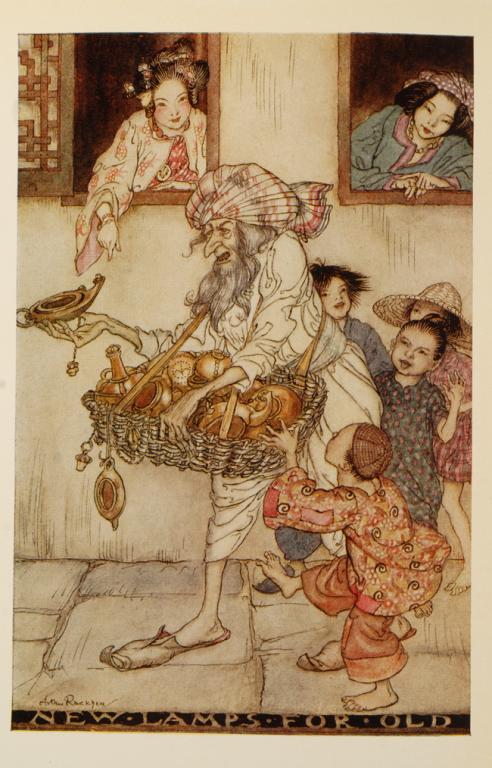
An illustration of the story of Aladdin and his magic lamp by Arthur Rackham (1867-1939)
Wikimedia Commons public domain image
One of the ways that I like to write is simply to throw things rapidly into a computer file, as the thoughts occur to me, for later revisiting. At that point, I’ll clean them up, organize them into a suitable flow, check assertions, provide references where appropriate, smooth out inconsistencies, and otherwise make what I’ve written suitable (I hope) for publication.
I’ve already announced my intention to compile a small volume of brief introductions to books that I like, under the current working title of Ten Muslim Classics:
https://www.patheos.com/blogs/danpeterson/2019/07/ten-muslim-classics.html
I’ve decided, quite arbitrarily, to begin with the Thousand and One Nights, or the Arabian Nights. So, here, I continue to use this blog as my workshop for that project. It’s a good way of writing while up in and around the Canadian Rockies, far from my libraries.
These aren’t finished products by any means. They’re preliminary drafts, hasty sketches. A first step.
The textual history of the Thousand and One Nights is extraordinarily complex, for the simple reason that, as already mentioned, there is no single author behind the stories, and no single time or place where they can be said to have been complete. In his introduction to his own translation of the Nights, Husain Haddawy tells how he became acquainted with the stories as a child growing up in Baghdad, when old ladies visiting his grandmother would begin telling them orally, mixing and modifying them, condensing and expanding them, adding to them and streamlining them, on each occasion. And, as he himself says, many of the tales plainly had a long history of oral transmission (almost certainly precisely like the oral transmission that he himself experienced at first hand) before they were ever written down.
That is why I find it distinctly odd that Haddawy is so insistent that the fourteenth-century Bibliotheque Nationale Syrian manuscript edited and published by Professor Muhsin Mahdi of Harvard — whom, incidentally, I knew, and who was somewhat involved at the very launch of BYU’s Islamic Translation Series (whereby hangs a tale in itself that I may or may not ever publicly tell) — represents the definitive text of the Thousand and One Nights. I’m not even sure that I know what it would mean for something to be the “definitive text” of the Nights.
And that is why I remain unconvinced that the Bibliotheque Nationale manuscript’s omission of such famous stories as “Aladdin and the Magic Lamp,” “Sindbad the Sailor,” and “Ali Baba and the Forty Thieves” — popularly thought, I suspect, to be at the very heart of the Nights — means that these tales ought to be discarded and dismissed as not pertaining to the collection, proper. In fact, Haddawy has translated Sindbad and Other Tales from the Arabian Nights; he regards the Sindbad cycle of stories as genuinely very old but also as a “late addition” to the Nights.
That said, Haddawy’s 1990 translation of the Mahdi edition is the version that I have chosen to use in my course at Brigham Young University titled “Introduction to the Humanities of Islam.” It’s a good and accurate translation, as far as it goes. But I encourage my students to remember Sindbad, Ali Baba, and Aladdin, as well. (These being among the very most popular characters associated with the Nights, often appearing in popular culture, I think it unlikely that my students will never encounter them on their own. So I’m content to remind them of the frame story, and to introduce them to such lessser known figures as the porter and the three ladies of Baghdad, the hunchback, the fisherman and the genie, Nur al-Din Ali b. Bakkar, and so forth.)
Posted from Calgary, Alberta, Canada
Next Post

July 30, 2019 A note -- probably not my last -- about the "Shroud of Turin"
Browse Our Archives
Select a Category Uncategorized
Select a Month October 2026 September 2026 August 2026 July 2026 June 2026 May 2026 April 2026 March 2026 February 2026 January 2026 December 2025 November 2025 October 2025 September 2025 August 2025 July 2025 June 2025 May 2025 April 2025 March 2025 February 2025 January 2025 December 2024 November 2024 October 2024 September 2024 August 2024 July 2024 June 2024 May 2024 April 2024 March 2024 February 2024 January 2024 December 2023 November 2023 October 2023 September 2023 August 2023 July 2023 June 2023 May 2023 April 2023 March 2023 February 2023 January 2023 December 2022 November 2022 October 2022 September 2022 August 2022 July 2022 June 2022 May 2022 April 2022 March 2022 February 2022 January 2022 December 2021 November 2021 October 2021 September 2021 August 2021 July 2021 June 2021 May 2021 April 2021 March 2021 February 2021 January 2021 December 2020 November 2020 October 2020 September 2020 August 2020 July 2020 June 2020 May 2020 April 2020 March 2020 February 2020 January 2020 December 2019 November 2019 October 2019 September 2019 August 2019 July 2019 June 2019 May 2019 April 2019 March 2019 February 2019 January 2019 December 2018 November 2018 October 2018 September 2018 August 2018 July 2018 June 2018 May 2018 April 2018 March 2018 February 2018 January 2018 December 2017 November 2017 October 2017 September 2017 August 2017 July 2017 June 2017 May 2017 April 2017 March 2017 February 2017 January 2017 December 2016 November 2016 October 2016 September 2016 August 2016 July 2016 June 2016 May 2016 April 2016 March 2016 February 2016 January 2016 December 2015 November 2015 October 2015 September 2015 August 2015 July 2015 June 2015 May 2015 April 2015 March 2015 February 2015 January 2015 December 2014 November 2014 March 2014 August 2013 February 2012
Follow Us!
TAKE THE
Religious Wisdom Quiz
What is the term for the 40 days Jesus spent in the wilderness, remembered by Christians in Lent?
Select your answer to see how you score.
Transfiguration Temptation of Christ Sermon on the Mount Crucifixion
Related posts from Sic et Non

Addendum 6: Founding the Middle Eastern Texts Initiative...

Against "tolerance," and "adieu" to teaching
Revision 5.10 "The Decline of the Abbasid Caliphate"

Do I ever do anything Islamic?
TRENDING AT PATHEOS Latter-day Saint

A new article, written by Jeff Lindsay and Gale L. Pooley,...

Swimfan: Forgotten Aughts Pleasures
This is a recovery effort. In 2002, My Big Fat Greek Wedding...

Top Three Anti-Catholic Lies About Catholicism
This is my initial transcript for the video, "THE 3 WORST...

Pope Leo Celebrates Mass for Nurses & Docs...
I don't have any idea how he did it, but Pope Leo...

The Sermon on the Mount, Part I: Matthew...
The Sermon on the Mount, Part I (Matthew 4:12-5:12) St. Matthew moves...

What's up from Crossway: Reviewing some of their latest A few weeks...
view all Latter-day Saint blogs
Ad-Free & Subscriber Log-In Subscription Support
- About Us
- 2026 Calendar
- Videos
- Podcasts
- Library of World Religions
- Faith In Media Tracker
- Advertise With Us
- Write for Us
- Privacy Policy
- Terms of Service
- Do Not Sell My Data
- Contact Us
- Radiant Digital
- Manage Newsletter Subscriptions
- Unsubscribe From Notifications
- Sitemap
Copyright 2008-2026, Patheos. All rights reserved.
Subscription Support Ad-Free & Subscriber Log-In
Follow Patheos