
BuddhistCatholicContemplativeEvangelicalGeneral ChristianHinduJewishLatter-day SaintMuslimNew VisionsProgressive Christian
Beliefs
- Buddhist
- Catholic
- Contemplative
- Evangelical
- General Christian
- Hindu
- Jewish
- Latter-day Saint
- More Voices
- Muslim
- New Visions
- Pagan
- Progressive Christian
Topics
- Religion News
- Food and Religion
- Sports and Religion
- Religious Art
- Religious Music and Entertainment
- Religious Events
- History and Religion
- Style and Religion
- Politics and Religion
- Women in Religion
- Recreation Outdoors and Religion
- Business Finance and Religion
- Careers Workplace and Religion
- Education and Religion
- Family Parenting and Religion
- Health Fitness and Religion
- Home and Religion
- Relationships and Religion
- Technology and Religion
- Travel and Religion
Columnists
- Buddhist Columnists
- Business Finance and Religion Columnists
- Careers Workplace and Religion Columnists
- Catholic Columnists
- Contemplative Columnists
- Education and Religion Columnists
- Evangelists Columnists
- Family Parenting and Religion Columnists
- General Christian Columnists
- Health Fitness and Religion Columnists
- Hindu Columnists
- History and Religion Columnists
- Home and Religion Columnists
- Jewish Columnists
- More Voices Columnists
- Latter Day Columnists
- Muslim Columnists
- New Visions Columnists
- Nonreligious Columnists
- Pagan Columnists
- Politics and Religion Columnists
- Progressive Columnists
- Recreation Outdoors and Religion Columnists
- Relationships and Religion Columnists
- Religion News Columnists
- Religious Art Columnists
- Religious Events Columnists
- Religious Music and Entertainment Columnists
- Sports and Religion Columnists
- Style and Religion Columnists
- Technology and Religion Columnists
- Travel and Religion Columnists
- Women in Religion Columnists
Resource Library
- 2026 Calendar
- Library of World Religions
- The 100 Most Holy Places on Earth
- Patheos Answers
- Podcasts
- Videos
- Faith Leaders Database
- Anglican Episcopalian
- Bahai
- Baptist
- Buddhism
- Christianity
- Confucianism
- Eastern Orthodoxy
- Hinduism
- Holiness and Pentecostal
- ISKCON
- Islam
- Judaism
- Lutheran
- Methodist
- The Church of Jesus Christ of Latter-day Saints
- New Age
- Paganism
- Presbytarian and Reformed
- Protestantism
- Religion Behind the Scenes
- Roman Catholic
- Scientology
- Shia Islam
- Sikhism
- Sufism
- Sunni Islam
- Taoism
- Zen
- See all religions
Research Tools
 Ad-Free & Subscriber Log-In Subscription Support
Ad-Free & Subscriber Log-In Subscription Support
Follow Patheos 

- Trending:
- Forgiveness
- |
- Marriage
- |
- Consciousness
- |
- Death Penalty
- |
- Election
- |
- Halloween

- Home
- Latter-day Saint
- Misogyny in the “Arabian Nights”?
Misogyny in the “Arabian Nights”?
Last updated on: July 30, 2019 at 6:55 pm by Dan Peterson
Misogyny in the “Arabian Nights”? 2019-07-30T18:55:54-06:00 Dan Peterson
Patheos Explore the world's faith through different perspectives on religion and spirituality! Patheos has the views of the prevalent religions and spiritualities of the world.
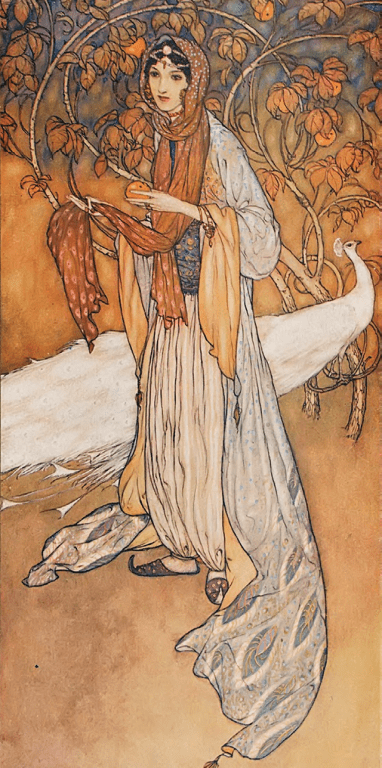
From “Stories from the Arabian Nights,” retold by Laurence Houseman, with drawings by Edmund Dulac
(Wikimedia Commons public domain image)
Some object to the Arabian Nights because certain of the stories are plainly misogynistic. And this is undeniably the case: You don’t need to go further to see it than the frame story itself, with King Shahriyar’s very negative opinion of the character of women and his plan to sleep with a different virgin every night and then kill her the following morning. And some object to them because they can be crude and even rather pornographic. (As I say, a number of the tales are very definitely not for children.)
But the fact is that Middle Eastern cultures have traditionally been extremely patriarchal, and the “misogynistic” tales in the Nights faithfully reflect their culture of origin. Indeed, in a curious way that is one of the reasons for reading them and, more generally, for reading texts that have been produced in cultures and times other than our own. One of the major points of reading literature is to see the world, if only briefly and imperfectly, through the eyes someone other — and sometimes radically other — than ourselves.
I’m not sympathetic to people who want to ban Mark Twain’s great novel Huckleberry Finn because of its use of “the n word.” First of all, if we’re going to understand the past we need to see it as it actually was. And secondly, in Twain’s case, his portrayal of Jim was astoundingly sympathetic for its day. That must not be forgotten.
But back to the Nights:
I’m reminded of an anecdote about the great Scottish-American orientalist Duncan Black MacDonald (1863-1943). He wrote extensively about Islam but, at least at the point in his life from which the anecdote comes, had never actually visited the Middle East. Somebody apparently asked him whether he didn’t consider that a serious defect in his background. Not really, he replied. He read the Arabian Nights every year.
That’s not actually as silly a response as many might initially think. A medievalist (like Professor MacDonald) can never actually visit the focus of his studies. The medieval Middle East is dead and gone. But he can learn very much about it and its attitudes and thought-patterns by reading its literature. And the Nights are remarkably useful in that way. Apart from the genies and wizards and the magic, they incorporate a vast amount of information about the assumptions and traditions and practices of the societies that produced them — both the good ones and the less praiseworthy ones. They are a remarkable window into the past.
Moreover, it must be said, not all of the tales in the Arabian Nights portray women as inferior or subordinate. (Don’t forget that the Nights are an anthology of tales from a wide variety of places and times. There is no single author or monolithic viewpoint.) Some tales, in fact, depict women as acting with remarkable freedom and autonomy and with extraordinary minds. You need go no further to see this than the frame story itself: Scheherazade is a woman of deep learning, with (the story says) a personal library consisting of “a thousand and one books.” She is resourceful and highly intelligent. And, in the end, in a very real way, she triumphs over King Shahriyar and brings him under her control.
Posted from Calgary, Alberta, Canada
Previous Post

July 29, 2019
Fauna in the Mountains Above Canmore
Next Post
July 29, 2019 Linking heaven and earth in Calgary
Browse Our Archives
Select a Category Uncategorized
Select a Month October 2026 September 2026 August 2026 July 2026 June 2026 May 2026 April 2026 March 2026 February 2026 January 2026 December 2025 November 2025 October 2025 September 2025 August 2025 July 2025 June 2025 May 2025 April 2025 March 2025 February 2025 January 2025 December 2024 November 2024 October 2024 September 2024 August 2024 July 2024 June 2024 May 2024 April 2024 March 2024 February 2024 January 2024 December 2023 November 2023 October 2023 September 2023 August 2023 July 2023 June 2023 May 2023 April 2023 March 2023 February 2023 January 2023 December 2022 November 2022 October 2022 September 2022 August 2022 July 2022 June 2022 May 2022 April 2022 March 2022 February 2022 January 2022 December 2021 November 2021 October 2021 September 2021 August 2021 July 2021 June 2021 May 2021 April 2021 March 2021 February 2021 January 2021 December 2020 November 2020 October 2020 September 2020 August 2020 July 2020 June 2020 May 2020 April 2020 March 2020 February 2020 January 2020 December 2019 November 2019 October 2019 September 2019 August 2019 July 2019 June 2019 May 2019 April 2019 March 2019 February 2019 January 2019 December 2018 November 2018 October 2018 September 2018 August 2018 July 2018 June 2018 May 2018 April 2018 March 2018 February 2018 January 2018 December 2017 November 2017 October 2017 September 2017 August 2017 July 2017 June 2017 May 2017 April 2017 March 2017 February 2017 January 2017 December 2016 November 2016 October 2016 September 2016 August 2016 July 2016 June 2016 May 2016 April 2016 March 2016 February 2016 January 2016 December 2015 November 2015 October 2015 September 2015 August 2015 July 2015 June 2015 May 2015 April 2015 March 2015 February 2015 January 2015 December 2014 November 2014 March 2014 August 2013 February 2012
Follow Us!
TAKE THE
Religious Wisdom Quiz
What does "Judas" mean in Greek?
Select your answer to see how you score.
Betrayer Deceiver Strong Praise
Related posts from Sic et Non

On Self-Absorption and Suppression: Though Not an Autobiographical...


Addendum 6: Founding the Middle Eastern Texts Initiative...

Against "tolerance," and "adieu" to teaching
TRENDING AT PATHEOS Latter-day Saint

The Real AI Story Is Adoption Without Trust
Artificial intelligence has crossed a political threshold. It is no longer a...

A new article, written by Jeff Lindsay and Gale L. Pooley,...

Swimfan: Forgotten Aughts Pleasures
This is a recovery effort. In 2002, My Big Fat Greek Wedding...

Top Three Anti-Catholic Lies About Catholicism
This is my initial transcript for the video, "THE 3 WORST...

Pope Leo Celebrates Mass for Nurses & Docs...
I don't have any idea how he did it, but Pope Leo...

The Sermon on the Mount, Part I: Matthew...
The Sermon on the Mount, Part I (Matthew 4:12-5:12) St. Matthew moves...
view all Latter-day Saint blogs
Ad-Free & Subscriber Log-In Subscription Support
- About Us
- 2026 Calendar
- Videos
- Podcasts
- Library of World Religions
- Faith In Media Tracker
- Advertise With Us
- Write for Us
- Privacy Policy
- Terms of Service
- Do Not Sell My Data
- Contact Us
- Radiant Digital
- Manage Newsletter Subscriptions
- Unsubscribe From Notifications
- Sitemap
Copyright 2008-2026, Patheos. All rights reserved.
Subscription Support Ad-Free & Subscriber Log-In
Follow Patheos