
BuddhistCatholicContemplativeEvangelicalGeneral ChristianHinduJewishLatter-day SaintMuslimNew VisionsProgressive Christian
Beliefs
- Buddhist
- Catholic
- Contemplative
- Evangelical
- General Christian
- Hindu
- Jewish
- Latter-day Saint
- More Voices
- Muslim
- New Visions
- Pagan
- Progressive Christian
Topics
- Religion News
- Food and Religion
- Sports and Religion
- Religious Art
- Religious Music and Entertainment
- Religious Events
- History and Religion
- Style and Religion
- Politics and Religion
- Women in Religion
- Recreation Outdoors and Religion
- Business Finance and Religion
- Careers Workplace and Religion
- Education and Religion
- Family Parenting and Religion
- Health Fitness and Religion
- Home and Religion
- Relationships and Religion
- Technology and Religion
- Travel and Religion
Columnists
- Buddhist Columnists
- Business Finance and Religion Columnists
- Careers Workplace and Religion Columnists
- Catholic Columnists
- Contemplative Columnists
- Education and Religion Columnists
- Evangelists Columnists
- Family Parenting and Religion Columnists
- General Christian Columnists
- Health Fitness and Religion Columnists
- Hindu Columnists
- History and Religion Columnists
- Home and Religion Columnists
- Jewish Columnists
- More Voices Columnists
- Latter Day Columnists
- Muslim Columnists
- New Visions Columnists
- Nonreligious Columnists
- Pagan Columnists
- Politics and Religion Columnists
- Progressive Columnists
- Recreation Outdoors and Religion Columnists
- Relationships and Religion Columnists
- Religion News Columnists
- Religious Art Columnists
- Religious Events Columnists
- Religious Music and Entertainment Columnists
- Sports and Religion Columnists
- Style and Religion Columnists
- Technology and Religion Columnists
- Travel and Religion Columnists
- Women in Religion Columnists
Resource Library
- 2026 Calendar
- Library of World Religions
- The 100 Most Holy Places on Earth
- Patheos Answers
- Podcasts
- Videos
- Faith Leaders Database
- Anglican Episcopalian
- Bahai
- Baptist
- Buddhism
- Christianity
- Confucianism
- Eastern Orthodoxy
- Hinduism
- Holiness and Pentecostal
- ISKCON
- Islam
- Judaism
- Lutheran
- Methodist
- The Church of Jesus Christ of Latter-day Saints
- New Age
- Paganism
- Presbytarian and Reformed
- Protestantism
- Religion Behind the Scenes
- Roman Catholic
- Scientology
- Shia Islam
- Sikhism
- Sufism
- Sunni Islam
- Taoism
- Zen
- See all religions
Research Tools
 Ad-Free & Subscriber Log-In Subscription Support
Ad-Free & Subscriber Log-In Subscription Support
Follow Patheos 

- Trending:
- Forgiveness
- |
- Marriage
- |
- Consciousness
- |
- Death Penalty
- |
- Election
- |
- Halloween

- Home
- Latter-day Saint
- A grotesquely obvious missed opportunity
A grotesquely obvious missed opportunity
Last updated on: July 6, 2019 at 2:23 pm by Dan Peterson
A grotesquely obvious missed opportunity 2019-07-06T14:23:19-06:00 Dan Peterson
Patheos Explore the world's faith through different perspectives on religion and spirituality! Patheos has the views of the prevalent religions and spiritualities of the world.
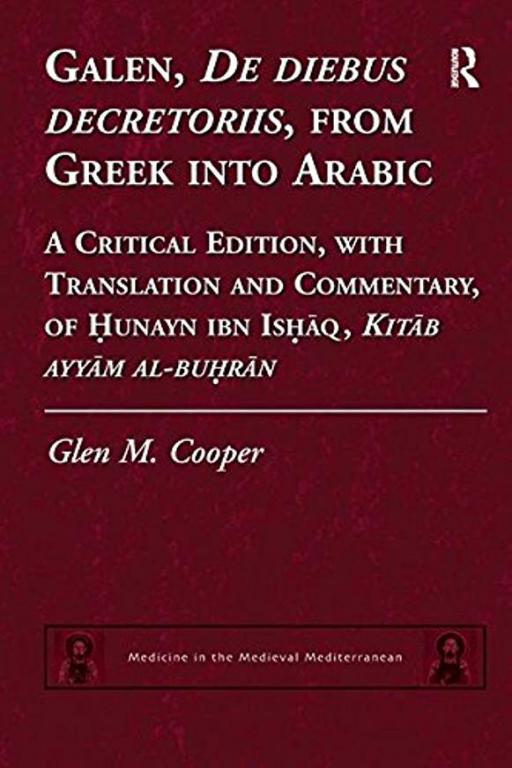
A book cover, from Amazon.com
I received a note the other day from my friend, former student, and former colleague Glen M. Cooper. He had just returned from Istanbul, where he was invited as a senior scholar to present a paper and to participate otherwise at an important three-day international conference there dedicated to the memory of a very distinguished Turkish scholar who recently passed away. Dr. Cooper was well received at the conference, as he deserved to be, and he was widely recognized, sheerly on the basis of his published scholarship. The mayor of Bergama (the ancient library and academic city of “Pergamon”) even invited him to address this year’s Bergama Festival as an expert on the great second-century AD physician Galen, who was a native of the city.
Dr. Cooper is among the most remarkable scholars ever produced within the Latter-day Saint community. His mastery of Greek and Arabic and other relevant languages — he served a Chinese-speaking mission — combined with expertise in ancient physics and astronomy and medicine and Islamic history and classical studies, is world class. His polyglot and multicultural erudition is rivaled by very few people on the planet:
“Professor Glen Cooper brings expertise in late antique Middle Eastern, European studies to CMC”
Here’s a description of the book whose cover appears above, which not only treats Galen but Hunayn ibn Ishaq, arguably the greatest of all medieval Arabic translators:
This volume presents the first edition of the Arabic translation, by Hunayn ibn Ishaq, of Galen’s Critical Days (De diebus decretoriis), together with the first translation of the text into a modern language. The substantial introduction contextualizes the treatise within the Greek and Arabic traditions. Galen’s Critical Days was a founding text of astrological medicine. In febrile illnesses, the critical days are the days on which an especially severe pattern of symptoms, a crisis, was likely to occur. The crisis was thought to expel the disease-producing substances from the body. If its precise timing were known, the physician could prepare the patient so that the crisis would be most beneficial. After identifying the critical days based on empirical data and showing how to use them in therapy, Galen explains the critical days via the moon’s influence. In the historical introduction Glen Cooper discusses the translation of the Critical Days in Arabic, and adumbrates its possible significance in the intellectual debates and political rivalries among the 9th-century Baghdad elite. It is argued that Galen originally composed the Critical Days both to confound the Skeptics of his own day and to refute a purely mathematical, rationalist approach to science. These features made the text useful in the rivalries between Baghdad scholars. Al-Kindi (d.c. 866) famously propounded a mathematical approach to science akin to the latter. The scholar-bureaucrat responsible for funding this translation, Muhammad ibn Musa (d. 873), al-Kindi’s nemesis, may have found the treatise useful in refuting that approach. The commentary and notes to the facing page translation address issues of translation, as well as important concepts.
As of today, though, Glen Cooper is an unaffiliated, independent scholar. He finds himself lacking institutional support, with no decent space to work, no library access, no office, with most of his books in storage, and with several projects in progress. He is very possibly better known in Europe and the Middle East than he is in his own neighborhood.
It is deeply sad — very deeply sad — that he lacks an academic appointment. It is beyond ridiculous that this remarkably learned man, an active and believing Latter-day Saint who lives within just a few miles of Brigham Young University, has no status on the BYU campus.
Part of the problem, I suppose, is that his field of specialization — the history of Greco-Arabic science — falls between the stools created by the neat compartmentalization of contemporary academic organization. What he does isn’t quite physics. It’s certainly not astronomy or medicine. And it’s not diplomatic history or political history, let alone the history of what one of my friends calls “forts, camps, and trails.”
So everybody thinks that he should be hired, that he belongs on campus somewhere, but no particular department wants to give up one of its own hard-won and badly needed faculty positions in order to hire him.
If I had the money or the power, though, Dr. Glen Cooper would occupy a professorial chair at Brigham Young University. His work would bring international acclaim to the University and would reflect well, indirectly, on its sponsor, the Church of Jesus Christ of Latter-day Saints. We Latter-day Saints have an image in many circles as earnest, nice, and rather empty-headed religious obscurantists. Even beyond the considerable intrinsic merit of his scholarly work, Glen Cooper provides as good a counterexample to that image as anybody I know.
Previous Post

July 6, 2019
"The conquest of the deadly flux of time"
Next Post
July 6, 2019 "Studied all about it. Didn't worry me then. Doesn't worry me now."
Browse Our Archives
Select a Category Uncategorized
Select a Month October 2026 September 2026 August 2026 July 2026 June 2026 May 2026 April 2026 March 2026 February 2026 January 2026 December 2025 November 2025 October 2025 September 2025 August 2025 July 2025 June 2025 May 2025 April 2025 March 2025 February 2025 January 2025 December 2024 November 2024 October 2024 September 2024 August 2024 July 2024 June 2024 May 2024 April 2024 March 2024 February 2024 January 2024 December 2023 November 2023 October 2023 September 2023 August 2023 July 2023 June 2023 May 2023 April 2023 March 2023 February 2023 January 2023 December 2022 November 2022 October 2022 September 2022 August 2022 July 2022 June 2022 May 2022 April 2022 March 2022 February 2022 January 2022 December 2021 November 2021 October 2021 September 2021 August 2021 July 2021 June 2021 May 2021 April 2021 March 2021 February 2021 January 2021 December 2020 November 2020 October 2020 September 2020 August 2020 July 2020 June 2020 May 2020 April 2020 March 2020 February 2020 January 2020 December 2019 November 2019 October 2019 September 2019 August 2019 July 2019 June 2019 May 2019 April 2019 March 2019 February 2019 January 2019 December 2018 November 2018 October 2018 September 2018 August 2018 July 2018 June 2018 May 2018 April 2018 March 2018 February 2018 January 2018 December 2017 November 2017 October 2017 September 2017 August 2017 July 2017 June 2017 May 2017 April 2017 March 2017 February 2017 January 2017 December 2016 November 2016 October 2016 September 2016 August 2016 July 2016 June 2016 May 2016 April 2016 March 2016 February 2016 January 2016 December 2015 November 2015 October 2015 September 2015 August 2015 July 2015 June 2015 May 2015 April 2015 March 2015 February 2015 January 2015 December 2014 November 2014 March 2014 August 2013 February 2012
Follow Us!
TAKE THE
Religious Wisdom Quiz
How did Jesus provide for the temple tax?
Select your answer to see how you score.
He multiplied bread A coin in a fish's mouth He borrowed from Judas Found in a tree
Related posts from Sic et Non

Looking at the Largest Orthodox Cathedral on Earth

The Iron Gates and the Lion of the...


Learning more about a region of which I've...
TRENDING AT PATHEOS Latter-day Saint

Looking at the Largest Orthodox Cathedral on Earth
There is often a considerable amount of anger and, shall we...

The Problem with False Prophets
Miller’s Station UMC| 10/18/26| Anchor Verse: Jeremiah 23: 1, 9-23 I...

Emotion in Early Christianity by Andrew Crislip
Andrew Crislip’s Emotion in Early Christianity examines an often overlooked dimension of...

16 Spiritual Touchstones for a More Grounded Life
After decades of spiritual study, here are 16 principles I try...

Catholic Evangelization: Sharing Your Faith Every Day
Welcome back to the Graceful Awakening mini-series called, “From Faith to Mission.” ...

The Pillar of the Boatmen: the Ancient Monument...
The Pillar of the Boatmen is a Romano-Gaulish sculpture that dates from...
view all Latter-day Saint blogs
Ad-Free & Subscriber Log-In Subscription Support
- About Us
- 2026 Calendar
- Videos
- Podcasts
- Library of World Religions
- Faith In Media Tracker
- Advertise With Us
- Write for Us
- Privacy Policy
- Terms of Service
- Do Not Sell My Data
- Contact Us
- Radiant Digital
- Manage Newsletter Subscriptions
- Unsubscribe From Notifications
- Sitemap
Copyright 2008-2026, Patheos. All rights reserved.
Subscription Support Ad-Free & Subscriber Log-In
Follow Patheos