
BuddhistCatholicContemplativeEvangelicalGeneral ChristianHinduJewishLatter-day SaintMuslimNew VisionsProgressive Christian
Beliefs
- Buddhist
- Catholic
- Contemplative
- Evangelical
- General Christian
- Hindu
- Jewish
- Latter-day Saint
- More Voices
- Muslim
- New Visions
- Pagan
- Progressive Christian
Topics
- Religion News
- Food and Religion
- Sports and Religion
- Religious Art
- Religious Music and Entertainment
- Religious Events
- History and Religion
- Style and Religion
- Politics and Religion
- Women in Religion
- Recreation Outdoors and Religion
- Business Finance and Religion
- Careers Workplace and Religion
- Education and Religion
- Family Parenting and Religion
- Health Fitness and Religion
- Home and Religion
- Relationships and Religion
- Technology and Religion
- Travel and Religion
Columnists
- Buddhist Columnists
- Business Finance and Religion Columnists
- Careers Workplace and Religion Columnists
- Catholic Columnists
- Contemplative Columnists
- Education and Religion Columnists
- Evangelists Columnists
- Family Parenting and Religion Columnists
- General Christian Columnists
- Health Fitness and Religion Columnists
- Hindu Columnists
- History and Religion Columnists
- Home and Religion Columnists
- Jewish Columnists
- More Voices Columnists
- Latter Day Columnists
- Muslim Columnists
- New Visions Columnists
- Nonreligious Columnists
- Pagan Columnists
- Politics and Religion Columnists
- Progressive Columnists
- Recreation Outdoors and Religion Columnists
- Relationships and Religion Columnists
- Religion News Columnists
- Religious Art Columnists
- Religious Events Columnists
- Religious Music and Entertainment Columnists
- Sports and Religion Columnists
- Style and Religion Columnists
- Technology and Religion Columnists
- Travel and Religion Columnists
- Women in Religion Columnists
Resource Library
- 2026 Calendar
- Library of World Religions
- The 100 Most Holy Places on Earth
- Patheos Answers
- Podcasts
- Videos
- Faith Leaders Database
- Anglican Episcopalian
- Bahai
- Baptist
- Buddhism
- Christianity
- Confucianism
- Eastern Orthodoxy
- Hinduism
- Holiness and Pentecostal
- ISKCON
- Islam
- Judaism
- Lutheran
- Methodist
- The Church of Jesus Christ of Latter-day Saints
- New Age
- Paganism
- Presbytarian and Reformed
- Protestantism
- Religion Behind the Scenes
- Roman Catholic
- Scientology
- Shia Islam
- Sikhism
- Sufism
- Sunni Islam
- Taoism
- Zen
- See all religions
Research Tools
 Ad-Free & Subscriber Log-In Subscription Support
Ad-Free & Subscriber Log-In Subscription Support
Follow Patheos 

- Trending:
- Forgiveness
- |
- Marriage
- |
- Consciousness
- |
- Death Penalty
- |
- Election
- |
- Halloween

- Home
- Latter-day Saint
- Where fish were processed and apostles called on the Sea of Galilee
Where fish were processed and apostles called on the Sea of Galilee
Last updated on: May 4, 2019 at 12:11 pm by Dan Peterson
Where fish were processed and apostles called on the Sea of Galilee 2019-05-04T12:11:15-06:00 Dan Peterson
Patheos Explore the world's faith through different perspectives on religion and spirituality! Patheos has the views of the prevalent religions and spiritualities of the world.
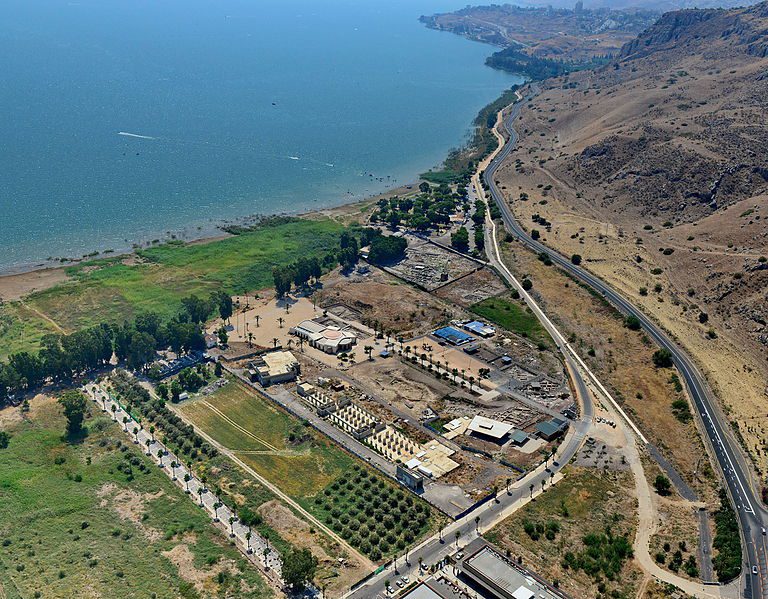
An aerial view of Magdala, on the western shore of the Sea of Galilee, as it appeared in August 2015. The remains of the first-century synagogue are under the light-colored shade roof slightly below and to the right of the center of the photograph. (Wikimedia Commons public domain image)
Bill Hamblin and I published the following column in the Deseret News on 28 April 2017:
When Jesus was born, the largest and most important city on the Sea of Galilee was Magdala — perhaps the same town as the New Testament’s “Dalmanutha” and “Magadan” — on the western shore.
Josephus’ “Jewish War” says that the Roman general Cassius (later one of the assassins of Julius Caesar) took 30,000 captives from Taricheae, as Magdala was known to classical authors. That number may be exaggerated but, plainly, the town was sizable.
The name “Taricheae” derives from the Greek word “tarichos,” which refers to salted, smoked, or dried meat (especially fish). The Greek geographer Strabo (d. A.D. 24) commented on the town’s excellent fish, which were very highly regarded even in the markets of Rome.
Around A.D. 20, however, Magdala’s status would be threatened when the Roman client-king Herod Antipas, son of Herod the Great, founded a new city called Tiberias — which he named in flattery of the emperor Tiberius Caesar.
But Magdala wasn’t overshadowed immediately, and its connection with Christianity guarantees that it will never be wholly eclipsed. It is, for example, very likely the place from which Mary Magdalene received her name. Moreover, as observed in the Biblical Archaeology Review by Marcela Zapata-Meza and Rosaura Sanz-Rincón of the Universidad Anáhuac México, which conducts archaeological research there, “Although there is no archaeological evidence that Jesus visited Magdala, it is almost certain that he did.”
Why? Not only because of Mary Magdalene. Referring to the Galilee region generally, Matthew 9:35 tells us that “Jesus went about all the cities and villages, teaching in their synagogues, and preaching the gospel of the kingdom, and healing every sickness and every disease among the people.” In 2009, during the construction of a new hotel, a small first-century synagogue was discovered at Magdala. We can be quite confident that Jesus preached in that newly found synagogue.
The verses immediately following Matthew 9:35 read as follows:
“But when he saw the multitudes, he was moved with compassion on them, because they fainted, and were scattered abroad, as sheep having no shepherd. Then saith he unto his disciples, The harvest truly is plenteous, but the labourers are few; pray ye therefore the Lord of the harvest, that he will send forth labourers into his harvest” (see Matthew 9:36-38).
An intriguing article published by S. Kent Brown, a retired Brigham Young University New Testament scholar with many years of experience in Israel and the region around it, suggests that Jesus took practical action to recruit more workers for his cause, and that Magdala or Taricheae may have played a central part in that (see “The Savior’s Compassion,” Ensign, March 2011).
Capernaum, where the future apostles Simon Peter, Andrew, James, John and Matthew lived, sits approximately six miles northward along the lake shore. It was a fishing village of perhaps about 1,500 people, and boats regularly set out from it onto what the New Testament sometimes calls “the lake of Gennesaret.”
The story to which Brown calls attention is the account, often called “the miraculous draught of fishes,” recounted at Luke 5:1-11. They had had no luck, but Jesus tells Peter and his associates to cast their net one more time. Doubtful, but already deeply impressed with Jesus, they do so and now they gather so many fish that their two boats nearly sink with the weight of the catch.
Verse 11 concludes the story by saying that, “when they had brought their ships to land, they forsook all, and followed him.”
But surely they didn’t just wastefully leave all those fish aboard their boats. Instead, Brown suggests, they would have taken the fish for processing — very likely to Magdala (or Taricheae), the most important center for such work in the area. A catch of fish as large as Luke describes would have sustained the families of the fishermen for months, if not for perhaps even a year or two.
Jesus would shortly call these men to leave their familiar Galilee in order to be “fishers of men” (Matthew 4:19). So the miracle of the wondrous catch of fish may have been not only intended to demonstrate Christ’s power over nature but designed as a practical measure to care for the apostles’ families while they were away.
Previous Post

May 3, 2019
Innocent Abroad
Next Post
May 4, 2019 Whatever happened to fasting among the Latter-day Saints?
Browse Our Archives
Select a Category Uncategorized
Select a Month October 2026 September 2026 August 2026 July 2026 June 2026 May 2026 April 2026 March 2026 February 2026 January 2026 December 2025 November 2025 October 2025 September 2025 August 2025 July 2025 June 2025 May 2025 April 2025 March 2025 February 2025 January 2025 December 2024 November 2024 October 2024 September 2024 August 2024 July 2024 June 2024 May 2024 April 2024 March 2024 February 2024 January 2024 December 2023 November 2023 October 2023 September 2023 August 2023 July 2023 June 2023 May 2023 April 2023 March 2023 February 2023 January 2023 December 2022 November 2022 October 2022 September 2022 August 2022 July 2022 June 2022 May 2022 April 2022 March 2022 February 2022 January 2022 December 2021 November 2021 October 2021 September 2021 August 2021 July 2021 June 2021 May 2021 April 2021 March 2021 February 2021 January 2021 December 2020 November 2020 October 2020 September 2020 August 2020 July 2020 June 2020 May 2020 April 2020 March 2020 February 2020 January 2020 December 2019 November 2019 October 2019 September 2019 August 2019 July 2019 June 2019 May 2019 April 2019 March 2019 February 2019 January 2019 December 2018 November 2018 October 2018 September 2018 August 2018 July 2018 June 2018 May 2018 April 2018 March 2018 February 2018 January 2018 December 2017 November 2017 October 2017 September 2017 August 2017 July 2017 June 2017 May 2017 April 2017 March 2017 February 2017 January 2017 December 2016 November 2016 October 2016 September 2016 August 2016 July 2016 June 2016 May 2016 April 2016 March 2016 February 2016 January 2016 December 2015 November 2015 October 2015 September 2015 August 2015 July 2015 June 2015 May 2015 April 2015 March 2015 February 2015 January 2015 December 2014 November 2014 March 2014 August 2013 February 2012
Follow Us!
TAKE THE
Religious Wisdom Quiz
What was the primary conflict resolution method in Biblical times?
Select your answer to see how you score.
Public debate Lottery Elder council Sword fight
Related posts from Sic et Non

The Iron Gates and the Lion of the...


Learning more about a region of which I've...

From Serbia's "White City," Belgrade
TRENDING AT PATHEOS Latter-day Saint

The Problem with False Prophets
Miller’s Station UMC| 10/18/26| Anchor Verse: Jeremiah 23: 1, 9-23 I...

Emotion in Early Christianity by Andrew Crislip
Andrew Crislip’s Emotion in Early Christianity examines an often overlooked dimension of...

16 Spiritual Touchstones for a More Grounded Life
After decades of spiritual study, here are 16 principles I try...

Catholic Evangelization: Sharing Your Faith Every Day
Welcome back to the Graceful Awakening mini-series called, “From Faith to Mission.” ...

The Pillar of the Boatmen: the Ancient Monument...
The Pillar of the Boatmen is a Romano-Gaulish sculpture that dates from...

In one sense walking into Westminster Abbey is like walking down the...
view all Latter-day Saint blogs
Ad-Free & Subscriber Log-In Subscription Support
- About Us
- 2026 Calendar
- Videos
- Podcasts
- Library of World Religions
- Faith In Media Tracker
- Advertise With Us
- Write for Us
- Privacy Policy
- Terms of Service
- Do Not Sell My Data
- Contact Us
- Radiant Digital
- Manage Newsletter Subscriptions
- Unsubscribe From Notifications
- Sitemap
Copyright 2008-2026, Patheos. All rights reserved.
Subscription Support Ad-Free & Subscriber Log-In
Follow Patheos