
BuddhistCatholicContemplativeEvangelicalGeneral ChristianHinduJewishLatter-day SaintMuslimNew VisionsProgressive Christian
Beliefs
- Buddhist
- Catholic
- Contemplative
- Evangelical
- General Christian
- Hindu
- Jewish
- Latter-day Saint
- More Voices
- Muslim
- New Visions
- Pagan
- Progressive Christian
Topics
- Religion News
- Food and Religion
- Sports and Religion
- Religious Art
- Religious Music and Entertainment
- Religious Events
- History and Religion
- Style and Religion
- Politics and Religion
- Women in Religion
- Recreation Outdoors and Religion
- Business Finance and Religion
- Careers Workplace and Religion
- Education and Religion
- Family Parenting and Religion
- Health Fitness and Religion
- Home and Religion
- Relationships and Religion
- Technology and Religion
- Travel and Religion
Columnists
- Buddhist Columnists
- Business Finance and Religion Columnists
- Careers Workplace and Religion Columnists
- Catholic Columnists
- Contemplative Columnists
- Education and Religion Columnists
- Evangelists Columnists
- Family Parenting and Religion Columnists
- General Christian Columnists
- Health Fitness and Religion Columnists
- Hindu Columnists
- History and Religion Columnists
- Home and Religion Columnists
- Jewish Columnists
- More Voices Columnists
- Latter Day Columnists
- Muslim Columnists
- New Visions Columnists
- Nonreligious Columnists
- Pagan Columnists
- Politics and Religion Columnists
- Progressive Columnists
- Recreation Outdoors and Religion Columnists
- Relationships and Religion Columnists
- Religion News Columnists
- Religious Art Columnists
- Religious Events Columnists
- Religious Music and Entertainment Columnists
- Sports and Religion Columnists
- Style and Religion Columnists
- Technology and Religion Columnists
- Travel and Religion Columnists
- Women in Religion Columnists
Resource Library
- 2026 Calendar
- Library of World Religions
- The 100 Most Holy Places on Earth
- Patheos Answers
- Podcasts
- Videos
- Faith Leaders Database
- Anglican Episcopalian
- Bahai
- Baptist
- Buddhism
- Christianity
- Confucianism
- Eastern Orthodoxy
- Hinduism
- Holiness and Pentecostal
- ISKCON
- Islam
- Judaism
- Lutheran
- Methodist
- The Church of Jesus Christ of Latter-day Saints
- New Age
- Paganism
- Presbytarian and Reformed
- Protestantism
- Religion Behind the Scenes
- Roman Catholic
- Scientology
- Shia Islam
- Sikhism
- Sufism
- Sunni Islam
- Taoism
- Zen
- See all religions
Research Tools
 Ad-Free & Subscriber Log-In Subscription Support
Ad-Free & Subscriber Log-In Subscription Support
Follow Patheos 

- Trending:
- Forgiveness
- |
- Marriage
- |
- Consciousness
- |
- Death Penalty
- |
- Election
- |
- Halloween

- Home
- Latter-day Saint
- On the so-called “Pilate Stone” in Israel’s Caesarea-by-the-Sea
On the so-called “Pilate Stone” in Israel’s Caesarea-by-the-Sea
Last updated on: May 2, 2019 at 9:09 pm by Dan Peterson
On the so-called “Pilate Stone” in Israel’s Caesarea-by-the-Sea 2019-05-02T21:09:18-06:00 Dan Peterson
Patheos Explore the world's faith through different perspectives on religion and spirituality! Patheos has the views of the prevalent religions and spiritualities of the world.
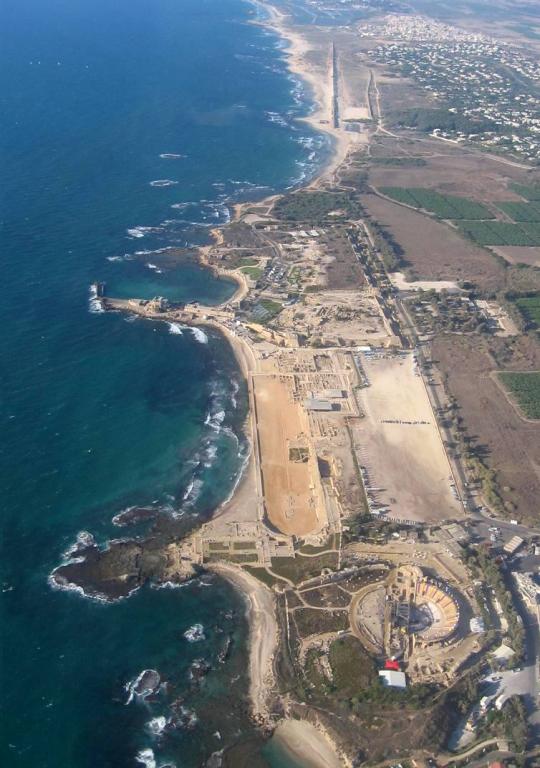
An aerial view of Caesarea Maritima. The hippodrome or chariot racing track is prominently visible, as is the Roman theater. Herod’s palace stood on the promontory or peninsula that extends out into the sea at the southern end of the hippodrome. This was the official residence, later, of Pontius Pilate, and, later still, the apostle Paul was imprisoned here and questioned by Felix and Agrippa.
(Wikimedia Commons public domain image)
I published the column below in the Deseret News on 3 May 2018:
Until the summer of 1961, absolutely no archaeological evidence existed that would demonstrate that Pontius Pilate, a pivotal figure in the New Testament gospels, ever really existed. Some literary sources mention him — including a few brief allusions in Jewish material (e.g., Josephus) and in late Roman chronicles (e.g., Tacitus) — but no administrative records survive from him and no genuine letters of his have been preserved. Plenty of Roman ruins exist in Israel, but none bears his name, and a historical Pilate isn’t required to account for them.
He has loomed large in subsequent Christian thought and legend. One thinks, for example, of the memorable opening line of Sir Francis Bacon’s early 17th-century essay “Of truth”: “What is truth? said jesting Pilate, and would not stay for an answer.”
But did he really even exist? Critics eager to dismiss the New Testament Gospels as imaginative fiction (along with their accounts of the life, death and resurrection of Jesus Christ) were only too happy to point to the lack of evidence for Pilate as support for their broader dismissal.
In June 1961, however, while working in the Mediterranean seaside ruins of Caesarea Maritima, a team led by the Italian archaeologist Antonio Frova found a sizable piece of limestone — slightly more than 0.8 meters wide and somewhat less than 0.7 meters high — that bears the name of “Pontius Pilatus.” The Latin inscription read as follows:
To the Divine Augusti (this) Tiberieum
… Pontius Pilate
… prefect of Judea
… has dedicated (this)
Pontius Pilate most likely made his headquarters at Caesarea Maritima, travelling up to Jerusalem only when he had to do so. (From a cynical Roman leader’s point of view, Jerusalem was a virtually ungovernable den of incomprehensible religious fanatics, while Caesarea possessed and still retains the charm that could easily have made it the site of a beautiful coastal resort.)
The inscription says that Pilate had built a “Tiberieum” — evidently a temple in or near Caesarea dedicated to the then-reigning Roman emperor, Tiberius, who ruled from A.D. 14 to A.D. 37. Plainly, as others also did, Pilate was seeking to flatter the emperor. (Herod Antipas, the son of Herod the Great, had founded the important city of Tiberias, on the western shore of the Sea of Galilee, in Tiberius’ honor sometime around A.D. 20.)
This fact perhaps explains the power over Pilate of the implicit threat from Jesus’ Jewish accusers, as recorded in John 19:12: When Pilate wanted to release Jesus, “the Jews cried out, saying, If thou let this man go, thou art not Caesar’s friend.”
The so-called “Pilate Stone” is historically significant because it dates to Pilate’s own lifetime. It is contemporary evidence. Yet — powerfully illustrating the distinctly random nature of archaeological discovery — the excavators could easily have missed it, simply discarding it as rubble. By the fourth century, it had been incorporated into a set of stairs in Caesarea’s Herodian theater. There, the inscription faced downward — fortunately, because that position preserved it from being worn away.
The “divine Augusti” to whom the dedication refers are the late (deified) Augustus Caesar (reigned 27 B.C. to A.D. 14) and his wife Livia, who were, respectively, the stepfather and the mother of Tiberius. The inscription identifies Pontius Pilate as the “prefect” of Judea, a title that seems to connote not only a governmental or administrative role but a military one — which seems to fit the brief literary references to his career.
A replica of the “Pilate Stone” stands directly to the east of Caesarea’s “Palace of the Procurators” — a place of enormous New Testament interest in its own right, where the apostle Paul was imprisoned for over two years under the Roman governors Felix and Festus (Acts 23:31-35; 24:27) and where he made his famous speech before Festus and Agrippa (as recorded in Acts 26) — while the original stone itself is located at Jerusalem’s Israel Museum, where it is protected from erosion and other damage.
It is, quite simply, no longer tenable to argue that Pontius Pilate never existed. And, while Pilate’s demonstrable reality certainly doesn’t prove that Jesus rose from the dead or atoned for our sins, or that he merits our devotion as our divine Lord, it constitutes an important part of a cumulative case for the reliability of the gospel accounts — which do, in fact, assert all of those things. In answer to Pilate’s question “What is truth?” (John 18:38), the New Testament declares that Jesus himself is (John 14:6).
Posted from Tel Aviv, Israel
Previous Post

May 2, 2019
New Testament Note 267
Next Post
May 3, 2019 "Joseph Smith: The World’s Greatest Guesser"
Browse Our Archives
Select a Category Uncategorized
Select a Month October 2026 September 2026 August 2026 July 2026 June 2026 May 2026 April 2026 March 2026 February 2026 January 2026 December 2025 November 2025 October 2025 September 2025 August 2025 July 2025 June 2025 May 2025 April 2025 March 2025 February 2025 January 2025 December 2024 November 2024 October 2024 September 2024 August 2024 July 2024 June 2024 May 2024 April 2024 March 2024 February 2024 January 2024 December 2023 November 2023 October 2023 September 2023 August 2023 July 2023 June 2023 May 2023 April 2023 March 2023 February 2023 January 2023 December 2022 November 2022 October 2022 September 2022 August 2022 July 2022 June 2022 May 2022 April 2022 March 2022 February 2022 January 2022 December 2021 November 2021 October 2021 September 2021 August 2021 July 2021 June 2021 May 2021 April 2021 March 2021 February 2021 January 2021 December 2020 November 2020 October 2020 September 2020 August 2020 July 2020 June 2020 May 2020 April 2020 March 2020 February 2020 January 2020 December 2019 November 2019 October 2019 September 2019 August 2019 July 2019 June 2019 May 2019 April 2019 March 2019 February 2019 January 2019 December 2018 November 2018 October 2018 September 2018 August 2018 July 2018 June 2018 May 2018 April 2018 March 2018 February 2018 January 2018 December 2017 November 2017 October 2017 September 2017 August 2017 July 2017 June 2017 May 2017 April 2017 March 2017 February 2017 January 2017 December 2016 November 2016 October 2016 September 2016 August 2016 July 2016 June 2016 May 2016 April 2016 March 2016 February 2016 January 2016 December 2015 November 2015 October 2015 September 2015 August 2015 July 2015 June 2015 May 2015 April 2015 March 2015 February 2015 January 2015 December 2014 November 2014 March 2014 August 2013 February 2012
Follow Us!
TAKE THE
Religious Wisdom Quiz
Who said, "What must I do to be saved?"
Select your answer to see how you score.
The Philippian jailer Nicodemus Zacchaeus Peter
Related posts from Sic et Non

Some notes on the archaeology of the Bible

An action movie and some vacuous theology

"The World's Sixteen Crucified Saviors"?
"The Loss of Jesus in the Small Plates...
TRENDING AT PATHEOS Latter-day Saint

'Super Scam Me' Exposes AI Jon Bon Jovi...
Leslie Pickett believed she was in a relationship with Jon Bon Jovi....

The Brazilian Remake of Kendricks' 'Flywheel' Opens in...
“Flywheel,” the story that launched the Kendrick Brothers’ filmmaking career is getting...

The Dangers of Gradual Accommodation (Winking at Sin)
Recently, the “law of gradualness” resurfaced during the opening of a weeklong,...

The Iron Gates and the Lion of the...
Yesterday, I didn't finish my report about, well, yesterday. So I'll...

The Image: On the Horror of Capitalism and...
The Image Then went the Pharisees, and took counsel how they might...

We are approaching the date of our new American national holiday: October...
view all Latter-day Saint blogs
Ad-Free & Subscriber Log-In Subscription Support
- About Us
- 2026 Calendar
- Videos
- Podcasts
- Library of World Religions
- Faith In Media Tracker
- Advertise With Us
- Write for Us
- Privacy Policy
- Terms of Service
- Do Not Sell My Data
- Contact Us
- Radiant Digital
- Manage Newsletter Subscriptions
- Unsubscribe From Notifications
- Sitemap
Copyright 2008-2026, Patheos. All rights reserved.
Subscription Support Ad-Free & Subscriber Log-In
Follow Patheos