
BuddhistCatholicContemplativeEvangelicalGeneral ChristianHinduJewishLatter-day SaintMuslimNew VisionsProgressive Christian
Beliefs
- Buddhist
- Catholic
- Contemplative
- Evangelical
- General Christian
- Hindu
- Jewish
- Latter-day Saint
- More Voices
- Muslim
- New Visions
- Pagan
- Progressive Christian
Topics
- Religion News
- Food and Religion
- Sports and Religion
- Religious Art
- Religious Music and Entertainment
- Religious Events
- History and Religion
- Style and Religion
- Politics and Religion
- Women in Religion
- Recreation Outdoors and Religion
- Business Finance and Religion
- Careers Workplace and Religion
- Education and Religion
- Family Parenting and Religion
- Health Fitness and Religion
- Home and Religion
- Relationships and Religion
- Technology and Religion
- Travel and Religion
Columnists
- Buddhist Columnists
- Business Finance and Religion Columnists
- Careers Workplace and Religion Columnists
- Catholic Columnists
- Contemplative Columnists
- Education and Religion Columnists
- Evangelists Columnists
- Family Parenting and Religion Columnists
- General Christian Columnists
- Health Fitness and Religion Columnists
- Hindu Columnists
- History and Religion Columnists
- Home and Religion Columnists
- Jewish Columnists
- More Voices Columnists
- Latter Day Columnists
- Muslim Columnists
- New Visions Columnists
- Nonreligious Columnists
- Pagan Columnists
- Politics and Religion Columnists
- Progressive Columnists
- Recreation Outdoors and Religion Columnists
- Relationships and Religion Columnists
- Religion News Columnists
- Religious Art Columnists
- Religious Events Columnists
- Religious Music and Entertainment Columnists
- Sports and Religion Columnists
- Style and Religion Columnists
- Technology and Religion Columnists
- Travel and Religion Columnists
- Women in Religion Columnists
Resource Library
- 2026 Calendar
- Library of World Religions
- The 100 Most Holy Places on Earth
- Patheos Answers
- Podcasts
- Videos
- Faith Leaders Database
- Anglican Episcopalian
- Bahai
- Baptist
- Buddhism
- Christianity
- Confucianism
- Eastern Orthodoxy
- Hinduism
- Holiness and Pentecostal
- ISKCON
- Islam
- Judaism
- Lutheran
- Methodist
- The Church of Jesus Christ of Latter-day Saints
- New Age
- Paganism
- Presbytarian and Reformed
- Protestantism
- Religion Behind the Scenes
- Roman Catholic
- Scientology
- Shia Islam
- Sikhism
- Sufism
- Sunni Islam
- Taoism
- Zen
- See all religions
Research Tools
 Ad-Free & Subscriber Log-In Subscription Support
Ad-Free & Subscriber Log-In Subscription Support
Follow Patheos 

- Trending:
- Forgiveness
- |
- Marriage
- |
- Consciousness
- |
- Death Penalty
- |
- Election
- |
- Halloween

- Home
- Latter-day Saint
- New Testament Notes 218-222
New Testament Notes 218-222
Last updated on: April 18, 2019 at 12:26 am by Dan Peterson
New Testament Notes 218-222 2019-04-18T00:26:26-06:00 Dan Peterson
Patheos Explore the world's faith through different perspectives on religion and spirituality! Patheos has the views of the prevalent religions and spiritualities of the world.

Salt crystals (Wikimedia Commons pubic domain image)
Compare 5:13; Mark 9:49-50
If we become bland, wholly conformed to the society and culture around us, in complete sync with surrounding social trends and current fashions, thinking just the thoughts that everybody around us thinks, desperately trying to ape the socio-cultural elite, there’s no reason for us to exist and no reason to call us the Church.

A flock of sheep –perhaps even, judging from the background, in Utah
(Wikimedia Commons public domain image)
Compare Matthew 18:12-14
There are at least three points to be drawn from these brief passages:
1) The Lord really, really values the souls of individual people; there is nobody, not even the most unrighteous, for whom he has no concern. (This works powerfully, I think, against certain Calvinistic suggestions that he essentially created some people for the purpose of damning them.)
2) Christians aren’t supposed to interact solely with “the righteous.” If we’re to reach out, we’re to do it even to people whom we might regard as unlikely to accept the Gospel. They might well surprise us. (I know that I’ve been surprised. More than once.)
3) On one level, these parables seem to apply to people whom the Lord has lost. They’re his strayed children. (See the parable of the Prodigal Son, coming up next at Luke 15:11-32.) Taken that way, these parables charter missionary work and evangelization, taking the Gospel to people who haven’t heard it. (See Matthew 9:36-38.) However, they might just as well be taken as applying to those who’ve once known the Gospel but have gone missing. In that sense, these little vignettes support reaching out to those who’ve rejected their covenants and abandoned their former beliefs. Again, we’re to reach out even to people whom we might regard as unlikely to accept our message. They might well surprise us. I’ve been surprised on several occasions to see once embittered people return to full belief and fellowship.
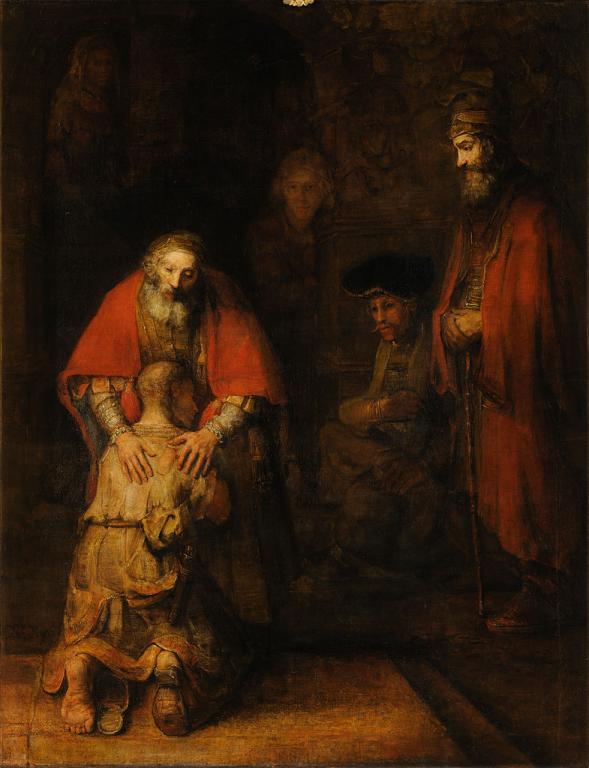
Rembrandt, “Return of the Prodigal Son” (ca. 1668)
Wikimedia Commons public domain
This is, of course, one of the great parables in the New Testament, and, if I may say so, one of the great stories in all of literature.
It has at least two themes:
1) It illustrates the mercy, forgiveness, and love of the father/Father.
2) It warns against smug self-righteousness and self-centeredness among those who’re trying to be disciples.
It would be important for either of those themes.

A Jan Luyken etching of the New Testament parable of the unjust servant or steward
(Wikimedia Commons public domain image)
This is one of the weirder passages in the Gospels.
Is Jesus really commending what is, by just about any standard, unethical behavior?
I think that’s extremely unlikely.
What he is clearly praising, though, is worldly wisdom, prudence — canniness, if you will. Competence in real life. Functioning.
Disciples of Christ are not to be fools. They’re to be fully in the world, while, of course, not being of the world. They’re to be able to negotiate real life as well as non-Christians do while at the same time being fully Christian.
Perhaps the Incarnation of Jesus is a parallel to this, in a way. He was fully divine, and his Kingdom was not of this world. But he was fully human, too.
Previous Post

April 16, 2019
An Easter sermon from more than sixteen centuries ago
Next Post
April 17, 2019 "Infected with doubt"
Browse Our Archives
Select a Category Uncategorized
Select a Month October 2026 September 2026 August 2026 July 2026 June 2026 May 2026 April 2026 March 2026 February 2026 January 2026 December 2025 November 2025 October 2025 September 2025 August 2025 July 2025 June 2025 May 2025 April 2025 March 2025 February 2025 January 2025 December 2024 November 2024 October 2024 September 2024 August 2024 July 2024 June 2024 May 2024 April 2024 March 2024 February 2024 January 2024 December 2023 November 2023 October 2023 September 2023 August 2023 July 2023 June 2023 May 2023 April 2023 March 2023 February 2023 January 2023 December 2022 November 2022 October 2022 September 2022 August 2022 July 2022 June 2022 May 2022 April 2022 March 2022 February 2022 January 2022 December 2021 November 2021 October 2021 September 2021 August 2021 July 2021 June 2021 May 2021 April 2021 March 2021 February 2021 January 2021 December 2020 November 2020 October 2020 September 2020 August 2020 July 2020 June 2020 May 2020 April 2020 March 2020 February 2020 January 2020 December 2019 November 2019 October 2019 September 2019 August 2019 July 2019 June 2019 May 2019 April 2019 March 2019 February 2019 January 2019 December 2018 November 2018 October 2018 September 2018 August 2018 July 2018 June 2018 May 2018 April 2018 March 2018 February 2018 January 2018 December 2017 November 2017 October 2017 September 2017 August 2017 July 2017 June 2017 May 2017 April 2017 March 2017 February 2017 January 2017 December 2016 November 2016 October 2016 September 2016 August 2016 July 2016 June 2016 May 2016 April 2016 March 2016 February 2016 January 2016 December 2015 November 2015 October 2015 September 2015 August 2015 July 2015 June 2015 May 2015 April 2015 March 2015 February 2015 January 2015 December 2014 November 2014 March 2014 August 2013 February 2012
Follow Us!
TAKE THE
Religious Wisdom Quiz
Who is known as the "weeping prophet"?
Select your answer to see how you score.
Joel Jeremiah Ezekiel Isaiah
Related posts from Sic et Non

Some notes on the resurrection of Jesus

Setting the Record Straight, Though Without Much Real...

"Parting is such sweet sorrow"

TRENDING AT PATHEOS Latter-day Saint

The First Eucharistic Controversy: Christ’s Real Presence
For Catholics, the Eucharist is the source and summit of the Christian...

What a Stop Sign Can Teach Us About...
How to Make a Decision When You Can't Hear God Main point:...

Archdiocese Hosts Military Marriage Retreat in Germany
RASTATT, Germany — The transient military lifestyle, with its frequent deployments and...

Nearly every morning, I make the drive to Detroit with my high-school-age...

The Real AI Story Is Adoption Without Trust
Artificial intelligence has crossed a political threshold. It is no longer a...

A new article, written by Jeff Lindsay and Gale L. Pooley,...
view all Latter-day Saint blogs
Ad-Free & Subscriber Log-In Subscription Support
- About Us
- 2026 Calendar
- Videos
- Podcasts
- Library of World Religions
- Faith In Media Tracker
- Advertise With Us
- Write for Us
- Privacy Policy
- Terms of Service
- Do Not Sell My Data
- Contact Us
- Radiant Digital
- Manage Newsletter Subscriptions
- Unsubscribe From Notifications
- Sitemap
Copyright 2008-2026, Patheos. All rights reserved.
Subscription Support Ad-Free & Subscriber Log-In
Follow Patheos