
BuddhistCatholicContemplativeEvangelicalGeneral ChristianHinduJewishLatter-day SaintMuslimNew VisionsProgressive Christian
Beliefs
- Buddhist
- Catholic
- Contemplative
- Evangelical
- General Christian
- Hindu
- Jewish
- Latter-day Saint
- More Voices
- Muslim
- New Visions
- Pagan
- Progressive Christian
Topics
- Religion News
- Food and Religion
- Sports and Religion
- Religious Art
- Religious Music and Entertainment
- Religious Events
- History and Religion
- Style and Religion
- Politics and Religion
- Women in Religion
- Recreation Outdoors and Religion
- Business Finance and Religion
- Careers Workplace and Religion
- Education and Religion
- Family Parenting and Religion
- Health Fitness and Religion
- Home and Religion
- Relationships and Religion
- Technology and Religion
- Travel and Religion
Columnists
- Buddhist Columnists
- Business Finance and Religion Columnists
- Careers Workplace and Religion Columnists
- Catholic Columnists
- Contemplative Columnists
- Education and Religion Columnists
- Evangelists Columnists
- Family Parenting and Religion Columnists
- General Christian Columnists
- Health Fitness and Religion Columnists
- Hindu Columnists
- History and Religion Columnists
- Home and Religion Columnists
- Jewish Columnists
- More Voices Columnists
- Latter Day Columnists
- Muslim Columnists
- New Visions Columnists
- Nonreligious Columnists
- Pagan Columnists
- Politics and Religion Columnists
- Progressive Columnists
- Recreation Outdoors and Religion Columnists
- Relationships and Religion Columnists
- Religion News Columnists
- Religious Art Columnists
- Religious Events Columnists
- Religious Music and Entertainment Columnists
- Sports and Religion Columnists
- Style and Religion Columnists
- Technology and Religion Columnists
- Travel and Religion Columnists
- Women in Religion Columnists
Resource Library
- 2026 Calendar
- Library of World Religions
- The 100 Most Holy Places on Earth
- Patheos Answers
- Podcasts
- Videos
- Faith Leaders Database
- Anglican Episcopalian
- Bahai
- Baptist
- Buddhism
- Christianity
- Confucianism
- Eastern Orthodoxy
- Hinduism
- Holiness and Pentecostal
- ISKCON
- Islam
- Judaism
- Lutheran
- Methodist
- The Church of Jesus Christ of Latter-day Saints
- New Age
- Paganism
- Presbytarian and Reformed
- Protestantism
- Religion Behind the Scenes
- Roman Catholic
- Scientology
- Shia Islam
- Sikhism
- Sufism
- Sunni Islam
- Taoism
- Zen
- See all religions
Research Tools
 Ad-Free & Subscriber Log-In Subscription Support
Ad-Free & Subscriber Log-In Subscription Support
Follow Patheos 

- Trending:
- Forgiveness
- |
- Marriage
- |
- Consciousness
- |
- Death Penalty
- |
- Election
- |
- Halloween

- Home
- Latter-day Saint
- The Grand Canyon’s natural “temples”
The Grand Canyon’s natural “temples”
Last updated on: March 19, 2019 at 11:02 pm by Dan Peterson
The Grand Canyon’s natural “temples” 2019-03-19T23:02:39-06:00 Dan Peterson
Patheos Explore the world's faith through different perspectives on religion and spirituality! Patheos has the views of the prevalent religions and spiritualities of the world.
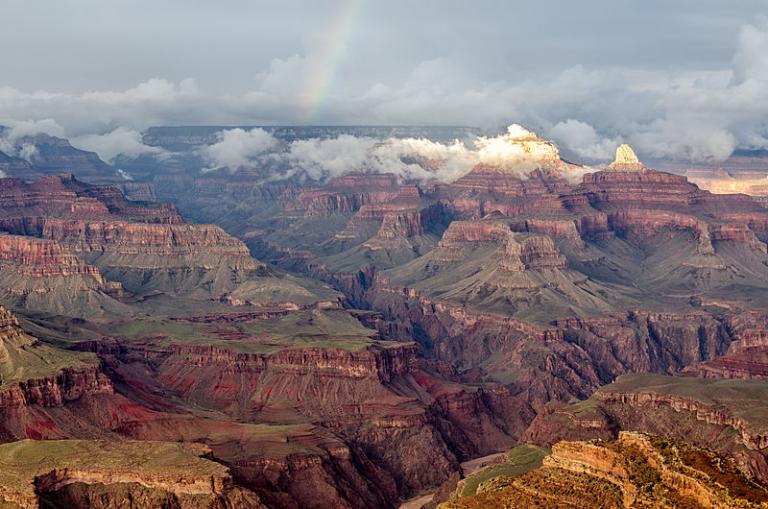
A view over the Grand Canyon from Hopi Point
(Tuxyso / Wikimedia Commons / CC BY-SA 3.0)
Bill Hamblin and I published the column below in the Deseret News for 21 August 2015:
There is something instinctive in us that causes us to stand in awe before the majesty of nature. In the earliest known forms of religion, the veneration of natural beauty, fecundity and power held a central place in the hearts of mankind. All great polytheistic religions have gods and goddesses associated with the powers of nature. Rain, fertility, storms, rivers, mountains, oceans, earthquakes and volcanoes were all associated with gods and goddesses.
Ancient art is, in many ways, fundamentally an attempt, however inadequate, to imitate the power and beauty of the great artist’s manifold achievements in nature.
For many ancient religions, all nature was infused not only with life but also with divine power. For the Romans, whatever moved had “anima,” or soul. Hence, our term “animal” derived from “anima”; anything that moved was “animate” — possessed of “anima.”
Animals were obviously animate, but so, too, were plants, which not only moved in the breeze but also by growing, and hence had anima/souls. The flowing of a river made it animate. The heavens, planets and stars moved, and the names of all of our planets are still those of animate Roman gods. More rarely, even the earth moved — for example, in earthquakes and volcanoes. Hence, all nature was “soul-full” — full of anima/soul. Non-moving things were “in-animate” — that is, lacking in anima. When you die, movement ceases, for your anima/soul has departed.
A part of this nearly universal human religious belief of seeing the divine in nature is the association of mountains with the home of the gods. Mountains are the largest things in nature, with their peaks seeming to ascend into the heavens. Scripture is filled with sacred mountains where man encounters God: Moses on Sinai (Exodus), Nephi’s vision on a high mountain (1 Nephi 16:30, 17:7, 18:3), and the brother of Jared on Mount Shelem (Ether 3:1).
Many ancient peoples believed that their gods dwelt upon the top of a majestic mountain — the idea of the Mountain of the Lord, found in the Bible, is a nearly universal belief. Zeus dwelt upon Mount Olympus, Baal of the Canaanites upon Mount Zaphon. The Hindu gods found their abode on Mount Meru.
Somewhat paradoxically, a canyon is in many ways an inverse mountain, and one of the greatest canyons in the world, the Grand Canyon, has evoked a sense of awe since the first Native Americans gazed upon it in wonder. As the Colorado River and its tributaries cut their meandering paths through northern Arizona over millions of years, those rivers created a sequence of mountains all lying within the vast depth beneath the rim of the canyon.
Most visitors to the canyon today don’t realize that, in addition to the magnificent geological vistas, they also encounter a mini-catalog of world mythology. Many of the early canyon geologists, such as Clarence Dutton (1841-1912), applied mythological names to the prominent mountain peaks within the canyon, seeing in the grandeur of the canyon the sacred mountains and temples of the gods and goddesses of mythology.
The Greek and Roman gods are represented with temples to Jupiter, Apollo and Diana, the goddess of the hunt, which stand somewhat incongruously beside Solomon’s Temple. Most readers are perhaps unaware that the Viking paradise of the gods is actually found in the Grand Canyon, on Walhalla (Valhalla) Plateau — where these words were actually written at sunset. Nearby, Wotan (Odin) sits enthroned. England’s medieval mythology is represented, with King Arthur’s Castle nestled beside the Holy Grail Temple.
But early geologists went beyond Western mythological traditions. The Egyptian gods are clustered in temples to Isis, Osiris, Horus and the Tower of Set. Nor is Asia’s mythology neglected. Hindus have temples to their “trinity” of Vishnu, Brahma and Shiva, as well as a shrine to Rama, one of the legendary incarnations of the god Vishnu and the hero of the great Hindu “Ramayana.” Even preeminent philosopher-prophets such as Confucius, the Buddha of India and the Persian Zoroaster receive temples.
Much of this is merely fanciful. But in a sense, the Grand Canyon is transformed into a mythological paradise for all of the gods, dwelling harmoniously in their temples upon their own sacred mountains. This poetic mythos of the Grand Canyon reminds us that the mechanistic interpretations of modern science need not destroy the sacred mystery of the cosmos, and that we, like our ancient ancestors, can still see divine power manifest in nature and in natural wonders like the Grand Canyon.
Previous Post

March 15, 2019
Temples, psalms, prophets, and Catholics
Next Post
March 15, 2019 New Testament Notes 112-116
Browse Our Archives
Select a Category Uncategorized
Select a Month October 2026 September 2026 August 2026 July 2026 June 2026 May 2026 April 2026 March 2026 February 2026 January 2026 December 2025 November 2025 October 2025 September 2025 August 2025 July 2025 June 2025 May 2025 April 2025 March 2025 February 2025 January 2025 December 2024 November 2024 October 2024 September 2024 August 2024 July 2024 June 2024 May 2024 April 2024 March 2024 February 2024 January 2024 December 2023 November 2023 October 2023 September 2023 August 2023 July 2023 June 2023 May 2023 April 2023 March 2023 February 2023 January 2023 December 2022 November 2022 October 2022 September 2022 August 2022 July 2022 June 2022 May 2022 April 2022 March 2022 February 2022 January 2022 December 2021 November 2021 October 2021 September 2021 August 2021 July 2021 June 2021 May 2021 April 2021 March 2021 February 2021 January 2021 December 2020 November 2020 October 2020 September 2020 August 2020 July 2020 June 2020 May 2020 April 2020 March 2020 February 2020 January 2020 December 2019 November 2019 October 2019 September 2019 August 2019 July 2019 June 2019 May 2019 April 2019 March 2019 February 2019 January 2019 December 2018 November 2018 October 2018 September 2018 August 2018 July 2018 June 2018 May 2018 April 2018 March 2018 February 2018 January 2018 December 2017 November 2017 October 2017 September 2017 August 2017 July 2017 June 2017 May 2017 April 2017 March 2017 February 2017 January 2017 December 2016 November 2016 October 2016 September 2016 August 2016 July 2016 June 2016 May 2016 April 2016 March 2016 February 2016 January 2016 December 2015 November 2015 October 2015 September 2015 August 2015 July 2015 June 2015 May 2015 April 2015 March 2015 February 2015 January 2015 December 2014 November 2014 March 2014 August 2013 February 2012
Follow Us!
TAKE THE
Religious Wisdom Quiz
Which prophet often wept over the sins and fate of Jerusalem?
Select your answer to see how you score.
Habakkuk Jeremiah Isaiah Ezekiel
Related posts from Sic et Non

Beware the chains of hell! And mark the...
Jesus, Osiris, and the Mystery Cults
Another faith-promoting encounter with law enforcement
TRENDING AT PATHEOS Latter-day Saint

Methodist Central Hall and Westminster Abbey
Situated on the same square is Methodist Central Hall and Westminster Abbey. ...

57th Dove Awards Honor Dolly Parton, Crown New...
On gospel music’s biggest night, the 57th annual GMA Dove Awards honored...

The First Eucharistic Controversy: Christ’s Real Presence
For Catholics, the Eucharist is the source and summit of the Christian...

What a Stop Sign Can Teach Us About...
How to Make a Decision When You Can't Hear God Main point:...

Archdiocese Hosts Military Marriage Retreat in Germany
RASTATT, Germany — The transient military lifestyle, with its frequent deployments and...

Nearly every morning, I make the drive to Detroit with my high-school-age...
view all Latter-day Saint blogs
Ad-Free & Subscriber Log-In Subscription Support
- About Us
- 2026 Calendar
- Videos
- Podcasts
- Library of World Religions
- Faith In Media Tracker
- Advertise With Us
- Write for Us
- Privacy Policy
- Terms of Service
- Do Not Sell My Data
- Contact Us
- Radiant Digital
- Manage Newsletter Subscriptions
- Unsubscribe From Notifications
- Sitemap
Copyright 2008-2026, Patheos. All rights reserved.
Subscription Support Ad-Free & Subscriber Log-In
Follow Patheos