
BuddhistCatholicContemplativeEvangelicalGeneral ChristianHinduJewishLatter-day SaintMuslimNew VisionsProgressive Christian
Beliefs
- Buddhist
- Catholic
- Contemplative
- Evangelical
- General Christian
- Hindu
- Jewish
- Latter-day Saint
- More Voices
- Muslim
- New Visions
- Pagan
- Progressive Christian
Topics
- Religion News
- Food and Religion
- Sports and Religion
- Religious Art
- Religious Music and Entertainment
- Religious Events
- History and Religion
- Style and Religion
- Politics and Religion
- Women in Religion
- Recreation Outdoors and Religion
- Business Finance and Religion
- Careers Workplace and Religion
- Education and Religion
- Family Parenting and Religion
- Health Fitness and Religion
- Home and Religion
- Relationships and Religion
- Technology and Religion
- Travel and Religion
Columnists
- Buddhist Columnists
- Business Finance and Religion Columnists
- Careers Workplace and Religion Columnists
- Catholic Columnists
- Contemplative Columnists
- Education and Religion Columnists
- Evangelists Columnists
- Family Parenting and Religion Columnists
- General Christian Columnists
- Health Fitness and Religion Columnists
- Hindu Columnists
- History and Religion Columnists
- Home and Religion Columnists
- Jewish Columnists
- More Voices Columnists
- Latter Day Columnists
- Muslim Columnists
- New Visions Columnists
- Nonreligious Columnists
- Pagan Columnists
- Politics and Religion Columnists
- Progressive Columnists
- Recreation Outdoors and Religion Columnists
- Relationships and Religion Columnists
- Religion News Columnists
- Religious Art Columnists
- Religious Events Columnists
- Religious Music and Entertainment Columnists
- Sports and Religion Columnists
- Style and Religion Columnists
- Technology and Religion Columnists
- Travel and Religion Columnists
- Women in Religion Columnists
Resource Library
- 2026 Calendar
- Library of World Religions
- The 100 Most Holy Places on Earth
- Patheos Answers
- Podcasts
- Videos
- Faith Leaders Database
- Anglican Episcopalian
- Bahai
- Baptist
- Buddhism
- Christianity
- Confucianism
- Eastern Orthodoxy
- Hinduism
- Holiness and Pentecostal
- ISKCON
- Islam
- Judaism
- Lutheran
- Methodist
- The Church of Jesus Christ of Latter-day Saints
- New Age
- Paganism
- Presbytarian and Reformed
- Protestantism
- Religion Behind the Scenes
- Roman Catholic
- Scientology
- Shia Islam
- Sikhism
- Sufism
- Sunni Islam
- Taoism
- Zen
- See all religions
Research Tools
 Ad-Free & Subscriber Log-In Subscription Support
Ad-Free & Subscriber Log-In Subscription Support
Follow Patheos 

- Trending:
- Forgiveness
- |
- Marriage
- |
- Consciousness
- |
- Death Penalty
- |
- Election
- |
- Halloween

- Home
- Latter-day Saint
- On “Spooky action at a distance”
On “Spooky action at a distance”
Last updated on: March 19, 2019 at 10:56 pm by Dan Peterson
On “Spooky action at a distance” 2019-03-19T22:56:08-06:00 Dan Peterson
Patheos Explore the world's faith through different perspectives on religion and spirituality! Patheos has the views of the prevalent religions and spiritualities of the world.
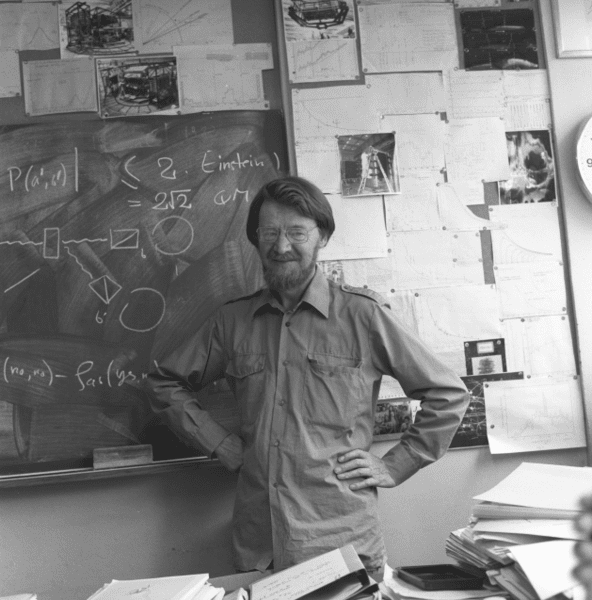
John Stewart Bell at CERN (the “Conseil Européen pour la Recherche Nucléaire”), in June 1982
Wikimedia Commons public domain
Wikipedia defines “quantum entanglement” as “a physical phenomenon that occurs when pairs or groups of particles are generated or interact in ways such that the quantum state of each particle cannot be described independently of the others, even when the particles are separated by a large distance—instead, a quantum state must be described for the system as a whole.”
Here’s the second paragraph of that Wikipedia article:
“Measurements of physical properties such as position, momentum, spin, and polarization, performed on entangled particles, are found to be appropriately correlated. For example, if a pair of particles are generated in such a way that their total spin is known to be zero, and one particle is found to have clockwise spin on a certain axis, the spin of the other particle, measured on the same axis, will be found to be counterclockwise, as to be expected due to their entanglement. However, this behavior gives rise to paradoxical effects: any measurement of a property of a particle can be seen as acting on that particle (e.g., by collapsing a number of superposed states) and will change the original quantum property by some unknown amount; and in the case of entangled particles, such a measurement will be on the entangled system as a whole. It thus appears that one particle of an entangled pair ‘knows’ what measurement has been performed on the other, and with what outcome, even though there is no known means for such information to be communicated between the particles, which at the time of measurement may be separated by arbitrarily large distances.”
Albert Einstein never altogether liked quantum physics and, although he couldn’t get rid of them, he was troubled throughout his life by certain of its implications. In a 4 December 1926 letter to his fellow German-Jewish physicist Max Born (who would later win the 1954 Nobel Prize in Physics), he said that “eine innere Stimme” (“an inner voice”) told him that they weren’t right. That’s, for instance, what’s behind his famous comment, in that same letter to Max Born, that God (literally, “the Ancient One”) doesn’t play dice with the Universe (Jedenfalls bin ich überzeugt, daß der [Alte] nicht würfelt). He disliked quantum indeterminacy.
Einstein also noted quantum theory’s prediction of so-called “entangled particles,” and, in 1949, he compared that concept to telepathy. Why? Presumably because, for him, telepathy represented the ultimate in pseudoscientific nonsense. The point of his analogy, of course, was that he rejected as essentially “magical” or “occultic” the notion that separated particles could still be “entangled” when at a large distance from each other. It was a reductio ad absurdum argument. (See P. A. Schilpp, ed., Albert Einstein, Philosopher-Scientist, The Library of Living Philosophers [Evanston, IL, 1949], 683.)
But it seems that, great though he was, Einstein was wrong in this rejection of “quantum entanglement” — which, I suppose goes to illustrate that even the most illustrious scientists and thinkers can go wrong because of preconceptions and preferences.
In 1964, roughly nine years after Einstein’s death, the Irish physicist John Stewart Bell formulated a mathematical proof — in what has since been called “Bell’s theorem” — that quantum theory does genuinely entail “spooky action at a distance,” as he himself called it. (He probably borrowed that phrase, either directly or indirectly, from Einstein’s derisive reference to “spukhafte Fernwirkung” in a 3 March 1947 letter to Max Born, which could also be translated as “ghostly action at a distance.”) Sadly, Bell died unexpectedly in 1990 of a cerebral hemorrhage, only 62 years old and unaware that he had just been nominated for a Nobel Prize, which cannot be awarded posthumously.
But that was a theoretical, mathematical proof. Could “quantum entanglement” actually be shown to occur? In 1972, the American physicists Stuart Jay Freedman (1944-2012) and John F. Clauser (1942-) published the results of their successful experimental observation of quantum entanglement, thereby providing real-world support to Bell’s theorem. (See “Bell test experiments.”) In the early 1980s, the French physicist Alain Aspect (1947-) provided further experimental evidence for the proposition that “spooky action at a distance” actually exists and occurs.
So, how close is the analogy, really, between telepathy and quantum entanglement?
(Drawn, in part, from Dean Radin, Entangled Minds: Extrasensory Experiences in a Quantum Reality [New York: Paraview/Pocket Books, 2006], 72-76].)
Previous Post

March 15, 2019
New Testament Notes 112-116
Next Post
March 16, 2019 Shen Yun
Browse Our Archives
Select a Category Uncategorized
Select a Month October 2026 September 2026 August 2026 July 2026 June 2026 May 2026 April 2026 March 2026 February 2026 January 2026 December 2025 November 2025 October 2025 September 2025 August 2025 July 2025 June 2025 May 2025 April 2025 March 2025 February 2025 January 2025 December 2024 November 2024 October 2024 September 2024 August 2024 July 2024 June 2024 May 2024 April 2024 March 2024 February 2024 January 2024 December 2023 November 2023 October 2023 September 2023 August 2023 July 2023 June 2023 May 2023 April 2023 March 2023 February 2023 January 2023 December 2022 November 2022 October 2022 September 2022 August 2022 July 2022 June 2022 May 2022 April 2022 March 2022 February 2022 January 2022 December 2021 November 2021 October 2021 September 2021 August 2021 July 2021 June 2021 May 2021 April 2021 March 2021 February 2021 January 2021 December 2020 November 2020 October 2020 September 2020 August 2020 July 2020 June 2020 May 2020 April 2020 March 2020 February 2020 January 2020 December 2019 November 2019 October 2019 September 2019 August 2019 July 2019 June 2019 May 2019 April 2019 March 2019 February 2019 January 2019 December 2018 November 2018 October 2018 September 2018 August 2018 July 2018 June 2018 May 2018 April 2018 March 2018 February 2018 January 2018 December 2017 November 2017 October 2017 September 2017 August 2017 July 2017 June 2017 May 2017 April 2017 March 2017 February 2017 January 2017 December 2016 November 2016 October 2016 September 2016 August 2016 July 2016 June 2016 May 2016 April 2016 March 2016 February 2016 January 2016 December 2015 November 2015 October 2015 September 2015 August 2015 July 2015 June 2015 May 2015 April 2015 March 2015 February 2015 January 2015 December 2014 November 2014 March 2014 August 2013 February 2012
Follow Us!
TAKE THE
Religious Wisdom Quiz
What is the largest predominantly Catholic country in South America?
Select your answer to see how you score.
Brazil Argentina Mexico Peru
Related posts from Sic et Non


A rather strange notion about Earth's fall
Easter Week and a Distant Beginning

"Frankenstein Mathematics" and the Unimaginable
TRENDING AT PATHEOS Latter-day Saint

Swimfan: Forgotten Aughts Pleasures
This is a recovery effort. In 2002, My Big Fat Greek Wedding...

Top Three Anti-Catholic Lies About Catholicism
This is my initial transcript for the video, "THE 3 WORST...

Pope Leo Celebrates Mass for Nurses & Docs...
I don't have any idea how he did it, but Pope Leo...

The Sermon on the Mount, Part I: Matthew...
The Sermon on the Mount, Part I (Matthew 4:12-5:12) St. Matthew moves...

What's up from Crossway: Reviewing some of their latest A few weeks...

Janie Learns the Way of the Cross: A...
Teaching children about Jesus' Passion can be challenging. Many parents and educators...
view all Latter-day Saint blogs
Ad-Free & Subscriber Log-In Subscription Support
- About Us
- 2026 Calendar
- Videos
- Podcasts
- Library of World Religions
- Faith In Media Tracker
- Advertise With Us
- Write for Us
- Privacy Policy
- Terms of Service
- Do Not Sell My Data
- Contact Us
- Radiant Digital
- Manage Newsletter Subscriptions
- Unsubscribe From Notifications
- Sitemap
Copyright 2008-2026, Patheos. All rights reserved.
Subscription Support Ad-Free & Subscriber Log-In
Follow Patheos