
BuddhistCatholicContemplativeEvangelicalGeneral ChristianHinduJewishLatter-day SaintMuslimNew VisionsProgressive Christian
Beliefs
- Buddhist
- Catholic
- Contemplative
- Evangelical
- General Christian
- Hindu
- Jewish
- Latter-day Saint
- More Voices
- Muslim
- New Visions
- Pagan
- Progressive Christian
Topics
- Religion News
- Food and Religion
- Sports and Religion
- Religious Art
- Religious Music and Entertainment
- Religious Events
- History and Religion
- Style and Religion
- Politics and Religion
- Women in Religion
- Recreation Outdoors and Religion
- Business Finance and Religion
- Careers Workplace and Religion
- Education and Religion
- Family Parenting and Religion
- Health Fitness and Religion
- Home and Religion
- Relationships and Religion
- Technology and Religion
- Travel and Religion
Columnists
- Buddhist Columnists
- Business Finance and Religion Columnists
- Careers Workplace and Religion Columnists
- Catholic Columnists
- Contemplative Columnists
- Education and Religion Columnists
- Evangelists Columnists
- Family Parenting and Religion Columnists
- General Christian Columnists
- Health Fitness and Religion Columnists
- Hindu Columnists
- History and Religion Columnists
- Home and Religion Columnists
- Jewish Columnists
- More Voices Columnists
- Latter Day Columnists
- Muslim Columnists
- New Visions Columnists
- Nonreligious Columnists
- Pagan Columnists
- Politics and Religion Columnists
- Progressive Columnists
- Recreation Outdoors and Religion Columnists
- Relationships and Religion Columnists
- Religion News Columnists
- Religious Art Columnists
- Religious Events Columnists
- Religious Music and Entertainment Columnists
- Sports and Religion Columnists
- Style and Religion Columnists
- Technology and Religion Columnists
- Travel and Religion Columnists
- Women in Religion Columnists
Resource Library
- 2026 Calendar
- Library of World Religions
- The 100 Most Holy Places on Earth
- Patheos Answers
- Podcasts
- Videos
- Faith Leaders Database
- Anglican Episcopalian
- Bahai
- Baptist
- Buddhism
- Christianity
- Confucianism
- Eastern Orthodoxy
- Hinduism
- Holiness and Pentecostal
- ISKCON
- Islam
- Judaism
- Lutheran
- Methodist
- The Church of Jesus Christ of Latter-day Saints
- New Age
- Paganism
- Presbytarian and Reformed
- Protestantism
- Religion Behind the Scenes
- Roman Catholic
- Scientology
- Shia Islam
- Sikhism
- Sufism
- Sunni Islam
- Taoism
- Zen
- See all religions
Research Tools
 Ad-Free & Subscriber Log-In Subscription Support
Ad-Free & Subscriber Log-In Subscription Support
Follow Patheos 

- Trending:
- Forgiveness
- |
- Marriage
- |
- Consciousness
- |
- Death Penalty
- |
- Election
- |
- Halloween

- Home
- Latter-day Saint
- On Mani and Manichaeism
On Mani and Manichaeism
Last updated on: March 4, 2019 at 9:22 pm by Dan Peterson
On Mani and Manichaeism 2019-03-04T21:22:33-07:00 Dan Peterson
Patheos Explore the world's faith through different perspectives on religion and spirituality! Patheos has the views of the prevalent religions and spiritualities of the world.
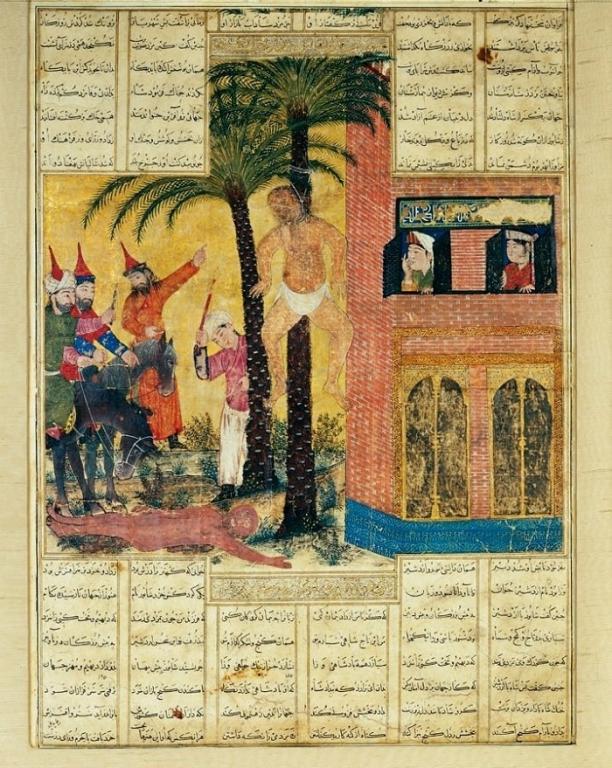
The execution of Mani, as depicted in an illustrated manuscript of Firdawsi’s “Shahnameh”
(Wikimedia Commons public domain image)
Bill Hamblin and I published this article in the Deseret News very nearly five years ago, on 7 March 2014:
Although Manicheism — the religion founded by the Mesopotamian prophet Mani — is dead, its influence still continues in subtle and indirect ways.
Mani was born in A.D. 216 near the modern city of Baghdad in Iraq, which was then part of the Persian Empire. Although a Persian, Mani was raised in a Gnostic Christian sect known as the Elkesaites, whose founder, Elkesai, was a Christian prophet living in Jordan around A.D. 100. His followers believed that a heavenly book of scripture had been revealed to him as a supplement to the writings of the New Testament.
At the age of 12, Mani claimed to have received a vision from his angelic “celestial twin,” who revealed heavenly secrets to him. As Mani himself described his first vision: “In the reign of King Ardashir (of Persia) the Holy Spirit came down and spoke to me. He revealed to me the hidden mystery, hidden from the ages and the generations of Man: the mystery of the Deep (underworld) and the High (heavens), the mystery of Light and Darkness, the mystery of the (apocalyptic) Contest, the War, and the Great (Final) War. The Holy Spirit disclosed to me all that has been and all that will be.”
At age 25, Mani left the Elkesaites, founding his own new religion. In the following years, he preached in India and Iran with some success, eventually converting the brother of the Persian emperor Shapur, who introduced Mani at the imperial court.
However, his success made him a threat to the Zoroastrian state religion of the Iranian empire. After the emperor Shapur’s death, Mani was imprisoned as a dangerous heretic. In 276, he was martyred by being flayed alive under the order of the famous Zoroastrian High Priest Kirder.
Mani believed that he was the last and greatest of the prophets, successor to the founders of the three great religions of Iran in his day: Zoroastrianism, Buddhism and Christianity. He described himself as an apostle of Jesus, teaching the true original form of Christianity.
According to Mani, there is a fundamental dualism between spirit and matter, light and darkness. The pristine world created by God was a world of light and spirit, but when the powers of darkness overcame the first man, the spirits of light became imprisoned in the chains of dark matter. These sons of light need to be freed from darkness in order to ascend back to the presence of God. This liberation from the bonds of material darkness was the goal of Mani’s revelation, which he called heavenly knowledge (gnosis).
Mani’s attempt to integrate Christianity, Buddhism and Zoroastrianism led to some interesting twists of doctrine, such as medieval Turkish Manichaean texts that speak of the nirvana of the Buddha Jesus on the cross.
Mani’s followers were organized into two groups: the Elect, who were expected to live the higher law, and the Hearers, who were followers of a lesser law. The Elect lived by the “three seals”: that they would abstain from wine and meat, that they would harm no living thing, and that they would live in celibacy so as not to imprison new spirits of light in the bondage of matter. The Hearers followed and supported the Elect, but were not required to live these three higher laws.
Perhaps Mani’s most important convert was the famous Catholic theologian Augustine (A.D. 354-430), who was a Manichean for nine years before his conversion back to Christianity at age 33. Thereafter, Augustine wrote a book condemning Manicheism.
But Augustine’s doctrine of the fall — which became normative for Catholics — was in part his reaction to Manichean thought. Later, medieval Christian heresies such as the Paulicians, Bogomils and Cathars were all influenced by Manichean ideas.
At its height in the sixth and seventh centuries, Manicheism was probably the most widespread religion in the world, with members found from Spain to India and China.
However, Manicheans were almost everywhere in the minority. Suffering religious persecution under increasingly intolerant kingdoms, their religion eventually disappeared.
Manicheism was most successful among the nomads of Central Asia, where it was declared the official religion by the king of the Uigur Turks in 762, surviving there until the 16th century. Today, only a few followers of neo-Gnostic New Age movements still revere the writings of Mani as scripture.
Nonetheless, subtle influences of his ideas can be found throughout the history and doctrines of both Christianity and Islam.
Previous Post

March 2, 2019
"The Hyperactive Agency Detector"?
Next Post
March 2, 2019 Variations on a theme from Jordan Peterson
Browse Our Archives
Select a Category Uncategorized
Select a Month October 2026 September 2026 August 2026 July 2026 June 2026 May 2026 April 2026 March 2026 February 2026 January 2026 December 2025 November 2025 October 2025 September 2025 August 2025 July 2025 June 2025 May 2025 April 2025 March 2025 February 2025 January 2025 December 2024 November 2024 October 2024 September 2024 August 2024 July 2024 June 2024 May 2024 April 2024 March 2024 February 2024 January 2024 December 2023 November 2023 October 2023 September 2023 August 2023 July 2023 June 2023 May 2023 April 2023 March 2023 February 2023 January 2023 December 2022 November 2022 October 2022 September 2022 August 2022 July 2022 June 2022 May 2022 April 2022 March 2022 February 2022 January 2022 December 2021 November 2021 October 2021 September 2021 August 2021 July 2021 June 2021 May 2021 April 2021 March 2021 February 2021 January 2021 December 2020 November 2020 October 2020 September 2020 August 2020 July 2020 June 2020 May 2020 April 2020 March 2020 February 2020 January 2020 December 2019 November 2019 October 2019 September 2019 August 2019 July 2019 June 2019 May 2019 April 2019 March 2019 February 2019 January 2019 December 2018 November 2018 October 2018 September 2018 August 2018 July 2018 June 2018 May 2018 April 2018 March 2018 February 2018 January 2018 December 2017 November 2017 October 2017 September 2017 August 2017 July 2017 June 2017 May 2017 April 2017 March 2017 February 2017 January 2017 December 2016 November 2016 October 2016 September 2016 August 2016 July 2016 June 2016 May 2016 April 2016 March 2016 February 2016 January 2016 December 2015 November 2015 October 2015 September 2015 August 2015 July 2015 June 2015 May 2015 April 2015 March 2015 February 2015 January 2015 December 2014 November 2014 March 2014 August 2013 February 2012
Follow Us!
TAKE THE
Religious Wisdom Quiz
What sea bordered the land of Canaan to the west?
Select your answer to see how you score.
Dead Sea Sea of Galilee Red Sea Mediterranean Sea
Related posts from Sic et Non

A basic working chronology of Islamic-era Iran
Some notes on Ancient Iran and Its Pre-Islamic...
Thoughts on a "primitive culture"
TRENDING AT PATHEOS Latter-day Saint

Methodist Central Hall and Westminster Abbey
Situated on the same square is Methodist Central Hall and Westminster Abbey. ...

57th Dove Awards Honor Dolly Parton, Crown New...
On gospel music’s biggest night, the 57th annual GMA Dove Awards honored...

The First Eucharistic Controversy: Christ’s Real Presence
For Catholics, the Eucharist is the source and summit of the Christian...

What a Stop Sign Can Teach Us About...
How to Make a Decision When You Can't Hear God Main point:...

Archdiocese Hosts Military Marriage Retreat in Germany
RASTATT, Germany — The transient military lifestyle, with its frequent deployments and...

Nearly every morning, I make the drive to Detroit with my high-school-age...
view all Latter-day Saint blogs
Ad-Free & Subscriber Log-In Subscription Support
- About Us
- 2026 Calendar
- Videos
- Podcasts
- Library of World Religions
- Faith In Media Tracker
- Advertise With Us
- Write for Us
- Privacy Policy
- Terms of Service
- Do Not Sell My Data
- Contact Us
- Radiant Digital
- Manage Newsletter Subscriptions
- Unsubscribe From Notifications
- Sitemap
Copyright 2008-2026, Patheos. All rights reserved.
Subscription Support Ad-Free & Subscriber Log-In
Follow Patheos