
BuddhistCatholicContemplativeEvangelicalGeneral ChristianHinduJewishLatter-day SaintMuslimNew VisionsProgressive Christian
Beliefs
- Buddhist
- Catholic
- Contemplative
- Evangelical
- General Christian
- Hindu
- Jewish
- Latter-day Saint
- More Voices
- Muslim
- New Visions
- Pagan
- Progressive Christian
Topics
- Religion News
- Food and Religion
- Sports and Religion
- Religious Art
- Religious Music and Entertainment
- Religious Events
- History and Religion
- Style and Religion
- Politics and Religion
- Women in Religion
- Recreation Outdoors and Religion
- Business Finance and Religion
- Careers Workplace and Religion
- Education and Religion
- Family Parenting and Religion
- Health Fitness and Religion
- Home and Religion
- Relationships and Religion
- Technology and Religion
- Travel and Religion
Columnists
- Buddhist Columnists
- Business Finance and Religion Columnists
- Careers Workplace and Religion Columnists
- Catholic Columnists
- Contemplative Columnists
- Education and Religion Columnists
- Evangelists Columnists
- Family Parenting and Religion Columnists
- General Christian Columnists
- Health Fitness and Religion Columnists
- Hindu Columnists
- History and Religion Columnists
- Home and Religion Columnists
- Jewish Columnists
- More Voices Columnists
- Latter Day Columnists
- Muslim Columnists
- New Visions Columnists
- Nonreligious Columnists
- Pagan Columnists
- Politics and Religion Columnists
- Progressive Columnists
- Recreation Outdoors and Religion Columnists
- Relationships and Religion Columnists
- Religion News Columnists
- Religious Art Columnists
- Religious Events Columnists
- Religious Music and Entertainment Columnists
- Sports and Religion Columnists
- Style and Religion Columnists
- Technology and Religion Columnists
- Travel and Religion Columnists
- Women in Religion Columnists
Resource Library
- 2026 Calendar
- Library of World Religions
- The 100 Most Holy Places on Earth
- Patheos Answers
- Podcasts
- Videos
- Faith Leaders Database
- Anglican Episcopalian
- Bahai
- Baptist
- Buddhism
- Christianity
- Confucianism
- Eastern Orthodoxy
- Hinduism
- Holiness and Pentecostal
- ISKCON
- Islam
- Judaism
- Lutheran
- Methodist
- The Church of Jesus Christ of Latter-day Saints
- New Age
- Paganism
- Presbytarian and Reformed
- Protestantism
- Religion Behind the Scenes
- Roman Catholic
- Scientology
- Shia Islam
- Sikhism
- Sufism
- Sunni Islam
- Taoism
- Zen
- See all religions
Research Tools
 Ad-Free & Subscriber Log-In Subscription Support
Ad-Free & Subscriber Log-In Subscription Support
Follow Patheos 

- Trending:
- Forgiveness
- |
- Marriage
- |
- Consciousness
- |
- Death Penalty
- |
- Election
- |
- Halloween

- Home
- Latter-day Saint
- New Testament Notes 157-158
New Testament Notes 157-158
Last updated on: March 30, 2019 at 11:00 pm by Dan Peterson
New Testament Notes 157-158 2019-03-30T23:00:44-06:00 Dan Peterson
Patheos Explore the world's faith through different perspectives on religion and spirituality! Patheos has the views of the prevalent religions and spiritualities of the world.
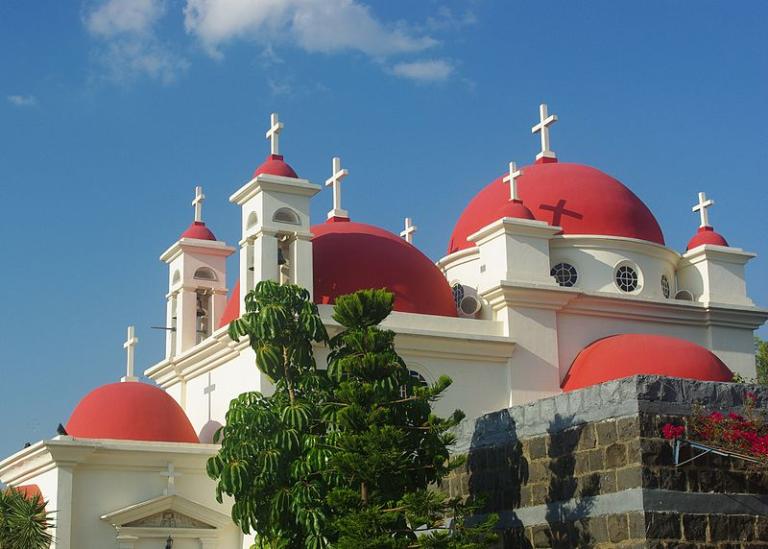
Капернаум – греческий православный монастырь (Wikimedia CC public domain photo by Sergey Serous)
This Greek Orthodox monastery stands beside the ruins of ancient Capernaum, where the exchange recounted in John 6 occurred.
Some critics that I’ve come across seem to imagine that, if the Church were really true, people would be lined up to enter the font, nobody would ever fall away, and all customers would be completely satisfied and unfailingly enthusiastically willing to pay the price. Everything that the Church taught would be pleasing to everybody, and instantly accepted without reservation.
The fact that the situation isn’t so, they believe (or pretend to believe) demonstrates that the claims of the Restoration are false.
This passage suggests the vacuity of that notion. At least, it should to a believing Christian.
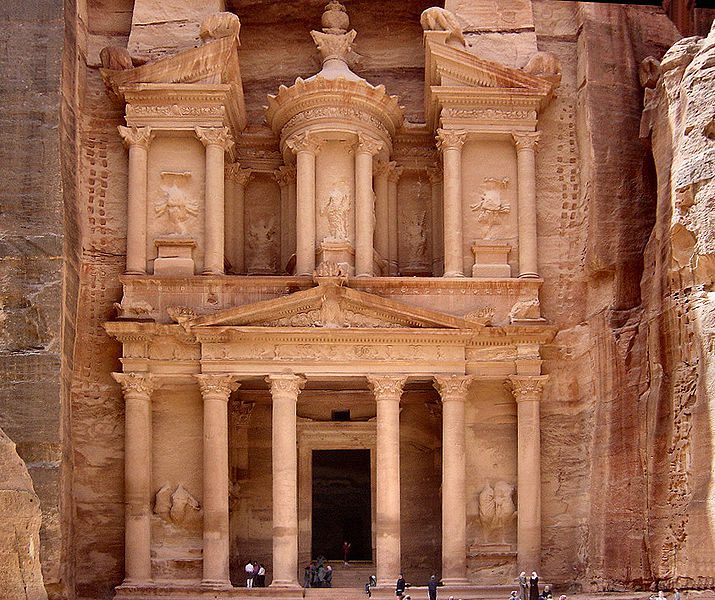
The Treasury (al-Khazneh) at Petra, Jordan; Wikimedia CC photo by Berthold Werner
Compare Matthew 18:18; John 6:66; 20:22-23
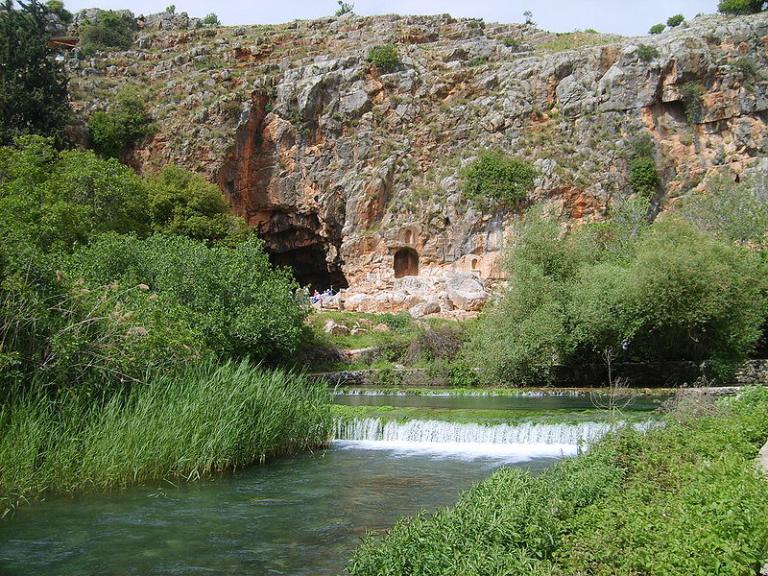
At Caesarea Philippi or Banias (Wikimedia Commons public domain image)

The coat of arms of the Vatican City State
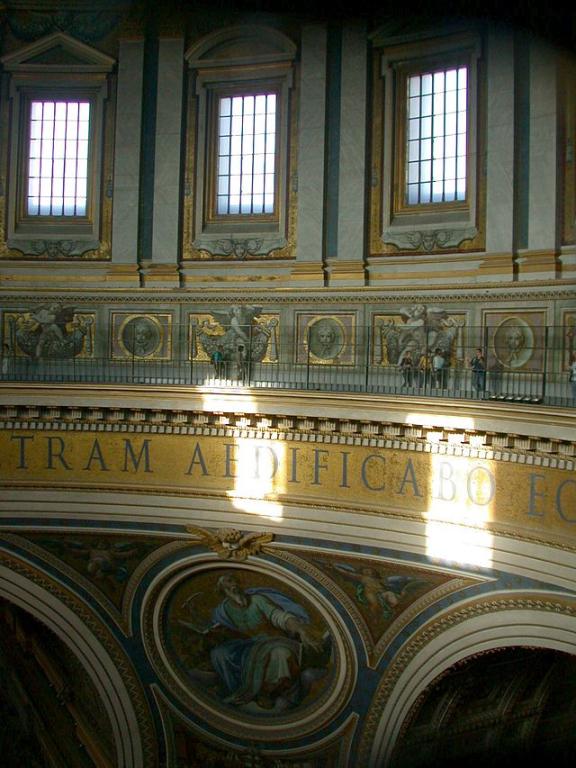
On the interior of St. Peter’s Basilica (Wikimedia Commons public domain photograph)
Compare Matthew 18:18; John 6:66; 20:22-23
I.
The passages of the synoptic gospels listed above are absolutely crucial to the claims of the papacy and the Roman Catholic Church. Right around the base of the dome of St. Peter’s Basilica, in enormous letters — see the photograph above — Jerome’s Latin Vulgate translation of the words of Jesus to Peter declares the authority of Peter and his papal successors: Tu es Petrus et super hanc petram aedificabo ecclesiam meam. “Thou art Peter, and upon this rock [hanc petram] I will build my church.” Everywhere in that massive basilica, the symbols of the popes prominently feature the crossed keys of Peter, and painting after painting of Peter, there and elsewhere, identifies him by placing large keys in his hands.
But the passage is crucial to the claims of the Church of Jesus Christ of Latter-day Saints, as well. And, on this point, those are clearly rival claims. (See pages 105-107 of an article that I published in Interpreter back in 2015 for a comment on precisely this topic.)
Allow me to provide some notes toward a Latter-day Saint reading of this portion of Matthew 16:
a.
As is very often the case in the New Testament, the term heaven in the phrase my Father who is in heaven (Mt 16:17) actually reflects an underlying Greek plural, heavens: ὁ πατήρ μου ὁ ἐν τοῖς οὐρανοῖς. This goes back, literally, to the biblical beginning: The King James Version’s In the beginning God created the heaven and the earth could more precisely be rendered as In the beginning God created the heavens and the earth [בְּרֵאשִׁ֖ית בָּרָ֣א אֱלֹהִ֑ים אֵ֥ת הַשָּׁמַ֖יִם וְאֵ֥ת הָאָֽרֶץ]. Although English translations usually obscure this, the biblical text almost always (or virtually always) refers to multiple heavens.
b.
There’s a crucial difference, in Greek, between the masculine petros (which is given to Cephas as a name) and the feminine petra. Petros refers to a stone, a smallish one of the kind that you might skip across a pond. Petra refers to a massive rock, like that at Gibraltar. Or like that at . . . well, Petra (see the photo above), the ancient city in Jordan that was carved right into the red sandstone cliffs of Edom.
“You are Peter [petros],” says Christ to his chief apostle, “and I will build my church upon this rock [petra]”: σὺ εἶ Πέτρος, καὶ ἐπὶ ταύτῃ τῇ πέτρᾳ οἰκοδομήσω μου τὴν ἐκκλησίαν.
There’s clearly a play on words going on here, but it contrasts the smallness (and instability? compare Mt 16:21-23, just a few verses later in the same chapter) of Peter as an individual with the solidity of the firm foundation upon which the Savior intends to build his church. I think it no coincidence that Jesus made this statement at Caesarea Philippi (see the photo above), which sits at the base of a substantial rock cliff where the headwaters of the Jordan River gush from the base of Mount Hermon. It’s a powerful visual aid.
c.
But it’s more than that.
Mount Hermon and the specific area of Caesarea Philippi (known today as Banias) were held sacred by many different faiths. In the photo above, you can see a cave that was once holy to the Greek god Pan — which is the source of the name Banias (because Arabic lacks a letter p). Out of the photo to the upper left is a Druze shrine. (The Druze are an esoteric offshoot of Islam. Many of them live in the Golan Heights, adjacent to Banias.)
Water coming out of the base of a mountain was seen as miraculous; caves were regarded as passageways to the underworld, to the realm of the dead.
Mount Hermon has been suggested by some as the site of the Transfiguration of Jesus, which, for Latter-day Saints, would imply temple connections (because many Latter-day Saints believe that priesthood keys were bequeathed to Peter, James, and John there). So it’s appropriately temple-like to have the waters of life issuing forth from the base of a temple-mountain. (Think where temple baptistries are located, within “the mountain of the Lord’s house.”)
In light of the foregoing, Mt 16:18-19 takes on a particular significance for Latter-day Saints:
Jesus says that he’s going to give to Peter “the keys of the kingdom of the heavens” (heavens, again, in the plural: τὰς κλεῖδας τῆς βασιλείας τῶν οὐρανῶν), the power to bind and loose in “in the heavens.” And, says the King James Translation, “the gates of Hell” won’t prevail against the Church. But KJV’s the gates of Hell misrepresents the Greek πύλαι ᾅδου, which really reads “the gates of Hades.”
“Hell” is a place of evil, so, with that in mind, many people have misread this promise as a pledge that the power of evil would never overcome the Christian church, and, specifically, as a refutation of the Latter-day Saint teaching of a universal apostasy of the ancient church.
Hades, however, is simply the place to which all the dead go, both good and bad. As such, it has no particular connotation of wickedness. It’s just a reference to the realm of the dead, to the spirit world (Hebrew she’ol), or to Death itself.
Thus, Peter is going to be given keys that will permit his authority to extend beyond the gates of death. Sealing power, in other words.
A significant text about temples and the power of their ordinances to pass the portals of the grave.
II.
I’ve always found Peter’s response to Jesus’ question (at John 6:67-68) quite moving:
“Jesus said to the twelve, ‘Do you also wish to go away?’ Simon Peter answered him, ‘Lord, to whom shall we go? You have the words of eternal life.”
This is the way I’ve felt, when aggressive anti-Mormons have summoned me to reject my own faith and accept theirs. With all respect, I can’t help but think of the words of the sixteenth century Hindu princess and mystic poet Mirabai:
“I have felt the swaying of the elephant’s shoulders; and now you want me to climb on a jackass? Try to be serious.”
Previous Post

March 30, 2019
Reprising "Everyone Else Makes Such Lonely Heavens"
Next Post
March 31, 2019 Sometimes, it's not getting better
Browse Our Archives
Select a Category Uncategorized
Select a Month October 2026 September 2026 August 2026 July 2026 June 2026 May 2026 April 2026 March 2026 February 2026 January 2026 December 2025 November 2025 October 2025 September 2025 August 2025 July 2025 June 2025 May 2025 April 2025 March 2025 February 2025 January 2025 December 2024 November 2024 October 2024 September 2024 August 2024 July 2024 June 2024 May 2024 April 2024 March 2024 February 2024 January 2024 December 2023 November 2023 October 2023 September 2023 August 2023 July 2023 June 2023 May 2023 April 2023 March 2023 February 2023 January 2023 December 2022 November 2022 October 2022 September 2022 August 2022 July 2022 June 2022 May 2022 April 2022 March 2022 February 2022 January 2022 December 2021 November 2021 October 2021 September 2021 August 2021 July 2021 June 2021 May 2021 April 2021 March 2021 February 2021 January 2021 December 2020 November 2020 October 2020 September 2020 August 2020 July 2020 June 2020 May 2020 April 2020 March 2020 February 2020 January 2020 December 2019 November 2019 October 2019 September 2019 August 2019 July 2019 June 2019 May 2019 April 2019 March 2019 February 2019 January 2019 December 2018 November 2018 October 2018 September 2018 August 2018 July 2018 June 2018 May 2018 April 2018 March 2018 February 2018 January 2018 December 2017 November 2017 October 2017 September 2017 August 2017 July 2017 June 2017 May 2017 April 2017 March 2017 February 2017 January 2017 December 2016 November 2016 October 2016 September 2016 August 2016 July 2016 June 2016 May 2016 April 2016 March 2016 February 2016 January 2016 December 2015 November 2015 October 2015 September 2015 August 2015 July 2015 June 2015 May 2015 April 2015 March 2015 February 2015 January 2015 December 2014 November 2014 March 2014 August 2013 February 2012
Follow Us!
TAKE THE
Religious Wisdom Quiz
What does the Hebrew word 'Shekinah' mean?
Select your answer to see how you score.
Holy Fire Divine Presence Everlasting Light God’s Glory
Related posts from Sic et Non


Learning more about a region of which I've...

From Serbia's "White City," Belgrade

TRENDING AT PATHEOS Latter-day Saint

When Halloween Unmasks Married Hearts
Written by Dr. David K. Ewen from Eternal Truth Bible College Behind...

Aristotle. He’s been called the father of logic, the father of the...

Methodist Central Hall and Westminster Abbey
Situated on the same square is Methodist Central Hall and Westminster Abbey. ...

57th Dove Awards Honor Dolly Parton, Crown New...
On gospel music’s biggest night, the 57th annual GMA Dove Awards honored...

The First Eucharistic Controversy: Christ’s Real Presence
For Catholics, the Eucharist is the source and summit of the Christian...

What a Stop Sign Can Teach Us About...
How to Make a Decision When You Can't Hear God Main point:...
view all Latter-day Saint blogs
Ad-Free & Subscriber Log-In Subscription Support
- About Us
- 2026 Calendar
- Videos
- Podcasts
- Library of World Religions
- Faith In Media Tracker
- Advertise With Us
- Write for Us
- Privacy Policy
- Terms of Service
- Do Not Sell My Data
- Contact Us
- Radiant Digital
- Manage Newsletter Subscriptions
- Unsubscribe From Notifications
- Sitemap
Copyright 2008-2026, Patheos. All rights reserved.
Subscription Support Ad-Free & Subscriber Log-In
Follow Patheos