
BuddhistCatholicContemplativeEvangelicalGeneral ChristianHinduJewishLatter-day SaintMuslimNew VisionsProgressive Christian
Beliefs
- Buddhist
- Catholic
- Contemplative
- Evangelical
- General Christian
- Hindu
- Jewish
- Latter-day Saint
- More Voices
- Muslim
- New Visions
- Pagan
- Progressive Christian
Topics
- Religion News
- Food and Religion
- Sports and Religion
- Religious Art
- Religious Music and Entertainment
- Religious Events
- History and Religion
- Style and Religion
- Politics and Religion
- Women in Religion
- Recreation Outdoors and Religion
- Business Finance and Religion
- Careers Workplace and Religion
- Education and Religion
- Family Parenting and Religion
- Health Fitness and Religion
- Home and Religion
- Relationships and Religion
- Technology and Religion
- Travel and Religion
Columnists
- Buddhist Columnists
- Business Finance and Religion Columnists
- Careers Workplace and Religion Columnists
- Catholic Columnists
- Contemplative Columnists
- Education and Religion Columnists
- Evangelists Columnists
- Family Parenting and Religion Columnists
- General Christian Columnists
- Health Fitness and Religion Columnists
- Hindu Columnists
- History and Religion Columnists
- Home and Religion Columnists
- Jewish Columnists
- More Voices Columnists
- Latter Day Columnists
- Muslim Columnists
- New Visions Columnists
- Nonreligious Columnists
- Pagan Columnists
- Politics and Religion Columnists
- Progressive Columnists
- Recreation Outdoors and Religion Columnists
- Relationships and Religion Columnists
- Religion News Columnists
- Religious Art Columnists
- Religious Events Columnists
- Religious Music and Entertainment Columnists
- Sports and Religion Columnists
- Style and Religion Columnists
- Technology and Religion Columnists
- Travel and Religion Columnists
- Women in Religion Columnists
Resource Library
- 2026 Calendar
- Library of World Religions
- The 100 Most Holy Places on Earth
- Patheos Answers
- Podcasts
- Videos
- Faith Leaders Database
- Anglican Episcopalian
- Bahai
- Baptist
- Buddhism
- Christianity
- Confucianism
- Eastern Orthodoxy
- Hinduism
- Holiness and Pentecostal
- ISKCON
- Islam
- Judaism
- Lutheran
- Methodist
- The Church of Jesus Christ of Latter-day Saints
- New Age
- Paganism
- Presbytarian and Reformed
- Protestantism
- Religion Behind the Scenes
- Roman Catholic
- Scientology
- Shia Islam
- Sikhism
- Sufism
- Sunni Islam
- Taoism
- Zen
- See all religions
Research Tools
 Ad-Free & Subscriber Log-In Subscription Support
Ad-Free & Subscriber Log-In Subscription Support
Follow Patheos 

- Trending:
- Forgiveness
- |
- Marriage
- |
- Consciousness
- |
- Death Penalty
- |
- Election
- |
- Halloween

- Home
- Latter-day Saint
- Anti-Catholicism, My Church, and I
Anti-Catholicism, My Church, and I
Last updated on: March 15, 2019 at 8:54 pm by Dan Peterson
Anti-Catholicism, My Church, and I 2019-03-15T20:54:09-06:00 Dan Peterson
Patheos Explore the world's faith through different perspectives on religion and spirituality! Patheos has the views of the prevalent religions and spiritualities of the world.
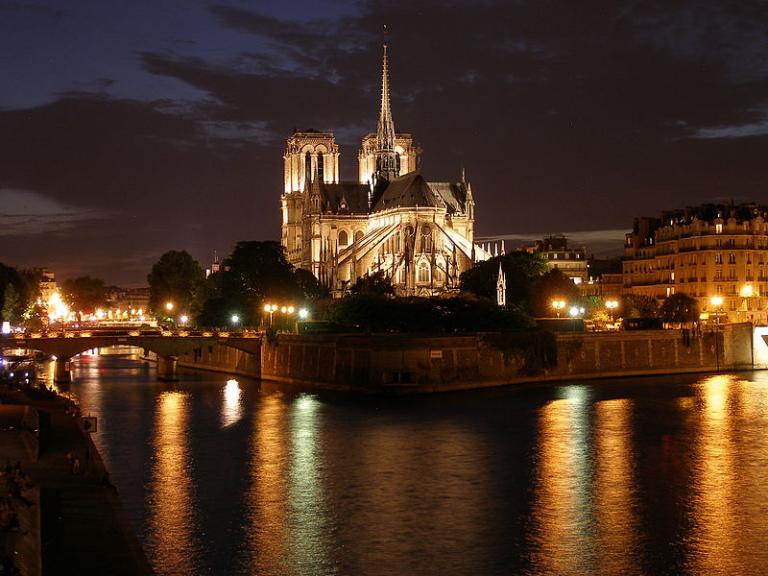
Cathédrale Notre-Dame de Paris (Wikimedia Commons)
From the Interpreter Foundation, two discussions of Gospel Doctrine materials by Martin Tanner:
Audio Roundtable: Come, Follow Me New Testament Lesson 11 “These Twelve Jesus Sent Forth”
Audio Roundtable: Come, Follow Me New Testament Lesson 12 “Who Hath Ears to Hear, Let Him Hear”
Also from the Interpreter Foundation, a video discussion by Hales Swift:
***
There is always hope:
***
Here’s another bit of Church history from Rome:
“Apostles Testify of Jesus Christ in Rome: Excerpts from “The Living Christ” document given”
***
And that will serve as a transition point for an issue that has been especially on my mind because of the remarkable events of this past weekend in Rome and Vatican City:
Back on 20 February 2019, I posted a comment here that I titled “Theatricality in Church?” As part of that post I recalled — not entirely positively — a spectacular experience that I had on 15 August 1970 when I attended a mass celebrated by the then cardinal-archbishop of Paris in the Cathedral of Notre-Dame de Paris.
That blog entry brought a response from a distinguished senior Catholic scholar — formerly, among other things, a president of the Mormon History Association — who describes himself as “a faithful reader of [my] blog” and who, at one point not too long ago, even seriously considered joining a tour of Israel with me. (I would have loved it and would have been honored, but, in the end, health considerations kept him from coming.)
Among other things (on other subjects, not relevant here), he wrote:
Surely you know that dismissing the RC Church as mere theater is an age-old mode of Puritan scorn.
Please consider this:
Is an address by President Nelson to thousands in LDS Conference Center backed by overwhelming power of the Tabernacle Choir not theatrical?
I replied to him, in part, as follows:
You raised a serious issue, and I want to make sure that I’m clearly understand. I’m not even remotely anti-Catholic, but perhaps I left myself open to misunderstanding. I would like to clarify my view, not only to you but publicly to anybody else who might be concerned.
Here’s a quick public clarification:
When I said that I’m “not even remotely anti-Catholic,” I could easily go further. I am, on the whole, an admirer of the Roman Catholic Church. When I go to Rome, with all its fascinating historical sites, it’s Vatican City that fascinates me the most. And I think that my feelings when I’m in and around St. Peter’s Basilica, and particularly among the tombs of the popes, can fairly be described as “reverence.” (I’m inclined to believe, for one thing, that the apostle Peter’s tomb probably does sit below the high altar of the Basilica: “Why was Peter in Rome?”)
One of the greatest experiences of my life was setting up and being involved with a project to digitize manuscripts in the Bibliotheca Apostolica Vaticana, which, among other things, had me meeting with various high-ranking Vatican cardinals and, in particular, interacting with Edward Idris Cardinal Cassidy, whom I admire and respect. I tell something about my experiences with him, and reflect more broadly on my feelings toward the Catholic Church, in
“It Took a Village to Prepare for the Restoration”
I also wrote about Latter-day Saint attitudes toward the Catholic Church here:
“Mormon-Catholic tolerance goes back to Brigham Young”
I consider Pope St. John Paul II one of the towering figures of the twentieth century, and a hero. Being privileged to see him at fairly close range when I was invited to attend a meeting with him in Rome’s Basilica of St. Paul Outside the Walls was a special thrill. Father Georges Anawati was my tutor in Islamic philosophy during my last year in Cairo. I held him not only in high esteem but in great affection, and I still do.
A story that I’ve mentioned here before:
Back in September 2006, I was lecturing about Islam on behalf of the area presidency in Australia and New Zealand, as well as meeting with local political leaders, Muslim authorities, and so forth, and doing radio interviews. While I was there, Pope Benedict XVI delivered some controversial remarks at Germany’s University of Regensburg, where he had once served as a professor. Some thought that he had insulted Islam. Very quickly, his comments became a focus of my interviews. Thanks to the miracle of the internet, I was soon able to read the original German text of his remarks, which, in my judgment and understood in context, weren’t nearly as inflammatory and negative as the press was reporting and as many Muslims were assuming. (I do think that the Pope was perhaps surprised by the fact that the subtle nuances of an academic lecture by the intellectually sophisticated former Professor Joseph Ratzinger were lost on sensationalistic and unsubtle journalists.)
Anyway, I found it ironic that I, a Latter-day Saint Islamicist, was soon busy on various radio programs defending the head of the Roman Catholic Church, pleading with people to calm down and carefully read what he had actually said rather than merely some cherry-picked excerpts. But I was happy to do it. The Pope’s points were debatable, but they were intellectually serious, and they deserved intellectually serious responses.
Incidentally, I had to do one of my interviews by cell phone, pulled over at an ice cream place (to which Elder Louis Midgley and his wife had introduced me on a previous visit) alongside the (surprisingly noisy) road between Auckland and Hamilton, New Zealand. Every once in a while a truck would go roaring by. It was . . . unusual. But, while we were there, we enjoyed the ice cream.
I should also point out that I have attended mass many times since that experience in Paris in 1970, and that, overwhelmingly, those experiences haven’t struck me as “theatrical.” I would never, ever, maintain that the Roman Catholic Church is “mere theater.” And, for the record, with a few exceptions, of all the members of the clergy that I met during my mission in Switzerland, I was most impressed with the Catholic priests and found them most congenial, intellectually and in other ways.
Finally, one of my children was born on what was, until relatively recently, the feast day of one of the official “doctors” of the Catholic Church, a saint for whom my admiration is vast — and, for that reason, that child shares the name of that saint.
I realize that there was a lot of anti-Catholic rhetoric among Latter-day Saints in the nineteenth century and into the twentieth. Elder Bruce R. McConkie was probably the last significant exponent of such views, but he was not encouraged in them by the leaders of the Church. I believe that they were a legacy of the Protestantism of virtually all of our first converts.
But I don’t share them. And neither, I think, did Joseph Smith:
In August 1836, Joseph Smith visited the burnt-out remains of the Catholic Ursuline convent in Charlestown, Massachusetts. Two years previously, a mob, angered at Irish Catholic immigrants to the United States, had destroyed the convent and left dozens of Catholic nuns homeless. Joseph was, evidently, indignant at the injustice.
“If it has been demonstrated that I have been willing to die for a ‘Mormon,'” he said in 1843, “I am bold to declare before Heaven that I am just as ready to die in defending the rights of a Presbyterian, a Baptist, or a good man of any denomination; for the same principle which would trample upon the rights of the Latter-day Saints would trample upon the rights of the Roman Catholics, or of any other denomination who may be unpopular and too weak to defend themselves. It is a love of liberty which inspires my soul — civil and religious liberty to the whole of the human race.”
In a manuscript by Thomas Bullock that is preserved in the Church History Library of The Church of Jesus Christ of Latter-day Saints (MS 155, box 4 folder 6), Joseph is reported to have said that
[the] old Catholic Church is worth more than all [the other churches]—here is a princ[iple]. of logic–that men have no more sense–I will illustrate [with] an old apple tree—here jumps off a branch & says I am the true tree. & you are corrupt–if the whole tree is corrupt how can any true thing come out of it—the charr[character] of the old ones have always been sland[ere]d. by all apos[tates] since the world began—I testify again as God never will acknowledge any apost[ate]: any man who will betray the Catholics will betray you–& if he will betray one anoth[e]r. he will betray you
Have I been clear enough? While I am not a Catholic and while I disagree with certain important elements of Catholic doctrine and practice — or, to put it more positively, while I am a convinced and committed believer in the Restoration and in the Restored Church of Jesus Christ — I utterly and absolutely reject anti-Catholicism.
Previous Post

March 13, 2019
"A potential biosignature" at 4.1 billion years before the present?
Next Post
March 14, 2019 New Testament Notes 106-107
Browse Our Archives
Select a Category Uncategorized
Select a Month October 2026 September 2026 August 2026 July 2026 June 2026 May 2026 April 2026 March 2026 February 2026 January 2026 December 2025 November 2025 October 2025 September 2025 August 2025 July 2025 June 2025 May 2025 April 2025 March 2025 February 2025 January 2025 December 2024 November 2024 October 2024 September 2024 August 2024 July 2024 June 2024 May 2024 April 2024 March 2024 February 2024 January 2024 December 2023 November 2023 October 2023 September 2023 August 2023 July 2023 June 2023 May 2023 April 2023 March 2023 February 2023 January 2023 December 2022 November 2022 October 2022 September 2022 August 2022 July 2022 June 2022 May 2022 April 2022 March 2022 February 2022 January 2022 December 2021 November 2021 October 2021 September 2021 August 2021 July 2021 June 2021 May 2021 April 2021 March 2021 February 2021 January 2021 December 2020 November 2020 October 2020 September 2020 August 2020 July 2020 June 2020 May 2020 April 2020 March 2020 February 2020 January 2020 December 2019 November 2019 October 2019 September 2019 August 2019 July 2019 June 2019 May 2019 April 2019 March 2019 February 2019 January 2019 December 2018 November 2018 October 2018 September 2018 August 2018 July 2018 June 2018 May 2018 April 2018 March 2018 February 2018 January 2018 December 2017 November 2017 October 2017 September 2017 August 2017 July 2017 June 2017 May 2017 April 2017 March 2017 February 2017 January 2017 December 2016 November 2016 October 2016 September 2016 August 2016 July 2016 June 2016 May 2016 April 2016 March 2016 February 2016 January 2016 December 2015 November 2015 October 2015 September 2015 August 2015 July 2015 June 2015 May 2015 April 2015 March 2015 February 2015 January 2015 December 2014 November 2014 March 2014 August 2013 February 2012
Follow Us!
TAKE THE
Religious Wisdom Quiz
Who was longest-serving judge of Israel?
Select your answer to see how you score.
Eli Samson Gideon Samuel
Related posts from Sic et Non

The Iron Gates and the Lion of the...


Learning more about a region of which I've...

From Serbia's "White City," Belgrade
TRENDING AT PATHEOS Latter-day Saint

In one sense walking into Westminster Abbey is like walking down the...

'Super Scam Me' Exposes AI Jon Bon Jovi...
Leslie Pickett believed she was in a relationship with Jon Bon Jovi....

The Brazilian Remake of Kendricks' 'Flywheel' Opens in...
“Flywheel,” the story that launched the Kendrick Brothers’ filmmaking career is getting...

The Dangers of Gradual Accommodation (Winking at Sin)
Recently, the “law of gradualness” resurfaced during the opening of a weeklong,...

The Iron Gates and the Lion of the...
Yesterday, I didn't finish my report about, well, yesterday. So I'll...

The Image: On the Horror of Capitalism and...
The Image Then went the Pharisees, and took counsel how they might...
view all Latter-day Saint blogs
Ad-Free & Subscriber Log-In Subscription Support
- About Us
- 2026 Calendar
- Videos
- Podcasts
- Library of World Religions
- Faith In Media Tracker
- Advertise With Us
- Write for Us
- Privacy Policy
- Terms of Service
- Do Not Sell My Data
- Contact Us
- Radiant Digital
- Manage Newsletter Subscriptions
- Unsubscribe From Notifications
- Sitemap
Copyright 2008-2026, Patheos. All rights reserved.
Subscription Support Ad-Free & Subscriber Log-In
Follow Patheos