
BuddhistCatholicContemplativeEvangelicalGeneral ChristianHinduJewishLatter-day SaintMuslimNew VisionsProgressive Christian
Beliefs
- Buddhist
- Catholic
- Contemplative
- Evangelical
- General Christian
- Hindu
- Jewish
- Latter-day Saint
- More Voices
- Muslim
- New Visions
- Pagan
- Progressive Christian
Topics
- Religion News
- Food and Religion
- Sports and Religion
- Religious Art
- Religious Music and Entertainment
- Religious Events
- History and Religion
- Style and Religion
- Politics and Religion
- Women in Religion
- Recreation Outdoors and Religion
- Business Finance and Religion
- Careers Workplace and Religion
- Education and Religion
- Family Parenting and Religion
- Health Fitness and Religion
- Home and Religion
- Relationships and Religion
- Technology and Religion
- Travel and Religion
Columnists
- Buddhist Columnists
- Business Finance and Religion Columnists
- Careers Workplace and Religion Columnists
- Catholic Columnists
- Contemplative Columnists
- Education and Religion Columnists
- Evangelists Columnists
- Family Parenting and Religion Columnists
- General Christian Columnists
- Health Fitness and Religion Columnists
- Hindu Columnists
- History and Religion Columnists
- Home and Religion Columnists
- Jewish Columnists
- More Voices Columnists
- Latter Day Columnists
- Muslim Columnists
- New Visions Columnists
- Nonreligious Columnists
- Pagan Columnists
- Politics and Religion Columnists
- Progressive Columnists
- Recreation Outdoors and Religion Columnists
- Relationships and Religion Columnists
- Religion News Columnists
- Religious Art Columnists
- Religious Events Columnists
- Religious Music and Entertainment Columnists
- Sports and Religion Columnists
- Style and Religion Columnists
- Technology and Religion Columnists
- Travel and Religion Columnists
- Women in Religion Columnists
Resource Library
- 2026 Calendar
- Library of World Religions
- The 100 Most Holy Places on Earth
- Patheos Answers
- Podcasts
- Videos
- Faith Leaders Database
- Anglican Episcopalian
- Bahai
- Baptist
- Buddhism
- Christianity
- Confucianism
- Eastern Orthodoxy
- Hinduism
- Holiness and Pentecostal
- ISKCON
- Islam
- Judaism
- Lutheran
- Methodist
- The Church of Jesus Christ of Latter-day Saints
- New Age
- Paganism
- Presbytarian and Reformed
- Protestantism
- Religion Behind the Scenes
- Roman Catholic
- Scientology
- Shia Islam
- Sikhism
- Sufism
- Sunni Islam
- Taoism
- Zen
- See all religions
Research Tools
 Ad-Free & Subscriber Log-In Subscription Support
Ad-Free & Subscriber Log-In Subscription Support
Follow Patheos 

- Trending:
- Forgiveness
- |
- Marriage
- |
- Consciousness
- |
- Death Penalty
- |
- Election
- |
- Halloween

- Home
- Latter-day Saint
- An amazing thought: “New find could be oldest evidence of life ever discovered”
An amazing thought: “New find could be oldest evidence of life ever discovered”
Last updated on: March 13, 2019 at 2:32 pm by Dan Peterson
An amazing thought: “New find could be oldest evidence of life ever discovered” 2019-03-13T14:32:32-06:00 Dan Peterson
Patheos Explore the world's faith through different perspectives on religion and spirituality! Patheos has the views of the prevalent religions and spiritualities of the world.
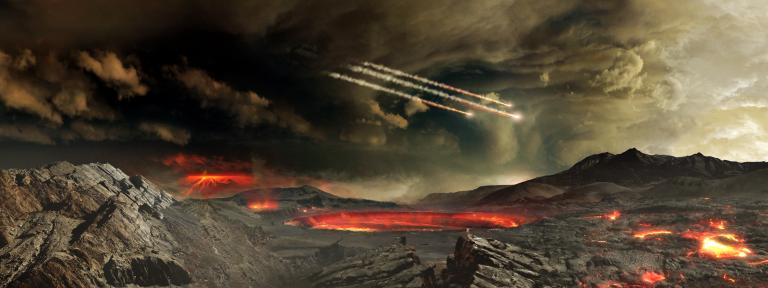
Even at this relatively late stage in the early history of Earth (shown in a public domain image from NASA’s Goddard Space Flight Center Conceptual Image Laboratory), our planet was still rather inhospitable to life.
Current estimates of the age of the Earth put it at about 4.543 billion years.
That makes this find potentially stunning:
If the discovery isn’t overturned — has anybody seen anything to overturn it? — the biology on our planet is at least 3.77 billion years old, and it could even be as old as 4.28 billion years.
That means that organic life was underway on Earth within no more than 773 million years of Earth’s earliest existence — and perhaps within as little as 263 million years. In other words, it appeared just about as soon as it possibly could. And there’s no reason to believe that scientists have found the absolutely earliest organisms ever to have lived here. The odds are extraordinarily low that, by sheer dumb luck, out of all the geological materials that have been submerged beneath the seas or have been folded underneath tectonic plates or now happen to rest upon Earth’s surface — scientists happen to have found the very first living things.
But what, exactly, does it mean to say that the Earth is about 4.543 billion years old? Did it simply suddenly appear as a solid ball at that point, ready for the advent of giant Sequoias, lemurs, and Bernie Sanders?
Not even close.
Remember that, according to current scientific consensus, the Earth came into being in the same fashion that most if not all other objects in our solar system did, as a solidified cloud of dust particles and gases remaining as “left overs” from the same process that formed the Sun. Probably the remnants of an exploded supernova, or of more than one, these gases and particles coalesced into planets, asteroids, and comets because of mutual and ever increasing gravitational attraction. For maybe half a billion years, the interior of the planetesimal or protoplanet that would become Earth remained solid and (relatively) cool, perhaps at a balmy temperature of approximately 2,000°F.
I say “relatively cool” because, by contrast, when the Sun shrank in upon itself by a process of gravitational compaction it began the steady nuclear fusion that continues today, radiating heat and light and (ultimately) making our lives possible. But our future home would have been hot, even molten, because the solar system wasn’t yet the rather orderly place with distinct planets and clear orbits that it would eventually become. For a long time, large and ever growing planetesimals were colliding and merging with each other, and such collisions — creating friction on an inconceivably massive scale — generated enormous heat.
This is what is called the “Hadean” period of Earth’s history — running from roughly 4.6 billion to 4 billion years before the present. (The term Hadean comes, as you might have guessed, from the Greek noun Hades, which, in this case, signifies Hell. Not a bad description, as you will see.) In a sense, the Hadean period wasn’t really a geological period at all, because, with the exception of meteorites (which are, by definition, extraterrestrial), no rocks ever found on our planet are so old. In fact, some scientists use an altogether different term to refer to the earliest stages of Earth’s history, calling our protoplanet “Gaia” in order to distinguish from the solid planet that it eventually became.
The oldest meteoric rocks that have been discovered are currently dated — apart from the fascinating “Hypatia” stone, which deserves its own discussion — to between 4.5 and 4.6 billion years ago. The oldest lunar rock thus far dated has been placed at about 4.44 billion years of age. (Although the Moon is derivative of the Earth and thus offers some clues to our planet’s formation, it doesn’t experience plate tectonics and, with neither water nor an atmosphere, it doesn’t experience erosion, either. So ancient lunar rocks don’t disappear. Unless astronauts take them.)
But these conditions couldn’t (and didn’t) last forever. The main components of the Earth’s interior in that epoch, according to currently available evidence and theory, were iron and various silicates — that is, salts combining silicon and oxygen. But there were also small amounts of other elements, including some (notably uranium, thorium, and potassium) that were radioactive. It is the relative abundance of these heavier elements in the early Earth and in our solar system more generally that points to their origin in one or more supernovas, since such heavier elements, otherwise rather uncommon in the universe as a whole, are produced by stellar nuclear fusion. By mass, only about 2% of our galaxy is composed of “heavy elements” — that is, of elements other than hydrogen and helium. Those two “light elements” represent an astonishing 74% and 24%, respectively, of all of the baryonic matter in the universe. And baryonic matter, we should recall, represents only about 4.6% of the universe’s total energy, which is otherwise composed of dark energy (74%) and dark matter (24%).) (For a reflection on this subject from quite another angle, see my 2015 Deseret News column “Materialism isn’t what it used to be.”)
As millions of years passed, energy released from those elements by slow radioactive decay gradually heated the Earth, melting some of its constituent materials. The iron melted before the silicates could and, because it was heavier, it naturally sank toward the center. In turn, this forced the lighter silicates that its descent displaced to rise up toward the proto-planetary surface. After many years, that slowly sinking and coalescing iron reached the center of the still-forming planet — and attained stability — at almost 4,000 miles from the surface. Finally, enough iron accumulated at the Earth’s center to become our planet’s core, more or less as we know it today. Gravitation now kept it in place, because, obviously, to move further would be to move upward.
By contrast, the face of the Earth was still turbulent and unstable—suffering (as it were) gigantic earthquakes and even occasional sheer liquid bubbling, like simmering oatmeal. Erupting volcanos pocked the Earth, and flowing lava covered virtually all of it. Moreover, because the Earth’s protective atmosphere hadn’t yet come into existence, solar rays baked its outer surface and meteors frequently bombarded it. Hadean seems a pretty apt adjective to describe this period.
But the Earth inevitably began to cool, as everything in the universe is naturally fated to do, and a thin but (again) fairly stable crust of solid rock formed (as, again, sometimes happens with oatmeal). The oldest terrestrial rocks currently known to scientists date to roughly 3.8 billion years before the present. It’s probable that rocks existed on Earth prior to this, but hard evidence for them — pardon the pun! — may never actually be found, partly because most really old things aren’t found but mostly because any older rocks have likely been destroyed by erosion and the constant recycling of materials caused by plate tectonics and its perpetual subductions.
With the advent of solid terrestrial rock, perhaps somewhat prior to our oldest evidence from 3.8 billion years ago, the geological history of Earth properly began. This is what is called the “Archaean eon.”
Of course, the new, hard terrestrial crust wasn’t perfectly smooth. There were depressions (and elevations) in it. These formed natural basins. Meanwhile, water was rising from the interior of the planet through fissures and via volcanic eruptions, as well as being delivered by meteorites, and that water collected to form Earth’s primordial seas.
It was in these primeval oceans, most contemporary scientists believe, that the first stirrings of organic life occurred — and, as noted above, they seem to have occurred at least 3.77 billion years ago, and perhaps even as long ago as 4.28 billion years.
All of the processes summarized above — accurately, I hope — had to happen before the Earth was ready for biology to appear. And then life arose with incredible speed, almost (it now seems) instantly.
(The basic story that I tell above relies on the clear and helpful summary given in the article “Origin of Earth” on the “Infoplease” website.)
Previous Post

March 10, 2019
Iran 4: Going to Church
Next Post
March 11, 2019 An iconic and historic photograph
Browse Our Archives
Select a Category Uncategorized
Select a Month October 2026 September 2026 August 2026 July 2026 June 2026 May 2026 April 2026 March 2026 February 2026 January 2026 December 2025 November 2025 October 2025 September 2025 August 2025 July 2025 June 2025 May 2025 April 2025 March 2025 February 2025 January 2025 December 2024 November 2024 October 2024 September 2024 August 2024 July 2024 June 2024 May 2024 April 2024 March 2024 February 2024 January 2024 December 2023 November 2023 October 2023 September 2023 August 2023 July 2023 June 2023 May 2023 April 2023 March 2023 February 2023 January 2023 December 2022 November 2022 October 2022 September 2022 August 2022 July 2022 June 2022 May 2022 April 2022 March 2022 February 2022 January 2022 December 2021 November 2021 October 2021 September 2021 August 2021 July 2021 June 2021 May 2021 April 2021 March 2021 February 2021 January 2021 December 2020 November 2020 October 2020 September 2020 August 2020 July 2020 June 2020 May 2020 April 2020 March 2020 February 2020 January 2020 December 2019 November 2019 October 2019 September 2019 August 2019 July 2019 June 2019 May 2019 April 2019 March 2019 February 2019 January 2019 December 2018 November 2018 October 2018 September 2018 August 2018 July 2018 June 2018 May 2018 April 2018 March 2018 February 2018 January 2018 December 2017 November 2017 October 2017 September 2017 August 2017 July 2017 June 2017 May 2017 April 2017 March 2017 February 2017 January 2017 December 2016 November 2016 October 2016 September 2016 August 2016 July 2016 June 2016 May 2016 April 2016 March 2016 February 2016 January 2016 December 2015 November 2015 October 2015 September 2015 August 2015 July 2015 June 2015 May 2015 April 2015 March 2015 February 2015 January 2015 December 2014 November 2014 March 2014 August 2013 February 2012
Follow Us!
TAKE THE
Religious Wisdom Quiz
What does "Eden" mean in Hebrew?
Select your answer to see how you score.
Peace Gift Paradise Delight
Related posts from Sic et Non

This Wednesday, at 4 PM, Utah time

What if Wallace had prevailed, rather than Darwin?

Ancient Egyptian Cosmology Illustrated in Soil Core Samples
TRENDING AT PATHEOS Latter-day Saint

The Problem with False Prophets
Miller’s Station UMC| 10/18/26| Anchor Verse: Jeremiah 23: 1, 9-23 I...

Emotion in Early Christianity by Andrew Crislip
Andrew Crislip’s Emotion in Early Christianity examines an often overlooked dimension of...

16 Spiritual Touchstones for a More Grounded Life
After decades of spiritual study, here are 16 principles I try...

Catholic Evangelization: Sharing Your Faith Every Day
Welcome back to the Graceful Awakening mini-series called, “From Faith to Mission.” ...

The Pillar of the Boatmen: the Ancient Monument...
The Pillar of the Boatmen is a Romano-Gaulish sculpture that dates from...

In one sense walking into Westminster Abbey is like walking down the...
view all Latter-day Saint blogs
Ad-Free & Subscriber Log-In Subscription Support
- About Us
- 2026 Calendar
- Videos
- Podcasts
- Library of World Religions
- Faith In Media Tracker
- Advertise With Us
- Write for Us
- Privacy Policy
- Terms of Service
- Do Not Sell My Data
- Contact Us
- Radiant Digital
- Manage Newsletter Subscriptions
- Unsubscribe From Notifications
- Sitemap
Copyright 2008-2026, Patheos. All rights reserved.
Subscription Support Ad-Free & Subscriber Log-In
Follow Patheos