
BuddhistCatholicContemplativeEvangelicalGeneral ChristianHinduJewishLatter-day SaintMuslimNew VisionsProgressive Christian
Beliefs
- Buddhist
- Catholic
- Contemplative
- Evangelical
- General Christian
- Hindu
- Jewish
- Latter-day Saint
- More Voices
- Muslim
- New Visions
- Pagan
- Progressive Christian
Topics
- Religion News
- Food and Religion
- Sports and Religion
- Religious Art
- Religious Music and Entertainment
- Religious Events
- History and Religion
- Style and Religion
- Politics and Religion
- Women in Religion
- Recreation Outdoors and Religion
- Business Finance and Religion
- Careers Workplace and Religion
- Education and Religion
- Family Parenting and Religion
- Health Fitness and Religion
- Home and Religion
- Relationships and Religion
- Technology and Religion
- Travel and Religion
Columnists
- Buddhist Columnists
- Business Finance and Religion Columnists
- Careers Workplace and Religion Columnists
- Catholic Columnists
- Contemplative Columnists
- Education and Religion Columnists
- Evangelists Columnists
- Family Parenting and Religion Columnists
- General Christian Columnists
- Health Fitness and Religion Columnists
- Hindu Columnists
- History and Religion Columnists
- Home and Religion Columnists
- Jewish Columnists
- More Voices Columnists
- Latter Day Columnists
- Muslim Columnists
- New Visions Columnists
- Nonreligious Columnists
- Pagan Columnists
- Politics and Religion Columnists
- Progressive Columnists
- Recreation Outdoors and Religion Columnists
- Relationships and Religion Columnists
- Religion News Columnists
- Religious Art Columnists
- Religious Events Columnists
- Religious Music and Entertainment Columnists
- Sports and Religion Columnists
- Style and Religion Columnists
- Technology and Religion Columnists
- Travel and Religion Columnists
- Women in Religion Columnists
Resource Library
- 2026 Calendar
- Library of World Religions
- The 100 Most Holy Places on Earth
- Patheos Answers
- Podcasts
- Videos
- Faith Leaders Database
- Anglican Episcopalian
- Bahai
- Baptist
- Buddhism
- Christianity
- Confucianism
- Eastern Orthodoxy
- Hinduism
- Holiness and Pentecostal
- ISKCON
- Islam
- Judaism
- Lutheran
- Methodist
- The Church of Jesus Christ of Latter-day Saints
- New Age
- Paganism
- Presbytarian and Reformed
- Protestantism
- Religion Behind the Scenes
- Roman Catholic
- Scientology
- Shia Islam
- Sikhism
- Sufism
- Sunni Islam
- Taoism
- Zen
- See all religions
Research Tools
 Ad-Free & Subscriber Log-In Subscription Support
Ad-Free & Subscriber Log-In Subscription Support
Follow Patheos 

- Trending:
- Forgiveness
- |
- Marriage
- |
- Consciousness
- |
- Death Penalty
- |
- Election
- |
- Halloween

- Home
- Latter-day Saint
- “The psychology of Islamic suicide bombing”?
“The psychology of Islamic suicide bombing”?
Last updated on: February 17, 2019 at 7:27 pm by Dan Peterson
“The psychology of Islamic suicide bombing”? 2019-02-17T19:27:35-07:00 Dan Peterson
Patheos Explore the world's faith through different perspectives on religion and spirituality! Patheos has the views of the prevalent religions and spiritualities of the world.
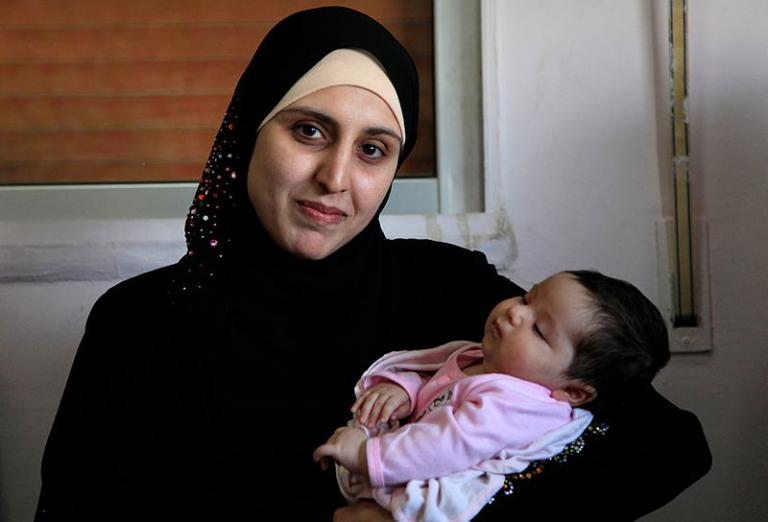
This photo, taken by Russell Watkins of the Department for International Development of the UK, shows a Syrian refugee with her 25-day-old daughter. Her home had recently been destroyed by a bomb. Her brother was killed in the attack, and she gave birth to the baby, her third, in a Jordanian refugee camp. She’s shown here in a clinic run in Ramtha, Jordan, by the International Rescue Committee. (Wikimedia Commons)
I’ve just begun reading Nancy Hartevelt Kobrin, The Banality of Suicide Terrorism: The Naked Truth About the Psychology of Islamic Suicide Bombing (Dulles, VA: Potomac Books. 2010).
Thus far, I’m not favorably impressed. I can only hope that it gets better.
Dr. Kobrin, a psychoanalyst who has strong ties to Israel but practices in Minnesota, offers an interesting thesis, which she states in various ways: “Islamic suicide terrorism can be understood as a new variant of an old problem — domestic violence” (1) “The Islamic suicide attack is a hybrid of domestic violence’s murder-suicide, serial killing, and the Arab clan custom of honor killing” (11). “This book explains Islamic suicide terrorism as displaced rage against the ‘Early Mother’ of childhood” (3). “Islamic suicide bombings are a form of displaced violence about the Early Mother in life, especially the Early Muslim Mother and the disavowed wish to murder her” (13). “The terror in Islamic suicide terrorism is nothing more than displaced murderous rage meant for the Early Mother . . . The terrorists do [what they do] because they have the need to hate and the need to have enemies, needs stemming from the externalization of the hatreds developed through blaming and shaming child-rearing practices, learned in early childhood, while these nascent terrorists were ’embedded’ in their families” (20). “Islamic suicide terrorism is informed by the child’s experience that violence and force are to be used as a means to control others. It is learned behavior, which is ingrained early in life” (4)
I become quite uneasy when I read phrases like that casual nothing more. Is there, perhaps, any political dimension to suicide terrorism? Is it really “nothing more” than an aftereffect of experiences in early infancy and childhood? Really?
Dr. Kobrin is plainly follows the lead of Sigmund Freud in her approach:
“Man created religion in order to fill a painful void left by the inability to mourn the loss of the Early Mother” (24).
She’s not quite an orthodox Freudian, though. She puts St. Sigmund himself on the couch, telling her readers that he didn’t really talk about “the Early Mother” because of his own “conflicted, ambivalent relationship with his own mother” (27).
Terrorists, says Dr. Kobrin, “are terrified to separate from their mothers psychologically and remain fused with them, which binds and blinds them” (xvii).
I would certainly like to see some evidence for that claim, some data. Thus far, though, I’ve seen none.
“[T]errorists have impaired thinking because they lack a maturity stemming from independence” (xviii).
Well, maybe. But maybe not.
Muhammad Bouyeri, she says, killed Theo van Gogh on an Amsterdam street because his mother had just died and her death had left him feeling bitter and abandoned (xv). Perhaps. It’s not impossible. But some actual evidence would be nice.
Beyond the seemingly ungrounded character of her assertions, though, it’s their sweeping nature that astonishes me:
At one point, Dr. Kobrin writes of “the Islamic suicide terrorists and all their accessories to the crime,” and she includes among those “accessories” not only “the engineer-bomb maker, the recruiter, the sender, the escort, [and] the charismatic leader” but “their mothers and fathers, their uncles, the clan, the tribe, the umma” (21). It’s a comprehensive indictment of absolutely every member of the Islamic community worldwide — which, in Arabic (including in the Qur’an itself) is called the umma. “They are all like newborns. They have never been allowed to grow up, to mature, or to be free, independent, self-sufficient, confident, and competent human beings. They have been raised to stay immature all their lives through terrorizing and shaming child-rearing practices” (22).
I have to admit that, in my judgment, anyway, Dr. Kobrin has been flirting thus far with what looks very much like a flagrant form of ethnic stereotyping, even racism. And she’s doing it on the basis of virtually no actual data.
“Arab culture — as found in Saudi Arabia — is the venerated culture for the Muslims” (9, emphasis in the original).
Really? Would Qataris agree to this, let alone Egyptians, Iraqis, Lebanese, and Moroccans? Does she have any evidence for her announcement? And, since she’s purporting to describe “the Muslims” generally, what about Indonesians, Turks, Iranians, Pakistanis, and Malaysians? And what of Muslims living in, say, Florida and Yorkshire and New South Wales?
The generalizations are vast, and deeply negative:
“The Arab Muslim culture in which they live has not permitted their children to grow up into confident and competent adults. Not being allowed to separate psychologically leaves their children feeling distrustful and terrified of the outside world and induces an inordinate amount of persecutory anxieties” (xvii)
“Where you have a devalued woman and an overidealized mother, as you do in Arab and Muslim cultures” (1)
“In Arab Muslim culture, the mother . . . herself is a victim” (4).
“[T]he young mother in these cultures has been so utterly devalued, abused, and traumatized as a child that when she becomes a mother, often at a young age, she is compromised. She struggles in her capacity to mother in a completely unsupported environment in which she is further abused” (3)
“In Arab Muslim families, children are not considered as individual personalities” (5).
“Arab Muslim culture is not one in which children are loved and hugged appropriately” (6)
“[I]n Arab Muslim culture everything is done in order to acquire prestige, which is confused with honor” (21)
“That there is widespread sexual abuse of children, and of girls in particular, should be an obvious indicator as to how men in the Arab Muslim world feel about themselves” (12)
In Arab Muslim culture, writes Dr. Kobrin, “Little boys are treasured and adored while little girls are despised” (19). “Arab Muslim boys grow up to become men who do not respect women” (19). Male children in Arab Muslim culture are psychologically, emotionally, and intellectually stunted by the way they’ve been raised (5).
Does some potential evidence seem to contradict her thesis? Do some informants seem to tell a different story? No problem! They’re lying. Dr. Kobrin simply dismisses contrary claims:
“Even though these families may claim to the media that their sons and daughters who became terrorists are really sweet, kind, and normal people, this assertion should be doubted and treated skeptically since their culture of shame has so infused the group’s sensitivity to criticism. They must always present a good face to the public because they feel so excruciatingly shamed” (10).
“The Arab Muslims have chosen to deny that honor killing is cold-blooded murder and that suicide bombing is mass slaughter of the innocent” (11)
Dr. Kobrin describes how, in “Arab Muslim culture,” a woman or a girl who has lost her “honor” is “put to death in an honor killing” (21).
But how common is this? How widespread? Are there socio-economic or class factors involved? Thus far at least, Dr. Kobrin has nothing to say about such questions. Even less than I’ve said:
Sometimes, her declarations have been a bit weird:
“Honor killing is . . . a misnomer since it has nothing to do with honor. . . . My colleague Dr. Chesler rightly refers to it as ‘honor murder'” (11)
But it’s self-contradictory for Dr. Kobrin to object to the adjective honor in the phrase honor killing while endorsing her colleague’s formulation honor murder.
Among her illustrations of Arab Muslim culture, which she interprets in a more or less Freudian way, is “the all-enveloping burka, which the Taliban has [sic] imposed on women it [sic] controls” (15). But the Taliban control portions of Afghanistan, which isn’t Arab. The burka is Afghan. And the Taliban aren’t Arabs, either.
And this statement strikes me as simply and self-evidently false:
“War is the misrecognition of the other as feared when, in fact, the other is familiar and legitimate” (34).
The Third Reich wasn’t “familiar and legitimate,” and Churchill didn’t “misrecognize” the Nazis.
“[I]t is estimated,” writes Dr. Kobrin, “[that] 1 percent of the nearly 1.5 billion Muslims become violent jihadis” (22).
Really? Is there any actual evidence that there are fifteen million violent jihadis out there?
https://www.deseretnews.com/article/865676865/Why-are-there-so-few-Muslim-terrorists.html
But I close with what I regard as merely a silly expression of that old-time Freudian religion:
Suicide bombing, Dr. Kobrin suggests, “merges” or “fuses” the bomber with his or her victims — which, seemingly inevitably for a psychoanalyst, means that it’s really about sex (28).
As I say, I hope that it gets better. Soon.
Previous Post

February 11, 2019
A note on veganism and vegetarianism (2)
Next Post
February 11, 2019 New Testament Note 31
Browse Our Archives
Select a Category Uncategorized
Select a Month October 2026 September 2026 August 2026 July 2026 June 2026 May 2026 April 2026 March 2026 February 2026 January 2026 December 2025 November 2025 October 2025 September 2025 August 2025 July 2025 June 2025 May 2025 April 2025 March 2025 February 2025 January 2025 December 2024 November 2024 October 2024 September 2024 August 2024 July 2024 June 2024 May 2024 April 2024 March 2024 February 2024 January 2024 December 2023 November 2023 October 2023 September 2023 August 2023 July 2023 June 2023 May 2023 April 2023 March 2023 February 2023 January 2023 December 2022 November 2022 October 2022 September 2022 August 2022 July 2022 June 2022 May 2022 April 2022 March 2022 February 2022 January 2022 December 2021 November 2021 October 2021 September 2021 August 2021 July 2021 June 2021 May 2021 April 2021 March 2021 February 2021 January 2021 December 2020 November 2020 October 2020 September 2020 August 2020 July 2020 June 2020 May 2020 April 2020 March 2020 February 2020 January 2020 December 2019 November 2019 October 2019 September 2019 August 2019 July 2019 June 2019 May 2019 April 2019 March 2019 February 2019 January 2019 December 2018 November 2018 October 2018 September 2018 August 2018 July 2018 June 2018 May 2018 April 2018 March 2018 February 2018 January 2018 December 2017 November 2017 October 2017 September 2017 August 2017 July 2017 June 2017 May 2017 April 2017 March 2017 February 2017 January 2017 December 2016 November 2016 October 2016 September 2016 August 2016 July 2016 June 2016 May 2016 April 2016 March 2016 February 2016 January 2016 December 2015 November 2015 October 2015 September 2015 August 2015 July 2015 June 2015 May 2015 April 2015 March 2015 February 2015 January 2015 December 2014 November 2014 March 2014 August 2013 February 2012
Follow Us!
TAKE THE
Religious Wisdom Quiz
We made a deceptive treaty with Israel by pretending to come from a distant land with moldy bread and worn-out wineskins. Who are we?
Select your answer to see how you score.
The Amorites The Hivites The Canaanites The Gibeonites
Related posts from Sic et Non

Islam in America or Islam versus America?

A basic working chronology of Islamic-era Iran

Actual Data and Actual Crusades

TRENDING AT PATHEOS Latter-day Saint

Nearly every morning, I make the drive to Detroit with my high-school-age...

The Real AI Story Is Adoption Without Trust
Artificial intelligence has crossed a political threshold. It is no longer a...

A new article, written by Jeff Lindsay and Gale L. Pooley,...

Swimfan: Forgotten Aughts Pleasures
This is a recovery effort. In 2002, My Big Fat Greek Wedding...

Top Three Anti-Catholic Lies About Catholicism
This is my initial transcript for the video, "THE 3 WORST...

Pope Leo Celebrates Mass for Nurses & Docs...
I don't have any idea how he did it, but Pope Leo...
view all Latter-day Saint blogs
Ad-Free & Subscriber Log-In Subscription Support
- About Us
- 2026 Calendar
- Videos
- Podcasts
- Library of World Religions
- Faith In Media Tracker
- Advertise With Us
- Write for Us
- Privacy Policy
- Terms of Service
- Do Not Sell My Data
- Contact Us
- Radiant Digital
- Manage Newsletter Subscriptions
- Unsubscribe From Notifications
- Sitemap
Copyright 2008-2026, Patheos. All rights reserved.
Subscription Support Ad-Free & Subscriber Log-In
Follow Patheos