
BuddhistCatholicContemplativeEvangelicalGeneral ChristianHinduJewishLatter-day SaintMuslimNew VisionsProgressive Christian
Beliefs
- Buddhist
- Catholic
- Contemplative
- Evangelical
- General Christian
- Hindu
- Jewish
- Latter-day Saint
- More Voices
- Muslim
- New Visions
- Pagan
- Progressive Christian
Topics
- Religion News
- Food and Religion
- Sports and Religion
- Religious Art
- Religious Music and Entertainment
- Religious Events
- History and Religion
- Style and Religion
- Politics and Religion
- Women in Religion
- Recreation Outdoors and Religion
- Business Finance and Religion
- Careers Workplace and Religion
- Education and Religion
- Family Parenting and Religion
- Health Fitness and Religion
- Home and Religion
- Relationships and Religion
- Technology and Religion
- Travel and Religion
Columnists
- Buddhist Columnists
- Business Finance and Religion Columnists
- Careers Workplace and Religion Columnists
- Catholic Columnists
- Contemplative Columnists
- Education and Religion Columnists
- Evangelists Columnists
- Family Parenting and Religion Columnists
- General Christian Columnists
- Health Fitness and Religion Columnists
- Hindu Columnists
- History and Religion Columnists
- Home and Religion Columnists
- Jewish Columnists
- More Voices Columnists
- Latter Day Columnists
- Muslim Columnists
- New Visions Columnists
- Nonreligious Columnists
- Pagan Columnists
- Politics and Religion Columnists
- Progressive Columnists
- Recreation Outdoors and Religion Columnists
- Relationships and Religion Columnists
- Religion News Columnists
- Religious Art Columnists
- Religious Events Columnists
- Religious Music and Entertainment Columnists
- Sports and Religion Columnists
- Style and Religion Columnists
- Technology and Religion Columnists
- Travel and Religion Columnists
- Women in Religion Columnists
Resource Library
- 2026 Calendar
- Library of World Religions
- The 100 Most Holy Places on Earth
- Patheos Answers
- Podcasts
- Videos
- Faith Leaders Database
- Anglican Episcopalian
- Bahai
- Baptist
- Buddhism
- Christianity
- Confucianism
- Eastern Orthodoxy
- Hinduism
- Holiness and Pentecostal
- ISKCON
- Islam
- Judaism
- Lutheran
- Methodist
- The Church of Jesus Christ of Latter-day Saints
- New Age
- Paganism
- Presbytarian and Reformed
- Protestantism
- Religion Behind the Scenes
- Roman Catholic
- Scientology
- Shia Islam
- Sikhism
- Sufism
- Sunni Islam
- Taoism
- Zen
- See all religions
Research Tools
 Ad-Free & Subscriber Log-In Subscription Support
Ad-Free & Subscriber Log-In Subscription Support
Follow Patheos 

- Trending:
- Forgiveness
- |
- Marriage
- |
- Consciousness
- |
- Death Penalty
- |
- Election
- |
- Halloween

- Home
- Latter-day Saint
- Some background notes, again, about the “Islamic State”
Some background notes, again, about the “Islamic State”
Last updated on: March 8, 2019 at 8:52 pm by Dan Peterson
Some background notes, again, about the “Islamic State” 2019-03-08T20:52:43-07:00 Dan Peterson
Patheos Explore the world's faith through different perspectives on religion and spirituality! Patheos has the views of the prevalent religions and spiritualities of the world.
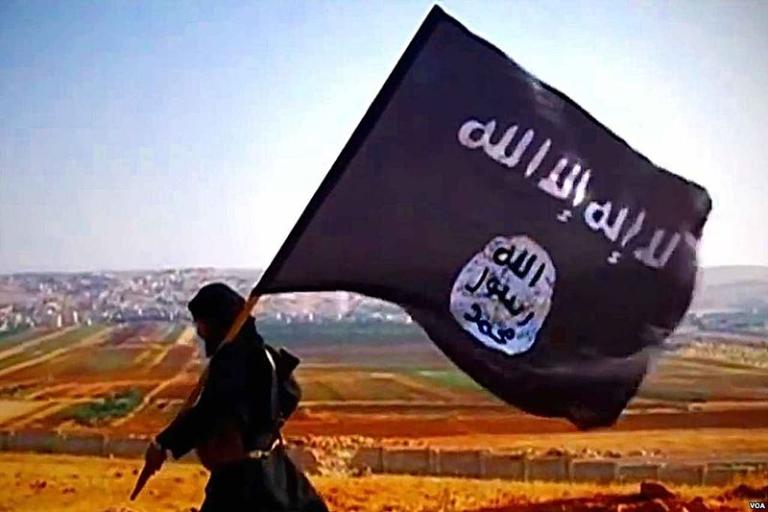
An ISIS fighter carrying the organization’s flag
(Wikimedia Commons public domain)
William Hamblin and I published this column in the Deseret News back on 4 October 2014:
Amid the recent attention garnered by the barbaric cruelty and spectacular battlefield success of the Islamic State and its new caliphate (on which, see our previous column “Turning the clock back to the 7th century in Iraq?“), the sudden arrival on the scene of a new and very threatening terrorist group called “Khorasan” might easily be overlooked. (In fact, some commentators at nationalreview.com and carnegieendowment.org argue that, strictly speaking, “Khorasan” doesn’t even exist.)
Perhaps some explanation on the linguistic, theological and historical background behind these related organizations — if, indeed, there really are two of them — might be helpful, including a few words about names.
The White House commonly refers to the Islamic State as ISIL, while others call it ISIS. These are simply different translations of the same name, which in Arabic is “Al-Dawla al-Islamiyyah fi al-Iraq wa al-Sham.” The last element in that name, “al-Sham,” can be translated as “Syria” (hence, ISIS) but, properly speaking, it denotes not merely the modern nation-state of Syria (the Islamic State cares nothing for modern political borders) but the larger historical area of “Greater Syria” or, as it’s sometimes called, “the Levant” (hence, ISIL). The Arabic acronym for the Islamic State is actually neither ISIS nor ISIL, but — based upon the name’s Arabic spelling — “Da’esh.”
Modern political Syria’s interest in regaining its traditional scope is, incidentally, one of the factors behind the Asad regime’s hostility to Israel and its constant interference in neighboring Lebanon, which, as an independent country, is a modern creation imposed by European colonial powers.
But what of the Khorasan group? If it exists (which, in the murky world of Islamist terrorism, isn’t easy to determine), it’s thought to be a very small elite corps (perhaps fewer than 100 men) that might be compared to the U.S. Army’s Special Forces units or the Navy Seals. Classically, Khorasan denoted the region of modern Turkmenistan, Afghanistan, Pakistan and eastern Iran (essentially the area known even more anciently as “Parthia”), located on the eastern margins of the early Islamic empire.
But the leaders of the alleged Khorasan group come from Kuwait, Syria and Yemen, not from Khorasan. So why the name?
If you’ve seen images of ISIS warriors cruising in caravans down major roads (before U.S. bombing raids, well telegraphed in advance, were launched against them) or of triumphant ISIS fighters standing over rows of executed captives, you’ve seen their black flags, inscribed in Arabic with the essentials of the Islamic testimony or profession of faith: “There is no god but God” and “Muhammad is the Messenger of God.”
This is a clue.
It’s said that the Prophet Muhammad flew a black battle flag, and that Ali, his cousin and son-in-law and the last of the four “orthodox” caliphs who succeeded him, also went to war under such a flag.
In the 740s, the Abbasid revolution overturned the corrupt and increasingly ineffective Umayyad Dynasty that had ruled the entire empire from Damascus. One of the most successful revolutions in pre-modern history, it commenced among disaffected non-Arab Muslims in the extreme east of the Islamic world — in Khorasan — and its fighters were called “musawwids” (roughly, “the black-bearers”) because they marched westward under a black banner (the “rayat al-sawda”). It was probably at about this time that a “prophecy” of Muhammad was set into circulation, predicting that the Mahdi, the apocalyptic figure expected by both Sunni and Shiite Muslims in the last days, would arrive accompanied by “black standards” from the East.
Since at least 2001, black banners have commonly appeared on jihadist websites and among members of al-Qaida, Somalia’s al-Shabaab and Hizbul Islam, and the Islamic State in Iraq and Syria.
Finally, if you’ve seen that black flag, you may also have noticed ISIS fighters gathered around it with their index fingers pointing skyward. They’re not boasting, in Western style, “We’re Number One.” Instead, they’re indicating their allegiance to the Islamic principle of “tawheed” or “making/declaring One.” In its most basic sense, “tawheed” refers to the Islamic principle of absolute monotheism (again, “There is no god but God”).
The worst sin in Islam is that of “shirk” or, roughly “polytheism,” and Muslims have historically regarded (and rejected) even Trinitarian Christianity as polytheistic heresy. Those single extended fingers indicate a rigid commitment to monotheism, and perhaps help to explain the Islamic State’s brutally harsh treatment of Middle Eastern Christians. However, the gesture also seems to represent ISIS’s vision of one global Islamic State, wholly subservient to that One God — and to one universal earthly caliph.
It seems that the “Islamic State” may be on its last legs as a holder of territory. At least, for the time being. It is, however, nowhere near done as an idea and a threat. We should not be complacent on that score.
Previous Post

February 25, 2019
"Even older and deeper than ethics"
Next Post
February 25, 2019 New Testament Notes 64-65
Browse Our Archives
Select a Category Uncategorized
Select a Month October 2026 September 2026 August 2026 July 2026 June 2026 May 2026 April 2026 March 2026 February 2026 January 2026 December 2025 November 2025 October 2025 September 2025 August 2025 July 2025 June 2025 May 2025 April 2025 March 2025 February 2025 January 2025 December 2024 November 2024 October 2024 September 2024 August 2024 July 2024 June 2024 May 2024 April 2024 March 2024 February 2024 January 2024 December 2023 November 2023 October 2023 September 2023 August 2023 July 2023 June 2023 May 2023 April 2023 March 2023 February 2023 January 2023 December 2022 November 2022 October 2022 September 2022 August 2022 July 2022 June 2022 May 2022 April 2022 March 2022 February 2022 January 2022 December 2021 November 2021 October 2021 September 2021 August 2021 July 2021 June 2021 May 2021 April 2021 March 2021 February 2021 January 2021 December 2020 November 2020 October 2020 September 2020 August 2020 July 2020 June 2020 May 2020 April 2020 March 2020 February 2020 January 2020 December 2019 November 2019 October 2019 September 2019 August 2019 July 2019 June 2019 May 2019 April 2019 March 2019 February 2019 January 2019 December 2018 November 2018 October 2018 September 2018 August 2018 July 2018 June 2018 May 2018 April 2018 March 2018 February 2018 January 2018 December 2017 November 2017 October 2017 September 2017 August 2017 July 2017 June 2017 May 2017 April 2017 March 2017 February 2017 January 2017 December 2016 November 2016 October 2016 September 2016 August 2016 July 2016 June 2016 May 2016 April 2016 March 2016 February 2016 January 2016 December 2015 November 2015 October 2015 September 2015 August 2015 July 2015 June 2015 May 2015 April 2015 March 2015 February 2015 January 2015 December 2014 November 2014 March 2014 August 2013 February 2012
Follow Us!
TAKE THE
Religious Wisdom Quiz
Who said, "Am I not sending you?"
Select your answer to see how you score.
Moses Jesus Elijah God
Related posts from Sic et Non

Islam in America or Islam versus America?

A basic working chronology of Islamic-era Iran

Actual Data and Actual Crusades

TRENDING AT PATHEOS Latter-day Saint

The First Eucharistic Controversy: Christ’s Real Presence
For Catholics, the Eucharist is the source and summit of the Christian...

What a Stop Sign Can Teach Us About...
How to Make a Decision When You Can't Hear God Main point:...

Archdiocese Hosts Military Marriage Retreat in Germany
RASTATT, Germany — The transient military lifestyle, with its frequent deployments and...

Nearly every morning, I make the drive to Detroit with my high-school-age...

The Real AI Story Is Adoption Without Trust
Artificial intelligence has crossed a political threshold. It is no longer a...

A new article, written by Jeff Lindsay and Gale L. Pooley,...
view all Latter-day Saint blogs
Ad-Free & Subscriber Log-In Subscription Support
- About Us
- 2026 Calendar
- Videos
- Podcasts
- Library of World Religions
- Faith In Media Tracker
- Advertise With Us
- Write for Us
- Privacy Policy
- Terms of Service
- Do Not Sell My Data
- Contact Us
- Radiant Digital
- Manage Newsletter Subscriptions
- Unsubscribe From Notifications
- Sitemap
Copyright 2008-2026, Patheos. All rights reserved.
Subscription Support Ad-Free & Subscriber Log-In
Follow Patheos