
BuddhistCatholicContemplativeEvangelicalGeneral ChristianHinduJewishLatter-day SaintMuslimNew VisionsProgressive Christian
Beliefs
- Buddhist
- Catholic
- Contemplative
- Evangelical
- General Christian
- Hindu
- Jewish
- Latter-day Saint
- More Voices
- Muslim
- New Visions
- Pagan
- Progressive Christian
Topics
- Religion News
- Food and Religion
- Sports and Religion
- Religious Art
- Religious Music and Entertainment
- Religious Events
- History and Religion
- Style and Religion
- Politics and Religion
- Women in Religion
- Recreation Outdoors and Religion
- Business Finance and Religion
- Careers Workplace and Religion
- Education and Religion
- Family Parenting and Religion
- Health Fitness and Religion
- Home and Religion
- Relationships and Religion
- Technology and Religion
- Travel and Religion
Columnists
- Buddhist Columnists
- Business Finance and Religion Columnists
- Careers Workplace and Religion Columnists
- Catholic Columnists
- Contemplative Columnists
- Education and Religion Columnists
- Evangelists Columnists
- Family Parenting and Religion Columnists
- General Christian Columnists
- Health Fitness and Religion Columnists
- Hindu Columnists
- History and Religion Columnists
- Home and Religion Columnists
- Jewish Columnists
- More Voices Columnists
- Latter Day Columnists
- Muslim Columnists
- New Visions Columnists
- Nonreligious Columnists
- Pagan Columnists
- Politics and Religion Columnists
- Progressive Columnists
- Recreation Outdoors and Religion Columnists
- Relationships and Religion Columnists
- Religion News Columnists
- Religious Art Columnists
- Religious Events Columnists
- Religious Music and Entertainment Columnists
- Sports and Religion Columnists
- Style and Religion Columnists
- Technology and Religion Columnists
- Travel and Religion Columnists
- Women in Religion Columnists
Resource Library
- 2026 Calendar
- Library of World Religions
- The 100 Most Holy Places on Earth
- Patheos Answers
- Podcasts
- Videos
- Faith Leaders Database
- Anglican Episcopalian
- Bahai
- Baptist
- Buddhism
- Christianity
- Confucianism
- Eastern Orthodoxy
- Hinduism
- Holiness and Pentecostal
- ISKCON
- Islam
- Judaism
- Lutheran
- Methodist
- The Church of Jesus Christ of Latter-day Saints
- New Age
- Paganism
- Presbytarian and Reformed
- Protestantism
- Religion Behind the Scenes
- Roman Catholic
- Scientology
- Shia Islam
- Sikhism
- Sufism
- Sunni Islam
- Taoism
- Zen
- See all religions
Research Tools
 Ad-Free & Subscriber Log-In Subscription Support
Ad-Free & Subscriber Log-In Subscription Support
Follow Patheos 

- Trending:
- Forgiveness
- |
- Marriage
- |
- Consciousness
- |
- Death Penalty
- |
- Election
- |
- Halloween

- Home
- Latter-day Saint
- New Testament Notes 64-65
New Testament Notes 64-65
Last updated on: March 8, 2019 at 8:56 pm by Dan Peterson
New Testament Notes 64-65 2019-03-08T20:56:15-07:00 Dan Peterson
Patheos Explore the world's faith through different perspectives on religion and spirituality! Patheos has the views of the prevalent religions and spiritualities of the world.
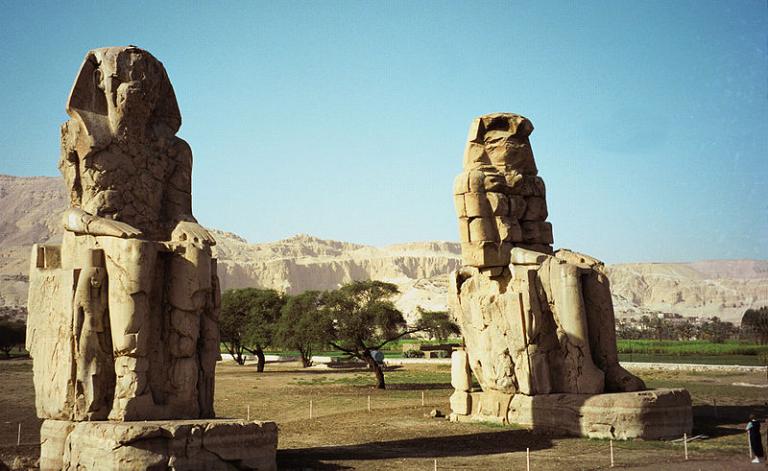
The Colossi of Memnon (Wikimedia Commons public domain image))
These two statues of Amenhotep IV (Eighteenth Dynasty; ca. 1350 BC), located on the western bank of the Nile, across from Luxor, are all that remains of his massive memorial temple.
(Wikimedia Commons public domain photograph)
Compare Luke 11:34-36; 12:33-34
1.
The transience of earthly treasures — referring not only to wealth, but to popularity, power, status, beauty, reputation, pleasure, and other such things — is a staple of religious moralizing, and not solely among Christians.
And justly so, because one of the most obvious and undeniable facts of human life is that such things simply don’t last.
Fame, beauty, reputation, power, and popularity typically fade — after death, if not (sometimes quite painfully) long before.
Status doesn’t count for much in the grave.
The famous poem “Ozymandias,” by the English Romantic poet Percy Bysshe Shelley (1792-1822), captures this well:
I met a traveller from an antique land
Who said: “Two vast and trunkless legs of stone
Stand in the desert. Near them, on the sand,
Half sunk, a shattered visage lies, whose frown,
And wrinkled lip, and sneer of cold command,
Tell that its sculptor well those passions read
Which yet survive, stamped on these lifeless things,
The hand that mocked them and the heart that fed:
And on the pedestal these words appear:
‘My name is Ozymandias, king of kings:
Look on my works, ye Mighty, and despair!’
Nothing beside remains. Round the decay
Of that colossal wreck, boundless and bare
The lone and level sands stretch far away.”
Moreover, pleasures end. But, very often, they begin to pall and to bore long before they end.
And, of course, great wealth can’t buy us an escape from the grave, and can’t accompany us into the world beyond.
I think, in this context, of an April 1968 General Conference talk given by Elder Spencer W. Kimball:
One day, a friend took me to his ranch. He unlocked the door of a large new automobile, slid under the wheel, and said proudly, “How do you like my new car?” We rode in luxurious comfort into the rural areas to a beautiful new landscaped home, and he said with no little pride, “This is my home.”
He drove to a grassy knoll. The sun was retiring behind the distant hills. He surveyed his vast domain. Pointing to the north, he asked, “Do you see that clump of trees yonder?” I could plainly discern them in the fading day.
He pointed to the east. “Do you, see the lake shimmering in the sunset?” It too was visible.
“Now, the bluff that’s on the south.” We turned about to scan the distance. He identified barns, silos, the ranch house to the west. With a wide sweeping gesture, he boasted, “From the clump of trees, to the lake, to the bluff, and to the ranch buildings and all between—all this is mine. And the dark specks in the, meadow—those cattle also are mine.” . . .
That was long years ago. I saw him lying in his death among luxurious furnishings in a palatial home. His had been a vast estate. And I folded his arms upon his breast, and drew down the little curtains over his eyes. I spoke at his funeral, and I followed the cortege from the good piece of earth he had claimed to his grave, a tiny, oblong area the length of a tall man, the width of a heavy one.
Yesterday I saw that same estate, yellow in grain, green in lucerne, white in cotton, seemingly unmindful of him who had claimed it. Oh, puny man, see the busy ant moving the sands of the sea.
Moreover, wealth cannot ultimately satisfy. It’s not bad, in itself, but it lacks the power to cure most ills, or to still our psychological and spiritual hungers.
Edwin Arlington Robinson’s 1897 poem “Richard Cory” is a memorable statement of this theme:
Whenever Richard Cory went down town,
We people on the pavement looked at him:
He was a gentleman from sole to crown,
Clean favored, and imperially slim.
And he was always quietly arrayed,
And he was always human when he talked;
But still he fluttered pulses when he said,
“Good-morning,” and he glittered when he walked.
And he was rich—yes, richer than a king—
And admirably schooled in every grace:
In fine, we thought that he was everything
To make us wish that we were in his place.
So on we worked, and waited for the light,
And went without the meat, and cursed the bread;
And Richard Cory, one calm summer night,
Went home and put a bullet through his head.
(If you’d like, listen to Simon and Garfunkel’s musical recasting of Robinson’s theme in their own “Richard Cory.” It’s less than three minutes long: https://www.youtube.com/watch?v=dwqwAy85CgY.)
2.
“The eye is the lamp of the body. So, if your eye is sound, your whole body will be full of light; but if your eye is not sound, your whole body will be full of darkness. If then the light in you is darkness, how great is the darkness!”
Perhaps this reflects some ancient theory of vision and physiology. Surely it’s meant to be taken metaphorically.
But what a powerful metaphor!
I think of the cynics with whom I come in too-frequent contact. How great is the darkness! Some people seem to see everything darkly. All is, to them, sordid, self-interested, pointless, a snare and a delusion, an occasion for sneers.
I pray that I never come to that point. I pray that they escape from it.
Previous Post

February 25, 2019
Some background notes, again, about the "Islamic State"
Next Post
February 25, 2019 Elder David B. Haight on the 1978 priesthood revelation
Browse Our Archives
Select a Category Uncategorized
Select a Month October 2026 September 2026 August 2026 July 2026 June 2026 May 2026 April 2026 March 2026 February 2026 January 2026 December 2025 November 2025 October 2025 September 2025 August 2025 July 2025 June 2025 May 2025 April 2025 March 2025 February 2025 January 2025 December 2024 November 2024 October 2024 September 2024 August 2024 July 2024 June 2024 May 2024 April 2024 March 2024 February 2024 January 2024 December 2023 November 2023 October 2023 September 2023 August 2023 July 2023 June 2023 May 2023 April 2023 March 2023 February 2023 January 2023 December 2022 November 2022 October 2022 September 2022 August 2022 July 2022 June 2022 May 2022 April 2022 March 2022 February 2022 January 2022 December 2021 November 2021 October 2021 September 2021 August 2021 July 2021 June 2021 May 2021 April 2021 March 2021 February 2021 January 2021 December 2020 November 2020 October 2020 September 2020 August 2020 July 2020 June 2020 May 2020 April 2020 March 2020 February 2020 January 2020 December 2019 November 2019 October 2019 September 2019 August 2019 July 2019 June 2019 May 2019 April 2019 March 2019 February 2019 January 2019 December 2018 November 2018 October 2018 September 2018 August 2018 July 2018 June 2018 May 2018 April 2018 March 2018 February 2018 January 2018 December 2017 November 2017 October 2017 September 2017 August 2017 July 2017 June 2017 May 2017 April 2017 March 2017 February 2017 January 2017 December 2016 November 2016 October 2016 September 2016 August 2016 July 2016 June 2016 May 2016 April 2016 March 2016 February 2016 January 2016 December 2015 November 2015 October 2015 September 2015 August 2015 July 2015 June 2015 May 2015 April 2015 March 2015 February 2015 January 2015 December 2014 November 2014 March 2014 August 2013 February 2012
Follow Us!
TAKE THE
Religious Wisdom Quiz
What does "Tabernacle" mean?
Select your answer to see how you score.
Sacrifice Holy altar Cupboard Dwelling place
Related posts from Sic et Non
"Look on my Works, ye Mighty, and despair!"

Some notes on the resurrection of Jesus
Setting the Record Straight, Though Without Much Real...
TRENDING AT PATHEOS Latter-day Saint

When Halloween Unmasks Married Hearts
Written by Dr. David K. Ewen from Eternal Truth Bible College Behind...

Aristotle. He’s been called the father of logic, the father of the...

Methodist Central Hall and Westminster Abbey
Situated on the same square is Methodist Central Hall and Westminster Abbey. ...

57th Dove Awards Honor Dolly Parton, Crown New...
On gospel music’s biggest night, the 57th annual GMA Dove Awards honored...

The First Eucharistic Controversy: Christ’s Real Presence
For Catholics, the Eucharist is the source and summit of the Christian...

What a Stop Sign Can Teach Us About...
How to Make a Decision When You Can't Hear God Main point:...
view all Latter-day Saint blogs
Ad-Free & Subscriber Log-In Subscription Support
- About Us
- 2026 Calendar
- Videos
- Podcasts
- Library of World Religions
- Faith In Media Tracker
- Advertise With Us
- Write for Us
- Privacy Policy
- Terms of Service
- Do Not Sell My Data
- Contact Us
- Radiant Digital
- Manage Newsletter Subscriptions
- Unsubscribe From Notifications
- Sitemap
Copyright 2008-2026, Patheos. All rights reserved.
Subscription Support Ad-Free & Subscriber Log-In
Follow Patheos