
BuddhistCatholicContemplativeEvangelicalGeneral ChristianHinduJewishLatter-day SaintMuslimNew VisionsProgressive Christian
Beliefs
- Buddhist
- Catholic
- Contemplative
- Evangelical
- General Christian
- Hindu
- Jewish
- Latter-day Saint
- More Voices
- Muslim
- New Visions
- Pagan
- Progressive Christian
Topics
- Religion News
- Food and Religion
- Sports and Religion
- Religious Art
- Religious Music and Entertainment
- Religious Events
- History and Religion
- Style and Religion
- Politics and Religion
- Women in Religion
- Recreation Outdoors and Religion
- Business Finance and Religion
- Careers Workplace and Religion
- Education and Religion
- Family Parenting and Religion
- Health Fitness and Religion
- Home and Religion
- Relationships and Religion
- Technology and Religion
- Travel and Religion
Columnists
- Buddhist Columnists
- Business Finance and Religion Columnists
- Careers Workplace and Religion Columnists
- Catholic Columnists
- Contemplative Columnists
- Education and Religion Columnists
- Evangelists Columnists
- Family Parenting and Religion Columnists
- General Christian Columnists
- Health Fitness and Religion Columnists
- Hindu Columnists
- History and Religion Columnists
- Home and Religion Columnists
- Jewish Columnists
- More Voices Columnists
- Latter Day Columnists
- Muslim Columnists
- New Visions Columnists
- Nonreligious Columnists
- Pagan Columnists
- Politics and Religion Columnists
- Progressive Columnists
- Recreation Outdoors and Religion Columnists
- Relationships and Religion Columnists
- Religion News Columnists
- Religious Art Columnists
- Religious Events Columnists
- Religious Music and Entertainment Columnists
- Sports and Religion Columnists
- Style and Religion Columnists
- Technology and Religion Columnists
- Travel and Religion Columnists
- Women in Religion Columnists
Resource Library
- 2026 Calendar
- Library of World Religions
- The 100 Most Holy Places on Earth
- Patheos Answers
- Podcasts
- Videos
- Faith Leaders Database
- Anglican Episcopalian
- Bahai
- Baptist
- Buddhism
- Christianity
- Confucianism
- Eastern Orthodoxy
- Hinduism
- Holiness and Pentecostal
- ISKCON
- Islam
- Judaism
- Lutheran
- Methodist
- The Church of Jesus Christ of Latter-day Saints
- New Age
- Paganism
- Presbytarian and Reformed
- Protestantism
- Religion Behind the Scenes
- Roman Catholic
- Scientology
- Shia Islam
- Sikhism
- Sufism
- Sunni Islam
- Taoism
- Zen
- See all religions
Research Tools
 Ad-Free & Subscriber Log-In Subscription Support
Ad-Free & Subscriber Log-In Subscription Support
Follow Patheos 

- Trending:
- Forgiveness
- |
- Marriage
- |
- Consciousness
- |
- Death Penalty
- |
- Election
- |
- Halloween

- Home
- Latter-day Saint
- New Testament Notes 48-49
New Testament Notes 48-49
Last updated on: February 19, 2019 at 6:54 pm by Dan Peterson
New Testament Notes 48-49 2019-02-19T18:54:55-07:00 Dan Peterson
Patheos Explore the world's faith through different perspectives on religion and spirituality! Patheos has the views of the prevalent religions and spiritualities of the world.
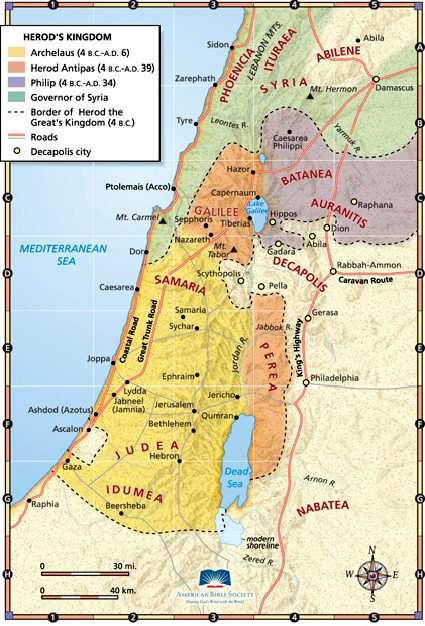
A map of Palestine at roughly the time of Jesus
Compare Matthew 4:24-25; 12:15-16; Luke 6:17-19
The accounts of healings given in the passages cited above mention people coming from Galilee, Idumea, Tyre and Sidon, the Decapolis, Jerusalem, and Judea, and from what used to be called Transjordan (that is, the area across the Jordan River, in what is today the Hashemite Kingdom of Jordan, which was itself known as Transjordan even into the twentieth century). “His fame spread throughout all Syria,” says Matthew 4:24.
I’m map-obsessed. And I hope that you are, too. At least a little bit.
Maybe you know all these places already. But let’s go through them, starting in the north:
Phoenicia runs along the Mediterranean coast, where the two cities of Tyre and Sidon are still major urban areas (in the country of Lebanon) to this day. Inland, to the east, is the area known as Galilee, of crucial importance for the ministry of Christ and the biographies of his apostles. The most obvious feature in Galilee is the large freshwater lake that’s often called, for obvious reasons, the Sea of Galilee. Both Nazareth, where Jesus was raised, and Capernaum, where he established his base of operations (to the extent that he had one), are in Galilee.
The Jordan River flows roughly to the southwest from its source at Caesarea Philippi, up in Batanea (toward Syria), at the foot of Mount Hermon. It feeds into the Sea of Galilee at its northern end, and then flows due south from the southern tip of the Sea of Galilee to the northern tip of the Dead Sea. It divides Judea from Perea, and, today, divides Israel from the Hashemite Kingdom of Jordan to the east.
To the southeast of the Galilee is the area known as the Decapolis (Greek for “ten cities”). They didn’t constitute a formal league or anything of that sort, but were more or less autonomous city-states grouped together for geographical and cultural reasons. The standard list of the ten cities that were included within the Decapolis is as follows:
1. Gerasa (modern Jordanian Jerash, an extraordinarily impressive archaeological site and tourist destination, modern location of a famous annual cultural festival)
2. Scythopolis or Beth-Shean (located in modern-day Israel, the only city of the Decapolis situated west of the Jordan and, again, an extremely impressive set of ruins that tourists often visit [come with us sometime!])
3. Hippos (in modern Israel, on the eastern shore of the Sea of Galilee [we’ll point it out as we drive by])
4. Gadara (in modern Israel; think of the “Gadarene swine”)
5. Pella (in modern Jordan)
6. Philadelphia (modern-day Amman, the capital of the Hashemite Kingdom of Jordan, which was known in Old Testament times as Rabbath-Ammon)
7. Capitolias (in modern Jordan)
8. Canatha (in modern Syria)
9. Raphana (in modern Jordan)
10. Damascus (the capital of modern Syria)
Jerusalem and nearby Bethlehem are roughly in the hilly center of Judea to the south, and Idumea is south of Judea.
Classically, the entire area covered by today’s Lebanon, Syria, Jordan, and Israel was often known as Syria. That’s why Matthew 4:24 says that Jesus’ fame spread throughout all of Syria.
***

A view of Capernaum and the Sea of Galilee from the Mount of Beatitudes
(Wikimedia Commons public domain image)
In the biblical account of Moses, that prophet goes up onto a mountain to receive instruction and to be given his commission from the Lord.
I think it not coincidental that, in these New Testament accounts, Jesus climbs a mountain and, from there, gives instruction to his disciples and commissions twelve of them as apostles.
There is, in my judgment, powerful symbolism in the topography.
Posted from Richmond, Virginia
Previous Post

February 18, 2019
"Can Mormon transhumanists revitalize the Latter-day Saints?"
Next Post
February 19, 2019 Israel and me
Browse Our Archives
Select a Category Uncategorized
Select a Month October 2026 September 2026 August 2026 July 2026 June 2026 May 2026 April 2026 March 2026 February 2026 January 2026 December 2025 November 2025 October 2025 September 2025 August 2025 July 2025 June 2025 May 2025 April 2025 March 2025 February 2025 January 2025 December 2024 November 2024 October 2024 September 2024 August 2024 July 2024 June 2024 May 2024 April 2024 March 2024 February 2024 January 2024 December 2023 November 2023 October 2023 September 2023 August 2023 July 2023 June 2023 May 2023 April 2023 March 2023 February 2023 January 2023 December 2022 November 2022 October 2022 September 2022 August 2022 July 2022 June 2022 May 2022 April 2022 March 2022 February 2022 January 2022 December 2021 November 2021 October 2021 September 2021 August 2021 July 2021 June 2021 May 2021 April 2021 March 2021 February 2021 January 2021 December 2020 November 2020 October 2020 September 2020 August 2020 July 2020 June 2020 May 2020 April 2020 March 2020 February 2020 January 2020 December 2019 November 2019 October 2019 September 2019 August 2019 July 2019 June 2019 May 2019 April 2019 March 2019 February 2019 January 2019 December 2018 November 2018 October 2018 September 2018 August 2018 July 2018 June 2018 May 2018 April 2018 March 2018 February 2018 January 2018 December 2017 November 2017 October 2017 September 2017 August 2017 July 2017 June 2017 May 2017 April 2017 March 2017 February 2017 January 2017 December 2016 November 2016 October 2016 September 2016 August 2016 July 2016 June 2016 May 2016 April 2016 March 2016 February 2016 January 2016 December 2015 November 2015 October 2015 September 2015 August 2015 July 2015 June 2015 May 2015 April 2015 March 2015 February 2015 January 2015 December 2014 November 2014 March 2014 August 2013 February 2012
Follow Us!
TAKE THE
Religious Wisdom Quiz
What was the primary liquid measurement in Biblical times?
Select your answer to see how you score.
Cor Hin Ephah Bath
Related posts from Sic et Non
Some notes on the resurrection of Jesus
TRENDING AT PATHEOS Latter-day Saint

The First Eucharistic Controversy: Christ’s Real Presence
For Catholics, the Eucharist is the source and summit of the Christian...

What a Stop Sign Can Teach Us About...
How to Make a Decision When You Can't Hear God Main point:...

Archdiocese Hosts Military Marriage Retreat in Germany
RASTATT, Germany — The transient military lifestyle, with its frequent deployments and...

Nearly every morning, I make the drive to Detroit with my high-school-age...

The Real AI Story Is Adoption Without Trust
Artificial intelligence has crossed a political threshold. It is no longer a...

A new article, written by Jeff Lindsay and Gale L. Pooley,...
view all Latter-day Saint blogs
Ad-Free & Subscriber Log-In Subscription Support
- About Us
- 2026 Calendar
- Videos
- Podcasts
- Library of World Religions
- Faith In Media Tracker
- Advertise With Us
- Write for Us
- Privacy Policy
- Terms of Service
- Do Not Sell My Data
- Contact Us
- Radiant Digital
- Manage Newsletter Subscriptions
- Unsubscribe From Notifications
- Sitemap
Copyright 2008-2026, Patheos. All rights reserved.
Subscription Support Ad-Free & Subscriber Log-In
Follow Patheos