
BuddhistCatholicContemplativeEvangelicalGeneral ChristianHinduJewishLatter-day SaintMuslimNew VisionsProgressive Christian
Beliefs
- Buddhist
- Catholic
- Contemplative
- Evangelical
- General Christian
- Hindu
- Jewish
- Latter-day Saint
- More Voices
- Muslim
- New Visions
- Pagan
- Progressive Christian
Topics
- Religion News
- Food and Religion
- Sports and Religion
- Religious Art
- Religious Music and Entertainment
- Religious Events
- History and Religion
- Style and Religion
- Politics and Religion
- Women in Religion
- Recreation Outdoors and Religion
- Business Finance and Religion
- Careers Workplace and Religion
- Education and Religion
- Family Parenting and Religion
- Health Fitness and Religion
- Home and Religion
- Relationships and Religion
- Technology and Religion
- Travel and Religion
Columnists
- Buddhist Columnists
- Business Finance and Religion Columnists
- Careers Workplace and Religion Columnists
- Catholic Columnists
- Contemplative Columnists
- Education and Religion Columnists
- Evangelists Columnists
- Family Parenting and Religion Columnists
- General Christian Columnists
- Health Fitness and Religion Columnists
- Hindu Columnists
- History and Religion Columnists
- Home and Religion Columnists
- Jewish Columnists
- More Voices Columnists
- Latter Day Columnists
- Muslim Columnists
- New Visions Columnists
- Nonreligious Columnists
- Pagan Columnists
- Politics and Religion Columnists
- Progressive Columnists
- Recreation Outdoors and Religion Columnists
- Relationships and Religion Columnists
- Religion News Columnists
- Religious Art Columnists
- Religious Events Columnists
- Religious Music and Entertainment Columnists
- Sports and Religion Columnists
- Style and Religion Columnists
- Technology and Religion Columnists
- Travel and Religion Columnists
- Women in Religion Columnists
Resource Library
- 2026 Calendar
- Library of World Religions
- The 100 Most Holy Places on Earth
- Patheos Answers
- Podcasts
- Videos
- Faith Leaders Database
- Anglican Episcopalian
- Bahai
- Baptist
- Buddhism
- Christianity
- Confucianism
- Eastern Orthodoxy
- Hinduism
- Holiness and Pentecostal
- ISKCON
- Islam
- Judaism
- Lutheran
- Methodist
- The Church of Jesus Christ of Latter-day Saints
- New Age
- Paganism
- Presbytarian and Reformed
- Protestantism
- Religion Behind the Scenes
- Roman Catholic
- Scientology
- Shia Islam
- Sikhism
- Sufism
- Sunni Islam
- Taoism
- Zen
- See all religions
Research Tools
 Ad-Free & Subscriber Log-In Subscription Support
Ad-Free & Subscriber Log-In Subscription Support
Follow Patheos 

- Trending:
- Forgiveness
- |
- Marriage
- |
- Consciousness
- |
- Death Penalty
- |
- Election
- |
- Halloween

- Home
- Latter-day Saint
- New Testament Notes 41-43
New Testament Notes 41-43
Last updated on: February 16, 2019 at 8:19 pm by Dan Peterson
New Testament Notes 41-43 2019-02-16T20:19:48-07:00 Dan Peterson
Patheos Explore the world's faith through different perspectives on religion and spirituality! Patheos has the views of the prevalent religions and spiritualities of the world.
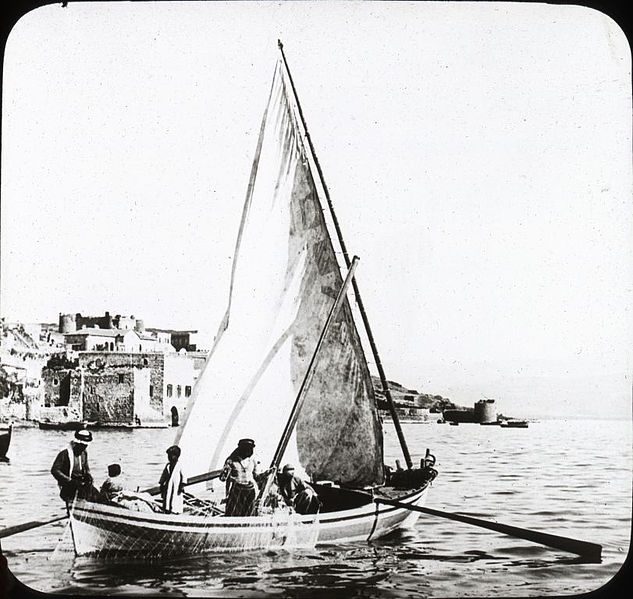
An early photograph of fishermen on the Sea of Galilee (Wikimedia Commons public domain photo)
Compare Matthew 13:1-3; 4:18-22; Mark 4:1-2; 1:16-20; John 21:1-11
On one level, it seems a fairly insignificant miracle. But it’s a teaching moment.
“You’re impressed by a miraculous catch of fish?” Jesus implicitly asks his astonished disciples. “Don’t be afraid. From this point on, you’ll be catching men.”
In after years, persecuted, harassed, traveling with difficulty even when not being threatened, encountering rejection, the apostles could look back on this experience and regain their confidence. If Jesus promised them success, they would have success.
But there was, perhaps, a very immediate and practical point to this miracle:
“Processing fish and calling apostles on the Sea of Galilee”
***
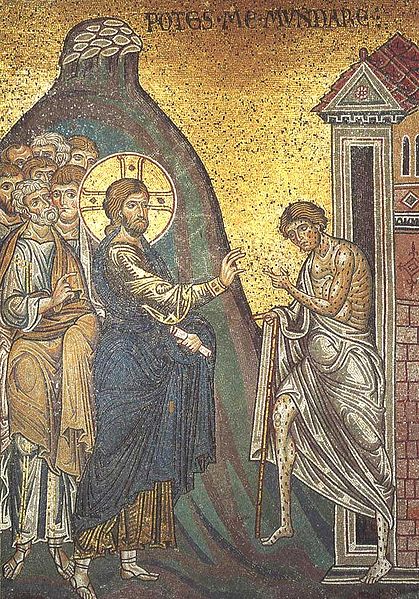
A Byzantine mosaic of Jesus healing a leper (Wikimedia Commons public domain photo)
We can only speculate as to why the Savior asked the cleansed leper not to tell others of his miraculous healing. Maybe Jesus hoped — in vain, as it turned out, since the formerly afflicted man couldn’t contain his excitement at his new life — to have some quiet (Luke 5:15-16) and to be able to move about freely in the furtherance of his mission (Mark 1:45).
It’s interesting to me, though, that Jesus didn’t actually ask the man to conceal his cure. Instead, all three synoptic accounts (John omits the incident) say that he directed the recovered leper to go to the temple priests and take the appropriate steps under the law of Moses “for a proof to the people” or, perhaps more literally, “as a witness to them” (eis martyrion autois).
Jesus didn’t cure everybody. Many people still became ill and died around the world, and presumably even in Palestine, during his ministry. Physical healing wasn’t his principal mission. But he cured some, and he evidently did so as a “witness” to his calling. That’s why John calls the miracles of Jesus “signs.” They were precisely that. They pointed toward an even more important kind of healing that was (and is) available to all.
***
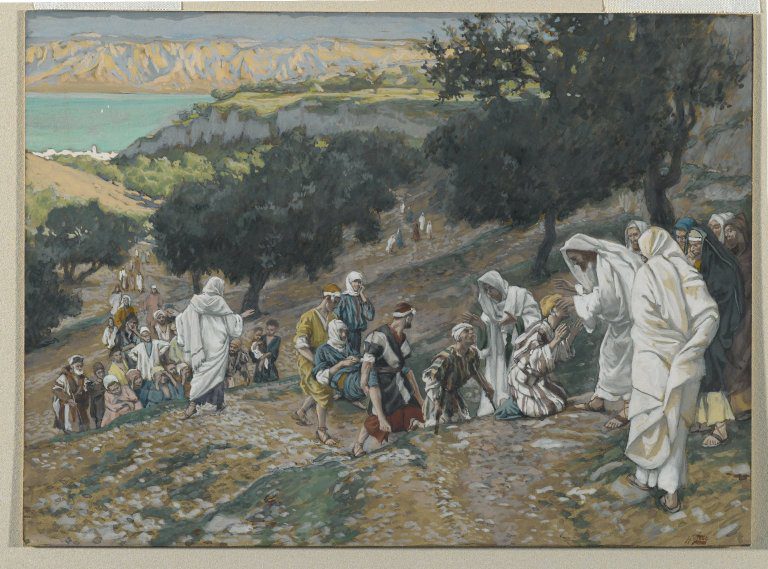
Jesus heals the blind and the lame near Capernaum (James Tissot)
Click to enlarge.
Compare John 5:1-9
The Pharisees and teachers of the law are offended, scandalized, when Jesus tells the paralytic that his sins are forgiven. “Who, apart from God,” they say, “can forgive sins?”
An excellent question. Well worth pondering. Indeed, that, I suspect, is the point.
But Jesus then asks them which is easier — to tell a man to be healed or to tell him that his sins are forgiven.
The implied premise, of course, is that declaring somebody’s sins forgiven is easy because it’s impossible for anybody among us mortals to test whether God has actually forgiven the person’s sins or not. There is no litmus test or chemical analysis or meter reading that will confirm forgiveness. Talk is cheap, and such a declaration might be mere empty words.
By contrast, the efficacy of a command to “Rise, take up your pallet, and walk” is easily tested. Empirical verification or disconfirmation will be quite unambiguous. Either the paralytic gets up, rolls up his bedding, and walks away, or he doesn’t.
If he does, though, that remarkable fact will confirm that Jesus has power to heal — and will very strongly imply that his other statement, about the forgiveness of sins, is also likely to be valid.
Which will suggest that Jesus is, in fact and as amazing as it may sound, God.
As John says, the miracles of Jesus are signs, pointing beyond themselves to something even more important.
Posted from Richmond, Virginia
Previous Post

February 15, 2019
"Curiously Unique"
Next Post
February 15, 2019 "Berührungsdenkfehler"
Browse Our Archives
Select a Category Uncategorized
Select a Month October 2026 September 2026 August 2026 July 2026 June 2026 May 2026 April 2026 March 2026 February 2026 January 2026 December 2025 November 2025 October 2025 September 2025 August 2025 July 2025 June 2025 May 2025 April 2025 March 2025 February 2025 January 2025 December 2024 November 2024 October 2024 September 2024 August 2024 July 2024 June 2024 May 2024 April 2024 March 2024 February 2024 January 2024 December 2023 November 2023 October 2023 September 2023 August 2023 July 2023 June 2023 May 2023 April 2023 March 2023 February 2023 January 2023 December 2022 November 2022 October 2022 September 2022 August 2022 July 2022 June 2022 May 2022 April 2022 March 2022 February 2022 January 2022 December 2021 November 2021 October 2021 September 2021 August 2021 July 2021 June 2021 May 2021 April 2021 March 2021 February 2021 January 2021 December 2020 November 2020 October 2020 September 2020 August 2020 July 2020 June 2020 May 2020 April 2020 March 2020 February 2020 January 2020 December 2019 November 2019 October 2019 September 2019 August 2019 July 2019 June 2019 May 2019 April 2019 March 2019 February 2019 January 2019 December 2018 November 2018 October 2018 September 2018 August 2018 July 2018 June 2018 May 2018 April 2018 March 2018 February 2018 January 2018 December 2017 November 2017 October 2017 September 2017 August 2017 July 2017 June 2017 May 2017 April 2017 March 2017 February 2017 January 2017 December 2016 November 2016 October 2016 September 2016 August 2016 July 2016 June 2016 May 2016 April 2016 March 2016 February 2016 January 2016 December 2015 November 2015 October 2015 September 2015 August 2015 July 2015 June 2015 May 2015 April 2015 March 2015 February 2015 January 2015 December 2014 November 2014 March 2014 August 2013 February 2012
Follow Us!
TAKE THE
Religious Wisdom Quiz
What does "Lo-debar" mean in Hebrew?
Select your answer to see how you score.
The Lord’s land The chosen city Valley of rest No pasture
Related posts from Sic et Non

An action movie and some vacuous theology

"The World's Sixteen Crucified Saviors"?
"The Loss of Jesus in the Small Plates...

We definitely didn't elect a mere choirboy.
TRENDING AT PATHEOS Latter-day Saint

Letters on Living the Faith by C.S. Lewis
Most of us met C.S. Lewis as a public intellectual. Mere Christianity....

When Halloween Unmasks Married Hearts
Written by Dr. David K. Ewen from Eternal Truth Bible College Behind...

Aristotle. He’s been called the father of logic, the father of the...

Methodist Central Hall and Westminster Abbey
Situated on the same square is Methodist Central Hall and Westminster Abbey. ...

57th Dove Awards Honor Dolly Parton, Crown New...
On gospel music’s biggest night, the 57th annual GMA Dove Awards honored...

The First Eucharistic Controversy: Christ’s Real Presence
For Catholics, the Eucharist is the source and summit of the Christian...
view all Latter-day Saint blogs
Ad-Free & Subscriber Log-In Subscription Support
- About Us
- 2026 Calendar
- Videos
- Podcasts
- Library of World Religions
- Faith In Media Tracker
- Advertise With Us
- Write for Us
- Privacy Policy
- Terms of Service
- Do Not Sell My Data
- Contact Us
- Radiant Digital
- Manage Newsletter Subscriptions
- Unsubscribe From Notifications
- Sitemap
Copyright 2008-2026, Patheos. All rights reserved.
Subscription Support Ad-Free & Subscriber Log-In
Follow Patheos