
BuddhistCatholicContemplativeEvangelicalGeneral ChristianHinduJewishLatter-day SaintMuslimNew VisionsProgressive Christian
Beliefs
- Buddhist
- Catholic
- Contemplative
- Evangelical
- General Christian
- Hindu
- Jewish
- Latter-day Saint
- More Voices
- Muslim
- New Visions
- Pagan
- Progressive Christian
Topics
- Religion News
- Food and Religion
- Sports and Religion
- Religious Art
- Religious Music and Entertainment
- Religious Events
- History and Religion
- Style and Religion
- Politics and Religion
- Women in Religion
- Recreation Outdoors and Religion
- Business Finance and Religion
- Careers Workplace and Religion
- Education and Religion
- Family Parenting and Religion
- Health Fitness and Religion
- Home and Religion
- Relationships and Religion
- Technology and Religion
- Travel and Religion
Columnists
- Buddhist Columnists
- Business Finance and Religion Columnists
- Careers Workplace and Religion Columnists
- Catholic Columnists
- Contemplative Columnists
- Education and Religion Columnists
- Evangelists Columnists
- Family Parenting and Religion Columnists
- General Christian Columnists
- Health Fitness and Religion Columnists
- Hindu Columnists
- History and Religion Columnists
- Home and Religion Columnists
- Jewish Columnists
- More Voices Columnists
- Latter Day Columnists
- Muslim Columnists
- New Visions Columnists
- Nonreligious Columnists
- Pagan Columnists
- Politics and Religion Columnists
- Progressive Columnists
- Recreation Outdoors and Religion Columnists
- Relationships and Religion Columnists
- Religion News Columnists
- Religious Art Columnists
- Religious Events Columnists
- Religious Music and Entertainment Columnists
- Sports and Religion Columnists
- Style and Religion Columnists
- Technology and Religion Columnists
- Travel and Religion Columnists
- Women in Religion Columnists
Resource Library
- 2026 Calendar
- Library of World Religions
- The 100 Most Holy Places on Earth
- Patheos Answers
- Podcasts
- Videos
- Faith Leaders Database
- Anglican Episcopalian
- Bahai
- Baptist
- Buddhism
- Christianity
- Confucianism
- Eastern Orthodoxy
- Hinduism
- Holiness and Pentecostal
- ISKCON
- Islam
- Judaism
- Lutheran
- Methodist
- The Church of Jesus Christ of Latter-day Saints
- New Age
- Paganism
- Presbytarian and Reformed
- Protestantism
- Religion Behind the Scenes
- Roman Catholic
- Scientology
- Shia Islam
- Sikhism
- Sufism
- Sunni Islam
- Taoism
- Zen
- See all religions
Research Tools
 Ad-Free & Subscriber Log-In Subscription Support
Ad-Free & Subscriber Log-In Subscription Support
Follow Patheos 

- Trending:
- Forgiveness
- |
- Marriage
- |
- Consciousness
- |
- Death Penalty
- |
- Election
- |
- Halloween

- Home
- Latter-day Saint
- New Testament Notes 14-15
New Testament Notes 14-15
Last updated on: February 2, 2019 at 12:45 am by Dan Peterson
New Testament Notes 14-15 2019-02-02T00:45:55-07:00 Dan Peterson
Patheos Explore the world's faith through different perspectives on religion and spirituality! Patheos has the views of the prevalent religions and spiritualities of the world.
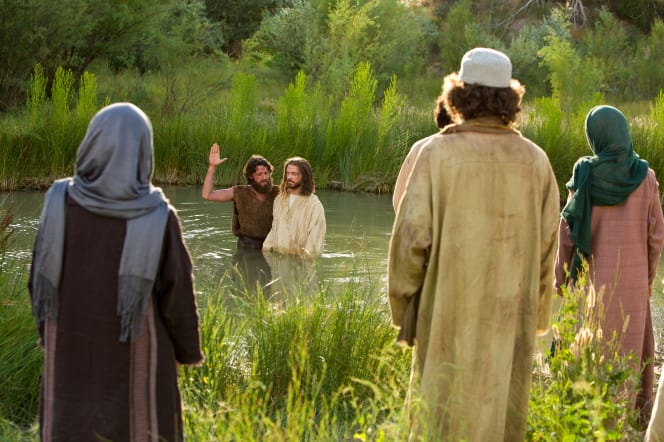
John baptizes Jesus in the Jordan River. (LDS Media Library)
Luke says that “multitudes” (ὄχλοις) came out to see John in the wilderness. Interestingly, Matthew says that those multitudes included “many of the Pharisees and Sadducees.” However, John is not precisely welcoming to them. He demands (rather harshly) that they repent, and that they do works appropriate to such a change of heart:
“Bring forth therefore fruits meet for repentance” (Matthew 3:8) = ποιήσατε οὖν καρπὸν ἄξιον τῆς μετανοίας
“Bring forth therefore fruits worthy of repentance” (Luke 3:8) = ποιήσατε οὖν καρποὺς ἀξίους τῆς μετανοίας
The King James translations above are slightly misleading. Although both use the word fruits, the Greek of Matthew is actually singular (fruit). And Matthew’s meet is exactly the same word in Greek (ἄξιος) as Luke’s worthy, with the difference that the adjective is accusative singular in Matthew and accusative plural in Luke because Greek adjectives must agree in number with the nouns that they modify. And worthy, or appropriate, or fitting, or suitable is a pretty good translation of it.
So, with that prefatory comment in mind, here’s a column that I published in the Deseret News on 22 August 2013, and which was focused primarily on the book of Genesis.
I have several pet peeves. Fortunately, I also have a newspaper column (at least for now). Which means that, unless and until my editors prevent me, I can sound off on things that bother me from time to time.
One of them is the frequent misuse of the word “literally.” Have you ever noticed how common it is for English-speakers to use the word “literally” when they actually mean exactly the opposite of “literally”? “I’m so hungry, I could literally eat a horse.” “That guy on the other team was literally 10 feet tall.” Or this one, presumably recorded from a conversation in the spirit world: “I literally died from embarrassment.”
But such quirky expressions aren’t the focus of this column. Instead, I have a different pet peeve in mind, though it’s still a linguistic one.
In Latter-day Saint circles (and perhaps beyond), it’s long since become customary for a husband to praise his wife as a “helpmeet.” However, since most of us find that term just a bit puzzling — intuitively, I suspect, we know that it makes no real sense — we sometimes change the word to “helpmate,” which, unlike “helpmeet,” is actually comprehensible.
The term “helpmeet” is derived from the King James rendition of Genesis 2:18, where God decides to provide a companion for the newly created man, Adam: “And the Lord God said, it is not good that the man should be alone; I will make him an help meet for him.”
However, it’s important here to note that “help meet” in the KJV is two words, not one. This is not only a hint as to how we ought to read it aloud, but a clue about what the passage means. We should already be familiar with such King James language from other biblical passages. In Acts 26:20, for instance, we see Paul telling the Gentiles that “they should repent and turn to God, and do works meet for repentance.” (Thankfully, we don’t call righteous deeds “worksmeets.”) It should be obvious from the context that “meet,” in this verse, means something like “worthy,” “befitting” or “appropriate.” (And that is, precisely, what the underlying Greek and Hebrew words do mean.)
It’s hardly surprising, in this light, to see how other translations render Genesis 2:18: The New International Version, for example, reads “It is not good for the man to be alone. I will make a helper suitable for him.” (I certainly hope that Mormon husbands won’t start calling their wives “helpersuitables” anytime soon!)
The very next verse launches into an amusing little story — amusing when it’s properly understood, and when it’s seen in its larger context — about the quest to find a suitable companion for Adam:
“And out of the ground the Lord God formed every beast of the field, and every fowl of the air; and brought them unto Adam to see what he would call them: and whatsoever Adam called every living creature, that was the name thereof. And Adam gave names to all cattle, and to the fowl of the air, and to every beast of the field; but for Adam there was not found an help meet for him” (Genesis 2:19-20).
It turns out that tigers, ostriches and bears (or perhaps velociraptors, trilobites and pterodactyls) aren’t appropriate companions for men. But directly after the failure of this little parade of the animals to supply a proper companion for Adam, to provide a creature who could pass audition before Adam and the Lord, God creates Eve, who instantly wins the man’s complete approval. (He was probably quite relieved.) She also receives a name from him, thus continuing the story of the beasts and their naming but, this time, bringing it to a successful conclusion: “And Adam said, This is now bone of my bones, and flesh of my flesh: she shall be called Woman, because she was taken out of Man” (Genesis 2:23).
There is, in other words, no “helpmeet” in the scriptures. There is, instead, a “help” who is specially suited to be “meet” for her husband, who was created to complete him in a way that nothing else in creation, whether animate or inanimate, properly can.
Likewise, the husband is “meet” for her, although he was plainly not appropriate as a companion for tortoises, kangaroos and warthogs.
Otherwise, notable elements of the passages under consideration here include a rejection of ethnic pride and of the assumption that lineage guarantees salvation, as well as an emphasis on repentance and moral reform. (There’s no doctrine in John the Baptist’s teaching of salvation by faith alone!) John exhorts his hearers to share generously with those in need and to be honest. Significantly, with respect to the soldiers in his audience, he doesn’t order withdrawal from the military in order to be pacifists. Rather, he calls upon them not to be oppressive, and to be content with their wages (which, I suspect, means that they shouldn’t attempt to extort money from civilians).

Browse Our Archives
Select a Category Uncategorized
Select a Month October 2026 September 2026 August 2026 July 2026 June 2026 May 2026 April 2026 March 2026 February 2026 January 2026 December 2025 November 2025 October 2025 September 2025 August 2025 July 2025 June 2025 May 2025 April 2025 March 2025 February 2025 January 2025 December 2024 November 2024 October 2024 September 2024 August 2024 July 2024 June 2024 May 2024 April 2024 March 2024 February 2024 January 2024 December 2023 November 2023 October 2023 September 2023 August 2023 July 2023 June 2023 May 2023 April 2023 March 2023 February 2023 January 2023 December 2022 November 2022 October 2022 September 2022 August 2022 July 2022 June 2022 May 2022 April 2022 March 2022 February 2022 January 2022 December 2021 November 2021 October 2021 September 2021 August 2021 July 2021 June 2021 May 2021 April 2021 March 2021 February 2021 January 2021 December 2020 November 2020 October 2020 September 2020 August 2020 July 2020 June 2020 May 2020 April 2020 March 2020 February 2020 January 2020 December 2019 November 2019 October 2019 September 2019 August 2019 July 2019 June 2019 May 2019 April 2019 March 2019 February 2019 January 2019 December 2018 November 2018 October 2018 September 2018 August 2018 July 2018 June 2018 May 2018 April 2018 March 2018 February 2018 January 2018 December 2017 November 2017 October 2017 September 2017 August 2017 July 2017 June 2017 May 2017 April 2017 March 2017 February 2017 January 2017 December 2016 November 2016 October 2016 September 2016 August 2016 July 2016 June 2016 May 2016 April 2016 March 2016 February 2016 January 2016 December 2015 November 2015 October 2015 September 2015 August 2015 July 2015 June 2015 May 2015 April 2015 March 2015 February 2015 January 2015 December 2014 November 2014 March 2014 August 2013 February 2012
Follow Us!
TAKE THE
Religious Wisdom Quiz
Which king of Judah destroyed Nehushtan, the bronze serpent?
Select your answer to see how you score.
Josiah Hezekiah Uzziah Manasseh
Related posts from Sic et Non

My ongoing (and, thus far, futile) war against...

Some notes on the resurrection of Jesus

On paving paradise with gold, or even with...

Setting the Record Straight, Though Without Much Real...
TRENDING AT PATHEOS Latter-day Saint

The First Eucharistic Controversy: Christ’s Real Presence
For Catholics, the Eucharist is the source and summit of the Christian...

How to Make a Decision When You Can't...
Main point: It’s much more valuable to stay close to God so...

Archdiocese Hosts Military Marriage Retreat in Germany
RASTATT, Germany — The transient military lifestyle, with its frequent deployments and...

Nearly every morning, I make the drive to Detroit with my high-school-age...

The Real AI Story Is Adoption Without Trust
Artificial intelligence has crossed a political threshold. It is no longer a...

A new article, written by Jeff Lindsay and Gale L. Pooley,...
view all Latter-day Saint blogs
Ad-Free & Subscriber Log-In Subscription Support
- About Us
- 2026 Calendar
- Videos
- Podcasts
- Library of World Religions
- Faith In Media Tracker
- Advertise With Us
- Write for Us
- Privacy Policy
- Terms of Service
- Do Not Sell My Data
- Contact Us
- Radiant Digital
- Manage Newsletter Subscriptions
- Unsubscribe From Notifications
- Sitemap
Copyright 2008-2026, Patheos. All rights reserved.
Subscription Support Ad-Free & Subscriber Log-In
Follow Patheos