
BuddhistCatholicContemplativeEvangelicalGeneral ChristianHinduJewishLatter-day SaintMuslimNew VisionsProgressive Christian
Beliefs
- Buddhist
- Catholic
- Contemplative
- Evangelical
- General Christian
- Hindu
- Jewish
- Latter-day Saint
- More Voices
- Muslim
- New Visions
- Pagan
- Progressive Christian
Topics
- Religion News
- Food and Religion
- Sports and Religion
- Religious Art
- Religious Music and Entertainment
- Religious Events
- History and Religion
- Style and Religion
- Politics and Religion
- Women in Religion
- Recreation Outdoors and Religion
- Business Finance and Religion
- Careers Workplace and Religion
- Education and Religion
- Family Parenting and Religion
- Health Fitness and Religion
- Home and Religion
- Relationships and Religion
- Technology and Religion
- Travel and Religion
Columnists
- Buddhist Columnists
- Business Finance and Religion Columnists
- Careers Workplace and Religion Columnists
- Catholic Columnists
- Contemplative Columnists
- Education and Religion Columnists
- Evangelists Columnists
- Family Parenting and Religion Columnists
- General Christian Columnists
- Health Fitness and Religion Columnists
- Hindu Columnists
- History and Religion Columnists
- Home and Religion Columnists
- Jewish Columnists
- More Voices Columnists
- Latter Day Columnists
- Muslim Columnists
- New Visions Columnists
- Nonreligious Columnists
- Pagan Columnists
- Politics and Religion Columnists
- Progressive Columnists
- Recreation Outdoors and Religion Columnists
- Relationships and Religion Columnists
- Religion News Columnists
- Religious Art Columnists
- Religious Events Columnists
- Religious Music and Entertainment Columnists
- Sports and Religion Columnists
- Style and Religion Columnists
- Technology and Religion Columnists
- Travel and Religion Columnists
- Women in Religion Columnists
Resource Library
- 2026 Calendar
- Library of World Religions
- The 100 Most Holy Places on Earth
- Patheos Answers
- Podcasts
- Videos
- Faith Leaders Database
- Anglican Episcopalian
- Bahai
- Baptist
- Buddhism
- Christianity
- Confucianism
- Eastern Orthodoxy
- Hinduism
- Holiness and Pentecostal
- ISKCON
- Islam
- Judaism
- Lutheran
- Methodist
- The Church of Jesus Christ of Latter-day Saints
- New Age
- Paganism
- Presbytarian and Reformed
- Protestantism
- Religion Behind the Scenes
- Roman Catholic
- Scientology
- Shia Islam
- Sikhism
- Sufism
- Sunni Islam
- Taoism
- Zen
- See all religions
Research Tools
 Ad-Free & Subscriber Log-In Subscription Support
Ad-Free & Subscriber Log-In Subscription Support
Follow Patheos 

- Trending:
- Forgiveness
- |
- Marriage
- |
- Consciousness
- |
- Death Penalty
- |
- Election
- |
- Halloween

- Home
- Latter-day Saint
- Maybe I should write that handbook on logical fallacies after all.
Maybe I should write that handbook on logical fallacies after all.
Last updated on: February 16, 2019 at 8:47 pm by Dan Peterson
Maybe I should write that handbook on logical fallacies after all. 2019-02-16T20:47:38-07:00 Dan Peterson
Patheos Explore the world's faith through different perspectives on religion and spirituality! Patheos has the views of the prevalent religions and spiritualities of the world.

The Kinshasa Democratic Republic of the Congo Temple is nearly ready for its open house and dedication. It will be a great day for Africa and for the Congolese Saints. (LDS Media Library)
New, on the website of the Interpreter Foundation:
“The Church in the DR Congo: A Personal Perspective: Part 11, “The Labourers Are Few””
***
From the astonishing Jeff Lindsay:
“Souls that Expand and Swell: An Intriguing But Not Unique Book of Mormon Concept”
***
Do not — do not — entrust the fate of your eternal soul to the tender ministrations of John Dehlin.
Here’s a brand new resource for evaluating his latest venture:
Mormon Stories Essays: Reviewing John Dehlin’s “Truth Claims” Essays
***
And, on rather a different note, here’s a new effort to assess the claims of Jonathan Neville, an aggressively vocal proponent of the “Heartland” model for Book of Mormon geography:
This is also relevant:
“Video: What did prophets think about Book of Mormon geography? Their old books may give clues.”
***
Years ago, I thought that it might be fun someday to write a guide to what logicians call “practical fallacies” or “informal fallacies.” Many such guides have already been published, but this one, I thought, would be unique in drawing its specimens entirely from the publications of Evangelical Protestant anti-Mormons.
One particular then-fresh example had inspired me.
A professional anti-Mormon named Robert McKay, writing for the now defunct Utah Evangel (published by Utah Missions, Inc., of Marlow, Oklahoma) made this argument:
Latter-day Saints, he said, claim to be Christians. But this cannot be true because, if it were, all Christians would necessarily accept the Book of Mormon, regard the president of the Church of Jesus Christ of Latter-day Saints as a prophet, believe in Joseph Smith’s First Vision, and so forth. But they don’t. Catholics don’t, and Protestants don’t, and the Orthodox don’t. Thus, he declared, by ironclad logical deduction Latter-day Saints cannot be Christians.
Wow.
The reasoning seems to be that, if all Latter-day Saints are Christians, it must follow that all Christians are Latter-day Saints.
The obvious problem here was Mr. McKay’s confusion of genus for species, of set for subset. In our correspondence, I tried to illustrate this for him by giving him precisely analogous arguments that reached obviously false conclusions:
If Democrats are politicians, politicians are Democrats.
If lakes are filled with water, everything filled with water is a lake.
If drowning causes death, all deaths must be caused by drowning.
All men are mortal.
Socrates is a man.
Therefore, all men are Socrates.
Catholics claim to be Christians. But this cannot be true because, if it were, all Christians would necessarily venerate the Mass, regard the bishop of Rome as the leader of global Christendom, etc. Which they obviously don’t.
Some people claim that squirrels are mammals. But this cannot be true because, if it were, all mammals would necessarily gather nuts, scurry up and down trees, etc. Which, obviously, dolphins and poodles and lions don’t do.
Some claim that General Motors is a manufacturer of automobiles. But this cannot be true because, if it were, all automobile manufacturers would necessarily be headquartered in Detroit. But Toyota and Jaguar and Rolls Royce and Mercedes Benz and Nissan and Volkswagen and Ferrari aren’t headquartered in Detroit.
Obviously, it would be easy to multiply such examples all day long (e.g., “poems can’t be literature,” “Princeton can’t be a university,” “Baptists can’t be humans,” and so forth). But he never grasped the point. Really. He never did.
Anyway, I’ve long since lost most of my interest in Evangelical Protestant anti-Mormonism. But I’ve recently experienced at least a slight flicker of revived interest in doing that handbook of logical fallacies.
Two specimens from just the last twenty four hours have reminded me of it.
In one, a habitual and often rather frenetic misreader of my blog entries mocks my little piece entitled “New light on the question of bees and the Book of Mormon” as arguing that evidence of apiculture among the ancient Maya proves the Book of Mormon true. Of course, I make no such claim. Like many of his comments previously, this recent response might well serve as an example of a “straw man” argument.
Another individual, responding to the Interpreter essay that I discuss in my blog entry “On that article about “Mental Distress and Disaffection from the Church,”” insists that, although it plainly doesn’t suggest that loss of faith is proof of mental illness, the actual intent of the essay is to plant precisely that defamatory notion in the minds of members of the Church of Jesus Christ of Latter-day Saints. This specimen could serve to illustrate a fallacious appeal to motive, in which a thesis is challenged by calling into question the motives (or, even worse, as in this case, the hypothetical or merely conceivable though undemonstrated motives) of its advocate. It represents a special case of the ad hominem circumstantial argument.
Previous Post

February 12, 2019
A reaction of the highest class
Next Post
February 12, 2019 New Testament Notes 32-33
Browse Our Archives
Select a Category Uncategorized
Select a Month October 2026 September 2026 August 2026 July 2026 June 2026 May 2026 April 2026 March 2026 February 2026 January 2026 December 2025 November 2025 October 2025 September 2025 August 2025 July 2025 June 2025 May 2025 April 2025 March 2025 February 2025 January 2025 December 2024 November 2024 October 2024 September 2024 August 2024 July 2024 June 2024 May 2024 April 2024 March 2024 February 2024 January 2024 December 2023 November 2023 October 2023 September 2023 August 2023 July 2023 June 2023 May 2023 April 2023 March 2023 February 2023 January 2023 December 2022 November 2022 October 2022 September 2022 August 2022 July 2022 June 2022 May 2022 April 2022 March 2022 February 2022 January 2022 December 2021 November 2021 October 2021 September 2021 August 2021 July 2021 June 2021 May 2021 April 2021 March 2021 February 2021 January 2021 December 2020 November 2020 October 2020 September 2020 August 2020 July 2020 June 2020 May 2020 April 2020 March 2020 February 2020 January 2020 December 2019 November 2019 October 2019 September 2019 August 2019 July 2019 June 2019 May 2019 April 2019 March 2019 February 2019 January 2019 December 2018 November 2018 October 2018 September 2018 August 2018 July 2018 June 2018 May 2018 April 2018 March 2018 February 2018 January 2018 December 2017 November 2017 October 2017 September 2017 August 2017 July 2017 June 2017 May 2017 April 2017 March 2017 February 2017 January 2017 December 2016 November 2016 October 2016 September 2016 August 2016 July 2016 June 2016 May 2016 April 2016 March 2016 February 2016 January 2016 December 2015 November 2015 October 2015 September 2015 August 2015 July 2015 June 2015 May 2015 April 2015 March 2015 February 2015 January 2015 December 2014 November 2014 March 2014 August 2013 February 2012
Follow Us!
TAKE THE
Religious Wisdom Quiz
What is the Christian holy day typically observed with rest and worship?
Select your answer to see how you score.
Sunday Saturday Monday Friday
Related posts from Sic et Non
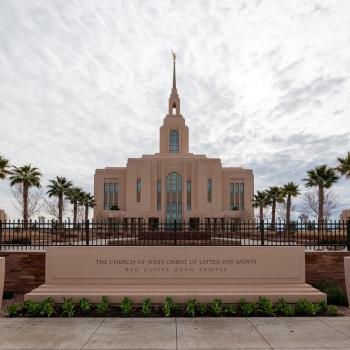
A new collection of articles on the temple!
"Protecting the Symbols of Christ’s Church"

Studying the Pearl of Great Price, and Evolution

"Early Anti-Mormonism in Great Britain, 1837–1842"
TRENDING AT PATHEOS Latter-day Saint

Swimfan: Forgotten Aughts Pleasures
This is a recovery effort. In 2002, My Big Fat Greek Wedding...

Top Three Anti-Catholic Lies About Catholicism
This is my initial transcript for the video, "THE 3 WORST...

Pope Leo Celebrates Mass for Nurses & Docs...
I don't have any idea how he did it, but Pope Leo...

The Sermon on the Mount, Part I: Matthew...
The Sermon on the Mount, Part I (Matthew 4:12-5:12) St. Matthew moves...

What's up from Crossway: Reviewing some of their latest A few weeks...

Janie Learns the Way of the Cross: A...
Teaching children about Jesus' Passion can be challenging. Many parents and educators...
view all Latter-day Saint blogs
Ad-Free & Subscriber Log-In Subscription Support
- About Us
- 2026 Calendar
- Videos
- Podcasts
- Library of World Religions
- Faith In Media Tracker
- Advertise With Us
- Write for Us
- Privacy Policy
- Terms of Service
- Do Not Sell My Data
- Contact Us
- Radiant Digital
- Manage Newsletter Subscriptions
- Unsubscribe From Notifications
- Sitemap
Copyright 2008-2026, Patheos. All rights reserved.
Subscription Support Ad-Free & Subscriber Log-In
Follow Patheos