
BuddhistCatholicContemplativeEvangelicalGeneral ChristianHinduJewishLatter-day SaintMuslimNew VisionsProgressive Christian
Beliefs
- Buddhist
- Catholic
- Contemplative
- Evangelical
- General Christian
- Hindu
- Jewish
- Latter-day Saint
- More Voices
- Muslim
- New Visions
- Pagan
- Progressive Christian
Topics
- Religion News
- Food and Religion
- Sports and Religion
- Religious Art
- Religious Music and Entertainment
- Religious Events
- History and Religion
- Style and Religion
- Politics and Religion
- Women in Religion
- Recreation Outdoors and Religion
- Business Finance and Religion
- Careers Workplace and Religion
- Education and Religion
- Family Parenting and Religion
- Health Fitness and Religion
- Home and Religion
- Relationships and Religion
- Technology and Religion
- Travel and Religion
Columnists
- Buddhist Columnists
- Business Finance and Religion Columnists
- Careers Workplace and Religion Columnists
- Catholic Columnists
- Contemplative Columnists
- Education and Religion Columnists
- Evangelists Columnists
- Family Parenting and Religion Columnists
- General Christian Columnists
- Health Fitness and Religion Columnists
- Hindu Columnists
- History and Religion Columnists
- Home and Religion Columnists
- Jewish Columnists
- More Voices Columnists
- Latter Day Columnists
- Muslim Columnists
- New Visions Columnists
- Nonreligious Columnists
- Pagan Columnists
- Politics and Religion Columnists
- Progressive Columnists
- Recreation Outdoors and Religion Columnists
- Relationships and Religion Columnists
- Religion News Columnists
- Religious Art Columnists
- Religious Events Columnists
- Religious Music and Entertainment Columnists
- Sports and Religion Columnists
- Style and Religion Columnists
- Technology and Religion Columnists
- Travel and Religion Columnists
- Women in Religion Columnists
Resource Library
- 2026 Calendar
- Library of World Religions
- The 100 Most Holy Places on Earth
- Patheos Answers
- Podcasts
- Videos
- Faith Leaders Database
- Anglican Episcopalian
- Bahai
- Baptist
- Buddhism
- Christianity
- Confucianism
- Eastern Orthodoxy
- Hinduism
- Holiness and Pentecostal
- ISKCON
- Islam
- Judaism
- Lutheran
- Methodist
- The Church of Jesus Christ of Latter-day Saints
- New Age
- Paganism
- Presbytarian and Reformed
- Protestantism
- Religion Behind the Scenes
- Roman Catholic
- Scientology
- Shia Islam
- Sikhism
- Sufism
- Sunni Islam
- Taoism
- Zen
- See all religions
Research Tools
 Ad-Free & Subscriber Log-In Subscription Support
Ad-Free & Subscriber Log-In Subscription Support
Follow Patheos 

- Trending:
- Forgiveness
- |
- Marriage
- |
- Consciousness
- |
- Death Penalty
- |
- Election
- |
- Halloween

- Home
- Latter-day Saint
- A note on veganism and vegetarianism (2)
A note on veganism and vegetarianism (2)
Last updated on: February 17, 2019 at 7:29 pm by Dan Peterson
A note on veganism and vegetarianism (2) 2019-02-17T19:29:59-07:00 Dan Peterson
Patheos Explore the world's faith through different perspectives on religion and spirituality! Patheos has the views of the prevalent religions and spiritualities of the world.
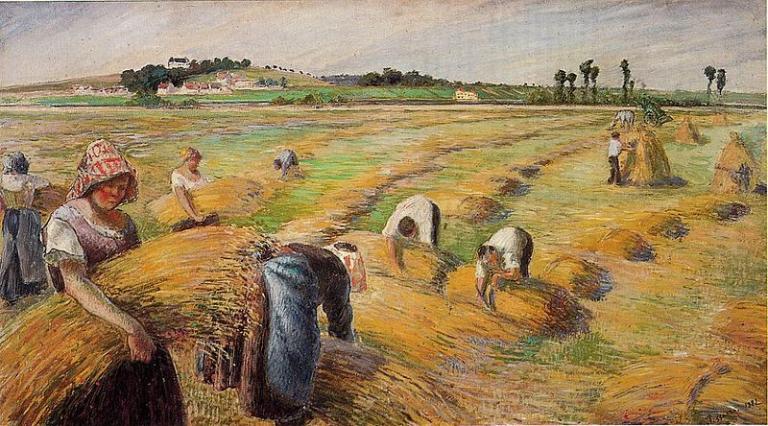
Camille Pissarro, “The Harvest” (1882) (Wikimedia Commons public domain image)
Continuing from the prior post:
An interesting and, to my mind, important article appeared in the 13 October 2018 issue of The Economist:
I’m drawing here from that article:
Across the “First World,” in affluent countries, interest in vegan foods has been rising sharply. In the United States, for example, according to The Economist, sales of “plant-based” foods — in other words, of foods that contain no meat, eggs, or dairy — rose 20% in the year preceding June 2018. That figure was ten times the growth in food as a whole that year, and two and a half times faster than vegan foods grew in the year before. Waitrose, an upscale British grocery chain, introduced a line of vegan foods in 2017 and then expanded its selection by 60% in mid-2018. Waitress reports that its sales of vegan and vegetarian foods in July 2018 were 70% above the level of sales just a year earlier, in July 2017.
Global meat consumption has been growing consistently by nearly 3% a year since 1960, but this is largely because people in poorer countries buy more meat as they become more affluent. In the early 1970s, the average resident of China consumed 14 kilograms (31 pounds) of meat a year. Today, the average Chinese resident eats 55 kilograms annually — well over three times as many. And that worldwide trend hasn’t slowed. But most growth in meat consumption has been in the developing world. While rich countries have been eating more meat, too, their consumption is increasing more slowly than it once did. According to the UN’s Food and Agriculture Organisation (FAO), meat consumption in the world’s richest nations has risen just 0.7% a year since 1991.
Is veganism as such surging? Maybe. Maybe not. Many non-vegans eat vegan foods from time to time — many more than formerly — without committing to a vegan way of life. For every active vegan or vegetarian, there are more than five people who identify themselves as former vegans or former vegetarians. But this may change, as more vegan and vegetarian options become available in restaurants and grocery stores.
Evidence for the health benefits of vegan and vegetarian diets is ambiguous. A large 2002-2007 study of Seventh Day Adventists who consumed a plant-only diet seemed to show substantially lower mortality rates, but a smaller survey of British vegetarians in 2016 failed to demonstrate such a benefit.
However, large studies have demonstrated that people who consume red meat in significant quantities, as opposed to poultry, have higher overall mortality rates. And eating large amounts of processed meats, specifically — meats such as bacon and salami — is linked to colorectal cancer.
A 2016 research study at the University of Oxford found that a global transition to well-balanced vegan diets might yield as many as 8.1 million fewer deaths a year. Worldwide vegetarianism would do almost as well, reducing annual deaths by 7.3 million.
However, most of the benefit claimed in that study could apparently still be achieved if omnivores simply ate better-balanced diets, including less meat. If, for instance, the world adopted what the Oxford study called a “healthy global diet,” which would include less sugar than most in the West typically consume as well as plenty of fruits and vegetables and only, on average, 43 grams of red meat daily, the reduction in deaths would still be approximately 5.1 million.
Rich-world diets tend to get all their daily protein requirement (about 50-60 grams) from animals. And, in fact, Americans eat 90 grams of protein a day while Europeans consume 85 grams — most of it from animal products.
But protein can also be obtained from plants. And relying more on plant proteins might convey notable benefits, both related to human health and to the environment:
Because meat is energy rich, eating more protein than is needed, and getting it from animals, entails consuming a large number of calories. And excess calories are likely to be stored as fat.
Vegans, by contrast, eat less protein and what they get comes from less energy-rich and less potentially fattening products. A 2017 French study found vegans and vegetarians were both eating more varied diets and consuming fewer overall calories — and eating only 67 grams of protein daily (vegetarians) or 62 grams (vegans), compared to 81 grams among the meat-eaters who were surveyed — which, rather than veganism or vegetarianism as such, may account for the difference in health outcomes.
Additionally, growing edible plants requires less land than raising meat does. More land is required per calorie of food in beef production than in the production of broccoli. Raising livestock takes about 80% of all agricultural land while producing just 18% of the world’s calories. A study from Israel’s Weizmann Institute contends that, if America obtained its protein from plants rather than animals, that would be equivalent to increasing the food supply by a third.
Amazingly, too, cattle farming alters the climate. For one thing, clearing land for pasture creates greenhouse gases. In addition, cattle and similar animals produce methane, a fairly powerful greenhouse gas — mostly, incidentally, released by belching rather than otherwise — and methane warms our environment. The United Nations Food and Agriculture organization calculates that cattle generate up to two-thirds of the greenhouse gases from livestock, and that they are the world’s fifth largest source of methane. “If cows were a country,” says The Economist, “the United Herds of Earth would be the planet’s third largest greenhouse-gas emitter.”
According to the Oxford study, by 2050 a vegan world’s agriculture would produce 70% lower greenhouse emissions than a world where people ate as they do today. In a world that had adopted the mixed “healthy global diet,” they would be 29% lower. Raising cattle produces seven times more emissions per ton of protein than raising pork or poultry does, 12 times more than soya, and 30 times more than wheat. And here’s a thought: Getting our protein from insects—who are very efficient converters of intake into output—might yield a world that was almost indistinguishable, in environmental terms, from a vegan one.
Church of Jesus Christ of Latter-day Saints
Previous Post

February 11, 2019
A note on veganism and vegetarianism (1)
Next Post
February 11, 2019 "The psychology of Islamic suicide bombing"?
Browse Our Archives
Select a Category Uncategorized
Select a Month October 2026 September 2026 August 2026 July 2026 June 2026 May 2026 April 2026 March 2026 February 2026 January 2026 December 2025 November 2025 October 2025 September 2025 August 2025 July 2025 June 2025 May 2025 April 2025 March 2025 February 2025 January 2025 December 2024 November 2024 October 2024 September 2024 August 2024 July 2024 June 2024 May 2024 April 2024 March 2024 February 2024 January 2024 December 2023 November 2023 October 2023 September 2023 August 2023 July 2023 June 2023 May 2023 April 2023 March 2023 February 2023 January 2023 December 2022 November 2022 October 2022 September 2022 August 2022 July 2022 June 2022 May 2022 April 2022 March 2022 February 2022 January 2022 December 2021 November 2021 October 2021 September 2021 August 2021 July 2021 June 2021 May 2021 April 2021 March 2021 February 2021 January 2021 December 2020 November 2020 October 2020 September 2020 August 2020 July 2020 June 2020 May 2020 April 2020 March 2020 February 2020 January 2020 December 2019 November 2019 October 2019 September 2019 August 2019 July 2019 June 2019 May 2019 April 2019 March 2019 February 2019 January 2019 December 2018 November 2018 October 2018 September 2018 August 2018 July 2018 June 2018 May 2018 April 2018 March 2018 February 2018 January 2018 December 2017 November 2017 October 2017 September 2017 August 2017 July 2017 June 2017 May 2017 April 2017 March 2017 February 2017 January 2017 December 2016 November 2016 October 2016 September 2016 August 2016 July 2016 June 2016 May 2016 April 2016 March 2016 February 2016 January 2016 December 2015 November 2015 October 2015 September 2015 August 2015 July 2015 June 2015 May 2015 April 2015 March 2015 February 2015 January 2015 December 2014 November 2014 March 2014 August 2013 February 2012
Follow Us!
TAKE THE
Religious Wisdom Quiz
In Philemon, what does Paul call Onesimus?
Select your answer to see how you score.
My friend My helper My very heart My brother
Related posts from Sic et Non


Notes on Women, Priesthood, and General Conference

"The Book of Moses as a Temple Text"

TRENDING AT PATHEOS Latter-day Saint

57th Dove Awards Honor Dolly Parton, Crown New...
On gospel music’s biggest night, the 57th annual GMA Dove Awards honored...

The First Eucharistic Controversy: Christ’s Real Presence
For Catholics, the Eucharist is the source and summit of the Christian...

What a Stop Sign Can Teach Us About...
How to Make a Decision When You Can't Hear God Main point:...

Archdiocese Hosts Military Marriage Retreat in Germany
RASTATT, Germany — The transient military lifestyle, with its frequent deployments and...

Nearly every morning, I make the drive to Detroit with my high-school-age...

The Real AI Story Is Adoption Without Trust
Artificial intelligence has crossed a political threshold. It is no longer a...
view all Latter-day Saint blogs
Ad-Free & Subscriber Log-In Subscription Support
- About Us
- 2026 Calendar
- Videos
- Podcasts
- Library of World Religions
- Faith In Media Tracker
- Advertise With Us
- Write for Us
- Privacy Policy
- Terms of Service
- Do Not Sell My Data
- Contact Us
- Radiant Digital
- Manage Newsletter Subscriptions
- Unsubscribe From Notifications
- Sitemap
Copyright 2008-2026, Patheos. All rights reserved.
Subscription Support Ad-Free & Subscriber Log-In
Follow Patheos