
BuddhistCatholicContemplativeEvangelicalGeneral ChristianHinduJewishLatter-day SaintMuslimNew VisionsProgressive Christian
Beliefs
- Buddhist
- Catholic
- Contemplative
- Evangelical
- General Christian
- Hindu
- Jewish
- Latter-day Saint
- More Voices
- Muslim
- New Visions
- Pagan
- Progressive Christian
Topics
- Religion News
- Food and Religion
- Sports and Religion
- Religious Art
- Religious Music and Entertainment
- Religious Events
- History and Religion
- Style and Religion
- Politics and Religion
- Women in Religion
- Recreation Outdoors and Religion
- Business Finance and Religion
- Careers Workplace and Religion
- Education and Religion
- Family Parenting and Religion
- Health Fitness and Religion
- Home and Religion
- Relationships and Religion
- Technology and Religion
- Travel and Religion
Columnists
- Buddhist Columnists
- Business Finance and Religion Columnists
- Careers Workplace and Religion Columnists
- Catholic Columnists
- Contemplative Columnists
- Education and Religion Columnists
- Evangelists Columnists
- Family Parenting and Religion Columnists
- General Christian Columnists
- Health Fitness and Religion Columnists
- Hindu Columnists
- History and Religion Columnists
- Home and Religion Columnists
- Jewish Columnists
- More Voices Columnists
- Latter Day Columnists
- Muslim Columnists
- New Visions Columnists
- Nonreligious Columnists
- Pagan Columnists
- Politics and Religion Columnists
- Progressive Columnists
- Recreation Outdoors and Religion Columnists
- Relationships and Religion Columnists
- Religion News Columnists
- Religious Art Columnists
- Religious Events Columnists
- Religious Music and Entertainment Columnists
- Sports and Religion Columnists
- Style and Religion Columnists
- Technology and Religion Columnists
- Travel and Religion Columnists
- Women in Religion Columnists
Resource Library
- 2026 Calendar
- Library of World Religions
- The 100 Most Holy Places on Earth
- Patheos Answers
- Podcasts
- Videos
- Faith Leaders Database
- Anglican Episcopalian
- Bahai
- Baptist
- Buddhism
- Christianity
- Confucianism
- Eastern Orthodoxy
- Hinduism
- Holiness and Pentecostal
- ISKCON
- Islam
- Judaism
- Lutheran
- Methodist
- The Church of Jesus Christ of Latter-day Saints
- New Age
- Paganism
- Presbytarian and Reformed
- Protestantism
- Religion Behind the Scenes
- Roman Catholic
- Scientology
- Shia Islam
- Sikhism
- Sufism
- Sunni Islam
- Taoism
- Zen
- See all religions
Research Tools
 Ad-Free & Subscriber Log-In Subscription Support
Ad-Free & Subscriber Log-In Subscription Support
Follow Patheos 

- Trending:
- Forgiveness
- |
- Marriage
- |
- Consciousness
- |
- Death Penalty
- |
- Election
- |
- Halloween

- Home
- Latter-day Saint
- Russell’s Teapot, Fine-Tuning, and the Multiverse
Russell’s Teapot, Fine-Tuning, and the Multiverse
Last updated on: January 13, 2019 at 3:07 pm by Dan Peterson
Russell’s Teapot, Fine-Tuning, and the Multiverse 2019-01-13T15:07:33-07:00 Dan Peterson
Patheos Explore the world's faith through different perspectives on religion and spirituality! Patheos has the views of the prevalent religions and spiritualities of the world.
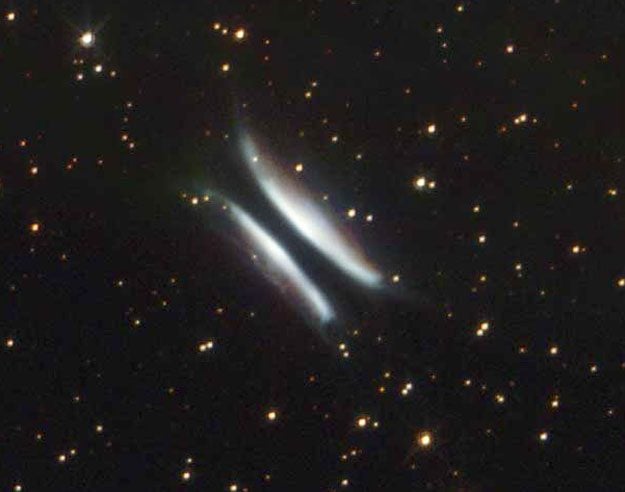
The protoplanetary nebula known as “Gomez’s Hamburger”
(Wikimedia Commons public domain image)
Bertrand Russell came up with the analogy of a celestial teapot — now, in his honor, often called “Russell’s teapot” — as a way of disparaging what he regarded as the irrationality of religious belief.
I cite a summary of it from the distinguished British journalist, author, and academic John Cornwell, who directs the Science and Human Dimension Project at the University of Cambridge:
If one were to claim that between Earth and Mars there is a teapot in orbit, nobody could disprove the assertion, especially if one were to claim that the teapot is too small to be seen by any telescope. Yet if one were to insist that it would be an “intolerable presumption” on the part of anyone to doubt it, this would be taken as nonsense. Russell goes on to add, however: “If the existence of such a teapot were affirmed in ancient books, taught as the sacred truth every Sunday and instilled into the minds of children at school, hesitation to believe in its existence would become a mark of eccentricity and entitle the doubter to the attentions of a psychiatrist in an enlightened age or of the Inquisition in an earlier time.”
A few pages later, in the same chapter, Cornwell cites the distinguished Anglo-American mathematical physicist Freeman Dyson, of Princeton’s Institute for Advanced Studies:
The strength of the attractive nuclear forces is just sufficient to overcome the electrical repulsion between the positive charges in the nuclei of ordinary atoms such as oxygen or iron. But the nuclear forces are not quite strong enough to bind together two protons (hydrogen nuclei) into a bound system which would be called a diproton if it existed. If the nuclear forces had been slightly stronger than they are, the diproton would exist and almost all the hydrogen in the universe would have been combined into diprotons and heavier nuclei. Hydrogen would be a rare element, and stars like the sun, which live for a long time, by the slow burning of hydrogen in their cores, could not exist.
Thus far, Professor Dyson. Now, back to Cornwell:
Dyson goes on. If the nuclear forces had been substantially weaker than they are, hydrogen could not burn at all and there would be no heavy elements. “If, as seems likely, the evolution of life requires a star like the sun, supplying energy at a constant rate for billions of years, then the strength of nuclear forces had to lie within a rather narrow range to make life possible.” And this is not all. The facts of astronomy, he points out, include other numerical accidents that worked to the advantage of the existence of life, not least the distance between stars. And the rich diversity of organic chemistry, he argues, depends on a delicate balance between electrical and quantum-mechanical forces. “There are many other lucky accidents in atomic physics,” he writes. “Without such accidents, water could not exist as a liquid, chains of carbon atoms could not form complex organic molecules, and hydrogen atoms could not form a breakable bridge between molecules.” Dyson felt obliged to raise questions about how so many of these “finely tuned” conditions should have come about by pure chance, and calculated that it is a mathematical impossibility. “Being a scientist, trained in the habits of thought and language of the twentieth century rather than the eighteenth, I do not claim that the architecture of the universe proves the existence of God. I claim only that the architecture of the universe is consistent with the hypothesis that mind plays an essential role in its functioning.” As the distinguished cosmologist and science expositor James Jeans once wrote: “The universe begins to look more like a great thought than a great machine.” For most philosophers of religion this constitutes a theistic position.
Of course, Richard Dawkins and other atheists respond to these facts with the suggestion of a “multiverse,” an infinite or essentially infinite assemblage of universes in which at least one is inevitably bound to meet the requirements for life. And we few, we happy few, happen to live in that universe. (After all, we could hardly live in one not fit for life.)
Cornwell isn’t exactly blown away by the hypothesis. This is how he concludes his chapter:
In fact, there are no more observable data for this “suggestion” than the positing of a miniature teapot circumnavigating the Earth..
See John Cornwell, Darwin’s Angel: An Angelic Riposte to The God Delusion (London: Profile Books, 2008), 53-58.
Previous Post

January 13, 2019
Compassion and Religious Belief
Next Post
January 13, 2019 C. S. Lewis and J. B. Phillips: An Unexpected Meeting
Browse Our Archives
Select a Category Uncategorized
Select a Month October 2026 September 2026 August 2026 July 2026 June 2026 May 2026 April 2026 March 2026 February 2026 January 2026 December 2025 November 2025 October 2025 September 2025 August 2025 July 2025 June 2025 May 2025 April 2025 March 2025 February 2025 January 2025 December 2024 November 2024 October 2024 September 2024 August 2024 July 2024 June 2024 May 2024 April 2024 March 2024 February 2024 January 2024 December 2023 November 2023 October 2023 September 2023 August 2023 July 2023 June 2023 May 2023 April 2023 March 2023 February 2023 January 2023 December 2022 November 2022 October 2022 September 2022 August 2022 July 2022 June 2022 May 2022 April 2022 March 2022 February 2022 January 2022 December 2021 November 2021 October 2021 September 2021 August 2021 July 2021 June 2021 May 2021 April 2021 March 2021 February 2021 January 2021 December 2020 November 2020 October 2020 September 2020 August 2020 July 2020 June 2020 May 2020 April 2020 March 2020 February 2020 January 2020 December 2019 November 2019 October 2019 September 2019 August 2019 July 2019 June 2019 May 2019 April 2019 March 2019 February 2019 January 2019 December 2018 November 2018 October 2018 September 2018 August 2018 July 2018 June 2018 May 2018 April 2018 March 2018 February 2018 January 2018 December 2017 November 2017 October 2017 September 2017 August 2017 July 2017 June 2017 May 2017 April 2017 March 2017 February 2017 January 2017 December 2016 November 2016 October 2016 September 2016 August 2016 July 2016 June 2016 May 2016 April 2016 March 2016 February 2016 January 2016 December 2015 November 2015 October 2015 September 2015 August 2015 July 2015 June 2015 May 2015 April 2015 March 2015 February 2015 January 2015 December 2014 November 2014 March 2014 August 2013 February 2012
Follow Us!
TAKE THE
Religious Wisdom Quiz
Who saw a vision of a valley full of dry bones?
Select your answer to see how you score.
Micah Ezekiel Amos Daniel
Related posts from Sic et Non


Learning more about a region of which I've...

From Serbia's "White City," Belgrade

TRENDING AT PATHEOS Latter-day Saint

Letters on Living the Faith by C.S. Lewis
Most of us met C.S. Lewis as a public intellectual. Mere Christianity....

When Halloween Unmasks Married Hearts
Written by Dr. David K. Ewen from Eternal Truth Bible College Behind...

Aristotle. He’s been called the father of logic, the father of the...

Methodist Central Hall and Westminster Abbey
Situated on the same square is Methodist Central Hall and Westminster Abbey. ...

57th Dove Awards Honor Dolly Parton, Crown New...
On gospel music’s biggest night, the 57th annual GMA Dove Awards honored...

The First Eucharistic Controversy: Christ’s Real Presence
For Catholics, the Eucharist is the source and summit of the Christian...
view all Latter-day Saint blogs
Ad-Free & Subscriber Log-In Subscription Support
- About Us
- 2026 Calendar
- Videos
- Podcasts
- Library of World Religions
- Faith In Media Tracker
- Advertise With Us
- Write for Us
- Privacy Policy
- Terms of Service
- Do Not Sell My Data
- Contact Us
- Radiant Digital
- Manage Newsletter Subscriptions
- Unsubscribe From Notifications
- Sitemap
Copyright 2008-2026, Patheos. All rights reserved.
Subscription Support Ad-Free & Subscriber Log-In
Follow Patheos