
BuddhistCatholicContemplativeEvangelicalGeneral ChristianHinduJewishLatter-day SaintMuslimNew VisionsProgressive Christian
Beliefs
- Buddhist
- Catholic
- Contemplative
- Evangelical
- General Christian
- Hindu
- Jewish
- Latter-day Saint
- More Voices
- Muslim
- New Visions
- Pagan
- Progressive Christian
Topics
- Religion News
- Food and Religion
- Sports and Religion
- Religious Art
- Religious Music and Entertainment
- Religious Events
- History and Religion
- Style and Religion
- Politics and Religion
- Women in Religion
- Recreation Outdoors and Religion
- Business Finance and Religion
- Careers Workplace and Religion
- Education and Religion
- Family Parenting and Religion
- Health Fitness and Religion
- Home and Religion
- Relationships and Religion
- Technology and Religion
- Travel and Religion
Columnists
- Buddhist Columnists
- Business Finance and Religion Columnists
- Careers Workplace and Religion Columnists
- Catholic Columnists
- Contemplative Columnists
- Education and Religion Columnists
- Evangelists Columnists
- Family Parenting and Religion Columnists
- General Christian Columnists
- Health Fitness and Religion Columnists
- Hindu Columnists
- History and Religion Columnists
- Home and Religion Columnists
- Jewish Columnists
- More Voices Columnists
- Latter Day Columnists
- Muslim Columnists
- New Visions Columnists
- Nonreligious Columnists
- Pagan Columnists
- Politics and Religion Columnists
- Progressive Columnists
- Recreation Outdoors and Religion Columnists
- Relationships and Religion Columnists
- Religion News Columnists
- Religious Art Columnists
- Religious Events Columnists
- Religious Music and Entertainment Columnists
- Sports and Religion Columnists
- Style and Religion Columnists
- Technology and Religion Columnists
- Travel and Religion Columnists
- Women in Religion Columnists
Resource Library
- 2026 Calendar
- Library of World Religions
- The 100 Most Holy Places on Earth
- Patheos Answers
- Podcasts
- Videos
- Faith Leaders Database
- Anglican Episcopalian
- Bahai
- Baptist
- Buddhism
- Christianity
- Confucianism
- Eastern Orthodoxy
- Hinduism
- Holiness and Pentecostal
- ISKCON
- Islam
- Judaism
- Lutheran
- Methodist
- The Church of Jesus Christ of Latter-day Saints
- New Age
- Paganism
- Presbytarian and Reformed
- Protestantism
- Religion Behind the Scenes
- Roman Catholic
- Scientology
- Shia Islam
- Sikhism
- Sufism
- Sunni Islam
- Taoism
- Zen
- See all religions
Research Tools
 Ad-Free & Subscriber Log-In Subscription Support
Ad-Free & Subscriber Log-In Subscription Support
Follow Patheos 

- Trending:
- Forgiveness
- |
- Marriage
- |
- Consciousness
- |
- Death Penalty
- |
- Election
- |
- Halloween

- Home
- Latter-day Saint
- New Testament Note 7
New Testament Note 7
Last updated on: February 1, 2019 at 2:53 pm by Dan Peterson
New Testament Note 7 2019-02-01T14:53:39-07:00 Dan Peterson
Patheos Explore the world's faith through different perspectives on religion and spirituality! Patheos has the views of the prevalent religions and spiritualities of the world.
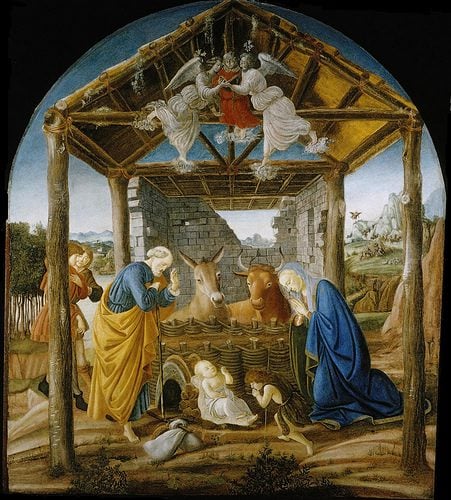
A nativity by Botticelli (Wikimedia Commons public domain)
What can I possibly say here about this most familiar of stories that hasn’t been said both recently and eloquently?
Not much, probably.
Perhaps a few very quick notes will need to suffice.
Matthew 1:21 — “You shall call his name Jesus, for he will save his people from their sins.” This statement presupposes that readers understand the meaning of that name, Jesus.
The English form of the name Jesus is derived from the name Iēsous (Greek: Ἰησοῦς), which, in its turn, is the Greek form of the Hebrew name Yeshua (Hebrew: ישוע). (Compare the Old Testament name of Joshua, the successor to Moses.) Yeshua is based on the Hebrew root y-š-ʕ (ישע), meaning “to deliver,” or “to rescue.” Both the name Yeshua and its longer form, Yehoshua, had become common among Jews of the Second Temple period — i.e., at the time of Jesus. The precise meaning of the name is somewhat debated, but all of the possibilities, which center on Yah, the first syllable of the divine name Yahweh (that is, Jehovah), carry closely related meanings, including “Yah saves,” “Yah is salvation,” “Yah is a saving-cry,” and so forth.
Thus, the statement “You shall call his name Jesus, for he will save his people from their sins” makes perfect sense.
Matthew likes to explain the meaning of names. Compare his explanation of the name Emmanuel, which, he says at 1:23, “means ‘God with us.'”
He is also eager, as at verses 1:22-23, to indicate how Jesus fulfills the ancient messianic promises. This will be a recurrent theme in his gospel; it’s far less common, if it occurs at all, in the gospel of Luke.
The “manger” (Greek phatne) into which the infant Jesus is placed after his birth and his wrapping in swaddling clothes wasn’t a cute little Austrian or Bavarian cradle but, rather, a feeding trough. And it was almost certainly made of stone. (The French verb manger, from which the English word derives, means “to eat.”)
And what about the “inn” of Luke 1:7?
The Greek word kataluma, which the King James translates as inn, does indeed refer to a “lodging place.” But it might be preferable to translate it as referring to an “upper room.” It can indicate the room of a house where guests visiting from out of town might be able to lodge for the night, or even simply a dining room. According to Mark 14:14, for example, Jesus celebrated Passover — the Last Supper — with his disciples in a kataluma, an “upper room.”
In Luke 10:34, which is plainly talking about a public inn (effectively, a motel), Luke uses the quite different word pandocheion. But Bethlehem, at the beginning of the first century, was a very tiny town, It may have had a population of no more than two or three hundred people altogether. There was probably no motel or inn there.
Previous Post

January 26, 2019
Women and Apologetics (3)
Next Post
January 27, 2019 How will we be judged?
Browse Our Archives
Select a Category Uncategorized
Select a Month October 2026 September 2026 August 2026 July 2026 June 2026 May 2026 April 2026 March 2026 February 2026 January 2026 December 2025 November 2025 October 2025 September 2025 August 2025 July 2025 June 2025 May 2025 April 2025 March 2025 February 2025 January 2025 December 2024 November 2024 October 2024 September 2024 August 2024 July 2024 June 2024 May 2024 April 2024 March 2024 February 2024 January 2024 December 2023 November 2023 October 2023 September 2023 August 2023 July 2023 June 2023 May 2023 April 2023 March 2023 February 2023 January 2023 December 2022 November 2022 October 2022 September 2022 August 2022 July 2022 June 2022 May 2022 April 2022 March 2022 February 2022 January 2022 December 2021 November 2021 October 2021 September 2021 August 2021 July 2021 June 2021 May 2021 April 2021 March 2021 February 2021 January 2021 December 2020 November 2020 October 2020 September 2020 August 2020 July 2020 June 2020 May 2020 April 2020 March 2020 February 2020 January 2020 December 2019 November 2019 October 2019 September 2019 August 2019 July 2019 June 2019 May 2019 April 2019 March 2019 February 2019 January 2019 December 2018 November 2018 October 2018 September 2018 August 2018 July 2018 June 2018 May 2018 April 2018 March 2018 February 2018 January 2018 December 2017 November 2017 October 2017 September 2017 August 2017 July 2017 June 2017 May 2017 April 2017 March 2017 February 2017 January 2017 December 2016 November 2016 October 2016 September 2016 August 2016 July 2016 June 2016 May 2016 April 2016 March 2016 February 2016 January 2016 December 2015 November 2015 October 2015 September 2015 August 2015 July 2015 June 2015 May 2015 April 2015 March 2015 February 2015 January 2015 December 2014 November 2014 March 2014 August 2013 February 2012
Follow Us!
TAKE THE
Religious Wisdom Quiz
What is the lesson of the Parable of the Wheat and the Weeds?
Select your answer to see how you score.
Sow only good seed Judgment will separate good and evil Water the crops often Never trust a stranger
Related posts from Sic et Non

An action movie and some vacuous theology

"The World's Sixteen Crucified Saviors"?

"The Loss of Jesus in the Small Plates...

We definitely didn't elect a mere choirboy.
TRENDING AT PATHEOS Latter-day Saint

57th Dove Awards Honor Dolly Parton, Crown New...
On gospel music’s biggest night, the 57th annual GMA Dove Awards honored...

The First Eucharistic Controversy: Christ’s Real Presence
For Catholics, the Eucharist is the source and summit of the Christian...

What a Stop Sign Can Teach Us About...
How to Make a Decision When You Can't Hear God Main point:...

Archdiocese Hosts Military Marriage Retreat in Germany
RASTATT, Germany — The transient military lifestyle, with its frequent deployments and...

Nearly every morning, I make the drive to Detroit with my high-school-age...

The Real AI Story Is Adoption Without Trust
Artificial intelligence has crossed a political threshold. It is no longer a...
view all Latter-day Saint blogs
Ad-Free & Subscriber Log-In Subscription Support
- About Us
- 2026 Calendar
- Videos
- Podcasts
- Library of World Religions
- Faith In Media Tracker
- Advertise With Us
- Write for Us
- Privacy Policy
- Terms of Service
- Do Not Sell My Data
- Contact Us
- Radiant Digital
- Manage Newsletter Subscriptions
- Unsubscribe From Notifications
- Sitemap
Copyright 2008-2026, Patheos. All rights reserved.
Subscription Support Ad-Free & Subscriber Log-In
Follow Patheos