
BuddhistCatholicContemplativeEvangelicalGeneral ChristianHinduJewishLatter-day SaintMuslimNew VisionsProgressive Christian
Beliefs
- Buddhist
- Catholic
- Contemplative
- Evangelical
- General Christian
- Hindu
- Jewish
- Latter-day Saint
- More Voices
- Muslim
- New Visions
- Pagan
- Progressive Christian
Topics
- Religion News
- Food and Religion
- Sports and Religion
- Religious Art
- Religious Music and Entertainment
- Religious Events
- History and Religion
- Style and Religion
- Politics and Religion
- Women in Religion
- Recreation Outdoors and Religion
- Business Finance and Religion
- Careers Workplace and Religion
- Education and Religion
- Family Parenting and Religion
- Health Fitness and Religion
- Home and Religion
- Relationships and Religion
- Technology and Religion
- Travel and Religion
Columnists
- Buddhist Columnists
- Business Finance and Religion Columnists
- Careers Workplace and Religion Columnists
- Catholic Columnists
- Contemplative Columnists
- Education and Religion Columnists
- Evangelists Columnists
- Family Parenting and Religion Columnists
- General Christian Columnists
- Health Fitness and Religion Columnists
- Hindu Columnists
- History and Religion Columnists
- Home and Religion Columnists
- Jewish Columnists
- More Voices Columnists
- Latter Day Columnists
- Muslim Columnists
- New Visions Columnists
- Nonreligious Columnists
- Pagan Columnists
- Politics and Religion Columnists
- Progressive Columnists
- Recreation Outdoors and Religion Columnists
- Relationships and Religion Columnists
- Religion News Columnists
- Religious Art Columnists
- Religious Events Columnists
- Religious Music and Entertainment Columnists
- Sports and Religion Columnists
- Style and Religion Columnists
- Technology and Religion Columnists
- Travel and Religion Columnists
- Women in Religion Columnists
Resource Library
- 2026 Calendar
- Library of World Religions
- The 100 Most Holy Places on Earth
- Patheos Answers
- Podcasts
- Videos
- Faith Leaders Database
- Anglican Episcopalian
- Bahai
- Baptist
- Buddhism
- Christianity
- Confucianism
- Eastern Orthodoxy
- Hinduism
- Holiness and Pentecostal
- ISKCON
- Islam
- Judaism
- Lutheran
- Methodist
- The Church of Jesus Christ of Latter-day Saints
- New Age
- Paganism
- Presbytarian and Reformed
- Protestantism
- Religion Behind the Scenes
- Roman Catholic
- Scientology
- Shia Islam
- Sikhism
- Sufism
- Sunni Islam
- Taoism
- Zen
- See all religions
Research Tools
 Ad-Free & Subscriber Log-In Subscription Support
Ad-Free & Subscriber Log-In Subscription Support
Follow Patheos 

- Trending:
- Forgiveness
- |
- Marriage
- |
- Consciousness
- |
- Death Penalty
- |
- Election
- |
- Halloween

- Home
- Latter-day Saint
- New Testament Note 1
New Testament Note 1
Last updated on: February 1, 2019 at 2:57 pm by Dan Peterson
New Testament Note 1 2019-02-01T14:57:42-07:00 Dan Peterson
Patheos Explore the world's faith through different perspectives on religion and spirituality! Patheos has the views of the prevalent religions and spiritualities of the world.
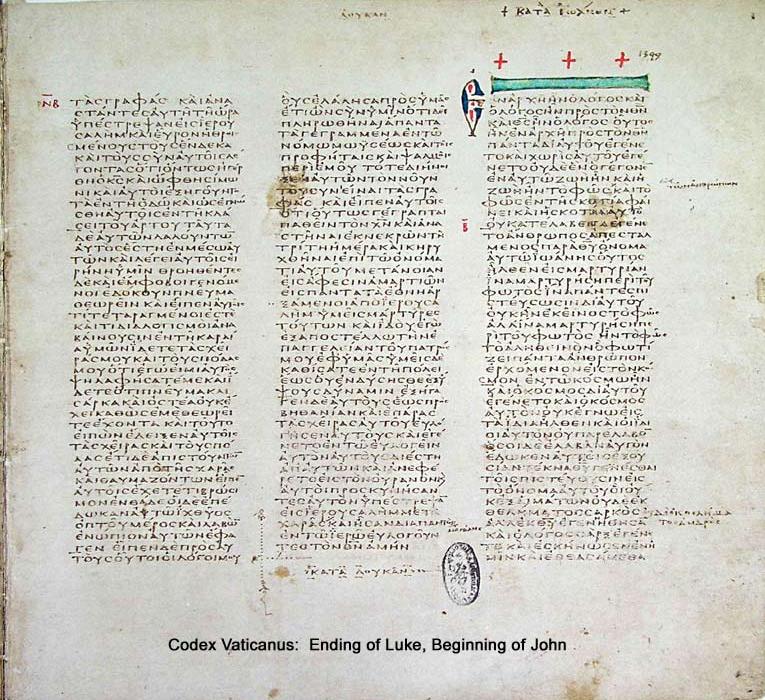
The end of the Gospel of Luke and the beginning of the Gospel of John in the fourth-century Codex Vaticanus (Wikimedia Commons)
It’s time to revisit my occasional commentary on the New Testament. I’ll take it slowly and in small snippets, and I plan to go through all four gospels and the book of Acts.
I won’t be doing the gospels one by one, but, rather, in “harmony,” using as the basis for my divisions of material Kurt Aland, ed., Synopsis of the Four Gospels: Greek-English Edition of the Synopsis Quattuor Evangeliorum, 14th ed. (Stuttgart: German Bible Society, 2009). The numbers in the titles of my posts in this series will refer to the sections of that publication.
I’ll make no pretense of completeness. I don’t have anything remotely like the time that a full commentary would require. I’ll simply pick up something of interest in each section, hoping that at least some out there will find what I have to say of interest or of use.
So now I begin:
Matthew begins fairly abruptly, announcing that it will give the genealogy of Jesus.
Mark announces “The beginning of the gospel of Jesus Christ, the Son of God” — providing the first Christian occurrence of that important word gospel. Or, more properly, of the Greek word euangelion [εὐαγγέλιον] — which is the source of such English words as evangelist and evangelical.
Gospel, of course, is a modern English rendering of the Old English god-spell, or “good news,” which is a calque (a literal, word-for-word translation) of the Greek εὐαγγέλιον, which also means “good news.” Eu- is a Greek prefix signifying “good” — think of English words such as euphoria (from the Greek phero, “to bear”), eulogy (good speech), euphemism (good saying), eugenics (good birth), and euthanasia (good death) — while the -angelion comes from the Greek equivalent of English “message” or “news,” as does the word angel (“messenger”).
Luke begins with a rather academic-sounding prologue or preface, signifying serious historical intent and method with its reference to “eyewitnesses” (autoptai, literally something like “own eyes”). This is very important. The author of Luke was, plainly, well educated, and the gospel of Luke is written in the manner of ancient Greek historiography. (For a brief review, by Noel Reynolds, of an extraordinarily interesting book on “eyewitnesses” and the four gospels, see this item in the more-or-less suppressed real first issue of the Mormon Studies Review.)
Finally, entire books could be written (and have been written) on the prologue to John’s gospel. I’ll content myself here with observing that John 1:1-14 can be read as a kind of Christmas or Nativity story. Around the time of Jesus and John, Jewish thinkers (notably Philo of Alexandria) were using the term logos (“word”) to describe an intermediary between humans and the Most High God. That’s also the term used in John 1:1, though its meaning is far richer than the English word suggests. It can mean reason, speech, logic, rationality, cosmic order, discussion or council, and many other things besides. At Faust 1.1.889, in fact, the German poet J. W. von Goethe famously translated it as Tat (or, in English, deed).
For more than 2,000 years, the Christian message has been that, in Jesus, this divine intermediary came to Earth and dwelt among us.
There. That’s a bit longer than I typically intend to go on. But it’s a beginning.
Previous Post

January 21, 2019
"Conceivably he could get along without his head"
Next Post
January 22, 2019 A deluge of notifications from 2012
Browse Our Archives
Select a Category Uncategorized
Select a Month October 2026 September 2026 August 2026 July 2026 June 2026 May 2026 April 2026 March 2026 February 2026 January 2026 December 2025 November 2025 October 2025 September 2025 August 2025 July 2025 June 2025 May 2025 April 2025 March 2025 February 2025 January 2025 December 2024 November 2024 October 2024 September 2024 August 2024 July 2024 June 2024 May 2024 April 2024 March 2024 February 2024 January 2024 December 2023 November 2023 October 2023 September 2023 August 2023 July 2023 June 2023 May 2023 April 2023 March 2023 February 2023 January 2023 December 2022 November 2022 October 2022 September 2022 August 2022 July 2022 June 2022 May 2022 April 2022 March 2022 February 2022 January 2022 December 2021 November 2021 October 2021 September 2021 August 2021 July 2021 June 2021 May 2021 April 2021 March 2021 February 2021 January 2021 December 2020 November 2020 October 2020 September 2020 August 2020 July 2020 June 2020 May 2020 April 2020 March 2020 February 2020 January 2020 December 2019 November 2019 October 2019 September 2019 August 2019 July 2019 June 2019 May 2019 April 2019 March 2019 February 2019 January 2019 December 2018 November 2018 October 2018 September 2018 August 2018 July 2018 June 2018 May 2018 April 2018 March 2018 February 2018 January 2018 December 2017 November 2017 October 2017 September 2017 August 2017 July 2017 June 2017 May 2017 April 2017 March 2017 February 2017 January 2017 December 2016 November 2016 October 2016 September 2016 August 2016 July 2016 June 2016 May 2016 April 2016 March 2016 February 2016 January 2016 December 2015 November 2015 October 2015 September 2015 August 2015 July 2015 June 2015 May 2015 April 2015 March 2015 February 2015 January 2015 December 2014 November 2014 March 2014 August 2013 February 2012
Follow Us!
TAKE THE
Religious Wisdom Quiz
I am twelve stones taken from a riverbed and set up as a memorial to a miraculous crossing. What am I?
Select your answer to see how you score.
Altar stones The memorial stones The Stones of remembrance Bethel
Related posts from Sic et Non
Some notes on the resurrection of Jesus
Setting the Record Straight, Though Without Much Real...

Christmas, the Israelite Tabernacle, and the Gospel of...
My one encounter, such as it was, with...
TRENDING AT PATHEOS Latter-day Saint

The Sermon on the Mount, Part I: Matthew...
The Sermon on the Mount, Part I (Matthew 4:12-5:12) St. Matthew moves...

What's up from Crossway: Reviewing some of their latest A few weeks...

Janie Learns the Way of the Cross: A...
Teaching children about Jesus' Passion can be challenging. Many parents and educators...

Looking For Good Catholic Writing - October 2026
He alone extends the heavens, and he walks upon the waves of...

In "Irreplaceable," our book on vocation and technology, Trevor Sutton and I...

I was strolling through the top floor of the brand new Parthenon...
view all Latter-day Saint blogs
Ad-Free & Subscriber Log-In Subscription Support
- About Us
- 2026 Calendar
- Videos
- Podcasts
- Library of World Religions
- Faith In Media Tracker
- Advertise With Us
- Write for Us
- Privacy Policy
- Terms of Service
- Do Not Sell My Data
- Contact Us
- Radiant Digital
- Manage Newsletter Subscriptions
- Unsubscribe From Notifications
- Sitemap
Copyright 2008-2026, Patheos. All rights reserved.
Subscription Support Ad-Free & Subscriber Log-In
Follow Patheos