
BuddhistCatholicContemplativeEvangelicalGeneral ChristianHinduJewishLatter-day SaintMuslimNew VisionsProgressive Christian
Beliefs
- Buddhist
- Catholic
- Contemplative
- Evangelical
- General Christian
- Hindu
- Jewish
- Latter-day Saint
- More Voices
- Muslim
- New Visions
- Pagan
- Progressive Christian
Topics
- Religion News
- Food and Religion
- Sports and Religion
- Religious Art
- Religious Music and Entertainment
- Religious Events
- History and Religion
- Style and Religion
- Politics and Religion
- Women in Religion
- Recreation Outdoors and Religion
- Business Finance and Religion
- Careers Workplace and Religion
- Education and Religion
- Family Parenting and Religion
- Health Fitness and Religion
- Home and Religion
- Relationships and Religion
- Technology and Religion
- Travel and Religion
Columnists
- Buddhist Columnists
- Business Finance and Religion Columnists
- Careers Workplace and Religion Columnists
- Catholic Columnists
- Contemplative Columnists
- Education and Religion Columnists
- Evangelists Columnists
- Family Parenting and Religion Columnists
- General Christian Columnists
- Health Fitness and Religion Columnists
- Hindu Columnists
- History and Religion Columnists
- Home and Religion Columnists
- Jewish Columnists
- More Voices Columnists
- Latter Day Columnists
- Muslim Columnists
- New Visions Columnists
- Nonreligious Columnists
- Pagan Columnists
- Politics and Religion Columnists
- Progressive Columnists
- Recreation Outdoors and Religion Columnists
- Relationships and Religion Columnists
- Religion News Columnists
- Religious Art Columnists
- Religious Events Columnists
- Religious Music and Entertainment Columnists
- Sports and Religion Columnists
- Style and Religion Columnists
- Technology and Religion Columnists
- Travel and Religion Columnists
- Women in Religion Columnists
Resource Library
- 2026 Calendar
- Library of World Religions
- The 100 Most Holy Places on Earth
- Patheos Answers
- Podcasts
- Videos
- Faith Leaders Database
- Anglican Episcopalian
- Bahai
- Baptist
- Buddhism
- Christianity
- Confucianism
- Eastern Orthodoxy
- Hinduism
- Holiness and Pentecostal
- ISKCON
- Islam
- Judaism
- Lutheran
- Methodist
- The Church of Jesus Christ of Latter-day Saints
- New Age
- Paganism
- Presbytarian and Reformed
- Protestantism
- Religion Behind the Scenes
- Roman Catholic
- Scientology
- Shia Islam
- Sikhism
- Sufism
- Sunni Islam
- Taoism
- Zen
- See all religions
Research Tools
 Ad-Free & Subscriber Log-In Subscription Support
Ad-Free & Subscriber Log-In Subscription Support
Follow Patheos 

- Trending:
- Forgiveness
- |
- Marriage
- |
- Consciousness
- |
- Death Penalty
- |
- Election
- |
- Halloween

- Home
- Latter-day Saint
- A few words on “shari‘a”
A few words on “shari‘a”
Last updated on: December 2, 2018 at 8:18 pm by Dan Peterson
A few words on “shari‘a” 2018-12-02T20:18:35-07:00 Dan Peterson
Patheos Explore the world's faith through different perspectives on religion and spirituality! Patheos has the views of the prevalent religions and spiritualities of the world.
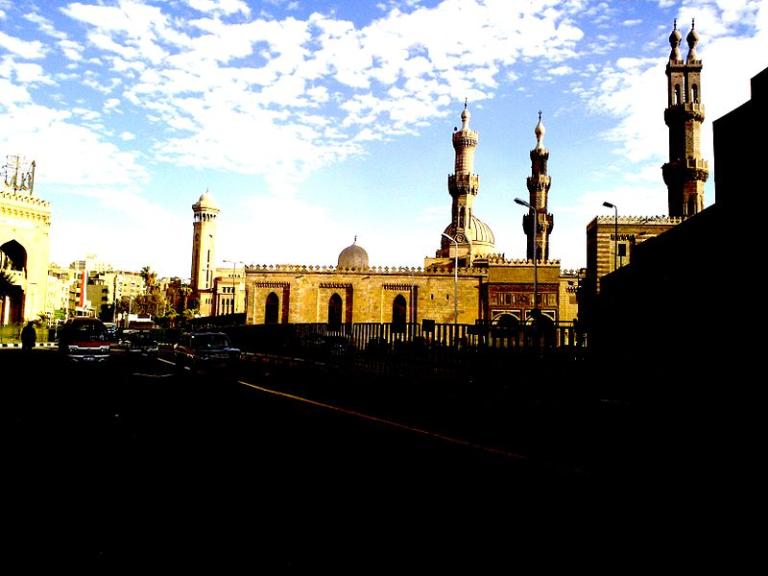
The mosque-university of al-Azhar in Cairo, founded in the early 970s AD.
(Wikimedia Commons)
I’ve lately received several inquiries about Islam’s shari‘a (or, as it’s often somewhat misleadingly termed, “shari‘a law’). With that in mind, I think it not inappropriate to share this column that Bill Hamblin and I wrote and that appeared in the Deseret News on 1 December 2012. It’s dated in parts, but, overall, it contains some still-useful information and, perhaps, a helpful insight or two:
The ongoing constitutional crisis in Egypt — provoked by President Mohammed Morsi’s attempt to seize near-dictatorial powers for himself — has again brought the concept of Islamic law, or Shariah, to the forefront of Western consciousness.
Morsi’s Freedom and Justice Party seeks to limit the authority of Egyptian judges in part to facilitate the restoration of Shariah, the much misunderstood and maligned Muslim legal system, as the country’s law.
Religion has always constituted a foundational element for the creation of law in traditional cultures. Such societies generally view laws as more than merely custom, the arbitrary will of the ruler or the continually shifting opinions of the people.
Viewed in context along with the “dharma” of Hindu and Buddhist cultures, Jewish rabbinic law (Halacha), and medieval Christian law, which attempt to work out the details and implications of God’s revelation as contained in holy scripture, Shariah is scarcely unusual. It’s simply the manifestation in Islamic culture of a universal goal of premodern societies: making their legal order reflect the will of God.
For Jews, the source of Halacha is the Torah (“Law”) found in the Bible — especially the five books of Moses — as expounded in the “oral Torah” by Moses and interpreted by subsequent rabbis. Likewise, for Muslims the source of Shariah is the Quran — the ultimate revelation of God to Muhammad the prophet — as expounded and exemplified by Muhammad and interpreted by later legal scholars known as the Ulema.
The Quran and Muhammad’s teachings (sunna) were codified into the Shariah in the late eighth century, nearly 150 years after Muhammad’s death; Muslim jurists attempted to systematize Islamic teachings, ethics, local customs, and even Roman law into consistent and coherent form. But they’ve never achieved complete consensus on the specifics of Shariah, and five major schools, or systems, of Islamic legal interpretation exist today — the Hanafi, Maliki, Shafi’i, Hanbali, and, among Shiites, Ja’fari schools — as well as a handful of minor ones. (All of the schools of law typically recognize the legitimacy of rival interpretations.)
Much in Shariah deals with what Westerners would see as purely religious regulations, such as purification rites, dietary restrictions, prayers, funerals and pilgrimage to Mecca. Other aspects of Shariah deal with social or civil matters such as marriage, divorce and inheritance. It’s important to note, in this regard, that Shariah applies only to Muslims. Non-Muslim minorities living under Muslim rule — e.g., Jewish or Christian communities — have their own traditional law codes covering these issues.
Movements by modern Muslims in England, for example, to implement Shariah often amount to the simple request that Muslims be permitted to follow Shariah in binding arbitration regarding such matters as marriage, divorce and inheritance. (English practice already permits this for Orthodox Jews, who are often allowed to have Halacha regulations binding for marriage, etc.)
Westerners sometimes describe a number of controversial aspects of Shariah as barbaric or “medieval” (as if “medieval” were an insult rather than a chronological period). Protected non-Muslim minorities (“dhimmis”) often face legal restrictions, for instance, though their right to worship is guaranteed. Polygamy, restricted rights of women, limits on freedom of speech, slavery and prohibitions against religious conversion and homosexuality are all viewed as problematic by many in the West. However, similar laws once existed in Europe, as well.
Few in the West realize that European imperialists systematically dismantled many of the traditional precepts of Shariah in the 19th century in order to further their dominance and colonialism among Muslim peoples. Thus many modern Muslim countries have fractured legal systems based on elements of Shariah inconsistently mixed with French or English law. Only a few Muslim countries today, including Iran, Saudi Arabia and Yemen, are governed solely by Shariah. A fundamental goal of contemporary Islamist movements such as the Muslim Brotherhood (which now rules Egypt through its Freedom and Justice Party) is to strip away foreign European colonial laws and return to Shariah, which had once been the law of the land throughout the Muslim world.
On the other hand, since several generations of Muslims have grown up under the hybrid colonial-Shariah legal systems that they now see as the norm, it will undoubtedly be a monumental and, no doubt, chaotic political task to reverse the process completely.
Thus, in this age of revolution, reformation and anarchy in the Muslim world, the future role of Shariah is a fundamental issue that will significantly impact the progress, stability and prosperity of the region.
Previous Post

December 2, 2018
Temple Attendance is a Christlike Gift
Next Post
December 2, 2018 A journey into a season of love, peace, and kindness
Browse Our Archives
Select a Category Uncategorized
Select a Month October 2026 September 2026 August 2026 July 2026 June 2026 May 2026 April 2026 March 2026 February 2026 January 2026 December 2025 November 2025 October 2025 September 2025 August 2025 July 2025 June 2025 May 2025 April 2025 March 2025 February 2025 January 2025 December 2024 November 2024 October 2024 September 2024 August 2024 July 2024 June 2024 May 2024 April 2024 March 2024 February 2024 January 2024 December 2023 November 2023 October 2023 September 2023 August 2023 July 2023 June 2023 May 2023 April 2023 March 2023 February 2023 January 2023 December 2022 November 2022 October 2022 September 2022 August 2022 July 2022 June 2022 May 2022 April 2022 March 2022 February 2022 January 2022 December 2021 November 2021 October 2021 September 2021 August 2021 July 2021 June 2021 May 2021 April 2021 March 2021 February 2021 January 2021 December 2020 November 2020 October 2020 September 2020 August 2020 July 2020 June 2020 May 2020 April 2020 March 2020 February 2020 January 2020 December 2019 November 2019 October 2019 September 2019 August 2019 July 2019 June 2019 May 2019 April 2019 March 2019 February 2019 January 2019 December 2018 November 2018 October 2018 September 2018 August 2018 July 2018 June 2018 May 2018 April 2018 March 2018 February 2018 January 2018 December 2017 November 2017 October 2017 September 2017 August 2017 July 2017 June 2017 May 2017 April 2017 March 2017 February 2017 January 2017 December 2016 November 2016 October 2016 September 2016 August 2016 July 2016 June 2016 May 2016 April 2016 March 2016 February 2016 January 2016 December 2015 November 2015 October 2015 September 2015 August 2015 July 2015 June 2015 May 2015 April 2015 March 2015 February 2015 January 2015 December 2014 November 2014 March 2014 August 2013 February 2012
Follow Us!
TAKE THE
Religious Wisdom Quiz
Which Christian denomination follows the teachings of John Wesley?
Select your answer to see how you score.
Catholic Baptist Methodist Lutheran
Related posts from Sic et Non

Islam in America or Islam versus America?

A basic working chronology of Islamic-era Iran

Actual Data and Actual Crusades

TRENDING AT PATHEOS Latter-day Saint

Methodist Central Hall and Westminster Abbey
Situated on the same square is Methodist Central Hall and Westminster Abbey. ...

57th Dove Awards Honor Dolly Parton, Crown New...
On gospel music’s biggest night, the 57th annual GMA Dove Awards honored...

The First Eucharistic Controversy: Christ’s Real Presence
For Catholics, the Eucharist is the source and summit of the Christian...

What a Stop Sign Can Teach Us About...
How to Make a Decision When You Can't Hear God Main point:...

Archdiocese Hosts Military Marriage Retreat in Germany
RASTATT, Germany — The transient military lifestyle, with its frequent deployments and...

Nearly every morning, I make the drive to Detroit with my high-school-age...
view all Latter-day Saint blogs
Ad-Free & Subscriber Log-In Subscription Support
- About Us
- 2026 Calendar
- Videos
- Podcasts
- Library of World Religions
- Faith In Media Tracker
- Advertise With Us
- Write for Us
- Privacy Policy
- Terms of Service
- Do Not Sell My Data
- Contact Us
- Radiant Digital
- Manage Newsletter Subscriptions
- Unsubscribe From Notifications
- Sitemap
Copyright 2008-2026, Patheos. All rights reserved.
Subscription Support Ad-Free & Subscriber Log-In
Follow Patheos