
BuddhistCatholicContemplativeEvangelicalGeneral ChristianHinduJewishLatter-day SaintMuslimNew VisionsProgressive Christian
Beliefs
- Buddhist
- Catholic
- Contemplative
- Evangelical
- General Christian
- Hindu
- Jewish
- Latter-day Saint
- More Voices
- Muslim
- New Visions
- Pagan
- Progressive Christian
Topics
- Religion News
- Food and Religion
- Sports and Religion
- Religious Art
- Religious Music and Entertainment
- Religious Events
- History and Religion
- Style and Religion
- Politics and Religion
- Women in Religion
- Recreation Outdoors and Religion
- Business Finance and Religion
- Careers Workplace and Religion
- Education and Religion
- Family Parenting and Religion
- Health Fitness and Religion
- Home and Religion
- Relationships and Religion
- Technology and Religion
- Travel and Religion
Columnists
- Buddhist Columnists
- Business Finance and Religion Columnists
- Careers Workplace and Religion Columnists
- Catholic Columnists
- Contemplative Columnists
- Education and Religion Columnists
- Evangelists Columnists
- Family Parenting and Religion Columnists
- General Christian Columnists
- Health Fitness and Religion Columnists
- Hindu Columnists
- History and Religion Columnists
- Home and Religion Columnists
- Jewish Columnists
- More Voices Columnists
- Latter Day Columnists
- Muslim Columnists
- New Visions Columnists
- Nonreligious Columnists
- Pagan Columnists
- Politics and Religion Columnists
- Progressive Columnists
- Recreation Outdoors and Religion Columnists
- Relationships and Religion Columnists
- Religion News Columnists
- Religious Art Columnists
- Religious Events Columnists
- Religious Music and Entertainment Columnists
- Sports and Religion Columnists
- Style and Religion Columnists
- Technology and Religion Columnists
- Travel and Religion Columnists
- Women in Religion Columnists
Resource Library
- 2026 Calendar
- Library of World Religions
- The 100 Most Holy Places on Earth
- Patheos Answers
- Podcasts
- Videos
- Faith Leaders Database
- Anglican Episcopalian
- Bahai
- Baptist
- Buddhism
- Christianity
- Confucianism
- Eastern Orthodoxy
- Hinduism
- Holiness and Pentecostal
- ISKCON
- Islam
- Judaism
- Lutheran
- Methodist
- The Church of Jesus Christ of Latter-day Saints
- New Age
- Paganism
- Presbytarian and Reformed
- Protestantism
- Religion Behind the Scenes
- Roman Catholic
- Scientology
- Shia Islam
- Sikhism
- Sufism
- Sunni Islam
- Taoism
- Zen
- See all religions
Research Tools
 Ad-Free & Subscriber Log-In Subscription Support
Ad-Free & Subscriber Log-In Subscription Support
Follow Patheos 

- Trending:
- Forgiveness
- |
- Marriage
- |
- Consciousness
- |
- Death Penalty
- |
- Election
- |
- Halloween

- Home
- Latter-day Saint
- Can reason survive naturalism?
Can reason survive naturalism?
Last updated on: November 4, 2018 at 3:19 pm by Dan Peterson
Can reason survive naturalism? 2018-11-04T15:19:25-07:00 Dan Peterson
Patheos Explore the world's faith through different perspectives on religion and spirituality! Patheos has the views of the prevalent religions and spiritualities of the world.
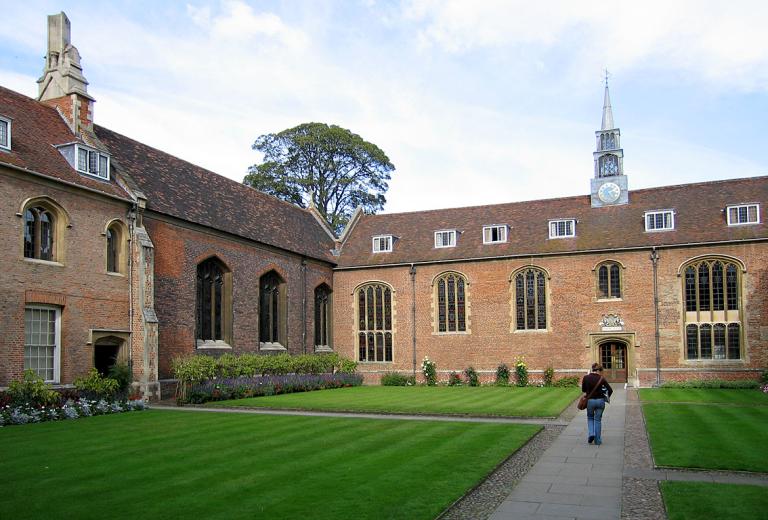
The first court at Magdalene College, Cambridge, where C. S. Lewis finished his teaching career
(Wikimedia Commons)
Yawn. More notes from another incomplete manuscript. I wrote this up several years ago. Eventually, in sha’a Allah, it will be incorporated (probably in substantially modified form) into a more finished text and submitted for publication:
It is not obvious that reason as reason can survive on a naturalistic view of the universe. Let us suppose, for example, that the universe did indeed commence with the Big Bang—as, to this point, the evidence overwhelmingly suggests that it did—and that various kinds of material substance were produced by that inconceivable explosion. These material substances fly away from each other according to the laws of physics, but for no purpose. Just as rocks fall down a mountainside in an avalanche according to the law of gravity—neither stopping because of a desire to avoid hitting and killing people in their path nor speeding up to swerving to hit them—so do the material products of the Big Bang hurtle on their way, blindly and unconsciously. Somehow, though, in the naturalistic world view, these material particles can organize themselves into complicated systems that we call “living,” systems or organisms that can work together to further their own individual survival and that of their class or “species.”
The human eye, for example, has, through vast eons of random evolutionary change, come together in such a way that it permits individual human organisms to see. But the particles of which the eye is composed are, in the naturalistic or mechanistic view, just as mechanistically determined as are the particles of a rock hurtling down a mountainside during an avalanche. Therefore, if what we call “drawing an inference” is, fundamentally, a matter merely of material particles in action, it, too, is mechanistic, and akin to the particles of that tumbling rock.
Perhaps our brains are structured in such a way that the activity that we call “rational inference” will be performed, and that this capacity contributes to our survival individually and collectively. But the description of this activity as a rational inference is not the description of this activity on the most basic level of analysis. The most basic level of analysis is that of physics, which makes no reference to purposes or logic whatsoever. At that point we’ve broken things down as far as possible, and we have reached the “basic stuff” of the universe.[1]
The brain is a material object in essentially the same way the heart is. One might say that the purpose of the heart is to pump blood throughout the body. But, of course, the heart itself doesn’t really have a “purpose” in the same way we say of a mountain climber who is systematically working his way up the face of a cliff that his purpose is to reach the summit of the mountain. The purpose or function of the heart is simply a byproduct of evolution. So, too, for the brain. Just as “pumping” doesn’t have a purpose in the sense that the heart knows what it is doing, “meaning” and “reasoning” seem to be (on a naturalistic view) physical processes that are, in a very important and fundamental way, simply evolutionary byproducts. In the final analysis, a naturalistic explanation for “meaning” and “reasoning” cannot be essentially different from the naturalistic explanation given for the pumping of the heart. It must be mechanical, and its apparent purposes must, in the end, be explained in terms of non-purposive processes.
Philosopher Victor Reppert makes the point clearly:
Any genuinely naturalistic position requires that all instances of explanation in terms of reasons be further explained in terms of a nonpurposive substratum. For if some purposive or intentional explanation can be given and no further analysis can be given in non-purposive and nonrational terms, then reason must be viewed as a fundamental cause in the universe, and this strikes me as a huge concession to positions such as theism, idealism and pantheism, which maintain that reasons are fundamental to the universe.[2]
[1] Victor Reppert, C. S. Lewis’s Dangerous Idea: In Defense of the Argument from Reason (Downers Grove: InterVarsity Press, 2003), 48.
[2] Reppert, C. S. Lewis’s Dangerous Idea, 51.
It’s been long enough since I typed the words above that I can’t recall how closely, or whether, they’re paraphrased from whatever I was reading at the time. Fortunately, I have some dedicated critics out there who plainly have lots of disposable time and who have given themselves over to me as unpaid research assistants, and they’ll be delighted should they find the paraphrase (if it is a paraphrase) too close. They’ll make an indignant fuss on their message board, and that will alert me to the need to rewrite what I’ve shared above before it goes into the final pre-publication manuscript. I thank them in advance! If they’re willing — and they certainly seem to be — I’ll probably use them for this purpose in the future, as well.
Previous Post

November 4, 2018
Islam and the supposed evils of theism
Browse Our Archives
Select a Category Uncategorized
Select a Month October 2026 September 2026 August 2026 July 2026 June 2026 May 2026 April 2026 March 2026 February 2026 January 2026 December 2025 November 2025 October 2025 September 2025 August 2025 July 2025 June 2025 May 2025 April 2025 March 2025 February 2025 January 2025 December 2024 November 2024 October 2024 September 2024 August 2024 July 2024 June 2024 May 2024 April 2024 March 2024 February 2024 January 2024 December 2023 November 2023 October 2023 September 2023 August 2023 July 2023 June 2023 May 2023 April 2023 March 2023 February 2023 January 2023 December 2022 November 2022 October 2022 September 2022 August 2022 July 2022 June 2022 May 2022 April 2022 March 2022 February 2022 January 2022 December 2021 November 2021 October 2021 September 2021 August 2021 July 2021 June 2021 May 2021 April 2021 March 2021 February 2021 January 2021 December 2020 November 2020 October 2020 September 2020 August 2020 July 2020 June 2020 May 2020 April 2020 March 2020 February 2020 January 2020 December 2019 November 2019 October 2019 September 2019 August 2019 July 2019 June 2019 May 2019 April 2019 March 2019 February 2019 January 2019 December 2018 November 2018 October 2018 September 2018 August 2018 July 2018 June 2018 May 2018 April 2018 March 2018 February 2018 January 2018 December 2017 November 2017 October 2017 September 2017 August 2017 July 2017 June 2017 May 2017 April 2017 March 2017 February 2017 January 2017 December 2016 November 2016 October 2016 September 2016 August 2016 July 2016 June 2016 May 2016 April 2016 March 2016 February 2016 January 2016 December 2015 November 2015 October 2015 September 2015 August 2015 July 2015 June 2015 May 2015 April 2015 March 2015 February 2015 January 2015 December 2014 November 2014 March 2014 August 2013 February 2012
Follow Us!
TAKE THE
Religious Wisdom Quiz
Who was the Roman governor who sentenced Jesus to be crucified?
Select your answer to see how you score.
Pontius Pilate Agrippa Herod Felix
Related posts from Sic et Non

Looking at the Largest Orthodox Cathedral on Earth

The Iron Gates and the Lion of the...


Learning more about a region of which I've...
TRENDING AT PATHEOS Latter-day Saint

Looking at the Largest Orthodox Cathedral on Earth
There is often a considerable amount of anger and, shall we...

The Problem with False Prophets
Miller’s Station UMC| 10/18/26| Anchor Verse: Jeremiah 23: 1, 9-23 I...

Emotion in Early Christianity by Andrew Crislip
Andrew Crislip’s Emotion in Early Christianity examines an often overlooked dimension of...

16 Spiritual Touchstones for a More Grounded Life
After decades of spiritual study, here are 16 principles I try...

Catholic Evangelization: Sharing Your Faith Every Day
Welcome back to the Graceful Awakening mini-series called, “From Faith to Mission.” ...

The Pillar of the Boatmen: the Ancient Monument...
The Pillar of the Boatmen is a Romano-Gaulish sculpture that dates from...
view all Latter-day Saint blogs
Ad-Free & Subscriber Log-In Subscription Support
- About Us
- 2026 Calendar
- Videos
- Podcasts
- Library of World Religions
- Faith In Media Tracker
- Advertise With Us
- Write for Us
- Privacy Policy
- Terms of Service
- Do Not Sell My Data
- Contact Us
- Radiant Digital
- Manage Newsletter Subscriptions
- Unsubscribe From Notifications
- Sitemap
Copyright 2008-2026, Patheos. All rights reserved.
Subscription Support Ad-Free & Subscriber Log-In
Follow Patheos