
BuddhistCatholicContemplativeEvangelicalGeneral ChristianHinduJewishLatter-day SaintMuslimNew VisionsProgressive Christian
Beliefs
- Buddhist
- Catholic
- Contemplative
- Evangelical
- General Christian
- Hindu
- Jewish
- Latter-day Saint
- More Voices
- Muslim
- New Visions
- Pagan
- Progressive Christian
Topics
- Religion News
- Food and Religion
- Sports and Religion
- Religious Art
- Religious Music and Entertainment
- Religious Events
- History and Religion
- Style and Religion
- Politics and Religion
- Women in Religion
- Recreation Outdoors and Religion
- Business Finance and Religion
- Careers Workplace and Religion
- Education and Religion
- Family Parenting and Religion
- Health Fitness and Religion
- Home and Religion
- Relationships and Religion
- Technology and Religion
- Travel and Religion
Columnists
- Buddhist Columnists
- Business Finance and Religion Columnists
- Careers Workplace and Religion Columnists
- Catholic Columnists
- Contemplative Columnists
- Education and Religion Columnists
- Evangelists Columnists
- Family Parenting and Religion Columnists
- General Christian Columnists
- Health Fitness and Religion Columnists
- Hindu Columnists
- History and Religion Columnists
- Home and Religion Columnists
- Jewish Columnists
- More Voices Columnists
- Latter Day Columnists
- Muslim Columnists
- New Visions Columnists
- Nonreligious Columnists
- Pagan Columnists
- Politics and Religion Columnists
- Progressive Columnists
- Recreation Outdoors and Religion Columnists
- Relationships and Religion Columnists
- Religion News Columnists
- Religious Art Columnists
- Religious Events Columnists
- Religious Music and Entertainment Columnists
- Sports and Religion Columnists
- Style and Religion Columnists
- Technology and Religion Columnists
- Travel and Religion Columnists
- Women in Religion Columnists
Resource Library
- 2026 Calendar
- Library of World Religions
- The 100 Most Holy Places on Earth
- Patheos Answers
- Podcasts
- Videos
- Faith Leaders Database
- Anglican Episcopalian
- Bahai
- Baptist
- Buddhism
- Christianity
- Confucianism
- Eastern Orthodoxy
- Hinduism
- Holiness and Pentecostal
- ISKCON
- Islam
- Judaism
- Lutheran
- Methodist
- The Church of Jesus Christ of Latter-day Saints
- New Age
- Paganism
- Presbytarian and Reformed
- Protestantism
- Religion Behind the Scenes
- Roman Catholic
- Scientology
- Shia Islam
- Sikhism
- Sufism
- Sunni Islam
- Taoism
- Zen
- See all religions
Research Tools
 Ad-Free & Subscriber Log-In Subscription Support
Ad-Free & Subscriber Log-In Subscription Support
Follow Patheos 

- Trending:
- Forgiveness
- |
- Marriage
- |
- Consciousness
- |
- Death Penalty
- |
- Election
- |
- Halloween

- Home
- Latter-day Saint
- “Advent refers to Christ’s Second Coming”
“Advent refers to Christ’s Second Coming”
Last updated on: December 1, 2018 at 9:16 pm by Dan Peterson
“Advent refers to Christ’s Second Coming” 2018-12-01T21:16:09-07:00 Dan Peterson
Patheos Explore the world's faith through different perspectives on religion and spirituality! Patheos has the views of the prevalent religions and spiritualities of the world.
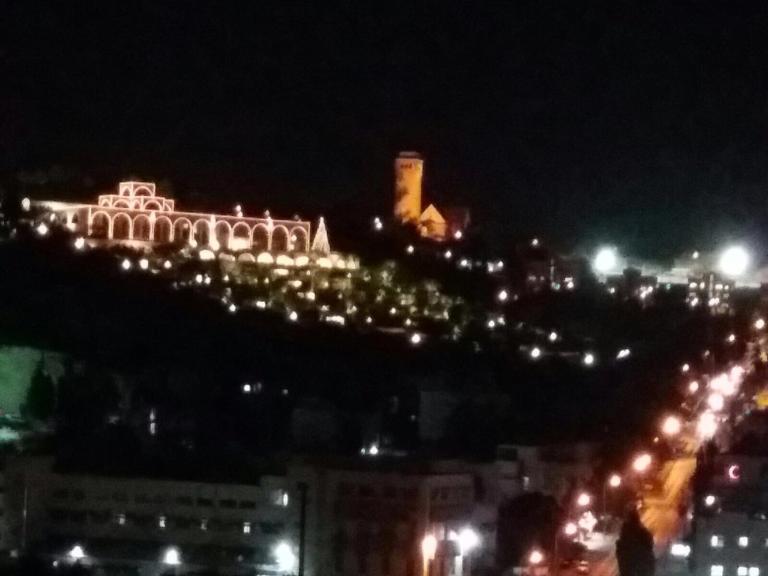
I received this photo just before Christmas 2017 from friends at Jimmy’s Bazaar in East Jerusalem. BYU’s Jerusalem Center for Near Eastern Studies — you can see it here in the upper left, with the tower of the Augusta Victoria Hospital to its right — had just turned on its Christmas lights for the first time that year.
Here’s a column that Bill Hamblin and I published in the Deseret News back on 15 December 2012:
Many Western Christians observe a season called “Advent” (from the Latin “adventus” or “coming”) during the month before they celebrate Jesus Christ’s Nativity at Christmas. Advent begins on the fourth Sunday prior to Dec. 25 and opens the liturgical year in the Moravian, Presbyterian, Methodist, Lutheran, Anglican and Roman Catholic calendars. (Eastern Christian communions celebrate a rough equivalent of Advent called the “Nativity Feast,” but its role and function differ somewhat.)
Latin “adventus” is equivalent to the Greek term “parousia,” which commonly refers to Christ’s Second Coming. Not coincidentally, therefore, Advent celebrations typically anticipate his glorious return in addition to commemorating his birth in Bethlehem. Just as ancient Jews longed for the coming of the Messiah, modern Christians yearn for his Second Advent. For this reason, some theologians call Advent “the season of already/not yet.”
Advent isn’t biblical — the first plain references to it appear late in the sixth century — and it surely isn’t required for salvation. But then, the same can be said of virtually every one of our Western Christmas traditions. And, amid the high-pressure commercialism and rat race of contemporary Christmas observance (if that’s really the word for what our society does), it seems a pretty good way of preparing spiritually for what is, after all, a supremely spiritual and religious holiday (i.e., “holy day”).
Various Advent candles, calendars, and wreaths are used to mark the season and to mark off its days as they pass, as are different colors (e.g., in candles and vestments) — notably purple, blue, and, sometimes, rose.
The ecclesiastical Latin hymn “Veni, veni, Emmanuel” is a metrical version, in seven verses, of part of the vespers or evening liturgy for the final week of Advent. Its origins are unclear, but the text goes back in some form or another to at least the 12th century, and possibly to the eighth. It’s based on the prophecy in Isaiah 7:14 that God will give Israel a child symbolically called “Immanuel” (literally, “God with us”), which Matthew 1:23 says was fulfilled in the birth of Jesus. The music appears to come from a 15th-century processional hymn for French Franciscan nuns, although it, too, may have eighth century origins in a Gregorian chant.
The lyrics also echo a number of other prophetic themes. The “Rod of Jesse” refers to the prophecy in Isaiah 11:1 concerning the father of David and the Davidic messiah. The term “Dayspring” stems from a prophecy given by Zacharias, the father of John the Baptist, and recorded in Luke 1:78. The reference to the “Key of David” is inspired by Isaiah 22:22 (“the key of the house of David will I lay upon his shoulder”), which in turn refers to Isaiah 9:6 (“the government shall be upon His shoulder”).
In the 19th century, John Mason Neale and Henry Sloane Coffin translated this medieval liturgical hymn into English as “O Come, O Come, Emmanuel”:
“O come, O come, Emmanuel, and ransom captive Israel that mourns in lonely exile here until the Son of God appear. Rejoice! Rejoice! Emmanuel shall come to you, O Israel!
“O come, thou Wisdom from on high, who ordered all things mightily. To us the path of knowledge show, and teach us in her ways to go.
“O come, thou Rod of Jesse, freethine own from Satan’s tyranny. From depths of hell thy people save,and give them victory over the grave.
“O come, thou Dayspring, come and cheerour spirits by thine advent here. Disperse the gloomy clouds of night, and death’s dark shadows put to flight.
“O come, thou Key of David, come, and open wide our heavenly home. Make safe the way that leads on high, and close the path to misery.
“O come, O come, great Lord of might,who to thy tribes on Sinai’s heightin ancient times once gave the lawin cloud and majesty and awe.
“O come, Desire of Nations, bind in one the hearts of all mankind. O, bid our sad divisions cease and be yourself our King of Peace.”
In the Roman Catholic Church, two verses of the hymn are sung each week of Advent, beginning with verses one and two on the first Sunday. On the second Sunday, verses three and four are sung and, on the third, verses five and six. Finally, on the last Sunday, congregations sing the first and seventh verses.
In their hope for Christ’s return, modern Christians echo the messianic dream of ancient Israel.
Posted from Sydney, New South Wales, Australia
Previous Post

November 30, 2018
The Odd Couple (Part One)
Next Post
December 1, 2018 "Artifact or Artifice?"
Browse Our Archives
Select a Category Uncategorized
Select a Month October 2026 September 2026 August 2026 July 2026 June 2026 May 2026 April 2026 March 2026 February 2026 January 2026 December 2025 November 2025 October 2025 September 2025 August 2025 July 2025 June 2025 May 2025 April 2025 March 2025 February 2025 January 2025 December 2024 November 2024 October 2024 September 2024 August 2024 July 2024 June 2024 May 2024 April 2024 March 2024 February 2024 January 2024 December 2023 November 2023 October 2023 September 2023 August 2023 July 2023 June 2023 May 2023 April 2023 March 2023 February 2023 January 2023 December 2022 November 2022 October 2022 September 2022 August 2022 July 2022 June 2022 May 2022 April 2022 March 2022 February 2022 January 2022 December 2021 November 2021 October 2021 September 2021 August 2021 July 2021 June 2021 May 2021 April 2021 March 2021 February 2021 January 2021 December 2020 November 2020 October 2020 September 2020 August 2020 July 2020 June 2020 May 2020 April 2020 March 2020 February 2020 January 2020 December 2019 November 2019 October 2019 September 2019 August 2019 July 2019 June 2019 May 2019 April 2019 March 2019 February 2019 January 2019 December 2018 November 2018 October 2018 September 2018 August 2018 July 2018 June 2018 May 2018 April 2018 March 2018 February 2018 January 2018 December 2017 November 2017 October 2017 September 2017 August 2017 July 2017 June 2017 May 2017 April 2017 March 2017 February 2017 January 2017 December 2016 November 2016 October 2016 September 2016 August 2016 July 2016 June 2016 May 2016 April 2016 March 2016 February 2016 January 2016 December 2015 November 2015 October 2015 September 2015 August 2015 July 2015 June 2015 May 2015 April 2015 March 2015 February 2015 January 2015 December 2014 November 2014 March 2014 August 2013 February 2012
Follow Us!
TAKE THE
Religious Wisdom Quiz
What was stored inside the Ark of the Covenant?
Select your answer to see how you score.
Sand The golden calf Incense Stone tablets, manna, Aaron's rod
Related posts from Sic et Non

An action movie and some vacuous theology

"The World's Sixteen Crucified Saviors"?
"The Loss of Jesus in the Small Plates...
TRENDING AT PATHEOS Latter-day Saint

How to Make a Decision When You Can't...
Main point: It’s much more valuable to stay close to God so...

Archdiocese Hosts Military Marriage Retreat in Germany
RASTATT, Germany — The transient military lifestyle, with its frequent deployments and...

Nearly every morning, I make the drive to Detroit with my high-school-age...

The Real AI Story Is Adoption Without Trust
Artificial intelligence has crossed a political threshold. It is no longer a...

A new article, written by Jeff Lindsay and Gale L. Pooley,...

Swimfan: Forgotten Aughts Pleasures
This is a recovery effort. In 2002, My Big Fat Greek Wedding...
view all Latter-day Saint blogs
Ad-Free & Subscriber Log-In Subscription Support
- About Us
- 2026 Calendar
- Videos
- Podcasts
- Library of World Religions
- Faith In Media Tracker
- Advertise With Us
- Write for Us
- Privacy Policy
- Terms of Service
- Do Not Sell My Data
- Contact Us
- Radiant Digital
- Manage Newsletter Subscriptions
- Unsubscribe From Notifications
- Sitemap
Copyright 2008-2026, Patheos. All rights reserved.
Subscription Support Ad-Free & Subscriber Log-In
Follow Patheos