
BuddhistCatholicContemplativeEvangelicalGeneral ChristianHinduJewishLatter-day SaintMuslimNew VisionsProgressive Christian
Beliefs
- Buddhist
- Catholic
- Contemplative
- Evangelical
- General Christian
- Hindu
- Jewish
- Latter-day Saint
- More Voices
- Muslim
- New Visions
- Pagan
- Progressive Christian
Topics
- Religion News
- Food and Religion
- Sports and Religion
- Religious Art
- Religious Music and Entertainment
- Religious Events
- History and Religion
- Style and Religion
- Politics and Religion
- Women in Religion
- Recreation Outdoors and Religion
- Business Finance and Religion
- Careers Workplace and Religion
- Education and Religion
- Family Parenting and Religion
- Health Fitness and Religion
- Home and Religion
- Relationships and Religion
- Technology and Religion
- Travel and Religion
Columnists
- Buddhist Columnists
- Business Finance and Religion Columnists
- Careers Workplace and Religion Columnists
- Catholic Columnists
- Contemplative Columnists
- Education and Religion Columnists
- Evangelists Columnists
- Family Parenting and Religion Columnists
- General Christian Columnists
- Health Fitness and Religion Columnists
- Hindu Columnists
- History and Religion Columnists
- Home and Religion Columnists
- Jewish Columnists
- More Voices Columnists
- Latter Day Columnists
- Muslim Columnists
- New Visions Columnists
- Nonreligious Columnists
- Pagan Columnists
- Politics and Religion Columnists
- Progressive Columnists
- Recreation Outdoors and Religion Columnists
- Relationships and Religion Columnists
- Religion News Columnists
- Religious Art Columnists
- Religious Events Columnists
- Religious Music and Entertainment Columnists
- Sports and Religion Columnists
- Style and Religion Columnists
- Technology and Religion Columnists
- Travel and Religion Columnists
- Women in Religion Columnists
Resource Library
- 2026 Calendar
- Library of World Religions
- The 100 Most Holy Places on Earth
- Patheos Answers
- Podcasts
- Videos
- Faith Leaders Database
- Anglican Episcopalian
- Bahai
- Baptist
- Buddhism
- Christianity
- Confucianism
- Eastern Orthodoxy
- Hinduism
- Holiness and Pentecostal
- ISKCON
- Islam
- Judaism
- Lutheran
- Methodist
- The Church of Jesus Christ of Latter-day Saints
- New Age
- Paganism
- Presbytarian and Reformed
- Protestantism
- Religion Behind the Scenes
- Roman Catholic
- Scientology
- Shia Islam
- Sikhism
- Sufism
- Sunni Islam
- Taoism
- Zen
- See all religions
Research Tools
 Ad-Free & Subscriber Log-In Subscription Support
Ad-Free & Subscriber Log-In Subscription Support
Follow Patheos 

- Trending:
- Forgiveness
- |
- Marriage
- |
- Consciousness
- |
- Death Penalty
- |
- Election
- |
- Halloween

- Home
- Latter-day Saint
- A very frustrating — and then revealing — experience in Cairo
A very frustrating — and then revealing — experience in Cairo
Last updated on: October 16, 2018 at 12:19 am by Dan Peterson
A very frustrating — and then revealing — experience in Cairo 2018-10-16T00:19:18-06:00 Dan Peterson
Patheos Explore the world's faith through different perspectives on religion and spirituality! Patheos has the views of the prevalent religions and spiritualities of the world.
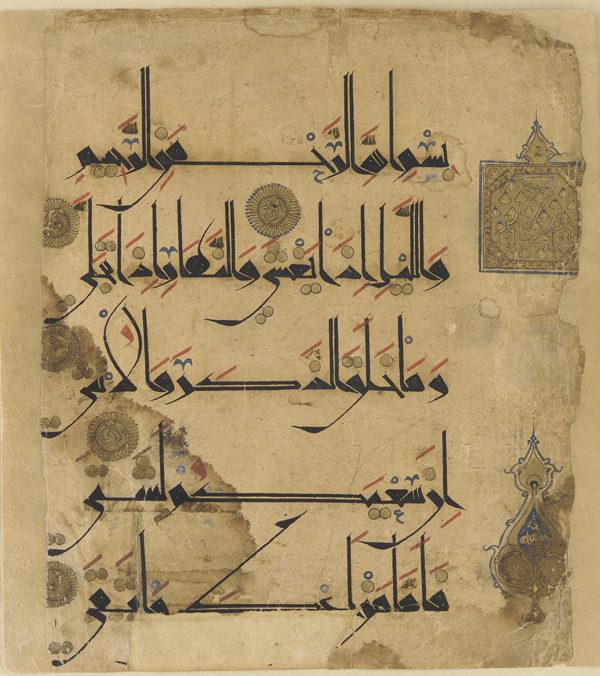
A page from an eleventh-century Iranian copy of the Qur’an, done in Kufic Arabic script.
(Wikimedia Commons public domain image)

A band of inscribed Kufic script against a background pattern of floriated leaves and stems, in the fourteenth-century Mosque of Sultan Hasan, in Cairo, Egypt
(Wikimedia Commons public domain photograph)
Preface: Kufic Arabic script is style of writing the Arabic language. It originated very early — presumably in the city of Kufa, in Iraq — but it’s still sometimes used today. It features the same Arabic letters that are commonly used elsewhere, in other script styles, but, in Kufic, they’re elongated and angular. (See above.) This makes Kufic script especially well-suited for, among other things, architectural inscriptions in stone.
Now to my anecdote:
Long ago, when my wife and I lived in Egypt, we often attended concerts and plays and lectures in Ewart Hall, on the old campus of the American University in Cairo that was located directly adjacent to Tahrir Square.
Above the stage in Ewart Hall was an inscription, in Kufic-style letters, that puzzled me for at least a year’s worth of attendance at events there. Maybe longer. I tried and tried and tried to read it, but I couldn’t recognize so much as a single actual word. This was profoundly discouraging to me, because it indicated that I had even further to go, in learning Arabic, than I had imagined.
And then, one evening, a spectacular realization came to me. I had been trying to read the inscription from right to left, because that’s the way Arabic script runs. Suddenly, though, it dawned on me that the inscription wasn’t even in Arabic at all. It was stylized Roman letters, made to resemble Arabic script. In fact, it was in English — a language that I already knew fairly well — and it ran, as English writing does, from left to right.
Once I recognized it as an English inscription, I could read it very easily. This is what it said:
“Let knowledge grow from more to more, but more of reverence in us dwell.”
It’s from the 1849 poem “In Memoriam A. H. H.,” by Alfred, Lord Tennyson (1809-1892).
I’ve thought about this experience many times over the years. It illustrates, for me, the difficulty that we sometimes have in seeing things that we’re not expecting to see.
My efforts were bent so intensely on learning to read Arabic at the time that, as an overreaction, I tried to read an admittedly Arabic-looking text as if it actually were Arabic rather than my own native English.
I had an analogous experience on another occasion: I had been reading so much Arabic, going from right to left, that, one day, while reading an English-language book and having just completed a page, I absentmindedly turned to the next page the way that I would do with an Arabic one. But the “next” page was a page that I had already read, and I thought that my book was defective, repeating pages. It took me surprisingly long — by which I mean several seconds — to see the stupid mistake that I had made.
But back to the first story, about that Tennyson inscription in Ewart Hall: Sometimes, we can’t see what’s clearly before our eyes because we’re so thoroughly certain of what we ought to be seeing.
***
We’re just back from a good Utah Opera performance of Charles Gounod’s Roméo et Juliette. Anya Matanovic was excellent in her title role.
I have a long history with this story. For example, I developed a major high school major crush on Olivia Hussey when I saw her in Franco Zeffirelli’s 1968 film version of Shakespeare’s Romeo and Juliet.
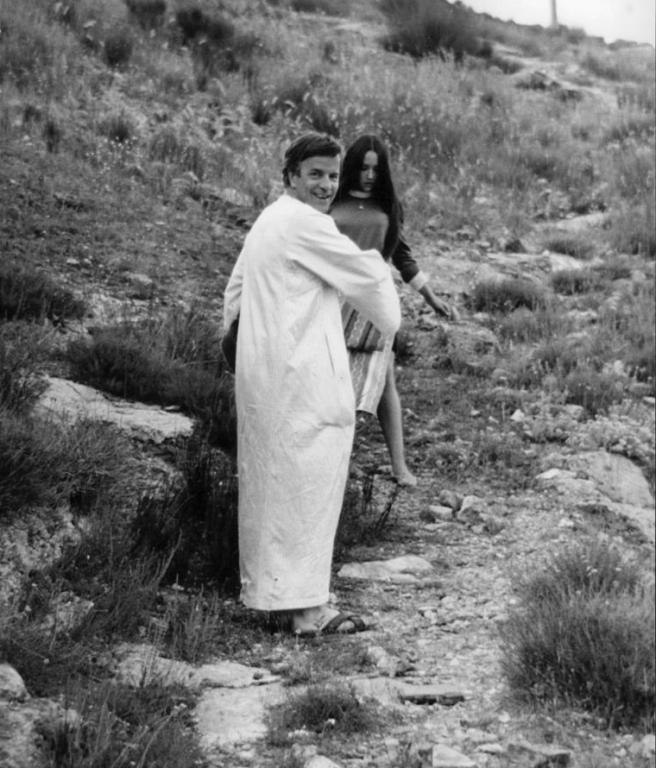
Director Franco Zeffirelli with Olivia Hussey in 1967, while filming “Romeo and Juliet”
(Wikimedia Commons public domain image)
And my wife and I have visited the actual house in Verona where Juliet didn’t live and where she never stood out on the balcony conversing with Romeo.
On Saturday, we saw a performance down in Cedar City of The Liar, a play in iambic pentameter by David Ives that was adapted from Pierre Corneille’s 1644 play of the same name (Le Menteur). It was hilarious. Very clever. I would recommend that you see it, but, alas! — or perhaps I should say hélas! — we saw it on the very last day of the Utah Shakespeare Festival’s fall season. It’s now over.
And another interesting dramatic experience from a couple of days ago was seeing the 2018 Dutch film The Resistance Banker (in Dutch, Bankier van het Verzet), about the brothers Walraven van Hall and Gijs van Hall and the spectacular “bank fraud” by means of which they managed to finance a large part of the Dutch Resistance right under the nose of the Nazi occupation of the Netherlands. Although it’s a dramatic film, the story is true. Perhaps it’s because I’m unusually interested in the Second World War, but I found it fascinating.
Previous Post

October 15, 2018
Everybody was suffering from illusions, until we came along.
Next Post
October 16, 2018 On sophistication and the Gospel
Browse Our Archives
Select a Category Uncategorized
Select a Month October 2026 September 2026 August 2026 July 2026 June 2026 May 2026 April 2026 March 2026 February 2026 January 2026 December 2025 November 2025 October 2025 September 2025 August 2025 July 2025 June 2025 May 2025 April 2025 March 2025 February 2025 January 2025 December 2024 November 2024 October 2024 September 2024 August 2024 July 2024 June 2024 May 2024 April 2024 March 2024 February 2024 January 2024 December 2023 November 2023 October 2023 September 2023 August 2023 July 2023 June 2023 May 2023 April 2023 March 2023 February 2023 January 2023 December 2022 November 2022 October 2022 September 2022 August 2022 July 2022 June 2022 May 2022 April 2022 March 2022 February 2022 January 2022 December 2021 November 2021 October 2021 September 2021 August 2021 July 2021 June 2021 May 2021 April 2021 March 2021 February 2021 January 2021 December 2020 November 2020 October 2020 September 2020 August 2020 July 2020 June 2020 May 2020 April 2020 March 2020 February 2020 January 2020 December 2019 November 2019 October 2019 September 2019 August 2019 July 2019 June 2019 May 2019 April 2019 March 2019 February 2019 January 2019 December 2018 November 2018 October 2018 September 2018 August 2018 July 2018 June 2018 May 2018 April 2018 March 2018 February 2018 January 2018 December 2017 November 2017 October 2017 September 2017 August 2017 July 2017 June 2017 May 2017 April 2017 March 2017 February 2017 January 2017 December 2016 November 2016 October 2016 September 2016 August 2016 July 2016 June 2016 May 2016 April 2016 March 2016 February 2016 January 2016 December 2015 November 2015 October 2015 September 2015 August 2015 July 2015 June 2015 May 2015 April 2015 March 2015 February 2015 January 2015 December 2014 November 2014 March 2014 August 2013 February 2012
Follow Us!
TAKE THE
Religious Wisdom Quiz
Who became jealous and tried to kill David several times?
Select your answer to see how you score.
Abiathar Samuel Saul Abner
Related posts from Sic et Non

The Iron Gates and the Lion of the...


Learning more about a region of which I've...

From Serbia's "White City," Belgrade
TRENDING AT PATHEOS Latter-day Saint

Emotion in Early Christianity by Andrew Crislip
Andrew Crislip’s Emotion in Early Christianity examines an often overlooked dimension of...

16 Spiritual Touchstones for a More Grounded Life
After decades of spiritual study, here are 16 principles I try...

Catholic Evangelization: Sharing Your Faith Every Day
Welcome back to the Graceful Awakening mini-series called, “From Faith to Mission.” ...

The Pillar of the Boatmen: the Ancient Monument...
The Pillar of the Boatmen is a Romano-Gaulish sculpture that dates from...

In one sense walking into Westminster Abbey is like walking down the...

'Super Scam Me' Exposes AI Jon Bon Jovi...
Leslie Pickett believed she was in a relationship with Jon Bon Jovi....
view all Latter-day Saint blogs
Ad-Free & Subscriber Log-In Subscription Support
- About Us
- 2026 Calendar
- Videos
- Podcasts
- Library of World Religions
- Faith In Media Tracker
- Advertise With Us
- Write for Us
- Privacy Policy
- Terms of Service
- Do Not Sell My Data
- Contact Us
- Radiant Digital
- Manage Newsletter Subscriptions
- Unsubscribe From Notifications
- Sitemap
Copyright 2008-2026, Patheos. All rights reserved.
Subscription Support Ad-Free & Subscriber Log-In
Follow Patheos