
BuddhistCatholicContemplativeEvangelicalGeneral ChristianHinduJewishLatter-day SaintMuslimNew VisionsProgressive Christian
Beliefs
- Buddhist
- Catholic
- Contemplative
- Evangelical
- General Christian
- Hindu
- Jewish
- Latter-day Saint
- More Voices
- Muslim
- New Visions
- Pagan
- Progressive Christian
Topics
- Religion News
- Food and Religion
- Sports and Religion
- Religious Art
- Religious Music and Entertainment
- Religious Events
- History and Religion
- Style and Religion
- Politics and Religion
- Women in Religion
- Recreation Outdoors and Religion
- Business Finance and Religion
- Careers Workplace and Religion
- Education and Religion
- Family Parenting and Religion
- Health Fitness and Religion
- Home and Religion
- Relationships and Religion
- Technology and Religion
- Travel and Religion
Columnists
- Buddhist Columnists
- Business Finance and Religion Columnists
- Careers Workplace and Religion Columnists
- Catholic Columnists
- Contemplative Columnists
- Education and Religion Columnists
- Evangelists Columnists
- Family Parenting and Religion Columnists
- General Christian Columnists
- Health Fitness and Religion Columnists
- Hindu Columnists
- History and Religion Columnists
- Home and Religion Columnists
- Jewish Columnists
- More Voices Columnists
- Latter Day Columnists
- Muslim Columnists
- New Visions Columnists
- Nonreligious Columnists
- Pagan Columnists
- Politics and Religion Columnists
- Progressive Columnists
- Recreation Outdoors and Religion Columnists
- Relationships and Religion Columnists
- Religion News Columnists
- Religious Art Columnists
- Religious Events Columnists
- Religious Music and Entertainment Columnists
- Sports and Religion Columnists
- Style and Religion Columnists
- Technology and Religion Columnists
- Travel and Religion Columnists
- Women in Religion Columnists
Resource Library
- 2026 Calendar
- Library of World Religions
- The 100 Most Holy Places on Earth
- Patheos Answers
- Podcasts
- Videos
- Faith Leaders Database
- Anglican Episcopalian
- Bahai
- Baptist
- Buddhism
- Christianity
- Confucianism
- Eastern Orthodoxy
- Hinduism
- Holiness and Pentecostal
- ISKCON
- Islam
- Judaism
- Lutheran
- Methodist
- The Church of Jesus Christ of Latter-day Saints
- New Age
- Paganism
- Presbytarian and Reformed
- Protestantism
- Religion Behind the Scenes
- Roman Catholic
- Scientology
- Shia Islam
- Sikhism
- Sufism
- Sunni Islam
- Taoism
- Zen
- See all religions
Research Tools
 Ad-Free & Subscriber Log-In Subscription Support
Ad-Free & Subscriber Log-In Subscription Support
Follow Patheos 

- Trending:
- Forgiveness
- |
- Marriage
- |
- Consciousness
- |
- Death Penalty
- |
- Election
- |
- Halloween

- Home
- Latter-day Saint
- The Latter-day Saints and “Stalinist Art” Revisited (Part Three)
The Latter-day Saints and “Stalinist Art” Revisited (Part Three)
Last updated on: September 5, 2018 at 9:52 am by Dan Peterson
The Latter-day Saints and “Stalinist Art” Revisited (Part Three) 2018-09-05T09:52:42-06:00 Dan Peterson
Patheos Explore the world's faith through different perspectives on religion and spirituality! Patheos has the views of the prevalent religions and spiritualities of the world.

Wulf Barsch, “The Ascension of Isaiah”
(I have been unable to find copyright information regarding this image of a work by a prominent contemporary LDS artist whom I admire, so, if anybody who holds copyright on it wishes to contact me, that would actually put my mind at ease.)
A few folks seem to be powerfully disinclined to follow the argument set forth in my prior posts “The Parthenon of the South Pacific?,” “The Latter-day Saints and ‘Stalinist Art’ Revisited (Part One?),” and “The Latter-day Saints and “Stalinist Art” Revisited (Part Two).”
So — still motivated, of course, by my characteristic ungovernable rage — I’ll try to spell part of that argument out a bit more clearly, in hopes that, even though it be plainly against their wills to do so, they’ll perhaps be able to grasp what I’m saying.
My contention (on this particular point) is that the exterior form of the Hamilton New Zealand Temple — which, for reasons best known to them, they wish to insist on pronouncing architecturally “Stalinist” — represents a stylized echo of such earlier temples as Kirtland and Nauvoo (which, in a much grander revisiting, echoed Kirtland) and St. George (which obviously echoes Nauvoo). And all of these stand (albeit with some undeniable modifications) squarely in the tradition of the familiar church architecture of their era. Here are a few examples of that architectural tradition, mostly from Ohio, with some from Vermont, that could be muliplied indefinitely (but to no real purpose, my point having already been made):

Cornwall Congregational Church, in Cornwall, Vermont, dates to 1803.
(Photo by Redjar at English language Wikipedia)
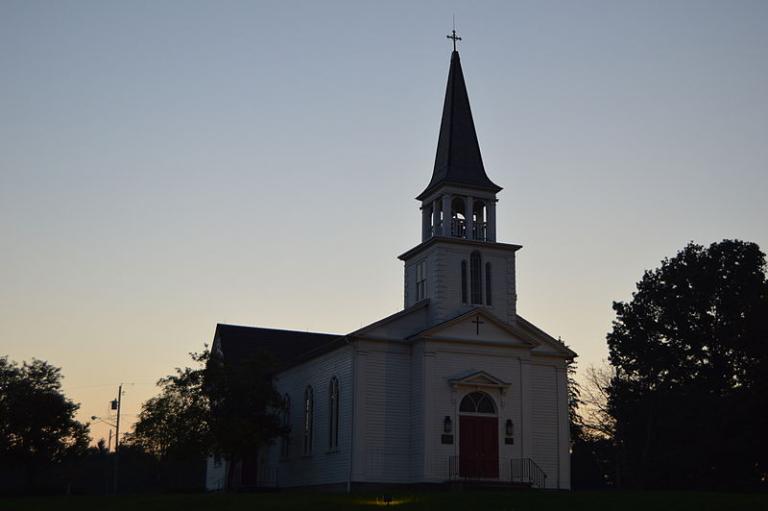
St. James Episcopal Church, in Boardman Park, Ohio, was originally constructed in 1828.
(Wikimedia Commons public domain image)
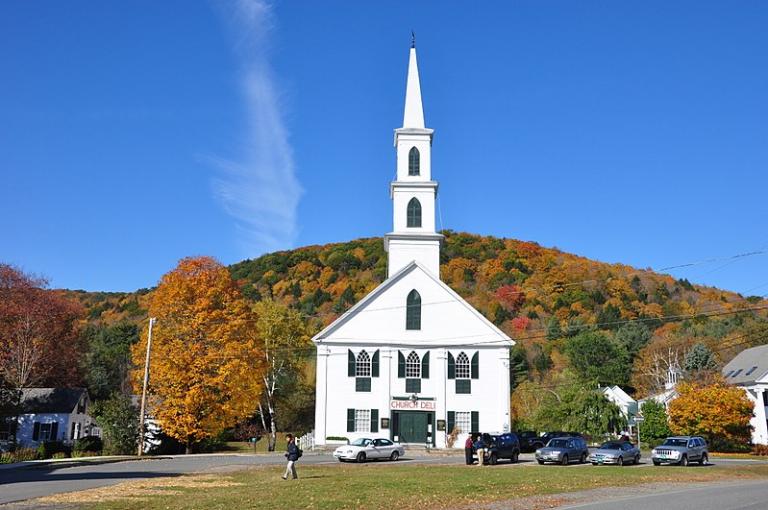
First Congregational Church, in Newfane, Vermont, was built in the 1830s
(Wikimedia Commons public domain)

The Rome Presbyterian Church, in Rome Center, Ohio, was completed in 1836.
(Wikimedia Commons public domain photograph)
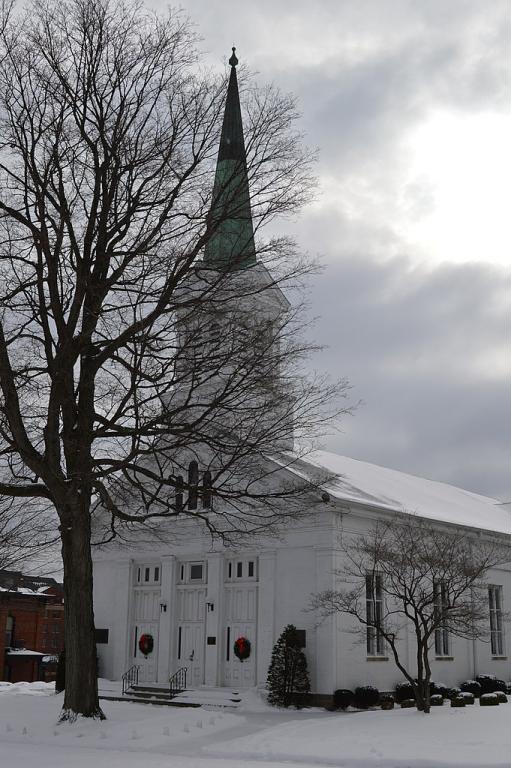
The First Congregational Church of Cuyahoga Falls, Ohio, was completed in 1847.
(Wikimedia CC public domain photo)
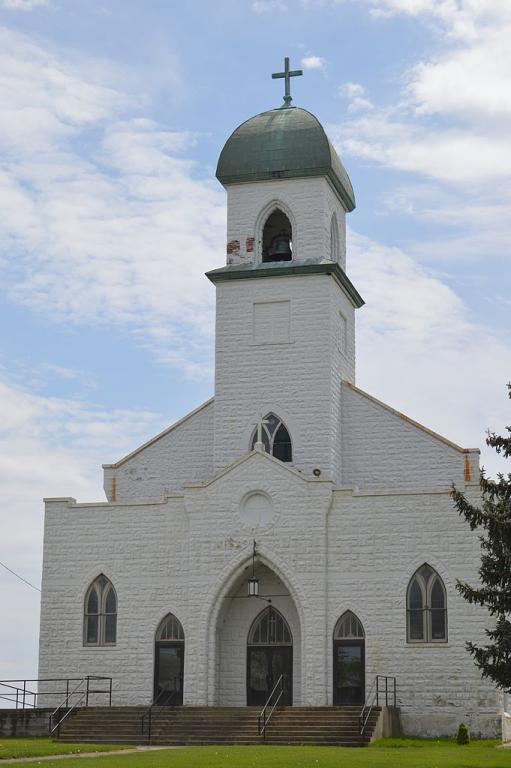
St. Sebastian’s Catholic Church, in Huron County, Ohio, was also built in 1847.
(Wikimedia CC public domain image)

St. Peter’s Evangelical Lutheran Church, in Darke County, Ohio, dates to 1850.
(Wikimedia CC public domain photo)
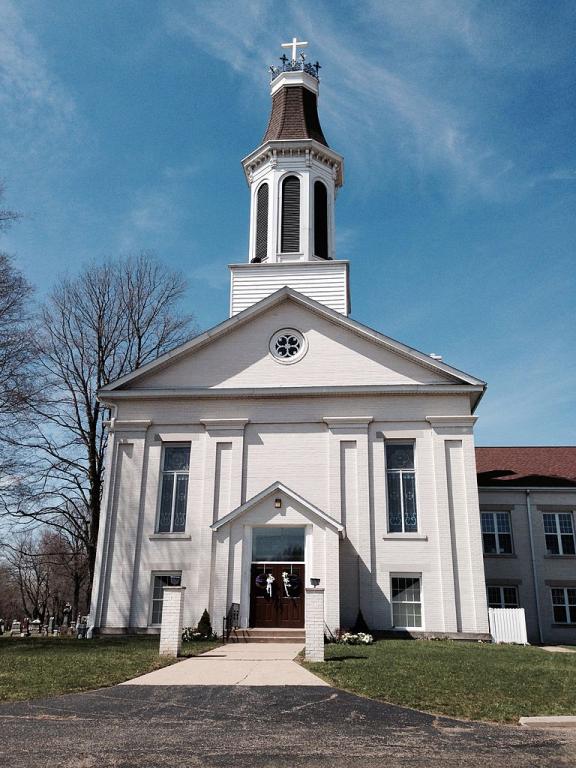
Sharon Moravian Church, in Tuscarawas, Ohio, dates to 1857.
(Wikimedia Commons public domain)
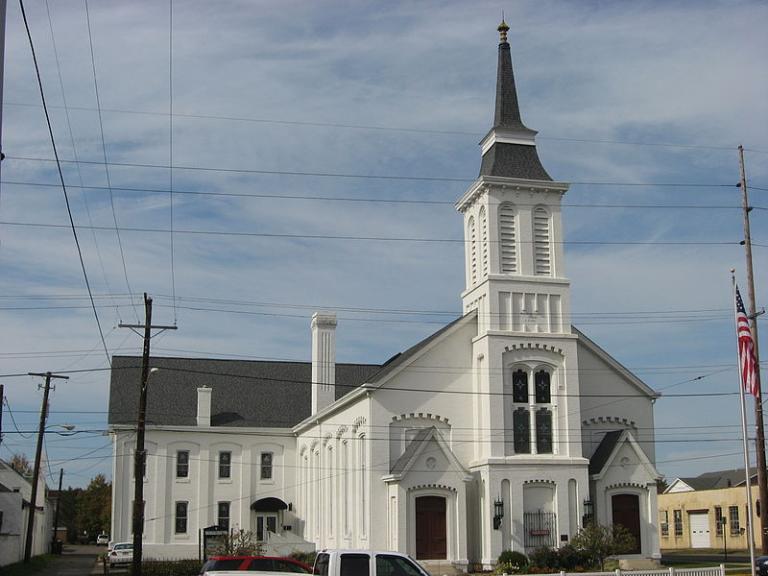
Bigelow United Methodist Church, in Portsmouth, Ohio, was completed in 1858.
(Wikimedia Commons public domain)
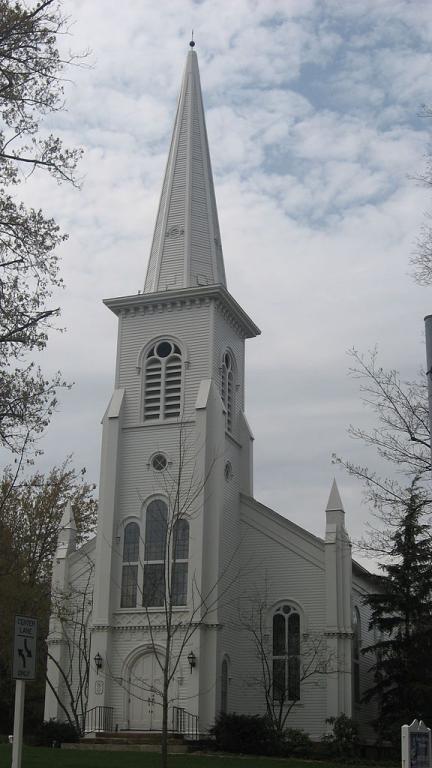
Old South Church, in, of all places, Kirtland, Ohio, was built in 1859.
(Wikimedia CC public domain)
There’s absolutely nothing “Stalinesque” about these Ohio and Vermont churches, and there is no need to invoke “Stalinism” in order to account for the temple architecture of the Church of Jesus Christ of Latter-day Saints that grew out of this American religious-architectural tradition. A longish nave with a tall spire mounted at the front of the structure? That’s as American as can be.
Of course, the design of any given temple will obviously be affected by the culture and environment of the architect who designs it, interacting with the culture, environment, and wishes of those who commission it. Here, for example, is a clear illustration of that point, involving a very different architectural tradition:
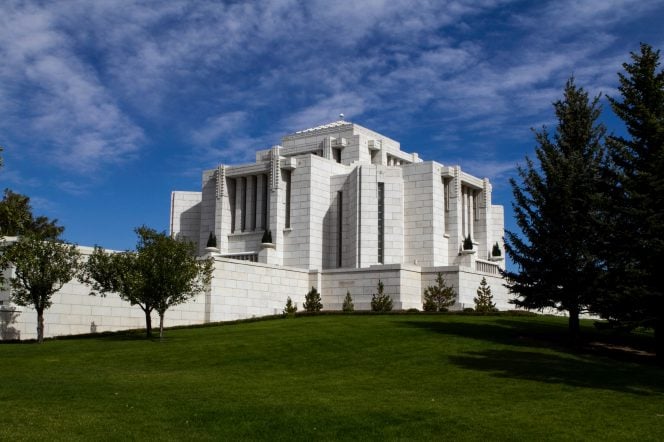
The Cardston Alberta Temple, which was dedicated in 1923, was the first temple built in Canada. (LDS.org)
I’m a very enthusiastic fan of the architecture of Frank Lloyd Wright. So it’s not coincidental that the 1923 Cardston Albert Temple is one of my favorite Latter-day Saint temples, since it’s an exceptional example of influence from the Prairie School of architecture that is associated first and foremost with his name. Compare the Cardston Alberta Temple to the specimens below (which, again, could be multiplied with such further examples as Dwight H. Perkins’s famous Carl Schurz High School, in Chicago’s Irving Park, and Wright’s own Robie House, in Hyde Park on Chicago’s South Side):

Frank Lloyd Wright’s 1915 house for Emil Bach (Wikimedia Commons public domain)
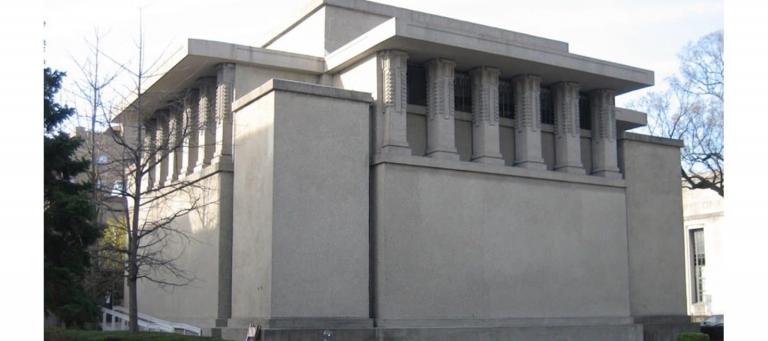
The Unity Temple, in Oak Park, Illinois, designed by Frank Lloyd Wright and completed around 1908 (Wikimedia CC public domain)
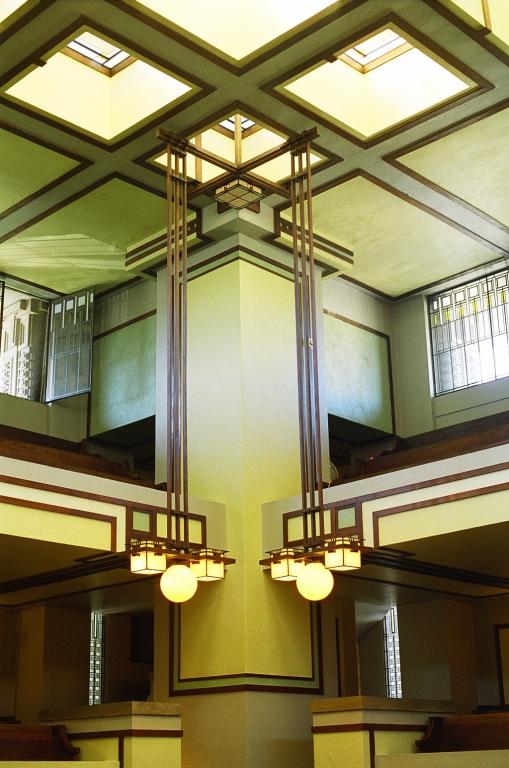
Anybody familiar with the interior of the Cardston Alberta Temple won’t fail to notice the similarities in this, the interior of Frank Lloyd Wright’s Unity Temple.
(Wikimedia CC public domain image)
In the case of the Cardston Alberta Temple, Frank Lloyd Wright and the Prairie School of architecture are an obvious influence. Stalinism, though? Again . . . umm, not so much.
Posted from Seaside, Oregon
Next Post

September 1, 2018 "A condition of indescribable repose and happiness"
Browse Our Archives
Select a Category Uncategorized
Select a Month October 2026 September 2026 August 2026 July 2026 June 2026 May 2026 April 2026 March 2026 February 2026 January 2026 December 2025 November 2025 October 2025 September 2025 August 2025 July 2025 June 2025 May 2025 April 2025 March 2025 February 2025 January 2025 December 2024 November 2024 October 2024 September 2024 August 2024 July 2024 June 2024 May 2024 April 2024 March 2024 February 2024 January 2024 December 2023 November 2023 October 2023 September 2023 August 2023 July 2023 June 2023 May 2023 April 2023 March 2023 February 2023 January 2023 December 2022 November 2022 October 2022 September 2022 August 2022 July 2022 June 2022 May 2022 April 2022 March 2022 February 2022 January 2022 December 2021 November 2021 October 2021 September 2021 August 2021 July 2021 June 2021 May 2021 April 2021 March 2021 February 2021 January 2021 December 2020 November 2020 October 2020 September 2020 August 2020 July 2020 June 2020 May 2020 April 2020 March 2020 February 2020 January 2020 December 2019 November 2019 October 2019 September 2019 August 2019 July 2019 June 2019 May 2019 April 2019 March 2019 February 2019 January 2019 December 2018 November 2018 October 2018 September 2018 August 2018 July 2018 June 2018 May 2018 April 2018 March 2018 February 2018 January 2018 December 2017 November 2017 October 2017 September 2017 August 2017 July 2017 June 2017 May 2017 April 2017 March 2017 February 2017 January 2017 December 2016 November 2016 October 2016 September 2016 August 2016 July 2016 June 2016 May 2016 April 2016 March 2016 February 2016 January 2016 December 2015 November 2015 October 2015 September 2015 August 2015 July 2015 June 2015 May 2015 April 2015 March 2015 February 2015 January 2015 December 2014 November 2014 March 2014 August 2013 February 2012
Follow Us!
TAKE THE
Religious Wisdom Quiz
What was the primary conflict resolution method in Biblical times?
Select your answer to see how you score.
Public debate Lottery Elder council Sword fight
Related posts from Sic et Non

The Iron Gates and the Lion of the...


Learning more about a region of which I've...

From Serbia's "White City," Belgrade
TRENDING AT PATHEOS Latter-day Saint

The Problem with False Prophets
Miller’s Station UMC| 10/18/26| Anchor Verse: Jeremiah 23: 1, 9-23 I...

Emotion in Early Christianity by Andrew Crislip
Andrew Crislip’s Emotion in Early Christianity examines an often overlooked dimension of...

16 Spiritual Touchstones for a More Grounded Life
After decades of spiritual study, here are 16 principles I try...

Catholic Evangelization: Sharing Your Faith Every Day
Welcome back to the Graceful Awakening mini-series called, “From Faith to Mission.” ...

The Pillar of the Boatmen: the Ancient Monument...
The Pillar of the Boatmen is a Romano-Gaulish sculpture that dates from...

In one sense walking into Westminster Abbey is like walking down the...
view all Latter-day Saint blogs
Ad-Free & Subscriber Log-In Subscription Support
- About Us
- 2026 Calendar
- Videos
- Podcasts
- Library of World Religions
- Faith In Media Tracker
- Advertise With Us
- Write for Us
- Privacy Policy
- Terms of Service
- Do Not Sell My Data
- Contact Us
- Radiant Digital
- Manage Newsletter Subscriptions
- Unsubscribe From Notifications
- Sitemap
Copyright 2008-2026, Patheos. All rights reserved.
Subscription Support Ad-Free & Subscriber Log-In
Follow Patheos