
BuddhistCatholicContemplativeEvangelicalGeneral ChristianHinduJewishLatter-day SaintMuslimNew VisionsProgressive Christian
Beliefs
- Buddhist
- Catholic
- Contemplative
- Evangelical
- General Christian
- Hindu
- Jewish
- Latter-day Saint
- More Voices
- Muslim
- New Visions
- Pagan
- Progressive Christian
Topics
- Religion News
- Food and Religion
- Sports and Religion
- Religious Art
- Religious Music and Entertainment
- Religious Events
- History and Religion
- Style and Religion
- Politics and Religion
- Women in Religion
- Recreation Outdoors and Religion
- Business Finance and Religion
- Careers Workplace and Religion
- Education and Religion
- Family Parenting and Religion
- Health Fitness and Religion
- Home and Religion
- Relationships and Religion
- Technology and Religion
- Travel and Religion
Columnists
- Buddhist Columnists
- Business Finance and Religion Columnists
- Careers Workplace and Religion Columnists
- Catholic Columnists
- Contemplative Columnists
- Education and Religion Columnists
- Evangelists Columnists
- Family Parenting and Religion Columnists
- General Christian Columnists
- Health Fitness and Religion Columnists
- Hindu Columnists
- History and Religion Columnists
- Home and Religion Columnists
- Jewish Columnists
- More Voices Columnists
- Latter Day Columnists
- Muslim Columnists
- New Visions Columnists
- Nonreligious Columnists
- Pagan Columnists
- Politics and Religion Columnists
- Progressive Columnists
- Recreation Outdoors and Religion Columnists
- Relationships and Religion Columnists
- Religion News Columnists
- Religious Art Columnists
- Religious Events Columnists
- Religious Music and Entertainment Columnists
- Sports and Religion Columnists
- Style and Religion Columnists
- Technology and Religion Columnists
- Travel and Religion Columnists
- Women in Religion Columnists
Resource Library
- 2026 Calendar
- Library of World Religions
- The 100 Most Holy Places on Earth
- Patheos Answers
- Podcasts
- Videos
- Faith Leaders Database
- Anglican Episcopalian
- Bahai
- Baptist
- Buddhism
- Christianity
- Confucianism
- Eastern Orthodoxy
- Hinduism
- Holiness and Pentecostal
- ISKCON
- Islam
- Judaism
- Lutheran
- Methodist
- The Church of Jesus Christ of Latter-day Saints
- New Age
- Paganism
- Presbytarian and Reformed
- Protestantism
- Religion Behind the Scenes
- Roman Catholic
- Scientology
- Shia Islam
- Sikhism
- Sufism
- Sunni Islam
- Taoism
- Zen
- See all religions
Research Tools
 Ad-Free & Subscriber Log-In Subscription Support
Ad-Free & Subscriber Log-In Subscription Support
Follow Patheos 

- Trending:
- Forgiveness
- |
- Marriage
- |
- Consciousness
- |
- Death Penalty
- |
- Election
- |
- Halloween

- Home
- Latter-day Saint
- “Si Dios quiere”
“Si Dios quiere”
Last updated on: September 23, 2018 at 6:45 pm by Dan Peterson
“Si Dios quiere” 2018-09-23T18:45:57-06:00 Dan Peterson
Patheos Explore the world's faith through different perspectives on religion and spirituality! Patheos has the views of the prevalent religions and spiritualities of the world.
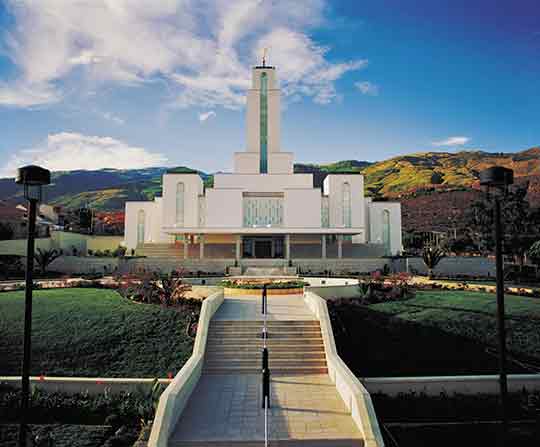
The Cochabamba Bolivia Temple (LDS.org)
During a meeting some years ago, one of the then-counselors in our stake presidency recalled his service, decades back, as a missionary in Bolivia. Among the phrases that he commonly heard there was Si Dios quiere (“If God wills”). He confessed that the phrase sometimes irritated him. “Will you promise to give up smoking?” a missionary would ask someone he was teaching. “Si Dios quiere!” the Bolivian would respond. All too often, it seemed a polite way of saying “I have not the slightest intention of actually trying.”
The phrase, which is common across the Spanish-speaking world, is almost certainly a translation of إن شاء الله, or in sha’a Allah — an Arabic phrase, omnipresent in Arabaphone countries and indeed the world of Islam, that means precisely the same thing. Arabic-speaking Muslims occupied greater or lesser portions of the Iberian peninsula from Tariq b. Ziyad’s invasion in A.D. 711 until the Reconquista led by Ferdinand and Isabella drove the last overt Muslims back across the Straits of Gibraltar (Jabal Tariq, or “Tariq’s Mountain”) into North Africa in A.D. 1492. The results of those nearly eight centuries of Arab Muslim presence dot the landscape of modern Spain — and its language.
I heard in sha’a Allah all the time while I lived in Cairo. “Can I count on you to be here tomorrow at four o’clock?” I would ask. “In sha’a Allah!” the plumber would respond. And he usually didn’t show up.
I came to regard in sha’a Allah as, on the whole, simply a polite or evasive way of saying “No.”
And there’s no question that many Arabic speakers use the phrase as a refuge, an escape, from commitment, just as many Spanish speakers use its Spanish equivalent.
However, that speaker years ago said that he had come to understand Si Dios quiere much more sympathetically in recent years. He had struggled with serious cancer for quite a while by that time — sadly, it eventually took his life — and he had just received word, after a seeming respite, that he needed still more treatment. This, he said, had impressed very deeply on his mind, in a way that few confident and healthy young men would fully comprehend, how much we are all in the hands of the Lord — or, if you insist, under the control of forces far beyond ourselves.
I, too, have come to understand in sha’a Allah in a different and more sympathetic way than when I first became acquainted with the phrase.
Many years ago, after my four years in Egypt but while I was a graduate student in California, I was saying goodbye for the evening to a classmate, a very devout Pakistani imam whom I liked a great deal. “I’ll see you tomorrow at 2 PM,” I said. He looked at me without response. So I tried again: “Two o’clock, right?” Still no response. “What do you want?” I asked, puzzled. “Say in sha’a Allah,” he said. I thought he was joking, so I replied “Alright. Alright. In sha’a Allah!”
He looked at me, friendly but not quite amused. “You arrogant Westerners,” he said. “You think you’re in control of everything, but you’re not. Your heart could stop at any moment. You could be hit by a car. God is in charge, not you!”
It was a gentle but clear rebuke from a friend, and it hit home. And, though it came from a Muslim, it was entirely biblical.
For several reasons, I’ve described the New Testament letter of James as the Bible’s “most Islamic epistle.” Consider, in the light of what I’ve said above, James 4:13-15:
“Go to now, ye that say, To day or to morrow we will go into such a city, and continue there a year, and buy and sell, and get gain: Whereas ye know not what shall be on the morrow. For what is your life? It is even a vapor, that appeareth for a little time, and then vanisheth away. For that ye ought to say, If the Lord will, we shall live, and do this, or that.”
There’s an old saying that is apropos here: “When is it that God laughs? When humans make plans.” Or, alternatively, “Man proposes; God disposes.”
In the last analysis, we’re actually not the “masters of our fates, the captains of our souls.” And we should never forget that.
Arabic influence on Spanish language
Previous Post

September 20, 2018
"People go unnoticed even though they can hear and see everything"
Next Post
September 21, 2018 A note on Latter-day Saints and alcohol
Browse Our Archives
Select a Category Uncategorized
Select a Month October 2026 September 2026 August 2026 July 2026 June 2026 May 2026 April 2026 March 2026 February 2026 January 2026 December 2025 November 2025 October 2025 September 2025 August 2025 July 2025 June 2025 May 2025 April 2025 March 2025 February 2025 January 2025 December 2024 November 2024 October 2024 September 2024 August 2024 July 2024 June 2024 May 2024 April 2024 March 2024 February 2024 January 2024 December 2023 November 2023 October 2023 September 2023 August 2023 July 2023 June 2023 May 2023 April 2023 March 2023 February 2023 January 2023 December 2022 November 2022 October 2022 September 2022 August 2022 July 2022 June 2022 May 2022 April 2022 March 2022 February 2022 January 2022 December 2021 November 2021 October 2021 September 2021 August 2021 July 2021 June 2021 May 2021 April 2021 March 2021 February 2021 January 2021 December 2020 November 2020 October 2020 September 2020 August 2020 July 2020 June 2020 May 2020 April 2020 March 2020 February 2020 January 2020 December 2019 November 2019 October 2019 September 2019 August 2019 July 2019 June 2019 May 2019 April 2019 March 2019 February 2019 January 2019 December 2018 November 2018 October 2018 September 2018 August 2018 July 2018 June 2018 May 2018 April 2018 March 2018 February 2018 January 2018 December 2017 November 2017 October 2017 September 2017 August 2017 July 2017 June 2017 May 2017 April 2017 March 2017 February 2017 January 2017 December 2016 November 2016 October 2016 September 2016 August 2016 July 2016 June 2016 May 2016 April 2016 March 2016 February 2016 January 2016 December 2015 November 2015 October 2015 September 2015 August 2015 July 2015 June 2015 May 2015 April 2015 March 2015 February 2015 January 2015 December 2014 November 2014 March 2014 August 2013 February 2012
Follow Us!
TAKE THE
Religious Wisdom Quiz
What does "Tamar" mean in Hebrew?
Select your answer to see how you score.
Daughter of the King The Lord is my refuge My delight Palm tree
Related posts from Sic et Non

Islam in America or Islam versus America?

A basic working chronology of Islamic-era Iran

Actual Data and Actual Crusades

TRENDING AT PATHEOS Latter-day Saint

The First Eucharistic Controversy: Christ’s Real Presence
For Catholics, the Eucharist is the source and summit of the Christian...

What a Stop Sign Can Teach Us About...
How to Make a Decision When You Can't Hear God Main point:...

Archdiocese Hosts Military Marriage Retreat in Germany
RASTATT, Germany — The transient military lifestyle, with its frequent deployments and...

Nearly every morning, I make the drive to Detroit with my high-school-age...

The Real AI Story Is Adoption Without Trust
Artificial intelligence has crossed a political threshold. It is no longer a...

A new article, written by Jeff Lindsay and Gale L. Pooley,...
view all Latter-day Saint blogs
Ad-Free & Subscriber Log-In Subscription Support
- About Us
- 2026 Calendar
- Videos
- Podcasts
- Library of World Religions
- Faith In Media Tracker
- Advertise With Us
- Write for Us
- Privacy Policy
- Terms of Service
- Do Not Sell My Data
- Contact Us
- Radiant Digital
- Manage Newsletter Subscriptions
- Unsubscribe From Notifications
- Sitemap
Copyright 2008-2026, Patheos. All rights reserved.
Subscription Support Ad-Free & Subscriber Log-In
Follow Patheos