
BuddhistCatholicContemplativeEvangelicalGeneral ChristianHinduJewishLatter-day SaintMuslimNew VisionsProgressive Christian
Beliefs
- Buddhist
- Catholic
- Contemplative
- Evangelical
- General Christian
- Hindu
- Jewish
- Latter-day Saint
- More Voices
- Muslim
- New Visions
- Pagan
- Progressive Christian
Topics
- Religion News
- Food and Religion
- Sports and Religion
- Religious Art
- Religious Music and Entertainment
- Religious Events
- History and Religion
- Style and Religion
- Politics and Religion
- Women in Religion
- Recreation Outdoors and Religion
- Business Finance and Religion
- Careers Workplace and Religion
- Education and Religion
- Family Parenting and Religion
- Health Fitness and Religion
- Home and Religion
- Relationships and Religion
- Technology and Religion
- Travel and Religion
Columnists
- Buddhist Columnists
- Business Finance and Religion Columnists
- Careers Workplace and Religion Columnists
- Catholic Columnists
- Contemplative Columnists
- Education and Religion Columnists
- Evangelists Columnists
- Family Parenting and Religion Columnists
- General Christian Columnists
- Health Fitness and Religion Columnists
- Hindu Columnists
- History and Religion Columnists
- Home and Religion Columnists
- Jewish Columnists
- More Voices Columnists
- Latter Day Columnists
- Muslim Columnists
- New Visions Columnists
- Nonreligious Columnists
- Pagan Columnists
- Politics and Religion Columnists
- Progressive Columnists
- Recreation Outdoors and Religion Columnists
- Relationships and Religion Columnists
- Religion News Columnists
- Religious Art Columnists
- Religious Events Columnists
- Religious Music and Entertainment Columnists
- Sports and Religion Columnists
- Style and Religion Columnists
- Technology and Religion Columnists
- Travel and Religion Columnists
- Women in Religion Columnists
Resource Library
- 2026 Calendar
- Library of World Religions
- The 100 Most Holy Places on Earth
- Patheos Answers
- Podcasts
- Videos
- Faith Leaders Database
- Anglican Episcopalian
- Bahai
- Baptist
- Buddhism
- Christianity
- Confucianism
- Eastern Orthodoxy
- Hinduism
- Holiness and Pentecostal
- ISKCON
- Islam
- Judaism
- Lutheran
- Methodist
- The Church of Jesus Christ of Latter-day Saints
- New Age
- Paganism
- Presbytarian and Reformed
- Protestantism
- Religion Behind the Scenes
- Roman Catholic
- Scientology
- Shia Islam
- Sikhism
- Sufism
- Sunni Islam
- Taoism
- Zen
- See all religions
Research Tools
 Ad-Free & Subscriber Log-In Subscription Support
Ad-Free & Subscriber Log-In Subscription Support
Follow Patheos 

- Trending:
- Forgiveness
- |
- Marriage
- |
- Consciousness
- |
- Death Penalty
- |
- Election
- |
- Halloween

- Home
- Latter-day Saint
- Islam and Mormonism: Some Similarities and Differences (Third Part)
Islam and Mormonism: Some Similarities and Differences (Third Part)
Last updated on: September 24, 2018 at 12:20 am by Dan Peterson
Islam and Mormonism: Some Similarities and Differences (Third Part) 2018-09-24T00:20:28-06:00 Dan Peterson
Patheos Explore the world's faith through different perspectives on religion and spirituality! Patheos has the views of the prevalent religions and spiritualities of the world.
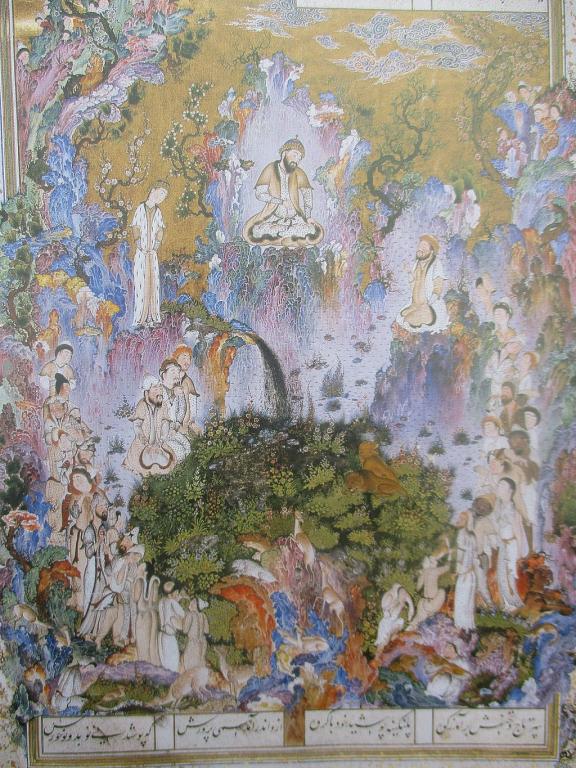
The legendary royal court of Kayumars, described in the 10th-11th-century “Shahnameh” of Firdawsi. in a miniature from the “Shahnameh” of Shah — also known as the “Houghton Shahnameh” — which was created somewhere in the period between 1520 and 1540. (Wikimedia CC)
Continuing with some notes on the topic:
Differences
Islam and Mormonism conceive of God rather differently. Mormonism teaches an embodied God; at least officially (whatever ordinary, uneducated Muslims may believe, and though the Qur’an can easily—and, I think, should—be read otherwise), Islam teaches of a God without body or location. (There is overwhelming evidence that many early Muslims, probably including the Prophet Muhammad himself, believed in a corporeal deity.)
The line of prophets in Islam culminates with Muhammad, and the overwhelming majority of Muslims do not believe that any prophet can or will come after Muhammad. Mormonism has never recognized Muhammad as a prophet (though some Church leaders have been willing to describe him as inspired), but affirms the post-biblical prophethood of Joseph Smith and a line of successors.
The unforgivable sin in Islam is shirk. (The Arabic word means, roughly, “association,” but can be loosely rendered as “polytheism.”) To commit shirk is to worship or recognize any other deity beyond or instead of the one true God. Muslims are uneasy with the mainstream Christian view of the Trinity, despite Trinitarian protests that the Trinity is really just one God; they will, I think, tend to find Latter-day Saint references to “the Gods” (as in the Book of Abraham and elsewhere) rather disturbing. I see this as a potential flashpoint in our relations with Muslims. (However, historically, Muslims have learned to live more or less in peace with Hindus and other undeniably polytheistic groups, and even to evolve ingenious ways of considering them “actually” monotheists, so this can probably be managed. There is, obviously, as the Book of Mormon makes clear, a very powerful sense in which we too can truthfully say that we worship and believe in only one God. This will need to be emphasized in any theological discussions with devout Muslims, when and if they arise.)
Crucial difference: Islam recognizes Jesus as a prophet, even a very great one, but only as a prophet. He is not the Son of God, for Islam recognizes no children of God. Qur’an 112 reads as follows: “Say: He is God, One. God, the Absolute. He does not beget nor is He begotten, and there is none like unto him.” (It is just remotely possible that Muhammad is not responsible for this passage. But I know of no way to prove it, and he probably was.)
While both Mormonism and Islam speak of the Virgin Birth of Jesus, Latter-day Saints do so to insist that Jesus’ father was not Joseph but God himself, with all that that entails for Jesus’ capacity to save us in his role as Savior and Redeemer. Muslims, by contrast, insist that Jesus was the “son of Mary.” He had no father at all, but was a miraculous sign from the all-powerful God.
To be continued.
Previous Post

September 23, 2018
"This absolute light, which seemed to envelop me"
Next Post
September 24, 2018 Introducing Royal Skousen, April 2017
Browse Our Archives
Select a Category Uncategorized
Select a Month October 2026 September 2026 August 2026 July 2026 June 2026 May 2026 April 2026 March 2026 February 2026 January 2026 December 2025 November 2025 October 2025 September 2025 August 2025 July 2025 June 2025 May 2025 April 2025 March 2025 February 2025 January 2025 December 2024 November 2024 October 2024 September 2024 August 2024 July 2024 June 2024 May 2024 April 2024 March 2024 February 2024 January 2024 December 2023 November 2023 October 2023 September 2023 August 2023 July 2023 June 2023 May 2023 April 2023 March 2023 February 2023 January 2023 December 2022 November 2022 October 2022 September 2022 August 2022 July 2022 June 2022 May 2022 April 2022 March 2022 February 2022 January 2022 December 2021 November 2021 October 2021 September 2021 August 2021 July 2021 June 2021 May 2021 April 2021 March 2021 February 2021 January 2021 December 2020 November 2020 October 2020 September 2020 August 2020 July 2020 June 2020 May 2020 April 2020 March 2020 February 2020 January 2020 December 2019 November 2019 October 2019 September 2019 August 2019 July 2019 June 2019 May 2019 April 2019 March 2019 February 2019 January 2019 December 2018 November 2018 October 2018 September 2018 August 2018 July 2018 June 2018 May 2018 April 2018 March 2018 February 2018 January 2018 December 2017 November 2017 October 2017 September 2017 August 2017 July 2017 June 2017 May 2017 April 2017 March 2017 February 2017 January 2017 December 2016 November 2016 October 2016 September 2016 August 2016 July 2016 June 2016 May 2016 April 2016 March 2016 February 2016 January 2016 December 2015 November 2015 October 2015 September 2015 August 2015 July 2015 June 2015 May 2015 April 2015 March 2015 February 2015 January 2015 December 2014 November 2014 March 2014 August 2013 February 2012
Follow Us!
TAKE THE
Religious Wisdom Quiz
What is the Hebrew name for the first five books of the Bible?
Select your answer to see how you score.
Apocrypha Mishnah Tanakh Torah
Related posts from Sic et Non

Islam in America or Islam versus America?

A basic working chronology of Islamic-era Iran

Actual Data and Actual Crusades

TRENDING AT PATHEOS Latter-day Saint

57th Dove Awards Honor Dolly Parton, Crown New...
On gospel music’s biggest night, the 57th annual GMA Dove Awards honored...

The First Eucharistic Controversy: Christ’s Real Presence
For Catholics, the Eucharist is the source and summit of the Christian...

What a Stop Sign Can Teach Us About...
How to Make a Decision When You Can't Hear God Main point:...

Archdiocese Hosts Military Marriage Retreat in Germany
RASTATT, Germany — The transient military lifestyle, with its frequent deployments and...

Nearly every morning, I make the drive to Detroit with my high-school-age...

The Real AI Story Is Adoption Without Trust
Artificial intelligence has crossed a political threshold. It is no longer a...
view all Latter-day Saint blogs
Ad-Free & Subscriber Log-In Subscription Support
- About Us
- 2026 Calendar
- Videos
- Podcasts
- Library of World Religions
- Faith In Media Tracker
- Advertise With Us
- Write for Us
- Privacy Policy
- Terms of Service
- Do Not Sell My Data
- Contact Us
- Radiant Digital
- Manage Newsletter Subscriptions
- Unsubscribe From Notifications
- Sitemap
Copyright 2008-2026, Patheos. All rights reserved.
Subscription Support Ad-Free & Subscriber Log-In
Follow Patheos