
BuddhistCatholicContemplativeEvangelicalGeneral ChristianHinduJewishLatter-day SaintMuslimNew VisionsProgressive Christian
Beliefs
- Buddhist
- Catholic
- Contemplative
- Evangelical
- General Christian
- Hindu
- Jewish
- Latter-day Saint
- More Voices
- Muslim
- New Visions
- Pagan
- Progressive Christian
Topics
- Religion News
- Food and Religion
- Sports and Religion
- Religious Art
- Religious Music and Entertainment
- Religious Events
- History and Religion
- Style and Religion
- Politics and Religion
- Women in Religion
- Recreation Outdoors and Religion
- Business Finance and Religion
- Careers Workplace and Religion
- Education and Religion
- Family Parenting and Religion
- Health Fitness and Religion
- Home and Religion
- Relationships and Religion
- Technology and Religion
- Travel and Religion
Columnists
- Buddhist Columnists
- Business Finance and Religion Columnists
- Careers Workplace and Religion Columnists
- Catholic Columnists
- Contemplative Columnists
- Education and Religion Columnists
- Evangelists Columnists
- Family Parenting and Religion Columnists
- General Christian Columnists
- Health Fitness and Religion Columnists
- Hindu Columnists
- History and Religion Columnists
- Home and Religion Columnists
- Jewish Columnists
- More Voices Columnists
- Latter Day Columnists
- Muslim Columnists
- New Visions Columnists
- Nonreligious Columnists
- Pagan Columnists
- Politics and Religion Columnists
- Progressive Columnists
- Recreation Outdoors and Religion Columnists
- Relationships and Religion Columnists
- Religion News Columnists
- Religious Art Columnists
- Religious Events Columnists
- Religious Music and Entertainment Columnists
- Sports and Religion Columnists
- Style and Religion Columnists
- Technology and Religion Columnists
- Travel and Religion Columnists
- Women in Religion Columnists
Resource Library
- 2026 Calendar
- Library of World Religions
- The 100 Most Holy Places on Earth
- Patheos Answers
- Podcasts
- Videos
- Faith Leaders Database
- Anglican Episcopalian
- Bahai
- Baptist
- Buddhism
- Christianity
- Confucianism
- Eastern Orthodoxy
- Hinduism
- Holiness and Pentecostal
- ISKCON
- Islam
- Judaism
- Lutheran
- Methodist
- The Church of Jesus Christ of Latter-day Saints
- New Age
- Paganism
- Presbytarian and Reformed
- Protestantism
- Religion Behind the Scenes
- Roman Catholic
- Scientology
- Shia Islam
- Sikhism
- Sufism
- Sunni Islam
- Taoism
- Zen
- See all religions
Research Tools
 Ad-Free & Subscriber Log-In Subscription Support
Ad-Free & Subscriber Log-In Subscription Support
Follow Patheos 

- Trending:
- Forgiveness
- |
- Marriage
- |
- Consciousness
- |
- Death Penalty
- |
- Election
- |
- Halloween

- Home
- Latter-day Saint
- Thoughts on “Othello,” and Iago
Thoughts on “Othello,” and Iago
Last updated on: September 5, 2018 at 9:52 am by Dan Peterson
Thoughts on “Othello,” and Iago 2018-09-05T09:52:52-06:00 Dan Peterson
Patheos Explore the world's faith through different perspectives on religion and spirituality! Patheos has the views of the prevalent religions and spiritualities of the world.
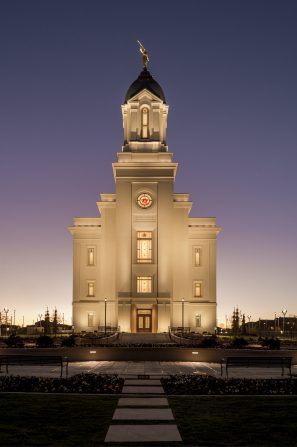
The new Cedar City Utah Temple by night, a reminder of a hope and of a better order of things (LDS Media Library)
On Saturday afternoon, we attended a solid performance of Shakespeare’s Othello. It’s a very great play that I never miss when I get a chance to see it, and I hate it. I find watching it excruciating. Iago is one of the most remarkable characters in all of literature — a consummate villain, a monster of remorseless and pitiless evil. He is cunning and malignant, and I hate to watch him scheme and plot throughout the play, knowing that he will succeed and that innocent people will suffer and die because of his seething hatred.
I once thought that such persistent malevolence, such enduring personal hatred, was absurdly unrealistic.
I no longer think so, because I’ve observed it. Not commonly, I’m happy to say. But false friendship, betrayal, subtle treachery, and vicious spite do occur, as does implacable hatred.
There’s much to be learned from Othello, and from Iago.
***
Thirty years after first seeing Franco Zeffirelli’s 1986 film version of Verdi’s opera Otello, I still vividly remember the chilling scene in which Iago sings his very Darwinian creed:
I believe in a cruel God
who created me in his image
and who in fury I name.
From the very vileness of a germ
or an atom, vile was I born.
I am a wretch because I am a man,
and I feel within me the primeval slime.
Yes! This is my creed!
I believe with a heart as steadfast
as that of the widow in church,
that the evil I think
and that which I perform
I think and do by destiny’s decree.
I believe the just man to be a mocking actor
in face and heart;
that all his being is a lie,
tear, kiss, glance,
sacrifice and honour.
And I believe man the sport of evil fate
from the germ of the cradle
to the worm of the grave.
After all this mockery then comes Death.
And then? . . . And then?
Death is nothingness,
heaven an old wives’ tale.
***
The full name of Shakespeare’s play is The Tragedy of Othello, the Moor of Venice. So, Othello is a Moor. But what does that word mean?
It’s the fashion, and has been for quite some time, to play Othello as black. And the text of the play certainly describes him (and some characters in the play deride him) as dark. But is he really “black” in the modern American sense of the term?
Possibly. But possibly not.
The English term Moor derives from the Greek word μαυρο (mauro or, in modern Greek, mavro) which literally means “black, blackened or charred.” But it doesn’t define a distinct people. It has no clear ethnic meaning. Medieval and early modern Europeans applied the word to Arabs, North African Berbers, and even Muslim Europeans, and sometimes to Muslims generally.
So there was some irony, to me anyway, in the casting for Othello this afternoon.
The eponymous character himself was played, and played well, by Wayne T. Carr. Meanwhile, the role of Montano, governor of Cyprus — who referred several times to Othello as “the Moor” — was assumed by Jamil Zraikat, whose name is plainly an Arab one and, from its form, very likely from the Maghrib (Morocco or, in earlier eras, perhaps Tunisia or Algeria), the homeland of the actual Moors. In The Merchant of Venice, the night before, he had actually played the Prince of Morocco.
Posted from Cedar City, Utah
Previous Post

August 11, 2018
An autobiographical note
Next Post
August 12, 2018 "On this knife edge of improbability"
Browse Our Archives
Select a Category Uncategorized
Select a Month October 2026 September 2026 August 2026 July 2026 June 2026 May 2026 April 2026 March 2026 February 2026 January 2026 December 2025 November 2025 October 2025 September 2025 August 2025 July 2025 June 2025 May 2025 April 2025 March 2025 February 2025 January 2025 December 2024 November 2024 October 2024 September 2024 August 2024 July 2024 June 2024 May 2024 April 2024 March 2024 February 2024 January 2024 December 2023 November 2023 October 2023 September 2023 August 2023 July 2023 June 2023 May 2023 April 2023 March 2023 February 2023 January 2023 December 2022 November 2022 October 2022 September 2022 August 2022 July 2022 June 2022 May 2022 April 2022 March 2022 February 2022 January 2022 December 2021 November 2021 October 2021 September 2021 August 2021 July 2021 June 2021 May 2021 April 2021 March 2021 February 2021 January 2021 December 2020 November 2020 October 2020 September 2020 August 2020 July 2020 June 2020 May 2020 April 2020 March 2020 February 2020 January 2020 December 2019 November 2019 October 2019 September 2019 August 2019 July 2019 June 2019 May 2019 April 2019 March 2019 February 2019 January 2019 December 2018 November 2018 October 2018 September 2018 August 2018 July 2018 June 2018 May 2018 April 2018 March 2018 February 2018 January 2018 December 2017 November 2017 October 2017 September 2017 August 2017 July 2017 June 2017 May 2017 April 2017 March 2017 February 2017 January 2017 December 2016 November 2016 October 2016 September 2016 August 2016 July 2016 June 2016 May 2016 April 2016 March 2016 February 2016 January 2016 December 2015 November 2015 October 2015 September 2015 August 2015 July 2015 June 2015 May 2015 April 2015 March 2015 February 2015 January 2015 December 2014 November 2014 March 2014 August 2013 February 2012
Follow Us!
TAKE THE
Religious Wisdom Quiz
What did Jesus use to feed the 5,000?
Select your answer to see how you score.
Five loaves and two fish Manna from heaven A basket of quail Grapes and figs
Related posts from Sic et Non


Learning more about a region of which I've...

From Serbia's "White City," Belgrade

TRENDING AT PATHEOS Latter-day Saint

Letters on Living the Faith by C.S. Lewis
Most of us met C.S. Lewis as a public intellectual. Mere Christianity....

When Halloween Unmasks Married Hearts
Written by Dr. David K. Ewen from Eternal Truth Bible College Behind...

Aristotle. He’s been called the father of logic, the father of the...

Methodist Central Hall and Westminster Abbey
Situated on the same square is Methodist Central Hall and Westminster Abbey. ...

57th Dove Awards Honor Dolly Parton, Crown New...
On gospel music’s biggest night, the 57th annual GMA Dove Awards honored...

The First Eucharistic Controversy: Christ’s Real Presence
For Catholics, the Eucharist is the source and summit of the Christian...
view all Latter-day Saint blogs
Ad-Free & Subscriber Log-In Subscription Support
- About Us
- 2026 Calendar
- Videos
- Podcasts
- Library of World Religions
- Faith In Media Tracker
- Advertise With Us
- Write for Us
- Privacy Policy
- Terms of Service
- Do Not Sell My Data
- Contact Us
- Radiant Digital
- Manage Newsletter Subscriptions
- Unsubscribe From Notifications
- Sitemap
Copyright 2008-2026, Patheos. All rights reserved.
Subscription Support Ad-Free & Subscriber Log-In
Follow Patheos